Victimized Twice

Gina Tron was attacked by a serial rapist in 2010. She describes her enraging experience reporting the crime to the NYPD:

I was interviewed by a detective who kept asking me about what I was wearing at the time and who told me that this case would probably never make it anywhere because I was intoxicated. Instead of focusing on what was done to me, most of his questions focused on why I didn’t fight back harder and run away sooner. The answer to both was because I was afraid and operating on a kind of autopilot–I never imagined anyone would accuse me of failing to get away.

I went to see the same detective at the Special Victims Unit (the division that deals with rape) a few days later to look through pictures of convicts on their database.

I spent hours scanning photo after photo of criminals to see if I could spot my guy. The detective was extremely discouraging about it, saying that it was a waste of time. He kept commenting to his buddies about how I looked like so-and-so from some other police unit–I couldn’t tell if it was a compliment or an insult, but my intuition was telling me it was the latter. I was probably being sensitive, but I really wasn’t happy about having my looks talked about, since I was literally searching for my rapist. I could barely take care of basic hygiene needs at the time, let alone look nice for the cops, and I told him to please stop talking about my looks. He replied that he was doing me a favor by humoring my iffy rape case, and that if I continued to give him attitude he would just drop it.

The indignities don’t end there. Marcotte fumes:

Women, it turns out, are in a perpetual state of consent unless they bring weapons to bars and are able to wield those weapons against rapists who have made it clear that they are willing to beat you into submission. Because of this, there’s probably a rapist still wandering around Brooklyn, hanging around groups of people in bars, and picking off women to kidnap and rape. And now he knows that the system is built for him to keep right on going.

Amanda Hess adds:

Reading the piece, I thought of a friend who told me that when he has children, he hopes they won’t be girls. His boys, he says, would benefit from a progressive upbringing that teaches them not to victimize women. But his girls would be impossible to protect from other people’s kids. Apparently, the thought of daughters who might be violated scares him so much that he’d prefer they didn’t exist.

Recent Dish on sexual assault herehere, and here.

The Punishment For An Accidental Death, Ctd

Readers respond to the story of a mother in New Orleans being tried for murder because her daughter shot herself:

You wrote, “There’s negligence and then there’s murder.” That’s incorrect.  There’s negligence, then there’s recklessness, and then there’s intent.  Adding each one to a homicide results in a different legal definition.  But “recklessness” can be substituted for “intent” in many jurisdictions when it comes to murder.  If the authorities determined that Smith was reckless, rather than simply negligent, then second-degree murder is the appropriate charge.

Another reader:

This reminds me of the woman in Georgia who was given a three-year sentence for walking with her daughter across a road with no crosswalks. Her daughter was hit, and she was charged with negligent homicide. (The driver of the car, who had previous hit-and-runs on his record, was charged with a lesser offense.) The charges were recently dropped, but it still, for a period of time, was looking like a gross miscarriage of justice.

Another:

Given the number of kids we hear about daily who are shot because their stupid parents left a gun out or let them play with their kid-sized gun, maybe it’s time we start prosecuting them for negligent homicide if their gun is used.

Maybe if we have a strict, no-tolerance rule in effect, that people will be more responsible for the deadly weapons they keep in the house. Why was this five year old “playing with” his kid-sized gun when he shot and killed his two-year-old sister? From all the rhetoric we hear from the gun lobby, gun owners are the most responsible people ever. So, again, why was this child allowed to “play with” a gun?

“Trooper Billy Gregory told the Lexington-Herald Leader that the gun used in the incident was kept in a corner of the house and the family did not realize that a shell had been left in it.” Did not realize a shell had been left in it. Did. Not. Realize. Fuck these people and their irresponsibility. They deserve jail time. If we’re gonna throw some kid in juvie or prison for having a joint, then we sure as hell better be tossing idiot parents who are too stupid to ensure no loaded weapons are in the house in prison. Let them grieve in jail and then maybe they’ll come around and start advocating for better laws and protections for such a deadly piece of equipment.

Another:

Megan McArdle is full of it. The research on accidental shootings and safe-storage laws for firearms has been done: “Laws that make gun owners responsible for storing firearms in a manner that makes them inaccessible to children were in effect for at least 1 year in 12 states from 1990 through 1994. Among children younger than 15 years, unintentional shooting deaths were reduced by 23% (95% confidence interval, 6%-37%) during the years covered by these laws.”

Another:

Here in Minnesota we have a relatively high-profile case of a four-year-old who found a loaded gun in his father’s bed, and shot his 2-year-old brother while playing with the gun. The father was just sentenced to 30 days for second-degree manslaughter and child endangerment. The County Attorney wanted to send a message in prosecuting this case: ““We need to send messages,” Freeman said. “We’re not looking for profound penalties for these people. We’re looking for messages: Don’t keep loaded handguns accessible to kids.”

I agree that murder is not the appropriate charge in these cases, but severe punishment is warranted nevertheless. And I disagree with McArdle that there is no deterrent effect. Most people have guns in their house because they believe that the potential for protection is greater than the risks. That is the same reason why they keep them loaded and accessible. I remember early in the press coverage, this father was quoted saying that he kept the gun ready to take with him when he went jogging or to the store for self-protection. He wanted it to be easy to get and use the gun if absolutely necessary.

Statistics demonstrate, over and over, that this belief is wrong, and the gun is much more likely to be a danger to you or your household, especially if it is not stored properly – unloaded, in a safe. But people don’t assess that risk properly. And they won’t, unless the media covers these accidental shooting stories as thoroughly and constantly as they cover home invasion stories, or kidnappings, or other things that terrify people. I don’t doubt that this father is heart-broken. But other parents who own guns and believe they are protecting their children by keeping one in the house are more likely to evaluate the risks of gun ownership properly if they hear his story.

Is Poaching Preventable?

Ivory Elephant

President Obama yesterday announced a $10-million initiative to prevent elephant and rhinoceros poaching in Africa, part of a larger program to fight animal trafficking around the globe. Max Fisher warns that the effort is in for a struggle:

The big problem is that time is running out. A 2011 study estimated that 7.4 percent of all African elephants may have been killed by poachers that year alone. From 1998 to 2007, the global ivory trade doubled, according to the International Union for Conservation of Nature. Since 2007, it has doubled again. And the trade is shifting from small smuggler networks to large-scale operations: seizures of 800-plus kilos of illegal ivory shipments (that’s about 1 ton) have doubled just since 2009. Elephants and rhinos are simply being wiped out, and quickly.

The other problem is economics, the simple force of which might be too much to overcome. Some of the countries trafficking in ivory and rhino tusks are among the poorest per capita in the world. Elephant tusks are worth $1,000 per pound, Ginette Hemley of the World Wildlife Fund told my colleague Juliet Eilperin; rhino horns sell for $30,000 per pound, about twice as much as gold. By comparison, Afghan opium farmers can charge about $606 per pound.

Meanwhile, researchers say that Cold War-era nuclear fallout could help the elephants. Scott K. Johnson explains:

[A] group of researchers have shown in a study published this week that the carbon-14 spike caused by atomic tests can be used to determine the age of biological materials from the mid-1950s on. … The technique has an immediate application in the troubling but lucrative world of ivory smuggling. Many nations have banned the trading of new ivory in an effort to stop the poaching that still threatens elephant populations. They make an exception, however, for ivory that existed before the ban went into effect. That obviously creates a pretty massive loophole for ivory smugglers, who just need to make it look like the ivory is old enough to be legal. A tiny sample analyzed for carbon-14 could definitively date the ivory, making it harder for smugglers to circumvent the law.

Earlier Dish on poaching here, here, and here.

(Photo by Lenny Montana)

Hathos Alert

38ce7107fbfb39ace551318b80b29ec1

Jamie Lee Curtis Taete crafts an open letter to the “worst wax museum in America,” in Hollywood:

Beyond just looking really, really, really, really shitty, your waxworks have a larger issue: you have, without exception, managed to depict each celebrity as a character in their least memorable movie. For instance, you chose to depict Adam Sandler, star of The Waterboy, Big Daddy, Happy Gilmore, and dozens of other films that people have actually seen (or heard of) as his character from the movie where it rains gumballs. Google tells me, it is called Bedtime Stories. 

Another Dish fave after the jump:

98c9daab68fbea03ae22713151c5e49e

More hilariously hideous photos here. And for more wax museum hathos, head over to Bad Postcards.

What’s Left Of The Left?

Barry Friedman and Dahlia Lithwick wonder what issue liberals will trumpet after marriage equality:

Abortion, the death penalty, gun control, economic injustice, all that stuff was fraught enough to make you just want to triangulate. Abortion clinics don’t poll well. Good grief, even access to primary health care polls poorly. And those issues are as popular as plums compared with the rights of death row inmates and freedom from religious coercion … Now that gay marriage is looking like a check in the win column, it is precisely the right moment to ask: What does it mean to be left anymore? Is there even a left left? Or just a center that calls itself left because it is always standing next to the dude labeled “right” in the photographs?

First off, a quibble. Not all those in favor of marriage equality are on the left. We just look that way because the right has become a faction of religious fundamentalism. Second, these questions are somewhat premature; Enten expects that the fight over marriage will last for many decades in the South:

All the southern states except for West Virginia have in place a constitutional ban against same-sex marriage. All the southern states – except for Arkansas and Mississippi, where support for gay marriage is somewhere between 20% and 30% – require state legislative action before overturning a state constitutional amendment against gay marriage.

The fact that state legislatures will be required to act changes the entire equation for the south. All the southern legislatures with a constitutional ban against gay marriage also feature Republican control of at least one house of the state legislature. In most cases, Republicans control both houses with plenty of room to spare and no sign that control is going to switch anytime soon. All of the states that require going to the legislature demand super-majorities (60%+) and/or at least two consecutively elected legislatures to approve an amendment for it to reach the popular ballot.

What this basically means is the same-sex marriage debate is not even about what the majority of the people thinks in most of these states. Republican legislators control the action. That’s the whole game.

Monogamy: Gay Men, Lesbians, And Straights

Gay Marriage Becomes Legal In California

Nathaniel Frank rebuts a Hannah Rosin’s post on same-sex marriage, which cites “decades-old statistics from the counterculture” to argue that married gays won’t likely be monogamous:

[H]ow different are gay and straight couples? Probably different but not that different. Data on straight monogamy are all over the map. One report suggests 70 percent of married men cheat. (OK, that was a Fox News report, but shouldn’t that skew toward idealizing heterosexuality?) A nationally representative survey of 884 men put the number at only 23 percent. A much bigger but unrepresentative MSNBC survey found that nearly half of adults cheat—exactly the same percentage as the San Francisco study found with gay men. Other reports have found the same—that 50 percent of married men cheat—and one also found that the vast majority will not admit to it, perhaps even on surveys.

The gay male culture of nonmonogamy, rooted in gay liberation (and again, not all gay men are part of it), is likely to encourage both nonmonogamy and honest reporting of it, a key difference from the norms and expectations of the heterosexual mainstream.

I’m not so sure, if only because these things tend to be kept private (for good reasons); and because the possibility of a monogamish marriage diminishes very quickly among heterosexuals and lesbians. And gay men are, to my mind, more likely to be influenced by the 99 percent of marriages that adhere to cultural norms than the 99 percent are to be influenced by the 1 percent. Dreher offers a critique of Steve Thrasher’s piece on married non-monogamous gays:

In the piece, someone praises gays for being “honest” about their sexual behavior, unlike hetero hypocrites like “Newt Gingrich.” But that’s just it: Gingrich’s infidelities were an occasion of moral opprobrium and legal consequence for him. If Gingrich and one of his wives had written a prenuptial contract that provided for his desire to wander sexually, there would have been stigma attached to it. That stigma is important to maintain. Of course there are straight people who commit infidelity within marriage, and there are, no doubt, straight people (swingers) who negotiate infidelity within the context of their marriage. The point is that these people are outside the norm, and are seen as outlaws in some sense. On Thrasher’s account, that’s not the case for gay men.

Gingrich is such an outlaw he has just been given a spot on CNN’s Crossfire and had a good run for president as a Catholic Republican! So I think Rod overplays his hand here. That barn door has been swinging wide or at least ajar for quite a while now. Nonetheless: it’s obvious that marriage between two men and between two women will be inherently different in some respects both from each other and from heterosexual marriages. But the core issue isn’t gay or straight, it seems to me; it’s male and female.

We do not hear moral panic around lesbian marriages, for example, because they tend to be more monogamous than straight ones – and more numerous than gay male ones. Hence the net result of marriage equality may be a slight uptick in monogamy as more women enter the institution. Heterosexual men are also constrained powerfully by the woman they are married to – but do break those constraints (often by lies or discretion) as the stats show.

The other core issue, it seems to me, is whether you have kids or not. Again this distinction is much more salient than gay vs straight. Monogamy matters much more insofar as it helps rear children in a clear and settled and stable environment. But childless couples? I would not want to peer into whatever arrangements they might have made with each other (or not). I’d simply hope they protect their own privacy, and be able to forgive one another and communicate with each other.

What’s different about a gay male couple is that extra-marital indiscretions can be – but not always are – negotiated/forgiven/understood – because men understand men and male desire, and the difference between mere sex and major betrayal. Dan Savage and I discussed this here. Does this mean gay male couples should publicly challenge the social norm of monogamy? I don’t believe so. What we can do – and what some straight couples do – is contain the details of our relationships to one another. It’s called discretion. And discretion is not the same as infidelity, which is ultimately and rightly defined by the couple themselves. (By the way, I see no relevance at all in the way any couple meets. Very sleazy hookups can lead to very stable marriages; squeaky-clean introductions can become living hells.)

Is there some hypocrisy here? Of course there is – as there is among straight couples who deal with an infidelity privately while “keeping up appearances”. A little hypocrisy is sometimes the tribute vice pays to virtue. Bottom line: I don’t want to investigate the private details of people’s marriages, straight or gay, but I do think upholding a public norm of fidelity is worthwhile, and more than worthwhile when children are involved. Equally, I think the obsession with sex in marriage mistakes wood for the trees (that was an attempt at a pun). Marriage is about so much more than sex. Fidelity is about much more than monogamy. And the more we appreciate that, the stabler and happier our marriages will be.

More Dish on gays and monogamy here, here, and here.

(Photo: Justin Sullivan/Getty)

Where Now For Snowden?

The leaker’s options for safe haven are vanishing:

Russian officials say Snowden withdrew his request for asylum in their country after President Vladimir Putin warned Snowden that he would have to stop harming American interests. He’s already lost Ecuador, too, which now says they regret trying to help at all. On Tuesday morning, India flat out said no, adding “we see no reason to accede to the request.” The extra ‘We’re suppposed to be allies with the United States, by the way’ was unsaid, but probably implied. And just moments ago, Brazil joined the chorus of negatives, by officially choosing to ignore him.

Joshua Tucker ponders Putin’s apparent gesture of goodwill to the US:

I wonder if Putin has found himself in a bit of a bind.  Snowden has become quite popular in Russia – not the least because he probably was a great tool for the regime to bolster its claim of the US as a threat to Russian national security, Putin’s protestations to the contrary notwithstanding – but I wonder if Putin is beginning to have second thoughts about having someone around long term who has made his name arguing that regimes shouldn’t monitor the online behavior of their citizens ….

Julia Ioffe isn’t too surprised:

What? Since when does Russia make people stop “inflicting damage on our American partners”? Is it a violation of Russia’s America-baiting monopoly?

Unlikely. As I’ve written before, Russia—well, Putin—is not hostile to the U.S. when it thinks the U.S. finds itself in a position with which it can empathize. For example, in the wake of the Boston Marathon bombings, Putin was the first to reach out to the U.S., just as he was the first world leader to call George W. Bush on 9/11. Russia has an insurgency and terrorist training camps on its own terroritory, and has been battling these guys for well over a decade. And it sees terrorism as a universal, largely undiferentiated foe, so it is in its interests to link up its efforts with the U.S. in fighting it. Thus, we’ve seen an unprecedented level of cooperation in counter-terrorism activities between the two countries, as well as in places like Afghanistan.

The View From Your Window Contest: Winner #160

Screen Shot 2013-06-28 at 5.54.40 PM

A reader writes:

I’m getting an Eastern European vibe from the architecture, but not overwhelmingly so. Perhaps a former part of the USSR? Romania? Bucharest?

Another:

This is my very first submission to VFYW, but I have a strong hunch this is from the former Yugoslavia, specifically Sarajevo, with its hilly topography, ugly government buildings, and charming red-shingled roofs.

Another:

I am in the midst of planning the final details of my vacation, later this month, to Croatia, which is why I’m sure this isn’t Zagreb, even though it looks exactly like all of the photos I’ve been poring over on websites and in guide books.  That would be just too much of a coincidence.

Another:

Dubrovnik, Croatia? Total guess.  I’ve got nothing more than “somewhere in Croatia” but figured I should at least try to guess a city.  Even the country is a guess!  I know someone will have rescued a family of marmosets from a fire in that building on the left but it wasn’t me!

Another gets close:

The hills, the whitewashed buildings with red-tiled roofs … gotta be Lisbon, looking southwest.

Another locks down the right location:

Based on the architecture it seemed obviously Mediterranean or at least Southern European.  I started in Athens, nope.  Naples, nope.  Tunis, nope.  Lisbon – looks like it!  But it couldn’t find the hill in the background with the corresponding out-of-place high-rise.  So I tried Porto … nope.  Coimbra … voila!

coimbra-aerial

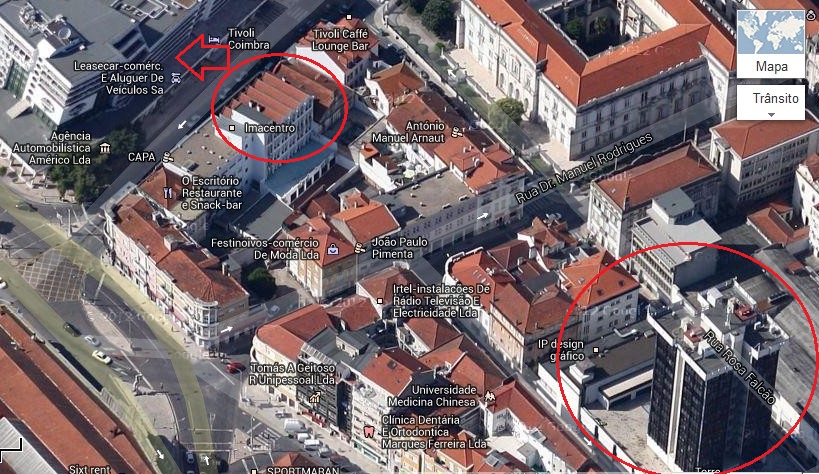
The picture was taken from the Hotel Tivoli in Coimbra, Portugal.  The Google map screenshot above shows the Hotel Tivoli in the upper left, the 6-peaked zig-zaggy roof in the foreground of the VFYW is just right and below the hotel, and the dark glass high-rise prominent in the VFYW is in the bottom right of the Google map screenshot.

I won with Granada a couple weeks ago, so I’m DQ’d from the winner, but I still like to be in the winners’ circle.

Another previous winner in the winner’s circle

So I’ve noted a similar sentiment before, but if you can work your way past all the pornography and cat videos, the remaining 8% or so of the internet is all about cataloguing bridges.  Is bridge-spotting a thing?  If it is, I’m becoming an accidental enthusiast.  When we VFYWers write the book on how to play this game, a prominent chapter will be devoted to identifying bridges.300px-Puente_Coimbra2

And this week’s bridge in the background is a cable-stayed bridge with a single slanted pylon, and in searching for it I happened across a dude whose life’s work appears to be a website featuring circa-1996 HTML that alphabetically lists every bridge in Europe, with photos.

Italy, nope.  Spain, nope.  Portugal … perhaps?  I found one that seemed to fit the general shape and scope of the bridge in the window view, and so we checked the town of Coimbra for another age-old VFYW trick – the Ugly Building That Should Not Be.  It’s almost always tall, dark, 40 or so years old, and disrupts an otherwise scenic or historical tableau.  Sure enough, we found it – so Coimbra it is.

The view is from the Hotel Tivoli Coimbra.  6th floor?  Why not.  From here I’ll let the yet-to-win crowd send in maps and visuals. By the way, between this and the view from the South of France a few weeks back, Europe needs a pressure washing.  I know it’s been a tough decade and budgets are tight, but still.  Have the Queen of Europe contact me to discuss rates.

Enjoyed as always – made for a nice little Saturday night at home.  Y’all enjoy the 4th – America, Fuck Yeah!

Our all-time best player strikes again:
VFYW Coimbra Overhead Marked - Copy

Despite its size, and the fact that it contains one of the oldest universities in Europe, I don’t think I’d ever even heard the name of the city featured in your viewer’s photo. Nothing like the VFYW contest to reveal one’s ignorance of the world.

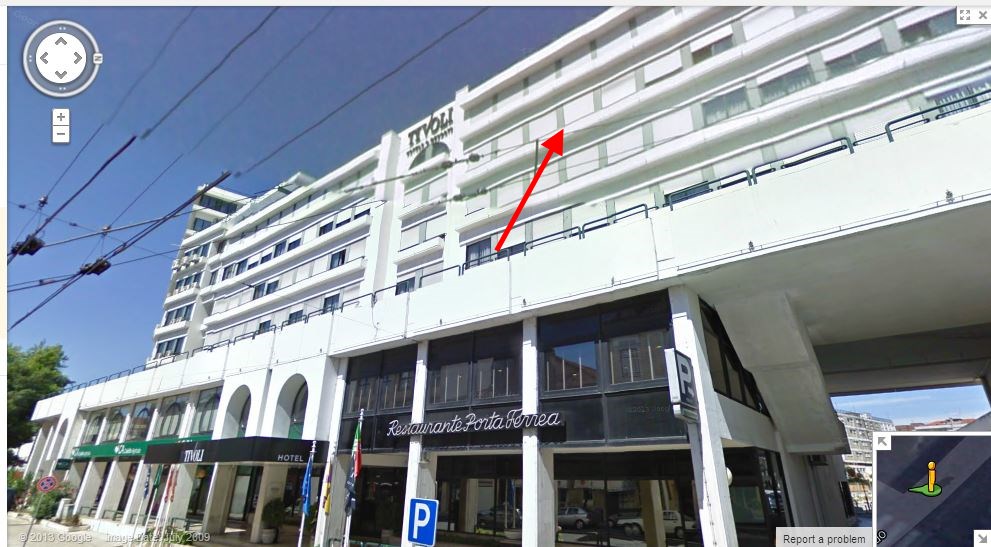
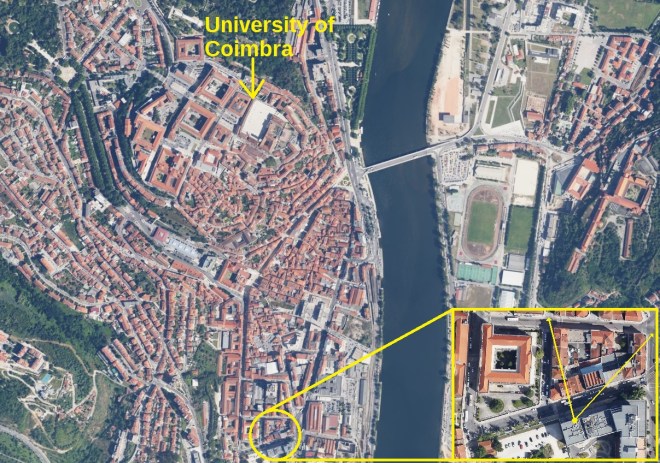
This week’s view comes from Coimbra, Portugal. The picture was taken from the top floor of the Tivoli Hotel and looks south, south east along a heading of 162 degrees towards the Torre Arnado, the modernist high rise at center frame. The large buildings atop the hill in the distance are those of the University of Coimbra, founded in 1290 and the thirteenth oldest university on Earth. A marked overhead map as well as a near view of the likely window are attached.

VFYW Coimbra Actual Window Marked - Copy

The winner this week is the reader with the most specific guess who hasn’t won already but guessed a difficult view in the past:

This is in Coimbra, Portugal, whose university, visible in the foreground, was just classified as a World Heritage Site by UNESCO. Although I’m Portuguese, and have been to Coimbra many times, this wasn’t immediately apparent from the photo, as they can be tricky, and if this contest has teached me something is that faraway places can look very familiar sometimes.

So the first clue wasn’t the university, but the bridge, just barely visible peeking over a building. It’s called the Europa Bridge and is infamous in Portugal for the time it took to build and for going seriously over budget in the meantime, having been projected at 38 million, and ending up costing 111 million.

Using the orientation of pillar as a compass, a little search with google maps led me to the main tower in the picture, and from there to Tivoli Hotel, at João Machado Street, from where this picture was taken:

Ecra_126

I’m guessing from a room high up the hotel, probably in the last floor. No doubt lots of people will get this one right, and someone will probably tell you exactly the room number, but it’s always fun to get one right.

Even more fun to win. Details from the submitter:

This was the first time you’ve ever picked one of my views (I’ve only submitted a half dozen or so) and for a contest no less! I was pretty excited. I suspect you’ll get quite a few correct answers to this contest, as anyone who has visited this picturesque university town will likely remember the ugly building that sticks out like a sore thumb. The picture is taken from the 5th floor (6th floor US style) of the Tivoli Hotel in Coimbra, Portugal, room 515. It’s the 3rd room after the elevator, in case you have people who tried to identify the specific window.

An honorable mention from a first-time correct guesser:

I thought this one was going to take a lot longer than it did. It probably means I just got lucky sooner this time. It also probably means that you are going to again shatter my weekend’s sense of triumphalism at doing the impossible by labeling this an “easy” view.

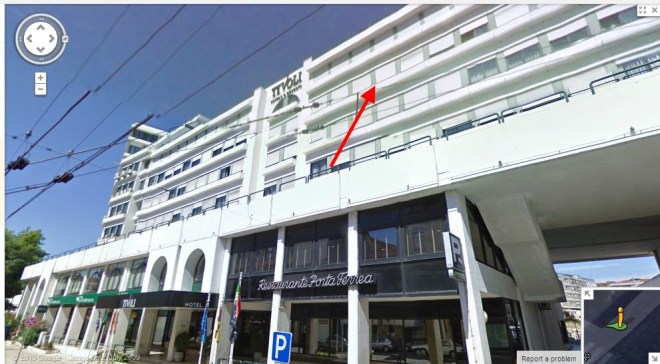
The architecture and the red tiled roofs had me thinking somewhere around the Mediterranean. The building up on the hill on the left looks to be a university or government building of some sort so I started scanning maps of cities with famous colleges around the Mediterranean. The black tower in the center of the photo jumped out on Google Earth almost as soon as I called up Coimbra. From there it was easy to trace back the view to one of the rooms on the top floors of the Hotel Tivoli. The black railing from the photo matches those that you can see from StreetView. From the angle it is from the right side of the hotel entrance when facing it from the street and from one of the top two floors. My guess is fourth window from the center, second floor down:
vfyw-160

(Archive)

How Would The GOP Run Against Clinton?

Jonathan Martin reported over the weekend that “Republican strategists and presidential hopefuls, in ways subtle and overt, are eager to focus a spotlight on Mrs. Clinton’s age.” Tomasky expects that strategy to backfire:

[J]ust as the Republicans cemented that loyalty by overdoing their attacks on her in the earlier White House years, so they will again, and they’ll make her a figure of sympathy to Middle America just as they did before. Talk about hard-wired: they so seethe with hatred for her, and are so incapable of understanding that the vast majority of America not only doesn’t share their hatred but indeed has named her our country’s most admired woman in 17 of the last 20 years, that they’ll say and do things that may well convert young people into her most ardent defenders. After a few Republican “jokes” about Clinton’s appearance, 70 will never have seemed so appealing.

Allahpundit suggests a slightly different line of attack:

The problem with Hillary isn’t that she’ll be almost 70 by election day, it’s that she’ll have been a Beltway institution for close to 25 years at that point. If, like many Americans, you’re disgusted with the federal government generally and Congress in particular, why nominate someone who’s been a “co-president,” senator, and Secretary of State, and not particularly effective in any role?

Barro counters:

[L]et’s say Republicans manage to walk a fine line: hit her for having “old ideas” and being around Washington too long without directly invoking her age. The strategy still doesn’t make any sense, because the Republicans are the party of old, tired ideas.

And Marc Tracy wants Hillary to embrace her status as a boomer:

There is no seeing Clinton without the Baby Boomer connotation. So she should make that work for her. Her campaign could be the Boomers’ last go-round. She could explicitly ask the country to give her generation, through her, one last chance to address those problems—from dangeous climate change to galloping entitlement costs—that in the past her generation has been fairly accused of selfishly ignoring or even abetting. And at the same time she could run as an advocate and even embodiment of all the big things the Boomers got right: personal freedoms, including abortion rights; tolerance of gays and lesbians and other classes of citizens who 50 years ago were outcasts; and, above all, feminism.

God save us from another boomer president.

Did Egypt’s Military Ever Stop Ruling?

That’s Judis’s theory:

I want to reiterate something that I wrote two-and-a-half years ago about the ouster of Egyptian President Hosni Mubarak. I wrote at the time that it was a mistake to describe Mubarak’s ouster a “revolution.”  My argument, drawn from Max Weber and Lenin, is that the possession of state power requires a monopoly over the use of force. In Egypt, in the wake of the 1952 coup that brought Gamel Abdel Nasser and a group of officers to power, the military gradually fashioned a state apparatus in which they would not formally govern, but would function as a ruling class—enjoying not merely control over the country’s armed forces, but also over a large part of its economy.

In State and Revolution, Lenin wrote that a revolution would have to “smash the state.” That was a vivid way of saying that it would have to alter fundamentally the terms of state power. That did not happen in Egypt, where the military itself eased Mubarak out of power.

Jeff Martini thinks the military taking direct control would require buy-in from Islamists:

Together, the Muslim Brotherhood and the Salafists won nearly three quarters of parliamentary seats in the 2011-2012 election. Although the lower house of parliament has since been dissolved over a technicality in the electoral law, those results and Morsi’s own 2012 victory cannot be dismissed out of hand.

An intervention absent Islamist support would risk an Algeria-like scenario, in which the military’s overturning of an Islamist electoral victory led to a civil war that embroiled the country throughout the 1990s. To mitigate against the possibility of a violent response, the military could try to coax the Muslim Brotherhood to the bargaining table with the opposition. Failing that, it could try reach out to Islamists from outside the Muslim Brotherhood, such as the Salafists, or breakaway groups, such as the Strong Egypt and Center parties.

Nour Youssef’s thoughts on military rule:

Shortly after the ultimatum was delivered, pictures of the “blue bra girl” resurfaced on Facebook with the caption: “Remember this?”

“The SCAF conducted virginity tests, they dragged, beat up and killed people, this (meaning the intervention) should not be cause for celebration,” according to my brother. His objection to toppling an elected president aside, he believes, along with the presumed majority of people, that no one other than the SCAF can run the country, given the continued lack of alternative leadership. “(The SCAF) is a necessary evil,” he concluded, after cursing out the people for being deserving better, the president and the SCAF for not being better.

Laura Dean chats with protesters in Cairo:

The “what next” question remains unanswered and each time I ask anyone tonight, I get a different answer. And no answer at all to the question of “who?”