Proust Without Presuppositions

Morgan Meis urges you to approach Marcel Proust’s writing without a rigid interpretive scheme, letting his beautiful prose carry you along:

The entire structure of Remembrance of Things Past, insofar as it has a structure, is meant to create a loose scaffolding for these incredible sentences, for these moments when Proust burrows his prose deepest into the murky core of his own existence and shines a light on aspects of his being, and thus our own experience, that we rarely get to see. For this reason, reading Swann’s Way can feel like falling into a dream. Pages will drift by light as ether. You sometimes forget you are reading. You get lost in the stories, the memories. Is Proust still unfolding that memory of his grandmother in Combray or have we moved back to the present tense again? You have to re-read Proust more than you do other authors. You have to move back and forth in the text, finding your place again. The dream world puts you to sleep. That’s okay. Let it do that. Let yourself fall away into the sleepy prose and then you will have the experience of snapping awake, suddenly, when Proust goes into one of his rhapsodies. The prose itself will shake you awake. “Now,” Proust will say, “now, I really have something to tell you.”

You cannot have an entire book of luminous sentences, just as you cannot have an entire musical composition made of poignant “little phrases.” The endless trivial babble of Proust’s various great-aunts provides necessary resting places, stretches of boredom from which extraordinary moments of Being can finally be plucked. But that is how experience is. Proust found a way to make his prose as numbing as the emptiest of conversations. And then, when you’ve started to loose the thread of the narrative completely, the urgency of his writing will start to jump and tremble on the page again and you’ll feel yourself convulsed “in one of those sobs which a fine line of poetry or a piece of alarming news will wring from us.”

Update from a reader:

I began reading Remembrance of Things Past back in 2008, and I have very slowly been making my way through the series since then. I am currently about a third of the way through “Cities of the Plain”. One of the more interesting aspects of these books, I find, is that as I have gotten deeper into the series they seem to be less and less defined by the hypnotic prose-poetry that Meis describes.

The Guermantes way takes place almost entirely in drawing rooms and society parties, and is preoccupied with the social rises and falls of its dozens of characters. Proust himself seems to acknowledge as much, going so far as to justify his change in focus as an examination of the changing society in which he grew up. Just like great works of art, he says, the fortunes of Parisian socialites are worth our scrutiny because they can show us how a new age is coming into being. In Proust’s view, the telltale sign is the dispute over the Dreyfus case. The anti-Dreyfusards/Nationalists, symbolizing the old world aristocracy with its easy condescension and thoughtless anti-Semitism, are fading away in the face of the Dreyfusards: modern, wealthy, of low birth but high station.

Compare this social analysis to the beautiful opening passages of Swann’s Way and the difference is striking. One has the impression that memories that are nearer to Proust’s present are less enshrouded in the beautiful poetic fog that immerses his younger days at Combray. Swann himself makes a dramatic reappearance at the end of The Guermantes Way, as an older and sicker man whose confession of a terminal illness fails to move his once close friend, Oriane Guermantes, that emblem of old world high society.

Proust closes this third volume with Basin Guermantes’ utterly vulgar encouragement to Swann (a Jew and a Dreyfusard): “Don’t worry old boy, I’m sure you’ll outlive us all!” In one moment, Proust captures the entirety of his social critique. The callousness and racism of the old guard, condescending to the new high society even as it predicts the very rise of that new high society. Swann himself (I assume) will not fulfill Basin’s prediction, but the irony is that Basin is quite right: the Dreyfusards will write history, and they will write aristocrats like the Duc de Guermantes out of it.

Ok, now back to my day job. You probably catch flak for it but let me say I always love your Proust coverage (if that’s the word for it).

Fabergé Fractals

dish_fabergefractal

series by artist and former physicist Tom Beddard:

Like an ornate Fabergé egg, Beddard’s creations boast brilliant and intricate design patterns. The English artist uses a formulaic method to create his digitally rendered three-dimensional models.

Beddard explains: “The 3D fractals are generated by iterative formulas whereby the output of one iteration forms the input for the next. The formulas effectively fold, scale, rotate or flip space. They are truly fractal in the fact that more and more detail can be revealed the closer to the surface you travel. The fascinating aspect is where combinations of parameters can combine to create structural ‘resonances’ of extraordinary detail and beauty—sometimes naturally organic and other times perfectly geometric. But then like a chaotic system it can completely disappear with the smallest perturbation.”

For more of Beddard’s work, see here.  Below the jump, a video visualization by Beddard:

(Image: courtesy Tom Beddard, subBlue)

The Maps In Our Minds

David Banks posts a belated reply to Evgeny Morozov, who recently cautioned against the dangers of personalized Google maps. Banks counters that personalized maps are nothing new:

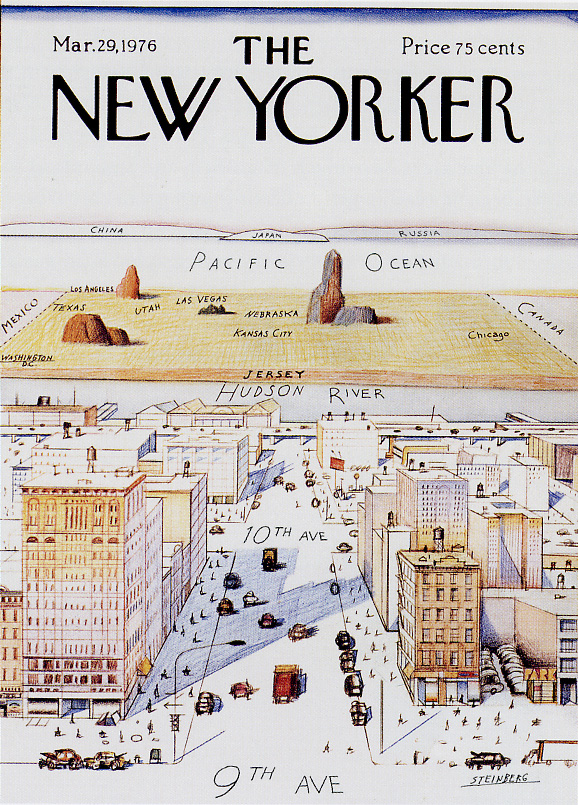
In the late 50s, MIT urban planner and architect Kevin Lynch asked residences of Boston, Los Angeles, and newyorkview4Jersey City to draw a map of their city. He found that while individual maps were distorted, the distortions almost disappeared in the aggregate. One person might forget the existence of an entire boulevard or transpose the order of churches going North to South, but overall the maps were fairly accurate. Lynch, while acknowledging that his sample sizes weren’t very representative or large (30 in Boston, 15 in Los Angeles and Jersey City, all of middle and upper income) couldn’t help but comment on how strong and predictable the trends were. People with cars would see highways as smaller than they actually were (the speed of the car tends to reduce perceived distance), while pedestrians tended to exaggerate the size of the highway (because it was a nuisance and an obstacle, rather than a useful path).

Lynch concluded that we all have an “image of the city” in our minds that exaggerate salient features and actively delete places that do not serve a purpose in our daily lives. We’ve always had personalized maps, but up until recently, lacked the tools to effectively share them with each other on a consistent basis or in useful ways. Personalized Google maps, so long as they provide an opportunity for sharing, could provide some of the richest, most evocative maps to date. The over-lapping of millions of personal maps will illuminate hot public spaces and identify emerging new ones. The key here is whether or not Google lets us compare our maps. It seems like a killer social media function so there’s no reason not to.

The Silent Mistreatment

David Berreby chronicles the plight of Sunnat, an Uzbek captured in Afghanistan at age 16 who was taken to Guantanamo Bay in 2002 – a situation made especially harrowing by his near total linguistic isolation:

Sunnat was, in many ways, simply unlucky. He spoke a language that was rare at Guantánamo. The camp had only six Uzbek speakers; none were housed near him. He was held for eight years not because he was dangerous but because no country, not even his native Uzbekistan, would accept him as a Guantánamo deportee. (The military was required to hold him until a nation agreed to take him.) In fact, his innocence isolated him further: once he was no longer deemed a threat, he ceased meeting with an Uzbek interpreter and an interrogator. Then he was denied materials to learn English or Arabic, because the detention center has a policy against helping the presumed-dangerous detainees communicate with one another.

Depriving a prisoner of linguistic company can be a strategy: it can increase a prisoner’s dependence on an interrogator, making him more likely to talk, or it can prevent prisoners from organizing resistance. More typically, cases like Sunnat’s are unfortunate consequences of policy and circumstance. Whatever the cause, Honigsberg argues in his paper, “Alone in a Sea of Voices: Recognizing a New Form of Isolation by Language Barriers, or Linguistic Isolation,” the psychological effects of solitary confinement through linguistic isolation are largely the same as those via lock and key: impaired impulse control, an inability to concentrate or think clearly, confusion, obsessive behaviors, paranoia, and even a state resembling catatonia. A growing body of evidence suggests that a few weeks of solitary confinement for a prisoner amounts to torture. “Isolation by language barriers,” Honigsberg writes, “should be recognized as a distinct human rights abuse.”

Real Men Love The Least Among Us

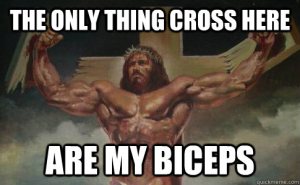
Responding to a number of recent debates about what it means to be a modern man, James Poulos asserts that “we do have a positive model for postpatriarchial masculinity—Jesus!”:

I don’t mean the Jesus who was turned into a convenient symbol of intolerance and hypocrisy by the buff-jesus1militant atheist crowd, or the twisted version worshipped by the Westboro Baptist crowd. No, today is a boom time in the making for the real Jesus: the one who told men that the single-minded pursuit of wealth or honor or even “family values” is sure to leave the soul barren; the one who told men that they should never be shocked when they feel despair or feel despised, because there is no rest or repose for us in this mortal world; the one who told men what he told the paralyzed guy in Mark 2:9—and this is why I have that verse permanently inked on my skin—take up thy mat and walk.

He continues:

We are created in a divine image and can choose to forgive one another and ourselves for being losers and failures—for malfunctioning, for going wrong, for defeating ourselves, for “deserving” disgust and disrespect by the standards of the world. The lesson of Jesus is a message about what it means to be human that’s so radical, it makes our petty squabbles about what it means to be a “real man” seem hopelessly animalistic and juvenile.

This analysis of the Gospel of Matthew seems dead-on to me:

Jesus radically challenges the leading male value of the ancient world – “honor”. He speaks of honor throughout the sermon on the mount, and “call[s] off the typical games whereby males pursued honor and physical, sexual, and verbal aggression …, and he demanded that his disciples on select occasions vacate the playing field where honor is claimed and awarded.” Thus “Jesus discredits conventional honor-gaining and honor-maintaining behavior. In this regard he challenges much of the prevailing male gender stereotype.”

During Jesus’ journey toward Jerusalem, Neyrey finds Jesus teaching “a new code of honor and shame,” one in which honor comes from taking up the cross and shame from lack of faith; honor comes from being like a child, while discipleship might require the shameful loss of a limb; honor comes from forgiveness of wrongs rather than engeance; honor comes from loss of wealth and power, and from renunciation of sexual aggression.

In short, Jesus is for Matthew the perfect public male figure, but at the same time a figure that radically undercuts the basis for ancient conceptions of masculinity.

Image: Meme generator.

An Education Made Of Glass

Kyle Baxter worries about the effects of Google Glass:

What I find most troubling is the philosophy underlying Larry Page and Sergey Brin’s thoughts on devices like Glass. They say that Glass’s goal is to get technology “out of the way,” but that isn’t it. The idea is that we will all be better off if we’re always connected to the web, always on, and have uninterrupted and instantaneous access to it and humanity’s “knowledge.” The idea that Page expresses is that if I can immediately learn about something I don’t know much about, I’ll be better off. I’ll be able to make smarter decisions and live a deeper, richer life by spending the time it would have taken to research and learn about something on more meaningful and substantive tasks.

I think, though, that is a terribly deluded and shallow understanding of what it means to “learn” about something.

When we — humans — learn about something, we are not simply committing facts to our memory so we can recall them in the future. That’s a very tiny part of a much larger and much more important process. To “learn” about something is to study the information (when historical events occurred, what happened, etc), find connections between it and other things we’ve learned and experiences we’ve had, and to synthesize it into something greater — knowledge.

Alan Jacobs thinks that college “students need to learn that they have been for almost all their lives the passive recipients of what the dominant culture around them designates as knowledge.” How technologies like Glass could make this harder:

[I]f awakening students from those slumbers has always been the task of the true educator, that task is all the more difficult in a time of technologies of knowledge, or “knowledge,” that asymptotically approach omnipresence. Google Glass, along with a whole range of similar technologies, enforces the very passivity which truly liberal education is concerned to defeat.

The Faith Of A Horror Writer

In a recent interview with NPR’s Terry Gross, the novelist Stephen King opened up about his thoughts on religion and the afterlife:

It’s certainly a subject that’s interested me, and I think it interests me more the older that I get. And I think we’d all like to believe that after we shuffle off this mortal coil, that there’s going to be something on the other side because for most of us, I know for me, life is so rich, so colorful and sensual and full of good things, things to read, things to eat, things to watch, places to go, new experiences, that I don’t want to think that you just go to darkness.

I can remember as a kid thinking to myself, oh God, I hope I don’t die because I’ll just have to lie down there in that box and I won’t be able to play with my friends or go to baseball games or any of those things. As a kid, death seemed boring to me. As an adult, I think that it seems more like a waste of everything. Somebody once said every time a professor dies, a library burns.

And there’s some of that feeling. But as far as God and church and religion and the Buddy Rosses and that sort of thing, I kind of always felt that organized religion was just basically a theological insurance scam where they’re saying if you spend time with us, guess what, you’re going to live forever, you’re going to go to some other plain where you’re going to be so happy, you’ll just be happy all the time, which is also kind of a scary idea to me.

But King still believes in God:

If you say, ‘Well, OK, I don’t believe in God. There’s no evidence of God,’ then you’re missing the stars in the sky and you’re missing the sunrises and sunsets and you’re missing the fact that bees pollinate all these crops and keep us alive and the way that everything seems to work together. Everything is sort of built in a way that to me suggests intelligent design.

Hemant Mehta, an atheist, takes offense:

That’s entirely backwards. Losing your belief in God in favor of more rational, scientific explanations allows you to enjoy sunrises, sunsets, and the way nature works. Letting God take credit for all of that just cheapens it all — it makes everything just a part of someone’s blueprint instead of something that turned up naturally yet came together beautifully.

Brian Switek agrees:

There is no need for the supernatural to invoke or appreciate wonder. And rather than reducing nature to equations and graphs, I truly believe that science – our ability to actually understand why bees pollinate flowers, why mountains rise, and how remnants of ancient life became locked in stone – makes the world all the more exquisite by not only giving us clues, but new questions to ask.

Switek quotes a poignant passage from Darwin’s On the Origin of Species by Means of Natural Selection to illustrate his point:

It is interesting to contemplate an entangled bank, clothed with many plants of many kinds, with birds singing on the bushes, with various insects flitting about, and with worms crawling through the damp earth, and to reflect that these elaborately constructed forms, so different from each other, and dependent on each other in so complex a manner, have all been produced by laws acting around us. These laws, taken in the largest sense, being Growth with Reproduction; Inheritance which is almost implied by reproduction; Variability from the indirect and direct action of the external conditions of life, and from use and disuse; a Ratio of Increase so high as to lead to a Struggle for Life, and as a consequence to Natural Selection, entailing Divergence of Character and the Extinction of less-improved forms. Thus, from the war of nature, from famine and death, the most exalted object which we are capable of conceiving, namely, the production of the higher animals, directly follows. There is grandeur in this view of life, with its several powers, having been originally breathed into a few forms or into one; and that, whilst this planet has gone cycling on according to the fixed law of gravity, from so simple a beginning endless forms most beautiful and most wonderful have been, and are being, evolved.

Bottom-Up Morality?

Beatrice Marovich uses Frans de Waal’s work on the moral lives of primates to question the way we typically think about religion:

Public debates about religion in the contemporary U.S. are still rooted in debates about belief. Prominent public atheists like Richard Dawkins speak about religion as though it’s something we need to understand rationally. How would these public debates change if we were to start thinking about the animal edges of religious life—the ways in which religious life has more to do with so-called animal instinct than we’ve often imagined? This is, precisely, where primatologist Frans de Waal’s new book The Bonobo and the Atheist (W.W. Norton, 2013) appears to be intervening into these hot-button conflicts.

People like Dawkins, says de Waal, are going about things in the wrong manner. “The question is not so much whether religion is true or false,” he writes, “but how it shapes our lives, and what might possibly take its place if we were to get rid of it the way an Aztec priest rips the beating heart out of a virgin.” What this violent metaphor is meant to gesture towards is “the gaping hole” that would be left by “the removed organ’s functions.” It seems to suggest that religion is some serviceable physiological element in the human body politic.

The broader drift of de Waal’s arguments:

The big targets for de Waal are what he calls “top down morality” and human exceptionalism. Top down morality is linked to the assertion that morality comes to human life from somewhere “on high,” which might be taken to mean that human life receives its morality from a transcendent, out-of-this-world, divine.

But de Waal notes that top down morality isn’t a purely religious problem. He attacks, for example, the philosophical presumption mentioned earlier, that morality is a matter of reasoning—that we reason our way “up” to moral action or decision. Likewise, de Waal takes issue with human exceptionalism—the idea that morality is something that only humans are capable of—regardless of its origin. Religion is a target, for de Waal, to the extent that it supports each of these presumptions.

The Internet Is For Marriage, Ctd

A new study suggests that meeting online is eclipsing more traditional matchmaking methods, and it’s even associated with a higher likelihood of staying together:

About 35% [of study participants] reported that they had met their spouse online, more than through introductions by friends, work and school combined. The study revealed that people who used this method to meet their spouses were slightly older, wealthier, more educated and more likely to be employed than those who went with tradition. But only about 45% of these online meetings took place on a dating site; the rest occurred through social networks such as Facebook and MySpace, as well as chat rooms, online communities, virtual worlds, multi-player games, blogs and discussion boards. …

About 94% of marriages that had started online lasted at least until the time of the survey in 2012, compared with about 92% of those in the offline group. The difference was still statistically significant after controlling for other demographics such as age, race, religion and income.

And something to consider while choosing an online dating service:

[T[he study examined differences between 18 individual dating sites, including eHarmony, Match, Plenty of Fish and Yahoo Personal. After controlling for demographic factors, they found no significant differences in the number of reported break-ups by people using the various services. But there were notable differences in marital satisfaction between users of different sites. For example, those who married a spouse they met on eHarmony rated their marriages more highly than did those who met on Match, who were in turn more satisfied than those who met their spouse on Yahoo Personals.

Previous Dish on marriages forged online here and here.

The Political Plath

April Bernard regrets that Sylvia Plath died before exploring “political themes nascent in her final work, which many readers ignore or misread as only ‘personal'”:

Take “Daddy,” a key example of how, in her last poems, Plath’s politics began to emerge more clearly. Of course many will already have its catchy thumping iambs imbedded in their minds—“You do not do, you do not do…” Here’s a stanza from later in the poem:

I have always been scared of you,
With your Luftwaffe, your gobbledygoo.
With your neat mustache
And your Aryan eye, bright blue.
Panzer-man, panzer-man, O You—

Plath can cause embarrassment through overstatement—going a little too far is her signature move. (One line from “Elm,” another late poem, that best captures her veer towards overstatement is, “I have suffered the atrocity of sunsets.”) But if we consider embarrassment as an aesthetic strategy rather than as a mistake, we begin to see how funny Plath often is. I confess I had read and admired Plath for several years before her humor struck me full-force—the first time I heard a now-famous BBC radio recording in which she reads “Daddy” with a discernible wave of laughter in her voice. (And yes, there is also rage, and profound sorrow.) I re-read the poem, and realized for the first time that her exaggerations and preposterous claims, which link the Holocaust with an American middle-class “family romance,” were meant to be an elaborate joke, one in extreme bad taste, right on the edge of kitsch. …

At the time of the poem’s writing, in the early 1960s, the first psychoanalytic studies of Hitler’s childhood were appearing in print; and this poem also has to do with how the Teutonic, rigidly patriarchal, model of the family affects the culture at large. When Plath says, “I may be a bit of a Jew,” she may indeed, as some critics have said, be speculating about her own origins; but more likely she is asserting that, for the purposes of her family, she contains the seeds of the “other” that must be eradicated. In the comic-grotesque scenario of “Daddy,” the bullying father is Hitler, the at-last rebelling daughter a Jew who is deciding, after all, not to be wiped out in the threatened genocide. “Daddy, Daddy, you bastard, I’m through,” as the final line ringingly announces, is a political rejection of patriarchal bullying at least as much as it is adolescent foot-stomping.

Previous Dish on Plath here, here, and here.