Better “Sponsor Content”

Since I’ve bashed the concept as blurring the line between editorial and advertizing, it’s good to see that publishers are beginning to be clearer about the difference. Atlantic Media’s Quartz does a much better job than its predecessors. Take the headline first:

Screen shot 2013-05-30 at 10.22.34 AM

That’s impossible to miss. Better still, the following simple sentence at the end of the piece:

This article is written by Boeing and not by the Quartz editorial staff.

I remain queasy about bringing an ad agency essentially in-house – because Quartz’s marketing department works with corporations to write, conceive and presumably edit their ad copy, which comes perilously close to editorial work. But as long as there is no overlap between the two staffs, marketing and editorial, and there are no lateral moves from one to the other, the perception of corporate control of journalism is mitigated. Not eliminated – I refuse to buy the propaganda that these are simply “better ads” – but mitigated.

Meanwhile, the Grey Lady has done something actually quite interesting and innovative on this front. It already has an app for navigating this bewildering, dense, rude, urine-baked tunnel-warren of a city.

And they could easily have incorporated the new Citibike guide on their app without Citibank actually paying for it. But they got the money from the sponsor and provided a service to local readers on top. I agree with Joshua Benton on this:

It’s a callback to the classic news advertising idea — we assemble the audience, you provide the content, we make a match — in a mobile, apped-up world… And it’s a match that can go both ways: The Times says that Citi Bike’s own iOS and Android apps will be updated this summer to feature … The Scoop’s listings of restaurants, coffee shops, and the like.

The difference, it seems to me, is that this content isn’t really journalism as such. It’s data you could get elsewhere (which bikes are available where, etc.) and, combined with the NYT’s version of Yelp, it’s obviously useful – unlike an editorial from some executive at IBM.
Ask Dan Savage Anything

This embed is invalid

[Re-posted from yesterday with many questions added by readers]

Dan Savage needs little introduction to Dish readers, but here is his Wiki page to peruse. Dan just came out with a new book this week, American Savage: Insights, Slights, and Fights on Faith, Sex, Love, and Politics. From a recent interview with Logan Lynn:

Savage: Well, the book is about marriage and family, and is a bit more political. I talk about healthcare and Obamacare, gun control, sex education…it originally started out as just a collection of essays, things I had written other places, just bringing things I had written over the last decade together. Then I started revising them and reworking them. Originally the book was going to be 80% old stuff and 20% new stuff, and now it’s 90% new stuff. There’s basically nothing in there that isn’t reworked or brand new. There is a big chapter about marriage, and where we are at right now…and that’s been changing so rapidly, I want the book to come out ASAP. I wrote about adopting, about becoming parents, about Terry and I getting married; and this book has essays about life and memoir-y stuff about my mother’s death, about my son, now 15, coming out to us as straight when he was 12, which was kind-of bizarro hilarious…

Lynn: Alternate universe!

Savage: Yeah, like, how we were so careful all his life to let him know we loved him whoever he was, and yet somehow still he thought we were going to be disappointed that he wasn’t gay. It really broke my heart. So, I touch on all of that stuff. There’s some humor and comedy in the book as well. I wrote a play – a short play – that’s in the book about Jesus and the huge asshole, which is Jesus talking to a fundamentalist Christian who opposes healthcare reform. I think people will enjoy it.

To submit a question for Dan, simply enter it into the Urtak survey after answering all of the existing questions (ignore the “YES or NO question” aspect and simply enter any open-ended question). To vote, click “Yes” if you have a strong interest in seeing Dan answer the question or “No” if you don’t particularly care.

Under The Knife And Behind The Veil

Celebrity plastic surgeon Jason Diamond set up shop in Dubai and was surprised by his clientele:

It could seem counterintuitive for these women to invest so much in their appearances given that they are covered most of the day. Diamond explained, “It took me a while to figure out, but in the Middle East many men are allowed to have four wives. The women want to be feminine and beautiful for their men. That is their only job. They are not out working. There’s no women’s lib. There’s none of that stuff. Their job is to look good for their men and that’s all they care about.”

“It’s my opinion,” Diamond added, “and I’m as a big an authority on this as anyone in the world, that they care more about their appearance than Beverly Hills’ women.”

Even though these women are very invested in looking good for their husbands, the men are uninvolved when it comes to the actual surgeries their wives undergo. On occasion women have a mother or sister with them, but more often than not, these women show up alone. “I would say I see more often here [in Beverly Hills] men coming in with their wives saying, ‘She needs to do this, or I really wish her breasts were bigger or smaller,'” said Mani. “The women are very self-directed there; they’re very empowered over their own bodies and know what they want. Men are not driving their wives to have plastic surgery.”

A Simple, Not Flat, Tax

James Pethokoukis at NRO agrees with me on the need to simplify the tax code without necessarily flattening it:

It’s an elegant, compelling model that might work splendidly if you were creating a tax code ex nihilo. Flat-tax fever swept across Eastern and Central Europe after the end of the Cold War, when finally independent nations were rebuilding their own economies, and the model has been quite successful, for the most part.

America, however, is in a much different place. Millions of individuals and businesses have made long-term plans based on expectations that the tax code will remain more or less the same. Half the nation, thanks to all those deductions and credits, pays no income tax. And, perhaps most important, an aging population means that the cost of health-care entitlements will grow rapidly, even if health-care inflation slows.

Adding that flat taxes are consistently unpopular with voters, Pethokoukis thinks through some other options:

One solution is to take the essentially flat consumption tax devised by economists Robert Hall and Alvin Rabushka and give it a progressive rate structure. Or we could combine a consumption tax with a flat income tax on wealthier Americans, as suggested by Yale’s Michael Graetz. Both ideas are also flexible enough give needed tax relief to parents. (Call it a “human-capital gains” tax cut.)

The flat tax embodies pro-growth, supply-side principles that are great starting points for tax reform, but it shouldn’t be the destination.

The Female Breadwinner, Ctd

A new report from the Pew Research Center finds yet more evidence that women are becoming the primary earners in their households. Bryce Covert parses the numbers:

Four in ten mothers are either the sole or primary source of income for their families, a new record, according to a Pew Research Center report released on Wednesday. That figure nearly tripled since 1960.

Yet the trend is not necessarily due to women making more than their husbands. Nearly two-thirds of this group of women workers are single mothers, and just 37 percent are married and have a higher income than their spouses. While the median total family income in houses where mothers earn more than their husbands was nearly $80,000 in 2011, much higher than the national median of $57,100 for families with children, it’s just $23,000 for single mothers’ families – just over a quarter of what families with married breadwinner mothers earn.

Joan C. Williams, meanwhile, looks at the differences in the number of hours men and women work per week:

How many employed American mothers work more than 50 hours a week? Go on, guess. I’ve been asking lots of people that question lately. Most guess around 50 percent. The truth is 9 percent. Nine percent of working moms clock more than 50 hours a week during the key years of career advancement: ages 25 to 44. If we limit the sample to mothers with at least a college degree, the number rises only slightly, to 13.9 percent. …

This “long hours problem,” analyzed so insightfully by Robin Ely and Irene Padavic, is a key reason why the percentage of women in top jobs has stalled at about 14 percent, a number that has barely budged in the past decade. We can’t expect progress when the fast track that leads to top jobs requires a time commitment that excludes most mothers — and by extension, most women.

Previous Dish on female breadwinners here.

The Legacy Of The Marquis

Hussein Ibish revisits the Marquis de Sade’s writings and considers the more nuanced points of the amoral aristocrat:

Sade’s deeply idiosyncratic views on the morality of personal violence are probably Exhibit A for why he cannot pass muster as any kind of guide for left-liberal cultural resistance. If we take his work at face value, he was not opposed to individual murders. He frequently had his characters argue that murder should not be punished by the state at all. Yet there probably has never been a more passionate opponent of capital punishment—the only form of premeditated homicide that normative “rational” thought typically considers potentially justifiable. This is Sade’s challenge to his readers in a nutshell: he specializes in justifying the conventionally unjustifiable while absolutely and passionately condemning what many would regard as, at least plausibly, defensible and rational.

There is, however, a much surer gauge of what might be called a vulgar Sadean legacy: the mainstreaming of American porn.

Pornography is now so ubiquitous in contemporary American culture—so impossible to get away from—that the two things one may be assured of being offered in even the cheapest motel are pay-per-view porn on the television and a Gideon Bible in the bedside table, should you find yourself in sudden need of one form or the other of shameless mystification. I’m sure I’m not the only frequent traveler who has never availed himself of either of these kindly offerings, but they’re always there. One can’t help but imagine both Sade and [John] Calvin bitterly grousing, in whatever mutually disappointing afterlife to which they’ve been jointly consigned, about how their intellectual legacies have been downgraded into all-but-interchangeable items of consumer convenience.

Recent Dish on pornography and its Sadean tones here.

Shutting Down The Shares

Last week the city of New York fined an Airbnb host $2,400 for violating a law against “illegal hotels.” Emily Badger suspects that more cases like this will trigger a reassessment of city codes:

It’s reasonable for cities to create some standards for how residents might operate what the [Sustainable Economies Law Center] calls “host homes” or “no-host homes.” Perhaps regulation could require the host to register the property for a small fee, while limiting the number of nights in a year that guests can stay there (this could be a concession to neighbors who don’t want their block or building to become a revolving door for tourists). The SELC also floats a cap on the income that a host can make in a year, tied for example to the cost of actual rent or the market value of a property (for example: your Airbnb income can’t exceed 75 percent of your actual yearly rent and utilities).

This last idea would certainly codify the notion that the “sharing economy” is fundamentally a different kind of economy, one where the ultimate goal for individual participants isn’t to make as much profit as possible.

Marcus Wohlsen insists government will have to make way for the share economy sooner rather than later:

New York is a city built on bureaucracy, and bureaucracies are inherently resistant to change, especially when a new technology comes along to undermine the assumptions on which those bureaucracies were built. And in a way that’s by design. The mechanization of the economy and the mechanization of government have occurred in parallel, often in the form of agencies meant to check industries’ more flagrant violations of the social contract. In a sense, those bureaucracies’ express mission is to hinder progress.

Still, renting out your room when you’re not home or your car when you’re not driving it hardly feels flagrant. If people and the politicians they elect feel the same way, these bureaucratic roadblocks to the sharing economy’s rise will also turn out to be very temporary. Whether or not Airbnb, RelayRides or Uber turn out to be the companies that define the future of sharing, the idea of using technology to leverage any resource’s excess idle capacity seems too sensible—and popular—to fail.

Walter Mead nods:

In the case of Airbnb, New York City’s zoning and administrative codes were so numerous and confusing that the client hit with the fine had no idea that he was breaking the law simply by renting out his room. A legal system in which the average citizen can’t make sense of when or how he or she is doing something illegal is not only unfair but a serious detriment to quality of life. America is not going to create the service jobs it needs to stay vital in the post-industrial age by making it hard for small-time entrepreneurs to succeed.

Previous Dish on Airbnb and the share economy here, here and here.

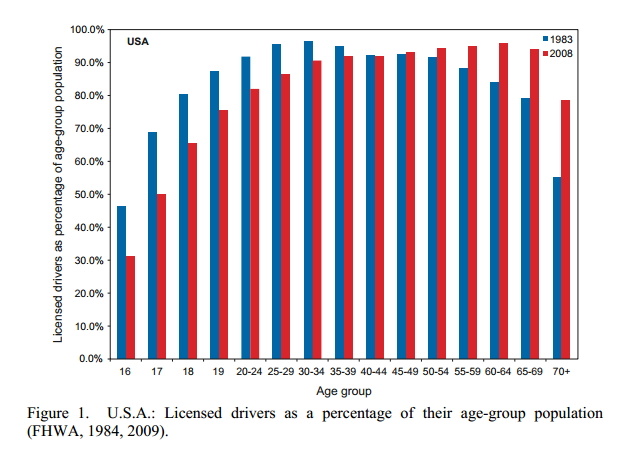
The Young And The Carless, Ctd

dish_driverdata

Brian Merchant believes that the car’s dominance in American culture has been eclipsed by Facebook and Brooklyn:

I’m evidence, I guess—once one of those wide-eyed car lovers, I moved to Brooklyn from car-heavy southern California and sold my Ford. I haven’t regretted ditching it at all. Brooklyn certainly isn’t the only model, but it has become a “global brand” for hip urbanity … Young, affluent people now overwhelmingly want to be able to walk or bike to artisanal restaurants, sweaty music venues, and bars stocked with organic beers. That’s partly why places like Charlotte are focusing on walkability. That’s in no small part Brooklyn’s doing/fault.

But the other explanation for the decline in driving is more interesting: the rise in internet use amongst the same demographic that used to be so eager to hop behind the wheel. A study conducted by researchers at the University of Michigan discovered that “a higher proportion of internet users was associated with a lower licensure rate,” which they found to be “consistent with the hypothesis that access to virtual contact reduces the need for actual contact among young people.”

Relatedly, Felix gives a thumbs up to NYC’s new bike-share:

Don’t worry about safety. I wore a helmet, many people won’t, it’s all OK. There’s a paradox here: the less safe you look and feel, the wider a berth cars give you. If I’m zooming down the street on a singlespeed, taxis will happily zoom past me, with inches to spare. But if I’m wobbling down the street on a CitiBike, not so much.

In fact, there’s very little evidence that helmet use reduces bike-injury rates. Certainly if you fall on your head, you want to be wearing a helmet. But CitiBikes, for one, are big and heavy and much less precarious than most bikes. They’re hard to fall off of, and they make it almost impossible to go flying over the handlebars.

Recent Dish on the the decline of driving among the young here.

Obamacare’s Other Mandate

Josh Barro suggests scrapping the ACA’s employer mandate:

Over time, the portions of Obamacare that encourage employer provision of health care are likely to be vulnerable. Employers hate the mandate, and argue (correctly) that it discourages job creation. Republicans want to repeal it. And Democrats may not remain totally averse to weakening it, since doing so would move more Americans into portable, government-subsidized coverage — that is, one step closer to the liberal single-payer vision.

If the employer mandate is weakened, Obamacare would become more expensive to taxpayers but less damaging to the economy and job creation. The health care exchanges would become the increasingly dominant venue through which Americans get insurance. Obama’s promise that you can keep that health plan you like would become less and less true. And we would be better off for it.

Even if the employer mandate isn’t weakened, Ezra suspects that few employers will drop coverage:

[T]he fraction of employers actually affected by the health law’s mandate is very small. “You’ve got 5.7 million firms in the U.S.,” says Wharton’s Mark Duggan, who served as the top health economist at White House’s Council of Economic Advisers from 2009 to 2010. “Only 210,000 have more than 50 employees. So 96 percent of firms aren’t affected. Then if you look among those firms with 50 or more employees, something on the order of 95 percent offer health insurance. So it’s basically 10,000 or so employers who have more than 50 employees and don’t offer coverage.” Those companies probably employ around one percent of American workers.

Has Battery Swapping Gone To A “Better Place”?

While Tesla basks in the afterglow of paying back its DoE loans nine years ahead of schedule, Israeli electric car infrastructure company Better Place has filed for bankruptcy:

Better Place aimed very high, trying to make real the vision of a world where depleted electric car batteries could be swapped rapidly for fully charged ones. The task apparently proved too difficult for the startup: After burning through about $850 million of private investor money, it couldn’t raise money anymore and had to file for bankruptcy. … Better Place’s bankruptcy could be the final nail in the coffin of battery swapping, as there aren’t many others doing this, and if it couldn’t be done with all the resources that they had, smaller startups probably won’t succeed either.

Todd Woody concludes that Better Place should have been “more like Tesla”:

Better Place’s business model depended on spending hundreds of millions of dollar building out its network before it could begin to sign up first paying customers. That turned out to be an extremely capital-intensive proposition. Each battery switch station cost about $500,000 and Better Place needed to deploy dozens, even in a small country like Israel. And once stations were built, the customers didn’t come. …

Tesla, on the other hand, is following consumer demand in scaling the manufacture of its Model S electric sports sedan and the build out of its network of Supercharger charging stations, which add 150 miles of range in 30 minutes to the already-long range car. While Tesla designed the Model S to be capable of battery swapping, the company believes the future lies in fixed-battery electric vehicles capable of going 200 miles to 300 miles (322 kilometers to 483 kilometers) on a charge and that will use a network of fast charging stations deployed on highways to make long-distance trips.

Joe Romm shrugs at the news:

Yes, lots of people put money into the company — but a lot of experts on alternative-fueled vehicles and electric cars had big doubts this business model made any sense.