Why Rule Out Racism?

Will Wilkinson asks:

I don’t think the subject or conclusion of Mr Richwine’s dissertation is out of the bounds of reasonable discourse. Yet I think a suspicion of racism is perfectly reasonable. Grad students can choose from an infinite array of subjects. Why choose this one? Who are especially keen to discover a rational basis for public policy that discriminates along racial lines? Racists, of course. Anyone who chooses this subject, and comes down on the side vindicating racist assumptions, volunteers to bring suspicion upon himself, to expose his work to an extraordinary level of scrutiny. Were Mr Richwine’s dissertation a model of scientific rigour, he might easily enough survive this scrutiny.

The first trouble with this is that Will provides no evidence that the dissertation is second-rate, except Dan Drezner’s quick browse. The PhD advisor is on record saying: “Jason’s empirical work was careful. Moreover, my view is that none of his advisors would have accepted his thesis had he thought that his empirical work was tilted or in error.” I’d put that more considered judgment over Dan’s. As for anyone thinking of examining group differences in IQ, the presumption of racism is pure prejudice. If Richwine had arrived at different conclusions, would he be given this treatment?

Freddie seconds Will:

Precisely so. It is not racist to ask these questions. James Flynn, one of the most important researchers of the question of human intelligence in history, has used this sort of research precisely to agitate for social justice and left-wing politics. But it is perfectly natural, in a country with such a long legacy of racism, to expect those arguing that race leads to inferior outcomes in as existential a quality as intelligence to be held to very stringent consideration. That is particularly true when, as in the case of Jason Richwine, that argument is levied in the service of further discrimination, a reactionary call against immigration and deepening racial diversity in the United States.

My problem here is with Freddie’s smuggling onto the argument a line about something “as existential a quality as intelligence.” That is not what IQ is. It’s a very limited measurement of predicted success on our modern economy. There are other kinds of intelligence, which can be measured differently. And you can also note that this research could also be saying that, on some cases, race may lead to superior outcomes – for, say, Asians and Ashkenazi Jews. If all this were a white supremacist plot based on rigged pseudo-science, I would not expect Jews to come out on top, or for there to be no measurable difference in IQ between the two genders, or for Caucasian whites to be in the middle of the pack. And I wouldn’t expect it to earn a PhD at my alma mater.

Since this issue is so explosive and important, I look forward to the scholarly dismantling of the Richwine thesis. Have at it. I’ll happily publish the grotesque, racist errors that somehow got past Christopher Jencks.

Fleeing The Sea

Michael Osborne interviews Andrew Guzman, author of Overheated: The Human Cost of Climate Change, about the strife that rising sea levels will likely cause:

The environmental-refugee problem becomes eye-poppingly scary when you look at the 150 million people living in Bangladesh. A one-meter sea level rise would swamp about 17 percent of the country. “We know where people go when they lose their land: They go to cities, and they go to refugee camps,” Guzman says. “So the Bangladeshi cities that remain are going to be overrun and crumbling. Just think of the sewage system alone.”

Lest you think no one has considered what might happen next, in recent years India has increased security along the border with Bangladesh. “But fences are only so good up to a point,” Guzman says. “So how much violence are you prepared to use to keep that border secure? It’s not at all clear to me that the border can remain intact.”

Closer to home, Suzanne Goldenberg reports on how rising sea levels threaten Newtok, a village in Alaska:

report by the US Army Corps of Engineers predicted that the highest point in the village – the school of Warner’s nightmare – could be underwater by 2017. There was no possible way to protect the village in place, the report concluded.

If Newtok can not move its people to the new site in time, the village will disappear. A community of 350 people, nearly all related to some degree and all intimately connected to the land, will cease to exist, its inhabitants scattered to the villages and towns of western Alaska, Anchorage and beyond.

It’s a choice confronting more than 180 native communities in Alaska, which are flooding and losing land because of the ice melt that is part of the changing climate.

Capturing Carbon In The Wild

Lawrence Krauss wants more research into extracting existing CO2 from the atmosphere as a way to address climate change. He notes that, unlike other forms of geoengineering, “direct air capture would treat the disease, not merely the symptoms”:

First, one removes CO2 from the air by using a sorbent, which is a material that can absorb gasses. Next, the CO2 has to be extracted from the sorbent and sequestered, presumably by pumping it deep underground at relatively high concentration or by binding it to minerals—a bit like how we handle nuclear waste. But another possibility includes actually converting it back into fuel. One particularly attractive possibility that has been proposed involves using an “exchange resin” sorbent which binds CO2 when dry and releases it when wet. In this way the evaporation of water could actually be used to help reduce the energy burden associated with binding and subsequently extracting the CO2.

Scott Rosenberg wonders whether geoengineering, through either carbon dioxide removal or solar radiation management, is “a slam-dunk no-brainer or a regrettable last resort”:

Unfortunately, the slam-dunkness of geoengineering turns out to be illusory at best. We really don’t know if any of these schemes can or would work. How much time, energy, and money should we put into finding out? That was the theme of a debate on geoengineering that I moderated last week, and here’s the lesson I took from it: If we expect new technology to save us from the mess old technology has made, but don’t also fix the broken political processes and social dynamics that made it impossible to avert that mess, we’re just inviting a bigger mess.

Akshat Rathi cites literature indicating that multiple types of geoengineering will be necessary to avoid climate change:

Several geoengineering initiatives plan to tackle climate change by cutting incoming sunlight, through methods such as spreading reflective aerosols in the stratosphere. But without also removing carbon dioxide from the atmosphere, such plans would fail to fully mitigate change in rainfall in the tropics, a study published in Nature Geoscience last week (21 April) suggests.

Her Breasts, Her Choice

Women in the World Summit 2013

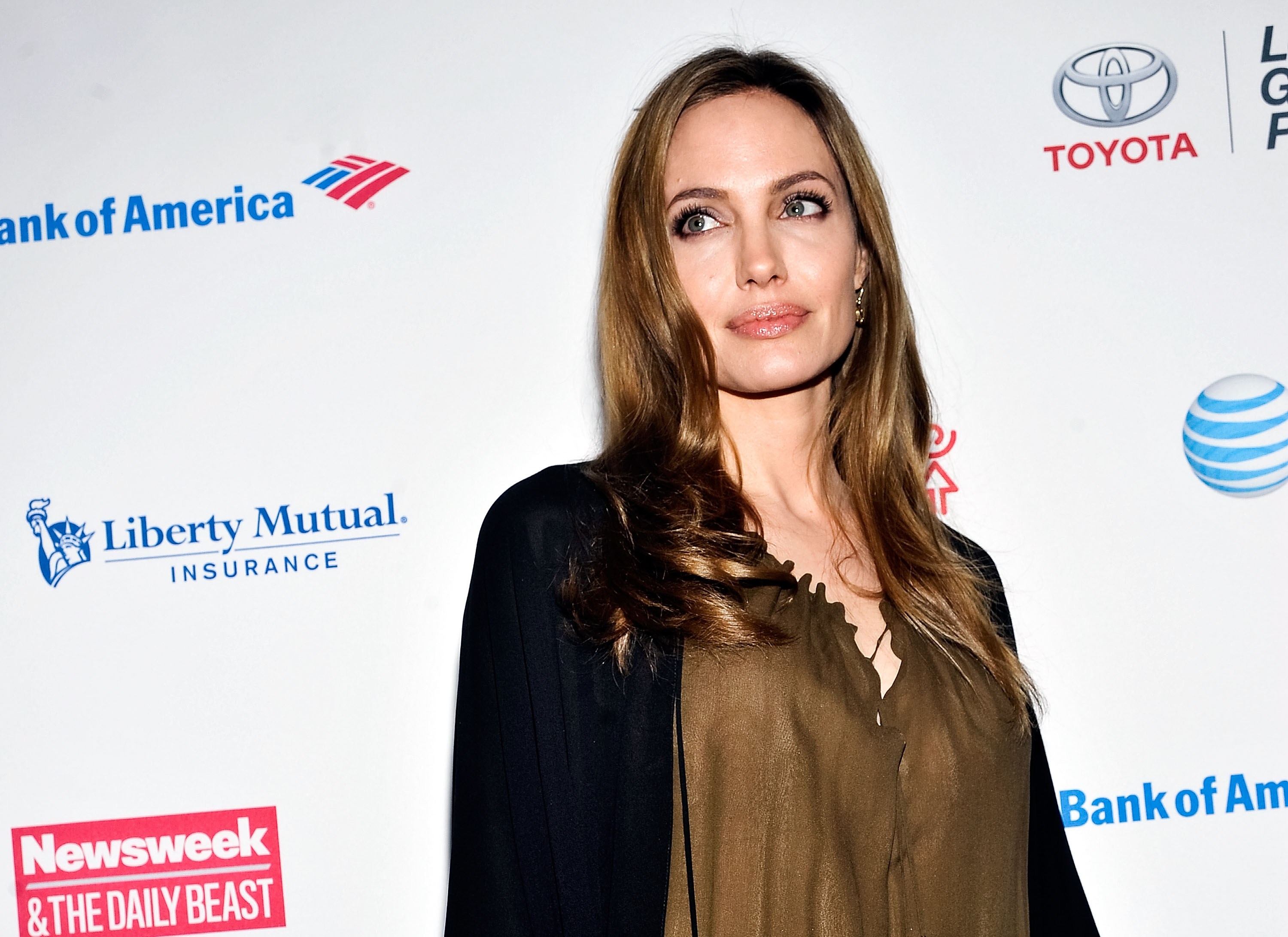
Yesterday, Angelina Jolie revealed that she had a preventive double mastectomy. A genetic test found that she carries a BRCA gene, which greatly increases the chances of breast cancer:

I wanted to write this to tell other women that the decision to have a mastectomy was not easy. But it is one I am very happy that I made. My chances of developing breast cancer have dropped from 87 percent to under 5 percent. I can tell my children that they don’t need to fear they will lose me to breast cancer.

Rebecca Mead applauds:

Jolie’s medical decision says again what shouldn’t need re-saying: that a woman’s body is hers, that breasts are for something other than ogling, and that hard choices are made for strong reasons. Her decision to make her choice public is bold and brave and admirable. It is what celebrity is for.

Aaron Carroll emphasizes that these types of medical decisions are highly personal:

[E]ven a preventive mastectomy is not a guarantee against cancer. Studies show that it’s about 90% effective in preventing breast cancer in moderate and high-risk women. That still leaves a 10% chance of developing cancer in the chest wall, armpit or even in the abdomen. That’s because it’s pretty much impossible for even the best surgeon to remove all breast tissue from a woman.

Because of this, some women choose not to have the procedure done, even when they are at high risk. Just a few weeks ago, Peggy Orenstein wrote a compelling account of her decision not to undergo the procedure after her first brush with breast cancer. Her reasons are just as valid and important as Jolie’s but may not make the same splash in our national discussion.

Elaine Schattner is on the same page:

I know physi­cians who’ve chosen, as did the celebrity, to have mas­tec­tomies upon finding out they carry BRCA muta­tions.

And I’ve known “ordinary” women—moms, home­makers, librarians (that’s fig­u­rative, I’m just pulling a stereotype) who’ve elected to keep their breasts and take their chances with close monitoring. I’ve known some women who have, perhaps rashly, chosen to ignore their risk and do nothing at all. At that opposite extreme, a woman might be so afraid, ter­rified, of finding cancer that she won’t even go to a doctor for a check-​​up, no less be tested, examined, or screened.

What’s great about this piece, and what’s wrong about it, is that it comes from an indi­vidual woman. Whether she’s made the right or wrong decision, neither I nor anyone can say for sure. Jolie’s essay reflects the dilemma of any person making a medical choice based on their cir­cum­stances, values, test results, and what information they’ve been given or oth­erwise found and interpreted.

Sarah Kliff notes that the BRCA test isn’t recommended for everyone:

The [U.S. Preventive Services Task Force (USPSTF)] recommended against widespread BRCA screening in 2005 and reiterated that stance in draft recommendations made last month. The task force gave widespread screenings a “D” grade, meaning that it would expect “no net benefit.”

“For women whose family history is not associated with an increased risk for potentially harmful mutations in the BRCA1 or BRCA2 genes,” the task force wrote, “there is moderate certainty that the net benefit of testing for potentially harmful mutations in the BRCA1 or BRCA2 genes and early intervention ranges from minimal to potentially harmful.”

Florence Williams explains why she didn’t get tested for BRCA:

Both my counselor and I thought I should get tested for the BRCA genes, but my insurance carrier firmly disagreed. At over $3,000, Myriad’s test is too expensive for me and most other women to get, regardless of what they and their doctors may think.

So why didn’t I just cough up the money? Isn’t my health and life worth it? A couple of reasons. For one thing, I learned that our fear of breast cancer is clouded by misconceptions. We tend to think of breast cancer as a heritable disease, but in the vast majority of cases, it’s not. Straight hereditary factors only account for about 10 percent of all breast cancers. And while the BRCA genes are the well-known poster children of risk,  they get more credit than they deserve. In families with histories of breast and ovarian cancer, about half do not have BRCA mutations at all.

Claudia Wallis shares her experience with the BRCA test:

The news was good: I did not carry the mutation. I wept with relief. But then the counselor told me that I should not give too much weight to the finding.

My negative result “would be more meaningful,” she told me, if one or more first-degree relatives (a sister, mother, first cousin) tested positive for one of the BRCAs. Then I would have evidence that the familial cancer pattern was due to this particular genetic mutation. Without that knowledge, it could be that my family’s crazy burden of breast cancer was due to another gene defect—either a less common one that’s known to researchers or one that has yet to be discovered. Sigh.

This was in some ways the hardest news to deal with. How would I tell my two sisters that I wanted them to get tested, too—and that, if they turned out to be BRCA carriers, it would be bad for them but good for me?

Amanda Hess defends Jolie against misogynists:

Said one commenter on a Jezebel post about the op-ed, “How many guys stopped reading as soon as they realized Angelina Jolie has no breasts—she’s dead to me!”

I’d like to dismiss these commenters as trolls, but their attitudes are unfortunately pervasive in our culture, and they don’t just represent a personal affront to Angelina Jolie, a veteran of such inappropriate body commentary. These comments affect every woman who has undergone a similar procedure—every woman who has overcome the pain, the fear, and the constant and casual reminders that her breasts are more valuable than her life. Really, these comments affect all women who have seen their bodies reduced to mere objects for others to consume. As scholar of the stars Anne Helen Petersen says, “Remember: What we talk about when we talk about celebrities is, as ever, ourselves.” Some of us are not speaking very highly of the women in our lives today.

Alyssa hopes that Jolie won’t shy away from nude scenes in the future:

If Jolie has decided that she’s done with nude scenes or with sex scenes, that’s entirely her decision, and all of us should respect that. But if she does accept such roles in the future, I hope that she, and the writers and directors she works with, see her scars as a feature of her body, rather that some sort of grotesquerie to be hidden by shot angles or erased in post-production. Mastectomy scars should be treated like a physical characteristic that could inflect characters Jolie plays in the future without requiring major plot alterations or commentary. And it would be good for audiences, particularly of the kind that snarked on Jolie today for her brave revelation, to see that they don’t make her any less stunningly gorgeous.

And Michelle Cottle, who also recently had a double mastectomy, praises Jolie’s courage:

Whatever her acting gifts, Jolie would not have become the megastar/tabloid darling she is if she were not damn near every man’s fantasy. … By discussing her mammary travails so openly, Jolie runs the risk of messing with the fantasy. And for this reason, her willingness to go public with her surgeries strikes me as a genuine act of bravery—and one that will hopefully provide comfort and even inspiration to many women out there facing similar challenges.

After all, if Jolie can boldly and publicly trade-in such prime assets, what are the rest of us so anxious about?

(Photo: by Daniel Zuchnik/Getty Images)

Failed States

After examining Ukraine’s depopulation, Edward Hugh asks “whether it is not possible that some countries will actually die, in the sense of becoming totally unsustainable, and whether or not the international community doesn’t need to start thinking about a country resolution mechanism somewhat along the lines of the one which has been so recently debated in Europe for dealing with failed banks.” Joshua Keating ponders this:

I suspect that even in the bleakest, Children of Men-style population scenarios, most countries would fight to the bitter end before surrendering their sovereignty. The exception might be places like Ukraine that have a relatively recent experience as part of a larger geopolitical entity and a large ethnic population with ties to a neighboring country.

A country couldn’t be liquidated quite as neatly as a company — even if the state goes away, there’s still a chunk of land and some people living on it to deal with. The main obstacle to countries being “dissolved” may be that other countries may not want to take on the responsibility of dealing with them — what country really wants to take on a new sparsely populated, economically stagnant region?

McArdle looks at similar problems closer to home. Why Detroit is in trouble:

The problem is that the old infrastructure is still there, and still needs to be maintained. Detroit might have the makings of a nice 50 square mile city within its population. But it has to maintain 139 square miles of water and sewer, electric, police and fire coverage, transportation, and so forth. It also needs to maintain legacy pension costs that were incurred when the city was more prosperous. For the last five or six years, Detroit has made up the mismatch between taxes and spending by borrowing money and deferring its pension contributions. But this only means bigger bills in the future, when Detroit may be even less able to pay.

Race And IQ. Again.

[Re-posted from earlier today]

I should know better than to bring this up again. But the effective firing of a researcher, Heritage’s Jason Richwine, because of his Harvard dissertation should immediately send up red flags about intellectual freedom. I am not defending the Heritage report on immigration because I think it’s a loaded piece of agitprop. And I am emphatically not defending everything that Richwine has said and done (not least his disturbing willingness to be published in white supremacist magazines).

What I do want to insist is that the premise behind almost all the attacks – that there is no empirical evidence of IQ differences between broad racial categories – is not true. It is true (pdf), if you accept the broad racial categories Americans use as shorthand for a bewilderingly complex DNA salad (a big if, of course). There’s no serious debate about that. The serious debate is about what importance to assign to the concept of “IQ” and about the possible reasons for the enduring discrepancies: environment, nurture, culture, or genes – or some variation of them all?

For my part, I’ve come to doubt the existence of something called “g” or general intelligence, as the research has gathered over the years. I believe IQ is an artificial construct created to predict how well a random person is likely to do in an advanced post-industrial society. And that’s all it is. It certainly shouldn’t be conflated with some Platonic idea of “intelligence.” I don’t think it carries any moral weight at all, either, and I don’t think it should be used in any way in immigration policy. In fact, any public policy that rests on this kind of data is anathema to me. It’s far too close to eugenics, and to the morally repugnant idea that smarter people are somehow better in any meaningful sense.

But Richwine’s dissertation was mainly a quant-job. He comes across in this Byron York interview as a bit clueless – suspiciously so, I’d say – in extrapolating policy conclusions from IQ data in the context of immigration. But the core point about any dissertation is a simple one: does it hold up under scholarly scrutiny? Richard Zeckhauser, the Frank P. Ramsey Professor of Political Economy at Harvard, is on record as saying that “Jason’s empirical work was careful. Moreover, my view is that none of his advisors would have accepted his thesis had he thought that his empirical work was tilted or in error.” One of those advisors was the very serious and very liberal scholar Christopher Jencks.

I haven’t had time to read the thing, and some have cast aspersions on it after a browse. But it is abhorrent to tar someone researching data as a racist and hound him out of a job simply because of his results, honestly discovered and analyzed. One particularly disturbing statement came from 23 separate student groups at Harvard:

Central to his claim is the idea that certain groups are genetically predisposed to be more intelligent than others. In his troubling worldview Asians are generally at the top, with whites in the middle, Hispanics follow, and African Americans at the bottom. To justify his assertions he cites largely discredited sources such as J. Philippe Rushton whose work enshrines the idea that there are genetically-rooted differences in cognitive ability between racial groups.

We condemn in unequivocal terms these racist claims as unfit for Harvard Kennedy School and Harvard University as a whole. Granting permission for such a dissertation to be published debases all of our degrees and hurts the University’s reputation … Even if such claims had merit, the Kennedy School cannot ethically stand by this dissertation whose end result can only be furthering discrimination under the guise of academic discourse.

My italics. They are, of course, caricaturing the argument – I know of no scholar who believes that genes are entirely responsible for the racial differences. Here’s another caricature of it:

Human beings have not existed long enough to be divided into separate and distinct racial “species.”

Of course not. We remain the same species, just as a poodle and a beagle are of the same species. But poodles, in general, are smarter than beagles, and beagles have a much better sense of smell. We bred those traits into them, of course, fast-forwarding evolution. But the idea that natural selection and environmental adaptation stopped among human beings the minute we emerged in the planet 200,000 years ago – and that there are no genetic markers for geographical origin or destination – is bizarre. It would be deeply strange if Homo sapiens were the only species on earth that did not adapt to different climates, diseases, landscapes, and experiences over hundreds of millennia. We see such adaptation happening very quickly in the animal kingdom. Our skin color alone – clearly a genetic adaptation to climate – is, well, right in front of one’s nose.

But what the Harvard students are saying is worse than creating a straw man. They are saying that even if it is true that there are resilient differences in IQ in broad racial groupings, such things should not be studied at Harvard because their “end result can only be furthering discrimination.” You can’t have a more explicit attack on intellectual freedom than that. They even seem to want the PhD to be withdrawn.

Freddie deBoer and Reihan Salam have two good posts about this. Freddie:

Racism thrives on conspiratorial thinking and the self-definition of racists as an oppressed group. When you say things that are true aren’t, and especially when you do so in a way that treats the other point of view as forbidden, you play directly into their hands. I cannot imagine an easier way to give them fuel for their argument than to say that certain test results don’t exist when they do.

That’s my view in a nutshell. What on earth are these “liberals” so terrified of, if not the truth? Instead of going on racist witch-hunts, why don’t they question what IQ means, how great the cultural and environmental impact can be (very considerable), whether such tests should guide public policy at all, or examine how “race” as a social construct does not always correlate to specific variations in human DNA. Note how the terms “race” and “historical ethnicity” are not the same things, as Reihan does. Or do what the scholar Dana Goldstein has done – criticize Richwine’s dismissal of education and poverty as factors affecting IQ in his dissertation.

But please don’t say truly stupid things like race has no biological element to it or that there is no data on racial differences in IQ (even though those differences are mild compared with overwhelming similarity). Denying empirical reality is not a good thing in any circumstance. In a university context, it is an embrace of illiberalism at its most pernicious and seductive: because its motives are good.

(Thumbnail image: DNA molecule display at the Oxford University Natural History Museum. By Flickr user net_efekt)

Will Robots Take Our Jobs?

A new police drama imagines a world where AI surpasses human intelligence:

Kevin Drum’s new article argues that this kind of technology might not be science fiction much longer. He thinks this will be beneficial in the long-term but worries that such advances will hugely disrupt the labor markets in the short-term:

Unlike humans, an intelligent machine does whatever you want it to do, for as long as you want it to. You want to gossip? It’ll gossip. You want to complain for hours on end about how your children never call? No problem. And as the technology of robotics advances—the Pentagon has developed a fully functional robotic arm that can be controlled by a human mind—they’ll be able to perform ordinary human physical tasks too. They’ll clean the floor, do your nails, diagnose your ailments, and cook your food.

Increasingly, then, robots will take over more and more jobs. And guess who will own all these robots? People with money, of course. As this happens, capital will become ever more powerful and labor will become ever more worthless. Those without money—most of us—will live on whatever crumbs the owners of capital allow us.

In an interview, Drum speculates about what will happen next:

Societies that suffer from mass unemployment, the history of what happens to those societies is not a bright one. At some point you have to respond, and there’s going to be a lot of resistance to responding because of ideology, because of politics, because of pure greed, but eventually we are going to respond to this. It’s going to be obvious what’s happening, that people are unemployed due to no fault of their own, and that we have to respond.

In the meantime, we’re going to resist responding, and we’re probably going to resist responding very very strongly, because rich people don’t like giving up their money. We’re in for a few decades of a really grim fight between the poor, who are losing jobs, and the rich, who don’t want to give up their riches.

Yglesias and Karl Smith chip in their two cents on the subject. Previous Dish on the subject here.

The Gatsby Budget

Kevin Roose estimates it, concluding that “Jay Gatsby was probably either living paycheck-to-paycheck or digging himself into debt”:

I ran Gatsby’s estimated cash flows by Rocco A. Carriero, a Southampton-based private wealth advisor. Carriero said that he would never take Gatsby on as a real-life client, given the illegality of his bootlegging business. But after looking at my estimates, he agreed with me that there’s no way a person earning as much as Gatsby did should be spending with such abandon. “He’s got to cut back on the lifestyle expenses,” Carriero told me of a hypothetical Gatsby-like client. “Rather than having fifteen parties at $150,000 apiece [in 2013 dollars], he may want to consider having one party, with maybe half the people.”

Yglesias thinks it’s not so simple:

The problem here is the dread relative price shifts. Over long time horizons not only does the overall price level shift but the relative price of different goods and services shifts. In particular, back in the 1920s labor-intensive services were very cheap. In her autobiography, Agatha Christie writes that when growing up she thought she’d never be so wealthy enough to own a car nor ever be so poor as to be unable to afford servants. And recall that Nick Carraway, who does not earn a lavish salary, has a “demoniac Finn” who cleans his house and cooks him breakfast on a daily basis. But if you were to calculate the 2013 price of a full-time servant and then retroactively attribute that income level to Nick, you’d end up vastly overstating how much he’s making in the bond game. It’s just that cars were expensive back then and unskilled human labor was incredibly cheap. The cost of throwing a giant party is primarily the cost of the labor involved, so huge parties would have been much more affordable in the twenties than today.

Reefer Revenues

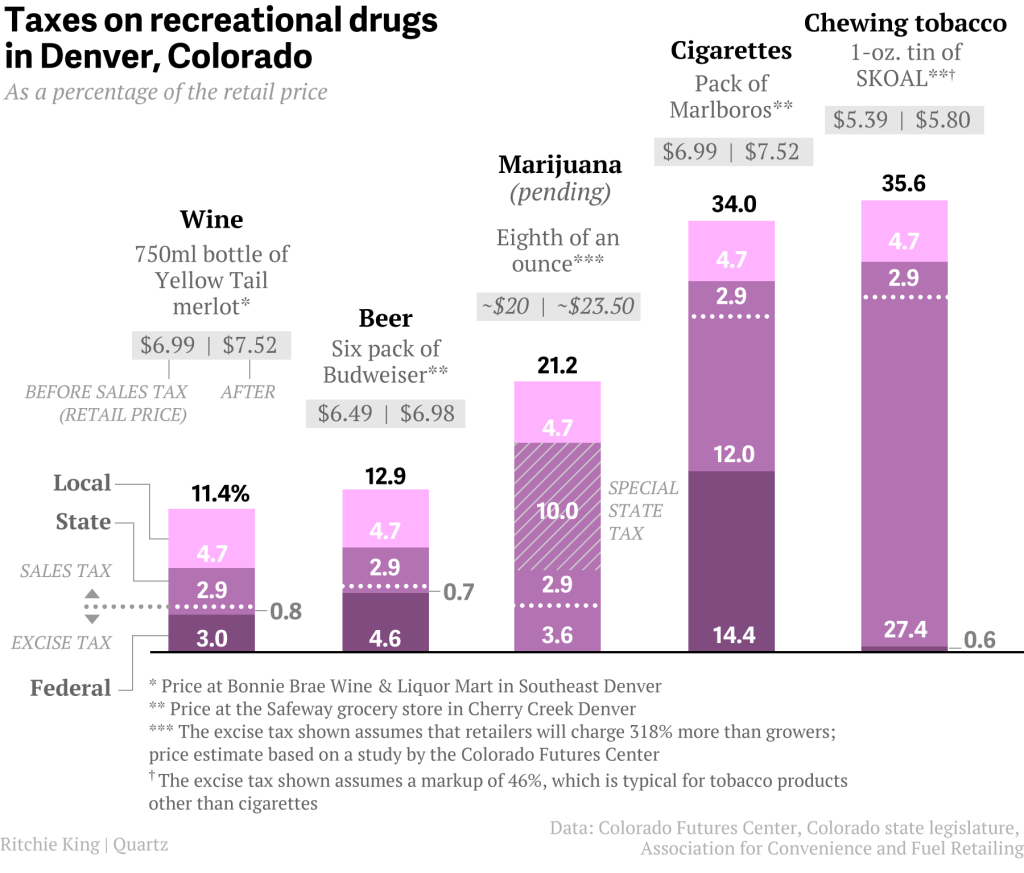
coloradopottax-chart2

Ritchie King checks in on pot taxes in Colorado:

One of the bills (pdf), passed on Wednesday, lays out the tax rates: a 15% excise tax on wholesale pot and a 10% special state sales tax, in addition to the standard sales tax of 2.9%. The taxes will take effect at the beginning of next year, when licensed retail stores first start selling the drug (pending approval of the bill by the governor and the state’s citizens, which are both expected). These rates will put pot in a tax realm that is somewhere in between a case of beer and a pack of cigarettes.

The big picture:

[Researchers at Colorado State] estimate that next year, 642,772 Coloradans (about 13%) will buy an average of 3.53 ounces apiece, making for a total tax revenue of $94.4 million. Though that amounts to almost a one percent increase in total state revenue, some, including the study’s authors, have expressed concern that the money raised won’t be enough to cover the cost of enforcing new marijuana laws, such as legal driving limits. But they don’t take into account the money that will be saved by not prosecuting and incarcerating the many marijuana users who were breaking the law prior to legalization but aren’t anymore. The Colorado Center on Law and Policy estimates those savings (pdf) to be $12 million per year.

Dogs vs Cats: Let The Great Debate Begin

Cats are sad:

But Ryan Kearney greatly prefers them to dogs:

Even leading dog-brain guy Brian Hare, who has an academic and financial interest in promoting the intelligence of dogs, concludes a Wall Street Journal piece—titled “Why Dogs Are Smarter Than Cats,” no less—by writing, “And what might the genius of cats be? Possibly, that they just can’t be bothered playing our silly games or giving us the satisfaction of discovering the extent of their intelligence.”

Nail on the head right there. Cats don’t rush me the moment I enter a room and put their paws on my chest or sniff my pant leg or shove their snout into my crotch or bark loudly or lick or bite me. Dogs alone do—which, in a way, is why so many people love them. Dogs are almost certainly the world’s most affectionate species, giving their owners what (most) humans, out of self-respect, cannot: mute devotion.

Elsewhere in the piece, Kearney claims to hate dogs. His main reason:

Few of us, relative to our ancestors, use dogs for hunting. Which means that, aside from several obvious niche uses (guiding the blind, sniffing for bombs or drugs, chasing down criminals; I draw the line at “therapy dogs“), we now rely on dogs for only one thing: to be our living stuffed animal, something to cuddle with when we’re feeling sad or wistful or lonely. That is all we ask of them—that they always be there when we need them—and they happily oblige, since we also happen to feed them in the process.

Some find poetry in the simplicity of this transaction. I see human neediness, if not weakness, and perhaps even exploitation.

Our oldest hound, Dusty the beagle, would not qualify as a dog on these grounds. She’s like Snoopy in her beagleness. Yes, she howls loudly whenever I arrive home. But the affection? Not so much. What I love about her – dustyivyand it’s been clear since she was eight inches long in my hands – is her ornery independence, her contempt for the lubrications of dog love, the minimalism of her gestures of affection, the constant insistence that all that really matters to her are her twice-daily meals. I know my place. Only a couple of times have I felt her need me badly. Once was when she got entangled in another leash on the beach and couldn’t move. That howl was different and it was directed toward me. Then there was a recent occasion when she was clearly feeling poorly – a urinary tract infection – and for the first time clambered up to sleep next to me on my pillow. I was so moved. It only took fifteen and a half years for her to open up.

Eddy, our younger hound-mutt? An open wound of vulnerable affection. I’d be reluctant to generalize about a species whose individuals seem to me to be as unique as humans are. As for cats, my mind is indifferent; my body, alas, gets hives and my face blows up and I have trouble breathing.

Recent Dish on dogs here.