The EU And Its Nations

A fascinating graphic from Pew’s new report on the EU:

European Stereotypes

Good to see the Brits are still focused on the real threat. But Germany is obviously becoming more isolated in the EU. What we are seeing is an almost text-book case of why conservatives can be smarter than liberals. The EU is in so many ways a wonderful development. It has fostered democracy, made another European war unimaginable, and generated growth and trade. But it has always been to my mind a utopian project because the actual human beings who live in Europe do not identify with the supra-state against their actual nation-state. The nation state seems to me to be the least worst unit of democratic accountability – drawing on ineffable bonds of solidarity, history and a scale that is actually manageable. To pretend that isn’t the case, or to try to impose some new form of identity, along with a new, abstract and cold currency, was always going to end in tears. It appears we are now at the stage when the whole project itself is being reconsidered:

First, attitudes towards the EU are getting worse. While there is always going to be some noise in these kind of data, the consistency of the negative changes is noticeable. What I think is potentially most important are the two countries (France and Spain) where we’ve gone from significant majorities with a favorable view of the EU to majorities without a favorable view.

Tyler Cowen adds:

The French are growing increasingly disillusioned with the European project, and on key questions the French see the world as the Italians or Spanish do, not the Germans.

Karl Smith bets that this state of affairs can’t last:

For a several years I have had a hard time seeing how the European project survives continual economic and monetary mismanagement. Little has happened to change that assessment. It appears that public opinion in France has turned decidedly against the project. Equally, as important the French, like everyone else, blame their own leaders more than they blame the EU.

This implies that new elections will be new leaders, who will be quite aware, that it is either Brussels or themselves. They’ll blame everything on the European Union and push unreasonable demands as a way of divorcing themselves from [popular] outrage.

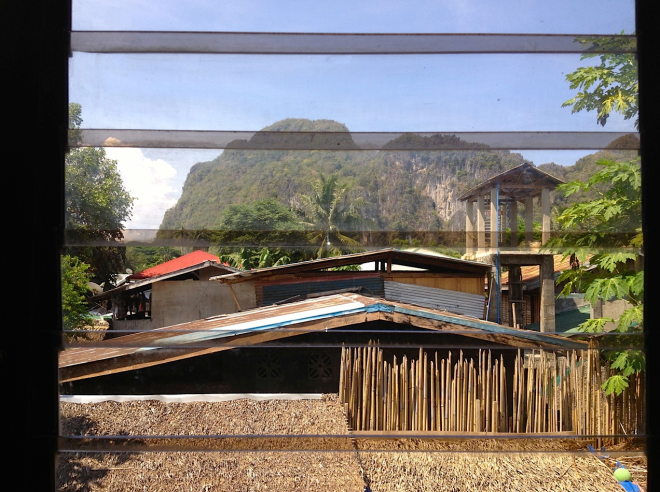
The View From Your Window Contest: Winner #153

Screen Shot 2013-05-10 at 11.26.51 PM

A reader writes:

It could be anywhere tropical. The coconut tree, the papaya plants, the bamboos – I am tempted to call it in some place in India, but the high cliffs are not what you typically see in India. It could be some other Asian country, but somehow the word Guatemala is screaming in my head. And I refuse to scan the entire country looking for this particular area – sorry. Neither my back, nor my brain, is quite cut up for that kind of effort.

Another:

Never actually tried to answer before, but this looks suspiciously like Cuamba, Mozambique. I traveled through this region when trying to get from Malawi to the coast of Mozambique. There is a somewhat sketchy old train line from Cuamba near the Malawi border to Nampula near the coast. It crosses Niassa province, once of the poorest but most beautiful parts of Africa. Niassa is peppered with rock formations lke the one in this week’s contest.

Another:

I’m guessing the photo was taken in Krabi, Thailand. The vegetation, the karst rock formations, the type of construction, the thatching on the roof, all points to Krabi. If that’s the view from a hotel, I’m a little sorry for the tourist who shot it. Weird mix of beauty and the mundane. But, hey, I’m also envious: He or she’s in Thailand!

Another:

The geography of in this week’s photo reminds me strongly of the limestone formations found on Thailand’s Andaman Coast. My guess is that the photo was taken on the isthmus of Ko Phi Phi Don. Satellite photos are not helpful, but this photo shows a red roofed home on the far end of the isthmus which could line up with the hills in the contest photo if the perspective is right. A friend and I took the ferry to Ko Phi Phi Don from Phuket in August of 2006 when the island was still very much in recovery mode from the 2004 Tsunami. We loved the island enough that we made an unplanned overnight stay with only the shirts on our backs and paid about $9 for a shack near the beach. The window frame in the contest photo reminds me very much of that shack. There were many interesting people on the island, ranging from Danish economics students to an American military contractor on leave from Afghanistan.

Another:

Could be any of the Andaman Sea islands of Thailand, or even Krabi on the mainland, but this looks vaguely reminiscent of Phi Phi Don (and I’m not going to go searching through ours of images to try to match up the cliffs).  If so, this is probably from a bungalow set back a bit from the beach and main road on the Ton Sai Bay side (I think they call the area “View Point”). This was one of the places devastated in the Boxing Day Tsunami in 2004.  We were back in 2009 and the recovery was in full swing – too much so, in fact.  The place was fast on the road to over-development and we escaped after two days (e.g., the south end of Koh Lanta was our favorite).

Another:

The nap of the felt on that tennis ball in the corner is clearly of a type sold only in the Lesser Antilles. Given that and some clues apparent only to me, I am certain that this photo was taken from Room 4F at the Still Beach House in Soufriere, St. Lucia.  Wait – Is that a mango?

Another:

The geography and the hanging tobacco remind me a lot of a visit to Viñales, in the Cuban province of Pilar del Río during my undergraduate career at Berkeley.  On one of the days there we visited an old tobacco plantation and we hiked a couple of mogotes, those hills in the background.  I might be wrong, but thanks for bringing back those wonderful memories.

Another:

I may be continents off, but as soon as I saw the photo, it reminded me of the many villages along the Mekong River, particularly the region between the Golden Triangle of Thailand and Luang imagePrabang, like the one in the photo below which I took last summer.   Since the writing on the water tower is in English, my first thought was that this was in Myanmar, and it may be, but my gut is saying Laos. This looks like a very small village, but I suspect it isn’t, because theres too much concrete and that would make it too impossible.  Since many of the slow boats that make this journey stop in Muang Pakbeng overnight, and there are plenty of hostels and guest houses there that look out on the outskirts of this small town, I’m going to guess that’s where this was taken.

Another:

Vang Vieng, Laos is a station on the backpackers’ SE Asia grand tour with spectacular karsts along the river. VV is the halfway point on the amazing bus ride from Vientiane to Luang Prabang. Parts of Laos are changing rapidly but the charm and good nature of the people has not yet been badly compromised by tourism but I fear it eventually will be. People need to eat and be sheltered and kids need education and unfortunately tourism is one the few revenue streams in very poor country. Part of me says, “Go now!” while another says, “Stay away.”

Another:

The eroded limestone mountains plus the tropical foliage leads me to guess this is a photo from a room in a hotel somewhere on Ha Long Bay in Vietnam. My parents were Americans in South Vietnam during the war. Dad was there working on malaria eradication and my mother was a French language intelligence collector for the CIA. I was born in that Saigon in 1965, but my mother and I were evacuated two weeks later. Some day I will have to go back to the country of my birth.

Another:

You’ve got to be kidding with this one!

It could be a million places in the tropics.  The dramatic peaks in the background looks like those which rise from South Pacific islands which I’ve visited, but the green is less intense.  It’s probably in Central America some place, but for kicks I’m going to say it’s Pago Pago, American Samoa.

Another gets closer:

For some reason, Sumatra popped into my head immediately upon seeing this. Have I been to Sumatra? No. Do I know anything whatsoever about Sumatra, other than its general location? No. Have I done an exhaustive (or even non-exhaustive) Google search to bolster my claim? Again, no. Nevertheless, this is my guess. I’m stuck working the weekend in a hotel in California. (The very same hotel from which I took the picture in Contest # 144.) It’s a beautiful and dry 88 degrees outside, but I’m inside. I needed a break and I knew it was VFYW day, so here I am, gazing at what may or may not be Sumatra. Thanks for the distraction!

Another gets really close:

Very challenging this week.  The only clues I could use (besides general tropicalness) were the watertank (“Bestank” is a Philippines company), cliffs are mostly in the Palawan Islands, and the presence of satelite dishes indicated some level of power usage and a southern view (assuming northern hemisphere).  Lots of swanning about the Palawans, trying to narrow it down but no success.  I’m sure others will have nailed it; we have such a sophisticated crew here!

A previous winner gets incredibly specific:

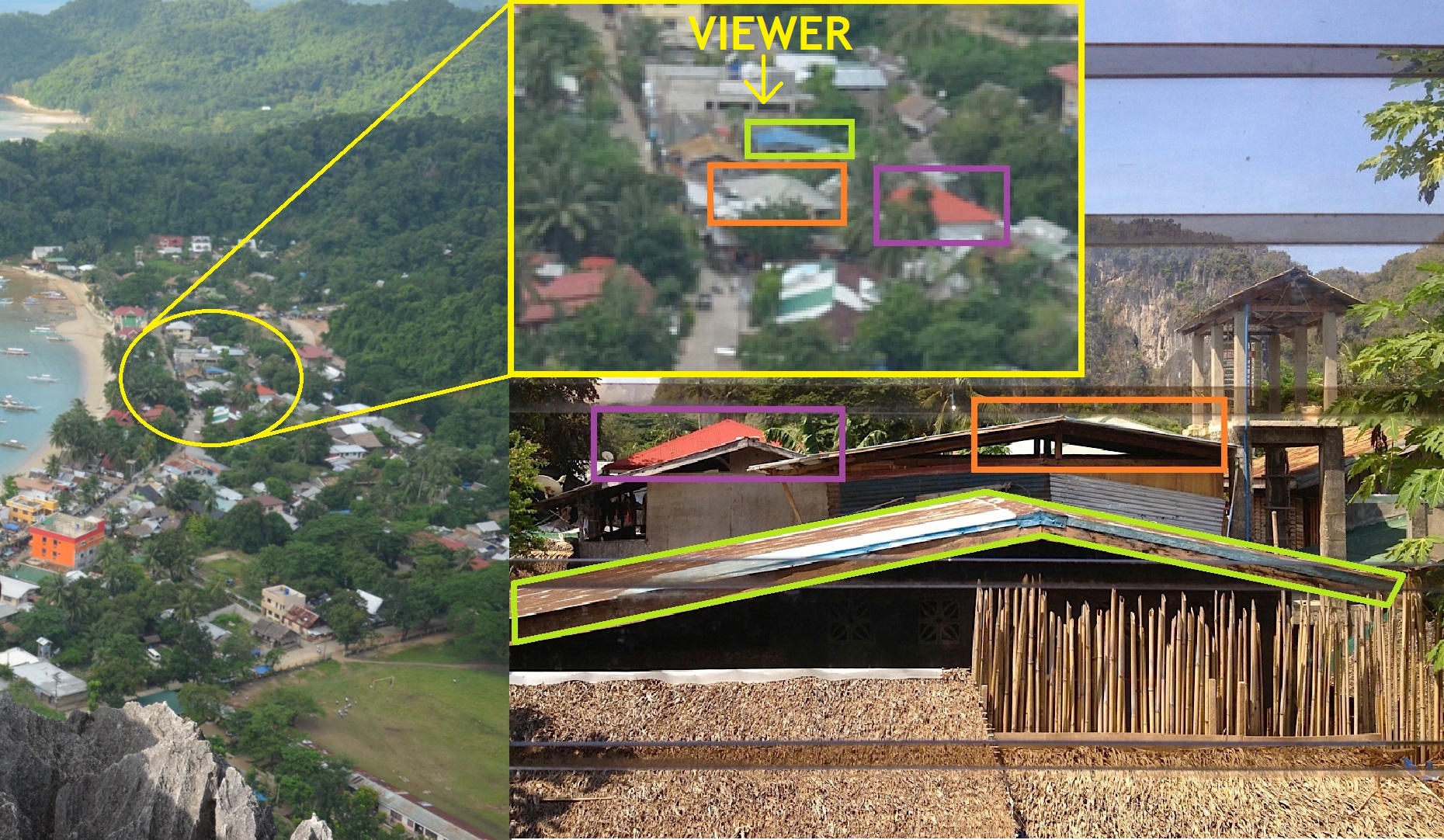
A brutal contest with a deceptive start. It only took me a few hours to find that this view is from  El Nido, Palawan, Philippines. So, sick with flu, I went to sleep thinking that I would quickly find theVFYW El Nido View Above with Insets - Copy actual window when I woke up. Ha. Two full days and one bottle of Dayquil later and I was still searching. See, the thing about resorts in developing nations is that the small inns and hotels are constantly rebuilding and expanding – as in, every year. And in the tropics, the roofs have a fun way of rusting into oblivion every year too. The upshot is that online searches are really hard because the architecture changes so much. This was especially true here because your viewer stayed at a building that’s only two years old.
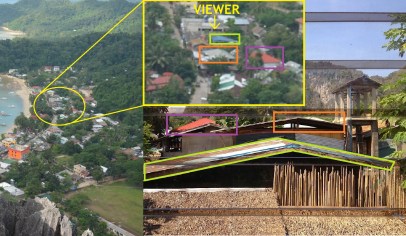
That building is the new expansion at “Rosanna’s Cottages” that sits on M. Quezon street (not the beach). The window is on the second floor, possibly in room #15, and looks towards Taraw Peak at a heading of 204.46. For the curious, the coordinates are 11°10’57.39″ N, 119°23’32.92″ E. VFYW El Nido Rosanna's Actual Window Marked - CopyUnfortunately, recent satellite maps only show a copse of trees on that spot; they were torn down for construction. Next time a Dish viewer goes to El Nido, I recommend the Four Seasons; it shows up on a map like you wouldn’t believe.
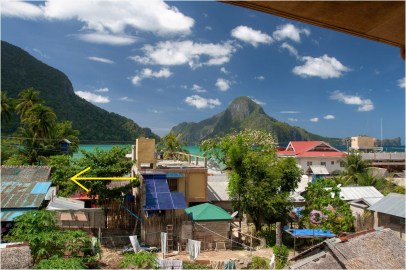
Attached is a combination image. On the left is a 2011 view from the cliffs looking down on the town and your viewer’s location, circled in yellow. On the right side is a magnified area from that shot inset into your viewer’s photo. The purple, orange and green boxes match up the three roofs seen in both images (the blue roof in your viewer’s foreground has rusted considerably in the past two years). Also attached is an oblique image of the actual window showing the direction your viewer was facing, and one of their building’s front.

VFYW El Nido Rosanna's Front - Copy

But the prize this week goes to a reader who has guessed a difficult view in the past without yet winning and who has participated in 12 total contests:

I’m sure in a few weeks I’ll be Google-mining trailer parks in Hickspit, Alabama, but as far as this view is concerned, thanks for forcing me to closely examine paradise. Wow.

As one of your less worldly Dishheads, the key for me this week was correctly identifying the steel gravity water tank. An hour or so in we had our manufacturer, based out of the Philippines. From there, image search “Philippine cliffs” and bam – El Nido! Done and wrapped up by 9:30 Saturday night.

But wait. It’s become apparent over the last few months that the Window View’s new obsession is picking non-Streetviewable locations, and as is often the case, getting the last few blocks became untenable. To me, anyway. I think I’m close, and I’ve attached a murky overhead in the block near where Calle Real meets Osmena St., but I can’t get inside the room this week, despite searching the entire wonderful town of El Nido for the right set of louvered windows.

I hope I’m closest, but under the assumption I’m not, I hope somebody won who can give me the right search criteria so I’ll know what I did wrong. I’ll set my laptop on fire if this one goes to the “I got married in that shanty” crowd.

(Archive)

Blaming America The Most

Perhaps it’s unfair, since this was said in the heat of a debate with Bill Maher. But this is how my friend Glenn Greenwald described the US last Friday night:

It’s amazing for you to say “Look at all these Muslims. The minute you give them a little freedom, they go wild and they start being all violent” … How can you be a citizen of the United States, the country that has generated more violence and militarism in the world over the last five or six decades and say “Look at those people over there? They are incredibly violent”?

I’m very much with Glenn on American denial about the consequences of our own actions. I’m with him in believing that we have a very dangerous capacity to whitewash our own sins and highlight those of others. I do think the US – mainly since 9/11 – has been generating violence on a large scale, most recently by invading and occupying Iraq and not providing minimal security for its inhabitants, leading to a sectarian bloodbath bigger even that Syria’s current horror.

But really: the US has generated more violence and militarism in the last sixty years than any other country? Has Glenn heard of the Cultural Revolution? Or the reign of Pol Pot? Or the brutal legacy of Stalin?

Or the invasion and suppression of Central Europe by the Soviets? Or the Chinese campaign to immiserate Tibet? Or the Rwandan civil war? Or the Balkan atrocities (which the US helped stop)? Or the civil war in Congo? Or Bashir Assad in Syria? Or Saddam Hussein in the Iran-Iraq war? Or the brutal repression of the Iranian regime in 2009?

Yes, we need to look our own recent militarism and war crimes with a clear eye. But America has not been the most violent and militaristic country on the planet over the last six decades. We are not inherently a force for good – no country can be. We are all humans prone to human failings and crimes. But I’m not going to stand by and have the US equated with the Soviet Union and Mao’s China and Saddam’s Iraq and Assad’s Syria without a protest.

And Then There Were Twelve, Ctd

A reader writes:

Okay, I think your reference to Minnesota as a “bastion of midwestern Catholic values” is a first. There are plenty of Catholics in the state, but Minnesota is really a bastion of Lutheran decency. Rev. Tim Faust, who gave the speech on the floor of the Minnesota House to which you linked to last week [and seen above], is a Lutheran minister. His lilting drone is the drone heard throughout childhood by millions of small-town Minnesotans before they moved to the burbs and joined the megachurch. It is the boring, drumbeat drone of “do the right thing.” The political equivalent of the Lutheran drone would be a speech by Walter Mondale.

The Evangelical Lutheran Church of America (ELCA) now ordains non-celibate gay ministers. It is the largest denomination in Minnesota. The debate within the synod was intense, and it took place two years ago in every hamlet in the state. It was the debate within the Lutheran Church in Minnesota that broke the ground for people to talk about gay people. I am not Lutheran, but they laid the groundwork for this week’s victory. Even though a substantial number of their congregations split away from the ELCA, many churches picked up members after the decision.

To their credit, my Catholic Minnesota friends were strongly opposed to last fall’s anti-gay marriage amendment. Like much of the state, they relished voting against inequality.

Yes, you’re right. I guess I just see it as Catholic as that’s what I’ve been exposed to in the state. Another Minnesotan adds:

Minnesota’s culture is rooted in northern Europe, northern Germany and Scandinavia, as opposed to more Catholic southern Germany and southern Europe. Minnesotans place a high value on privacy – not in a libertarian sense, but in a “don’t meddle” sense. This emphasis on privacy makes it hard for an outsider or newcomer to make friends. On the other hand, it means there is some level of respect for “your business,” as in “Well I suppose who you marry is really your business, isn’t it?”

While this attitude is sometimes derided as “Minnesota Nice,” the truth is that Minnesota Nice does exist. Beyond politeness, it allows some space for private individuality. Minnesota’s culture may not much like it when someone stands out too much, but it also doesn’t like it when someone gets singled out for ill treatment.

Minnesota is not a secular place. Religion still has influence on the culture there. However, in my 13 years living in Minnesota, that influence is expressed in terms of grace more than in terms of sin. That is the Lutheran influence and I would suggest this religious value – graciousness towards others – is the one that prevailed today.

The DOJ’s Press Probe

Yes, the Department of Justice secretly collected the phone records of AP editors and reporters:

According to an article published by the AP, [the surveillance] may relate to its May 2012 article revealing an Al-Qaeda bomb plot. That plot, originating in Yemen, was targeted for the anniversary of the death of Osama bin Laden, but was foiled when the device was given to a CIA double agent. The AP broke the story, holding it for several days at the request of the White House. According to the AP, the reporters on that story owned numbers that were among those subpoenaed, indicating that Justice may be trying to identify the source of the leak.

Ben Smith calls it yet another example of Bush era policy shaped into a leaner form by Obama:

The Justice Department’s subpoena of phone records in a leak case probably shouldn’t be a surprise: This Administration has been remarkably, unusually aggressive in targeting leaks — a policy that has surprised and pleased some critics, while alienating traditional allies. But, paired with questions about the IRS and a broader edginess over pervasive surveillance, it’s a sleeper issue that seems poised to break outside its small circle of reporters and advocates.

This reaction, and this new fear, is in no small part the Administration’s fault. Obama has always sought to control elements of politics that couldn’t be controlled, and has an obvious affection for the surgical strike. But it also taps perfectly into the fears of the moment, in which futuristic visions of surveillance, hacking, impersonation, and drone war have become everyday powers of corporations, civilians, and the government.

Orin Kerr thinks this is a “non-story”:

I would ask readers inclined to see this as an abuse to identify exactly what the government did wrong based on what we know so far.

Was the DOJ wrong to investigate the case at all? If it was okay for them to investigate the case, was it wrong for them to try to find out who the AP reporters were calling? If it was okay for them to get records of who the AP reporters were calling, was it wrong for them to obtain the records from the personal and work phone numbers of all the reporters whose names were listed as being involved in the story and their editor? If it was okay for them to obtain the records of those phone lines, was the problem that the records covered two months — and if so, what was the proper length of time the records should have covered?

Jonathan Adler disagrees with Kerr:

This is hardly the first time the federal government has investigated the leak of national security information in the past dozen years, and yet this is the first time a seizure of this scope has been reported.  The AP’s letter of protest certainly suggests this was an unprecedented seizure with serious implications for the AP’s newsgathering operations across a range of areas, and that the requisite efforts to obtain the necessary  information through other means were not undertaken. Perhaps the AP is wrong on these point, and perhaps DoJ did everything that is required.  If so, there might not be cause for outrage.  But that would hardly make this a “non-story.”

And Drum hopes the practice will finally receive proper scrutiny:

The government has been obtaining phone records like this for over a decade now, and it’s been keeping their requests secret that entire time. Until now, the press has showed only sporadic interest in this. But not anymore. I expect media interest in terror-related pen register warrants to show a healthy spike this week.

That could be a good thing. It’s just too bad that it took monitoring of journalists to get journalists fired up about this.

Incarcerated Ideas

Andrea Jones examines some of the banned books in prison, using the Texas Department of Criminal Justice as a case study:

As noted by the Texas Civil Rights Project, the majority of banned books fell into the two most nebulous threat categories: promoting deviant sexual behavior, and inciting disorder through strikes, gang violence, or riots. Wide tracts of literature grappling with challenging themes like race, sex, and poverty were denied at the discretion of prison authorities, with no clear link to penological objectives.

Examples:

Books by Pulitzer Prize-winning authors like Jeffrey Eugenides, Sinclair Lewis, Norman Mailer, Annie Proulx, Philip Roth, Art Spiegelman, Wallace Stegner, John Updike, Robert Penn Warren, and Alice Walker were deemed unfit. The Color Purple, for example, was banned for its opening scene of sexual abuse—Celie’s ensuing struggle for empowerment amid racism and patriarchy were of no value according to TDCJ’s mailroom inspectors. …

Books incriminating prison institutions were overwhelmingly censored for mentioning rape, despite the topic’s critical relevance. Prison Masculinities, a collection of essays edited by prison mental health experts, was banned for its candid discussion of sexual assault and violence behind bars. The Perpetual Prisoner Machine, a look into the profit motives driving mass incarceration, was barred for quoting a 1968 report from the Philadelphia District Attorney’s Office on the problem’s prevalence in local jails. Even self-help and rehabilitative titles about the prevention of violent sexual behavior, like Stopping Rape: A Challenge for Men, and Conspiracy of Silence: The Trauma of Incest, were prohibited by TDCJ.

Previous Dish on prison libraries here.

Invading The Privacy Of Paying Customers

After the revelation that Bloomberg journalists had been accessing user information on Bloomberg’s computer system, Bloomberg News editor-in-chief Matthew Winkler clarifies what information was compromised:

[Reporters] could see a user’s login history and when a login was created. Second, they could see high-level types of user functions on an aggregated basis, with no ability to look into specific security information. This is akin to being able to see how many times someone used Microsoft Word vs. Excel. And, finally, they could see information about help desk inquiries. … At no time did reporters have access to trading, portfolio, monitor, blotter or other related systems. Nor did they have access to clients’ messages to one another. They couldn’t see the stories that clients were reading or the securities clients might be looking at.

Adam Penenberg connects the episode to another media scandal:

How different is this from News Corp. and its phone hacking scandal?

With Bloomberg you have customers paying roughly $20,000 a year per terminal and rely on them to help execute trades with vast sums of money at stake. With the phone hacking scandal you had employees of Rupert Murdoch-owned newspapers accessing voicemails belonging to politicians, celebrities, and the British Royal Family. … If you think about it, Bloomberg reporters’ actions were not dissimilar to Gallagher and News Corp.’s. They intercepted information they were not supposed to have and gained unauthorized access to customers’ accounts. The difference: The latter is illegal. The former? It’s hard to say.

Neil Irwin argues that the incident reveals tension in the Bloomberg business model:

You can’t think about Bloomberg News without understanding that this is the ecosystem in which it exists. The journalists there create some excellent work on topics that have nothing to do with financial markets—but their bread and butter, their raison d’etre is to be one more thing that makes the Bloomberg terminal something that financial professionals can’t afford not to have. For Bloomberg, in other words, the terminal business is so lucrative and so important, that it can spare no expense to make sure that if a plane crashes in Mozambique or Hungary appoints a new central banker or, say, a senior executive of a major investment bank has been forced out of his job, the news will pop up on a Bloomberg terminal first.

Which brings us back to the events of the last few days. The practice of letting journalists access information about when subscribers had logged in and what broad categories of data they accessed pits the two imperatives of Bloomberg’s strategy against each other. On the one hand, it wants to do everything it can to ensure that its reporters are drumming up information that the competition isn’t. On the other, anything that discomfits the subscribers who are paying the bills could endanger the whole enterprise.

Kevin Roose doubts this will affect Wall Street’s “Bloomberg addiction”:

Terminal clients who are offended at the breach of privacy can take some steps — renegotiating their contracts with Bloomberg, moving certain extra-sensitive functions like IM off the terminal — but unless they’re willing to radically overhaul their company’s work flow at great expense and annoyance, they can’t just leave.

So while media watchers might rejoice in a legendarily secretive and cutthroat media organization coming under the microscope for a privacy breach, they shouldn’t celebrate too hard. After the privacy issues are tied up and a few pro forma steps are taken to put clients at ease, it will be back to business as usual for Bloomberg.

A Hate Map Of The US

dish_hate1

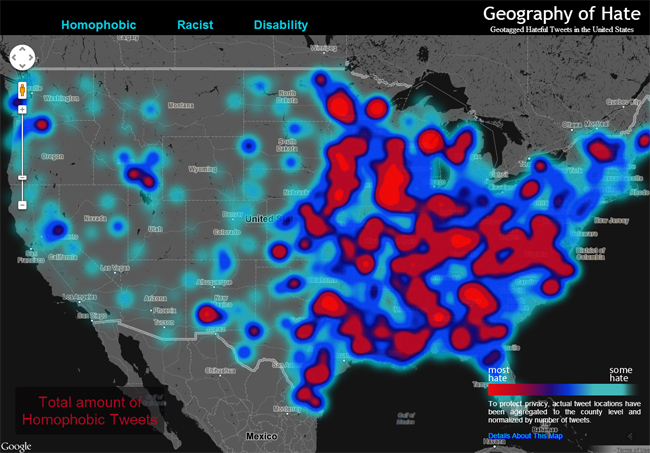
Researchers at Floating Sheep analyzed more than 150,000 geotagged tweets that included a homophobic, racist, or ableist slur and mapped the data:

Perhaps the most interesting concentration comes for references to ‘wetback’, a slur meant to degrade Latino immigrants to the US by tying them to ‘illegal’ immigration. Ultimately, this term is used most in different areas of Texas, showing the state’s centrality to debates about immigration in the US. But the areas with significant concentrations aren’t necessarily that close to the border, and neither do other border states who feature prominently in debates about immigration contain significant concentrations.

… Ultimately, some of the slurs included in our analysis might not have particularly revealing spatial distributions. But, unfortunately, they show the significant persistence of hatred in the United States and the ways that the open platforms of social media have been adopted and appropriated to allow for these ideas to be propagated.

Brian Anderson adds:

How can we be sure “positive” uses of an otherwise hateful slur (e.g., “dykes on bikes #SFPride”) weren’t inadvertently swept up in the Geography of Hate? Contextualiztion is crucial–is everything, really. Did Stephens’ team allow for it? They did. In fact, this is why they used humans (read: Humboldt State students), not machines, to analyze the entirety of the 150,000 offending tweets, all drawn from the University of Kentucky’s DOLLY project.

An interactive version of the map is here.

Hardcore Curriculum

The course instructor for “Navigating Pornography” at Pasadena City College explains what, exactly, goes on in the classroom:

We examine the history of sexualized imagery in art, exploring the often-murky, frequently false distinction between what was created to arouse and what was designed to inspire worship.428px-Sade-Biberstein
We explore the 18th-century origins of modern pornography (lots of time with the Marquis de Sade) and we focus on the history of several centuries of legal sanctions on “obscenity.” We look at the development of the modern mainstream porn business (based in the nearby San Fernando Valley), and analyze the way it has adapted and transformed over the four decades since the Supreme Court’s ruling in Miller v California (1973) essentially legitimized the adult industry.

My goal isn’t just to give my students an historical and cultural overview of pornography. It’s to give them tools “to navigate the sexually mediated world we live in,” as Long Beach State professor Shira Tarrant puts it.  Most of my students were born in the early-to-mid-1990s; they hit puberty under the influence of two conflicting social realities: the widespread availability of broadband and the Bush-era abstinence-only sex education policies.

Previous Dish on pornography here, here and here.

(Image: Depiction of the Marquis de Sade by H. Biberstein in L’Œuvre du marquis de SadeGuillaume Apollinaire (Edit.), Bibliothèque des Curieux, Paris, 1912, via Wikimedia Commons)

Bee Afraid

Honeybees are in deep trouble:

Almost a third of managed U.S. honey bees died last winter, according to a new survey of commercial and home beekeepers. That’s more than triple the losses of 5 to 10 percent that used to be normal for beekeepers before 2005 — and double the 15 percent that beekeepers say is acceptable for their businesses to continue unharmed. The finding marks a disturbing trend among honey bees: each winter since 2006, the Bee Informed Partnership has documented losses of 21.9 to 36 percent of U.S. hives. … The large-scale die offs — attributed in part to a phenomenon known as Colony Collapse Disorder — have gained widespread attention in the recent months. That’s partly because if the deaths continue, they could have a major impact on the nation’s food system. … The U.N. Food and Agriculture Organization estimates that 71 percent of the world’s most widely-consumed crops are pollinated by bees — and these crops are worth at least $207 billion. But this year, bee losses caused farmers to come extremely close to a pollination crisis, leading to warnings about impending food insecurity.

Alan Boyle explains “Colony Collapse Disorder”:

The malady is almost certainly due to combination of factors — including the Varroa mite, a single-celled parasite known as Nosema, several varieties of viruses, and pesticides. Researchers point to one particular class of pesticides, known as neonicotinoids, as a prime suspect.

Neonicotinoid-based pesticides are commonly applied as a coating on corn seeds, but the chemicals can persist in the environment. Although they have low toxicity for mammals, they’ve been found to have a significant neurotoxic effect on insects, including bees. Several European countries have banned neonicotinoids, the European Union has been looking at a wider ban, and the Environmental Protection Agency is considering new limitations as well.

Dr. Doug Yanega cautions that we still don’t fully understand the causes of Colony Collapse Disorder, examples of which date back as far as the late 1800s:

[I]n both 2007 and 2009 another paper pointed out that there were at least 18 historical episodes of similar large-scale losses of honey bees dating back to 1869, at least several of which had symptoms similar enough that they cannot be ruled out as being the exact same ailment. Yet, how often have you seen any of the scientists and journalists and beekeepers acknowledging that any theories about the cause of CCD need to accommodate the evidence for similar bee crashes that pre-date neonicotinoid pesticides, high-fructose corn syrup (HFCS), migratory beekeeping, cell phones, genetically modified crops, or any of the other human-made “causes” that have been run up the proverbial flagpole? …

A reasonable course of action, to my mind, is acknowledging that we aren’t likely to find that any man-made factors are the true cause of CCD, devoting energy to looking for contagious pathogenic agents, and taking a closer look at genetic diversity in honey bees themselves (e.g., are there strains that are resistant to CCD?), while at the same time working towards reducing the exposure and impacts of man-made factors that are capable of harming bees (but without BLAMING them in the process, or overreacting).