Victorian Marriages

Their portrayal in fiction is hardly something to aspire to:

But if you really think about Victorian marriage plots, something doesn’t add up. Jane Eyre boasts one of the most appalling marriages in fiction, between Rochester and Bertha, before its happy ending. David Copperfield miscalculates drastically in his first marriage. The two main marriages in Eliot’s Middlemarch are disastrous. Catherine Earnshaw is hardly happy in her union with Edgar Linton. One could go on. In fact, as scholar Kelly Hager has recently noted, the “failed-marriage plot” is actually more common than the happy marriage one.

Even more intriguing, some of the happy marriages don’t look at all like the romantic love matches we expect today.

In fiction by Charlotte M. Yonge, who was wildly popular in the nineteenth century, characters seem to marry for companionship, mutual caretaking and affection, but never seem to feel anything like desire. (One of Yonge’s biographers even wondered if she knew how babies were made.) The odd thing is that these kinds of companionable matches exist everywhere in Victorian literature, once you start noticing them. For instance, David Copperfield ends up married to (ewww!) his foster-sister, and Fanny Price to her adoptive brother. And there is hardly a Victorian novel without cousin marriages – cousin marriages that seem to promise reliability, kindness, and safety, rather than passion.

Author The Grouch

Mary Mann praises the cantankerous writing style of Max Beerbohm:

Max Beerbohm hates going for walks. He also hates when lady writers are more successful than he is. He wishes that people were more honestly unkind in their correspondence, and he doesn’t care too much for socializing. When reduced to a line, his essays — each a perfect parody of a different genre or author — sound annoyingly negative. They conjure up the greatest fear for a new essayist: how does one write about the self without being narcissistic and unlikable? The full essays, written in Beerbohm’s distinctive curmudgeonly voice, answer the question with a paradox: be willfully unlikeable, and people will like you.

Mann highlights some choice Beerbohm lines, such as, “Though I always liked to be invited anywhere, I very often preferred to stay at home.” Why his pejorative style was successful: 

Validation of human imperfections seems to be most important in times of great change, when everyone is feeling unsteady. This makes the specific imperfections of the curmudgeon especially valuable because the old grouch is always longing for the “good old days.” Beerbohm certainly did, once noting in his youth that his long-term goal was to go off and live away from modern things so he could “look forth and, in my remoteness, appreciate the distant pageant of the world.” In his lifetime he saw the advent of electric lights, home telephones, television, radio, airplanes, escalators, vacuum cleaners… even such ageless-seeming items as the teabag and the cross-word puzzle. He took some things more in stride then others — he broadcast on BBC radio during World War II and writer Rebecca West gushed that he sounded like “the last civilized man on earth” — but was almost impossible to reach on the telephone because, as writer S.N. Behrman tactfully put it in The New Yorker, “he tolerated the instrument, but he didn’t coddle it.”

A Street-Eye View

J. Hoberman reviews a new installation by James Nares at the Metropolitan Museum of Art, Street:

Most of Nares’s subjects are oblivious or indifferent to their documentation, although a few are hyper-alert. People point to things we cannot see or make hieroglyphic gestures that unfold too slowly to be decoded. Tourists take their own images and occasionally one catches a glimpse of the filmmaker’s silver SUV reflected in a storefront window. Kids clown, adults stare. The moments when someone locks eyes with the camera are always electric. Nothing may be more dramatic than the focused concentration of New Yorkers hailing a cab, but small sensations become thrilling events. Rain falls. A woman’s hair is caught in the breeze. A merchant demonstrating a child’s toy produces a trail of soap bubbles. A low-flying pigeon comes in for a landing.

The moment-expanding, arrested-time effect has appeared in any number of Hollywood films, including Taxi Driver and virtually every feature made by action-movie director Michael Bay. Here, however, congealed temporality is the main point: Street is a motion picture predicated on two types of motion.

The first is the inexorable forward movement of the filmmaker’s car, proceeding at a constant speed although periodically—and almost invisibly—reversing direction. The second is provided by the wildly contrapuntal activities of the people on camera. Nares is best known for paintings made with a single brush stroke. Street, which is composed of thirty or more smoothly conjoined separate shots, is a comparable gesture.

Transforming the city into a kind of mass choreography, Street may suggest an updated version of Godfrey Reggio’s 1982 Koyaanisqatsi, the only non-narrative avant-garde film to ever play Radio City Music Hall; actually, it is quite the opposite. Where Koyaanisqatsi is essentially a jeremiad, using pixilation as well as slow motion, along with Olympian camera angles and an overwrought Philip Glass score, to portray urban life as an unnatural catastrophe, Street, shot at eye-level and deliberately paced, is more investigation than judgment. There is much that can be gleaned from it regarding New York’s social structure but, far from condemning the metropolis, Street revels in its diverse types, feasting on what the sociologist Georg Simmel described 110 years ago as the psychological conditions of modern urban existence: “the rapid crowding of changing images, the sharp discontinuity in the grasp of a single glance, and the unexpectedness of onrushing impressions.”

An Uneasy Calm Amid The Terror

Benjamin Kunkel reflects on a hard couple of weeks in America:

I’m more than ever grateful to be alive, for the interest and pleasure I have in the people I know, in thinking about the world, in the prospect of doing good if politically unavailing work, and in little things photolike the sight last week of some just-bloomed forsythia. (My grandmother, in her dementia, was each spring in New Hampshire surprised repeatedly by the beautiful yellow blazes.)

But whenever I raise my head from more intimate concerns there is the miscarriage of my society and civilization going on around me, robbing many people of what I still have to enjoy, and I find myself appalled enough at the gradual and sudden calamity that it seems to reveal hopes that I never knew I had, evident only in the dashing. These are hopes for this world “which is the world/ Of all of us,—the place where, in the end,/ We find our happiness, or not at all.”

Those lines come from Wordsworth, whose 1805 version of his book-length poem The Prelude I’ve nearly finished for the first time. I wish I’d read it years ago, but at least I’ll have done it once, when no long work in English has made me gladder for my native language. …

Wordsworth, in other words, who as a child “with the breeze/ Had played, a green leaf on the blessed tree/ Of my beloved country,” has come in part to hate his country, and to have impulses of vengeance toward young Englishmen much like him except for their being soldiers. And then, at this knowledge, he feels hatred for the hatred bred in him, compounded with disgust at the French revolution’s turn toward terror and disgust at the counterrevolutionary alliance arrayed against it. It comes to seem, terribly, that the stream of contemporary events doesn’t at all lead into some ocean of peace and justice but deserves a different aquatic image, as if all history were “a reservoir of guilt/ And ignorance, filled up from age to age,/ That could no longer hold its loathsome charge,/ But that burst and spread in deluge through the land.” He consoles himself with the thought that even such a “disastrous period did not want/ Such sprinklings of all human excellence/ As were a joy to hear of.” But the consolation is small. Mass violence has contaminated his joy in either of the opposed countries that he loves, and twisted some of his deepest feelings, with their inclination toward beauty, into ugliness. It must have done something for him to write about all this, and it’s done something for me to read it. But what does it do, to read or write or speak about our grief, anger, and improbable stupid hopes?

In the moment an emotion is expressed or an event reported on, I don’t quite feel the emotion or the event; the names for things partially and temporarily replace their actuality. The need for this relief may explain the desperate quality of my and perhaps your online reading, and of much that is written online or said into TV cameras. Language in the utterance is some escape from what it says. But then the world that is not bits or syllables resumes its undeflected course.

Previous Dish on American terror here and here.

CSI: Internet

Despite Reddit’s well-publicized missteps last week (for which Reddit has issued a formal apology – still none from the New York Post), Tim Murphy argues that Internet sleuths are “actually surprisingly good at fighting crime”:

The best example of what Reddit could be—if it became a bit less like Reddit, that is—is a site called websleuths.com. Founded in 1999, Websleuths has become a haven for amateur investigators who spend their free-time using public records to crack cold cases. It works like most any other online forum. Users create accounts and subscribe to different subject threads—in this case, relating to different cases that come in—depending on their interests.

Susan Bray, an assistant professor of counseling at Wichita State University, started using Websleuths under the pseudonym when she was unemployed and looking for work. She developed a rapport with another user, Cathy Rhodes, a car dealer from Augusta, Ga., and realized they had a knack for connecting unclaimed bodies to their next-of-kin. Her track record has led some police departments to reach out to her directly when they need an extra set of eyes. The Department of Justice has looked to capitalize on the Internet hive mind by setting up a site, claimus.org, for people to identify unclaimed bodies.

Why Not Tax The Web?

Lydia DePhillis supports the Marketplace Fairness Act, which would require online retailers to collect sales taxes on out-of-state purchases:

Among the Internet’s great virtues is its ability to make everything easy: setting up a business, communicating with customers, organizing records … and paying taxes. Opponents fret that it’s unfair for online businesses to have to separate out different tax rates for 45 different states. But tools for managing sales and payments are already more than sophisticated enough to handle the task—every credit card has a billing address, after all—and the legislation requires states to provide appropriate software to the businesses it covers. Local governments that are legalizing online gambling are also legislating location-based online payments, having figured out how to pinpoint with near 100 percent accuracy where a customer is located. It might take a while for states to work out kinks in their systems, but to say it’s impossible is to deny the reasons we value the Web in the first place.

McArdle thinks the law would be a burden for small businesses:

The bill makes this slightly easier by exempting the smallest businesses and saying that you only have to file one return per state. But that’s still hours and hours of work per month, for folks who are probably already working pretty damn hard.

This bill, in fact, is good for Amazon—it kills off their small-fry competitors who can’t afford the staff accountants (or the software) to file 46 returns every month. And it frees them up to open warehouses in more states, the better to minimize their shipping costs. Presumably, that’s why they’re in favor of the bill.

But it’s going to be hell on sole proprietorships and other small businesses that can’t afford the compliance overhead. Anyone who has had to file income tax returns in two states can imagine why you might not want to file in almost 50—monthly.

Rock Band Nomenclature

Michael Erard wonders if all the best band names have been taken:

The main driver of the sense that band names are scarcer than they used to be is the central ritual of the naming process itself: typing a name candidate into Google and waiting breathlessly for 100 milliseconds for the verdict. Doing this is less to avoid legal liability than about securing one’s place in the wide world; given that you’re googling yourself and hoping not to find anything at all, it’s more than a little poignant. …

Musicians also point to the rise of Bandcamp, ReverbNation, SoundCloud, and the online music community for exhausting the stock of names.

“Every time we had a name idea we liked, it seemed like there were at least one or two groups with the same name,” Bruce Willen said. “Thanks to the internet any college kid who does home recordings on his or her laptop can start their “band” on Bandcamp or Myspace.” In a way, this makes sense. One can imagine that 20 years ago, any garage band could have any name it wanted—or no name at all. The only reason a band really needed a name was if they were going to gig or record or tour. Let’s say 10 percent of those bands ever left the garage. Today all those bands are on Bandcamp, and they can’t be on Bandcamp without a name. These sites, including Myspace, which has 14 million acts, have inflated the demand for band names.

Meanwhile, Jimmey Kimmel’s “Lie Witness News” went to Coachella this week and tested the limits of fake band names.

Why Is This Not A Weapon Of Mass Destruction? Ctd

John Cassidy imagines the public reaction if the Boston bombers had instead used assault rifles:

Well, for one thing, the brothers would probably have killed a lot more than three people at the marathon. AR-15s can fire up to forty-five rounds a minute, and at close range they can tear apart a human body. If the Tsarnaevs had started firing near the finish line, they might easily have killed dozens of spectators and runners before fleeing or being shot by the police.

The second thing that would have been different is the initial public reaction. Most Americans associate bomb attacks with terrorists. When they hear of mass shootings, they tend to think of sociopaths and unbalanced post-adolescents.

The reason he thinks this mental exercise is useful:

My point is about perceptions and reality, and how the former can shape the latter. The Tsarnaevs did have at least one gun—evidently a pistol, rather than the mini-arsenal originally reported—which they apparently used to kill an M.I.T. police officer, but that wasn’t what kept an entire city locked indoors: it was the fact that there were “terrorists,” who had carried out a bombing, on the loose. As I pointed out the other day, numerically speaking, terrorism, especially homegrown terrorism, is a minor threat to public safety and public health. It pales in comparison to gun violence.

Not An Actual Peggy Noonan Column

But see if you can tell the difference:

“What hurts me—not physically, but metaphorically, rhetorically, to (she taps her heart)—is the disdain some have for this man, a good, wonderful family man and someone who put down the bottle and picked up, —how do I say this?—God. His God. All of our God, even if you believe in another one. How can you not want to wrap you soul around that story? It’s something Democrats—how do I say this?—don’t have. Maybe their arms are too small, maybe—how do I say this?—they don’t see the soul in which to hug. All I know is they’re afraid—they seem to be afraid, I should say, uh–wow, this is hard, because I don’t really know— to show love. It’s a kinder, gentler love they’re lacking. And it makes me—how do I say this?—sad. And I grieve.”

The Creationist Curriculum

Genesis Gospel

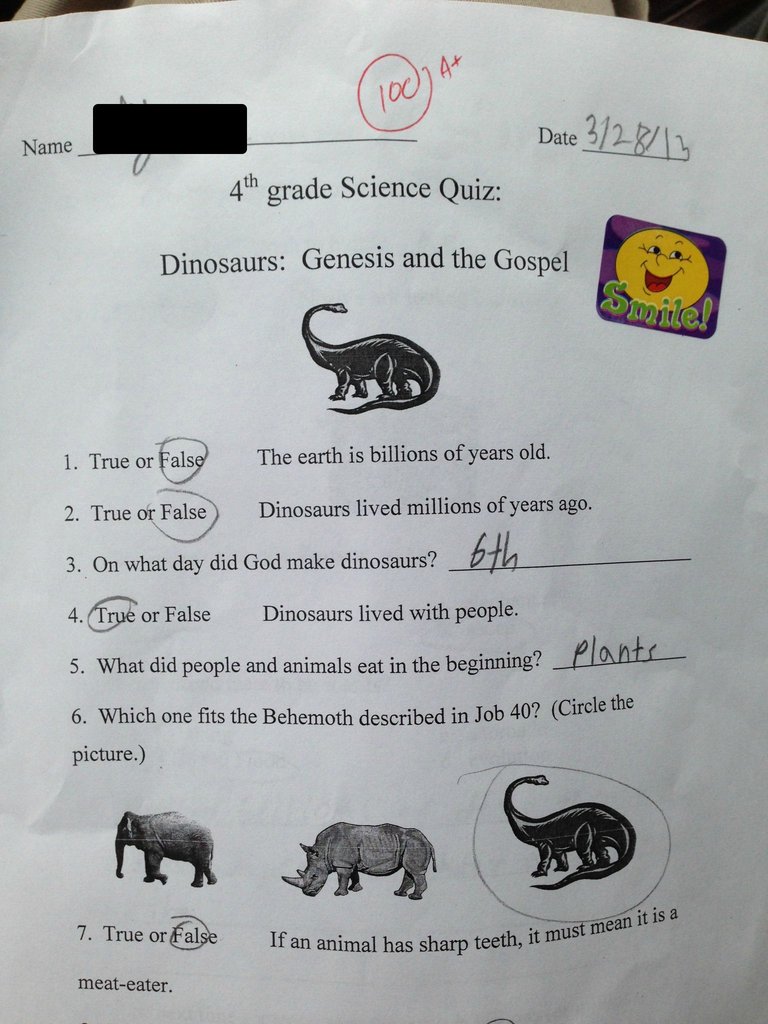
Joe My God passes along a test:

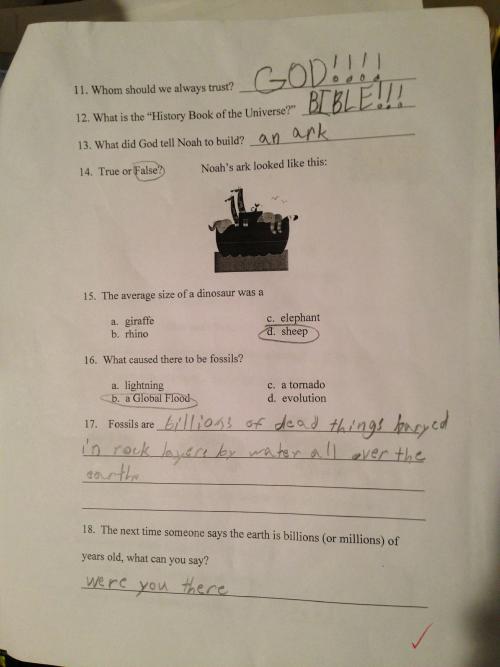
Above is the first page of a “science” test reportedly give to a fourth grade class at a Christian school in South Carolina. After receiving an email from a man claiming to be the father of the student, Snopes has rated the story as “probably true.”

Page two of the test after the jump:

God Genesis Page Two