That Broken Leg, Ctd

by Doug Allen

Responding to David Sirota’s fear that Ware’s injury would cause him to lose his scholarship, a reader writes:

In the case of a career-ending injury, the NCAA allows the school to continue financial aid to the injured player “off the books” (i.e. without it counting against the limit the NCAA imposes in each sport). It is a remarkable bit of common sense on the part of an organization that doesn’t show it very often.

Additionally, Louisville has made it clear that Ware will pay no out-of-pocket expenses for his medical treatment. Meanwhile, the injury has renewed the debate over the relationship between universities and their “student-athletes.” Anna North calculates the worker’s compensation for which Ware would be eligible if he were a paid employee:

Workers’ compensation [PDF] in Kentucky is based on the employee’s average weekly wage. Ware doesn’t make a wage, per se — that’s another feature of being a student-athlete. But researchers at Drexel University estimated [PDF] the fair market value of college players, based on how much they could make professionally; they estimated a University of Louisville basketball player’s market value for 2011-2012 at $1,632,103. An employee making that much in Kentucky would run up against worker’s comp maximums, which are pegged to the state’s average weekly wage. If that employee were totally disabled for a year from an on-the-job injury, he or she would get $39,139.88.

Jon Green thinks the “student-athlete” is a myth:

[L]et’s not kid ourselves; especially on powerhouse teams, collegiate rosters are filled out by athlete-students, not the other way around. From one-and-done recruits to softball courses specifically for varsity athletes to outright grade-changes, the idea that players are really on campus for the sake of going to college, and only play sports on the side, is laughable. They are on campus to win games and make money for their respective universities, though ticket sales, ad revenue and licensing rights. It is time they were paid accordingly.

While this may be true for athletes in the higher-profile sports like basketball and football, which always garner a lot of attention, it’s not the case for all student-athletes, even at very competitive Division 1 schools. Some of my good friends from college were student-athletes, in the very best sense of the word: they managed to balance their athletic and academic responsibilities and move on to successful careers after graduation.

I think that this ongoing debate about compensation for student-athletes (see previous Dish coverage here, here, here, here and here) often ignores a key point: the experience of playing a game that you love at a high level.

While in college, I was an athlete on a club sports team that traveled all over the country to play in tournaments. I did not receive a scholarship, and nearly all of my expenses for equipment, travel, and medical care for the injuries I sustained were out-of-pocket. There was never any hope of making money as a professional athlete after school, yet I wouldn’t trade that experience for anything.

The relationship between schools and athletes could certainly be improved. Previous readers have pointed to the prohibition on endorsements as particularly problematic, and I agree. Maybe colleges should be encouraged to think more long-term about their student-athletes, setting up safety nets for students like Ware who are injured while representing their school, to ensure that such injuries don’t threaten their ability to complete their education should they choose to. But I think the image of the poor, burdened, college athlete who suffers endlessly to line the pockets of their athletic department is a bit overdone.

The Original Project Glass

by Zoe Pollock

Steve Mann

Steve Mann has created computerized eyewear for over 35 years:

I have found these systems to be enormously empowering. For example, when a car’s headlights shine directly into my eyes at night, I can still make out the driver’s face clearly. That’s because the computerized system combines multiple images taken with different exposures before displaying the results to me. I’ve built dozens of these systems, which improve my vision in multiple ways.

Some versions can even take in other spectral bands. If the equipment includes a camera that is sensitive to long-wavelength infrared, for example, I can detect subtle heat signatures, allowing me to see which seats in a lecture hall had just been vacated, or which cars in a parking lot most recently had their engines switched off. Other versions enhance text, making it easy to read signs that would otherwise be too far away to discern or that are printed in languages I don’t know.

Believe me, after you’ve used such eyewear for a while, you don’t want to give up all it offers.

Update from a reader:

I have fond memories of Steven Mann from my undergraduate days at MIT. You’d see him walking around campus occasionally with like 40 pounds of electronics strapped to his back and a massive camera/screen system on his glasses. At first it was quite jarring to see, because you don’t really see stuff like that every day. But after a while I stopped thinking of him as an oddity … one of the occupational hazards of getting educated at MIT that it no longer becomes weird to see a guy with a pentium lashed to his forehead. Just one of the many interesting visionary characters that I was privileged to spy on during my time at the ‘tute, kinda like the guy who ran my freshman physics lab that turned out to have a Nobel prize.. Anyways, thanks for the trip down memory lane.

(Image: “Self-portraits of Mann with ‘Digital Eye Glass’ (wearable computer and Augmediated Reality systems) from 1980s to 2000s” from Wikimedia Commons)

The Partisan Court

by Doug Allen

Jonathan Bernstein calls on Justice Ginsburg to retire:

There’s every possibility she could not only continue in office beyond the Barack Obama presidency but that she could survive even eight years of a Republican in office after that, if that’s what’s in the cards. And yet: “Every possibility” isn’t good enough. Ginsburg will turn 84 soon after Obama’s successor will be sworn in. Realistically, anyone planning for the future has to assume there’s a 50 percent chance of that successor being a Republican.

He follows up:

I don’t understand the objections that this line of thought is insulting to Ginsburg, or what I think is a related argument that SCOTUS should be above politics. I think that’s a real misunderstanding of the Court. It’s true that Supreme Court justices don’t, and shouldn’t, simply vote the way that Members of Congress vote on issues. But yes, absolutely, the Court is and is meant to be “political” and a part of the US democracy. And during an era in which the polity is highly partisan and polarized, it’s no surprise that the Court is, too. Not only no surprise, but it’s basically what we should want. The idea that the Court should be the same regardless of what voters want is anti-democratic — and, given the Constitution, unrealistic.

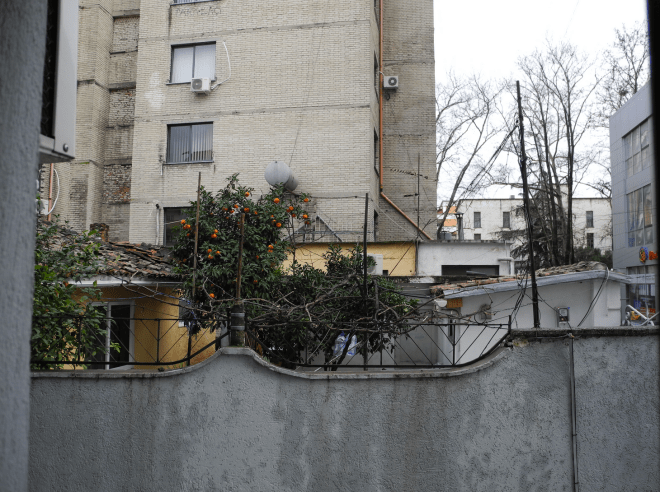
The View From Your Window Contest: Winner #147

by Chris Bodenner

vfyw_3-30

A reader writes:

The leafless trees and an evergreen in the background made me think of a northern climate, but since my guesses are rarely even in the correct hemisphere, I’m going to go out on a limb:  The orange tree, yellow house, and white-washed garden walls point to Athens, Greece.  The red-tile roofs visible in the photo make me think its in the Old Town area of Athens below the Acropolis.

Another reader:

This is my first time guessing a VFYW.  I am not using any investigative tools for this guess; I just have a hunch. The orange tree reminds me of the kind I used to see and pick oranges from walking through Damascus, but the roof shingles on the yellow building and lack of satellite dishes tells me this can’t be an Arab country. However, it does have a Mediterranean feel, just emerging out of winter.  Letters on the building could be Greek? It’s be in the news lately. But let’s go with Cyprus. To be more specific: Limassol, Cyprus.

Another:

The first step was to identify the logo in the lower-right corner. It’s ProCredit, and a quick search online reveals that they only operate in Latin America, Africa, and Eastern Europe. You’d think after cross-referencing the specific countries where they operate with orange-producing countries you could cross off Eastern Europe and Africa, but that’s not quite true. Since ProCredit’s website doesn’t offer an easy way to display all of their locations in any given country, I’m going to stop here and just guess Guadalajara, Mexico, since Mexico is the #1 orange producing country among countries where ProCredit operates.

Another:

Through a combination of Wikipedia and luck, I identified that building on the right as a ProCredit bank within a ten minutes. But it’s 60 degrees and sunny in New York today, so I’m not going to spend much of it indoors trudging through Google Maps. Time for educated guessing:

Given the week’s news, I suspected Cyprus, but ProCredit lists no branches there. The oranges made me think Mediterranean, where it has branches in Albania and many of the former Yugoslav Republic countries. Then again, Cyprus involves Russia, and Georgia is in the Russian sphere, grows wonderful citrus, and has ProCredit banks. So now I’m leaning Georgia. But hang on — the people who live where the picture was taken are clearly concerned with heavy rain: The drainpipes and gutters are prominent and well-tended. So, a tropical country? I’ll say Nicaragua, because Dish-heads seem to travel off the beaten path, although ProCredit also operates in El Salvador, Mexico, Honduras, and Colombia and I think it could just as easily be one of those.

Now I’m going out for some sun.

Another:

I’m going to go with Italy, and I’m going to go with a post-WWII neighborhood of Florence since the orange tree was a symbol of the Medici.

Another:
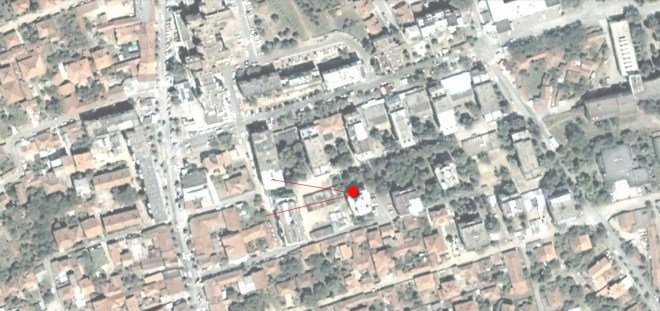
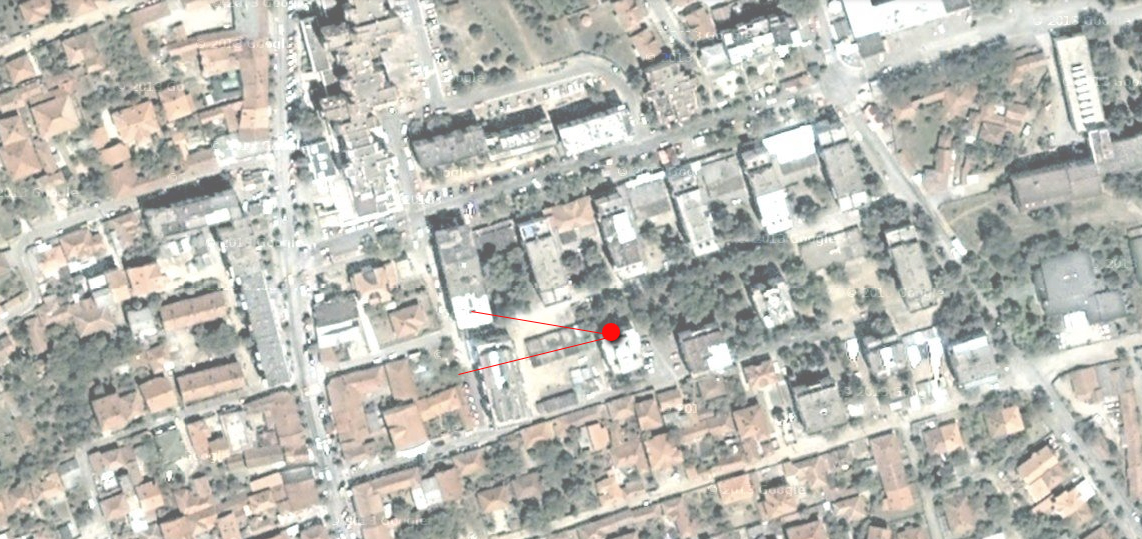
VFYWC033013

The picture this week was pretty difficult to due to the lack of coverage in Serbia of Google Street View, but thankfully the photo has a clear view of a Pro Credit Bank branch, and apparently they are pretty common throughout Serbia.  The photo also offers other clues such as the “aesthetics be damned, we are putting a Mitsubishi a/c unit in this place, and are going to plop the brilliant white condenser outside the window”, a common practice throughout the city of Vranja, where the citizens, like the rest of the country, prefer to grow apricots  on any available area of their back yard to help block out these eyesores.

I doubt I have much of a chance this week, as I am sure somebody’s ex-girlfriend’s cousin happens to be banker’s associate for Pro Credit Bank in Vranja, and has already sent them exact coordinates of the location to send in to The Dish and claim the prize. Nevertheless, if I win, I promise to send in my subscription.

Don’t let a loss stop you! Another reader:

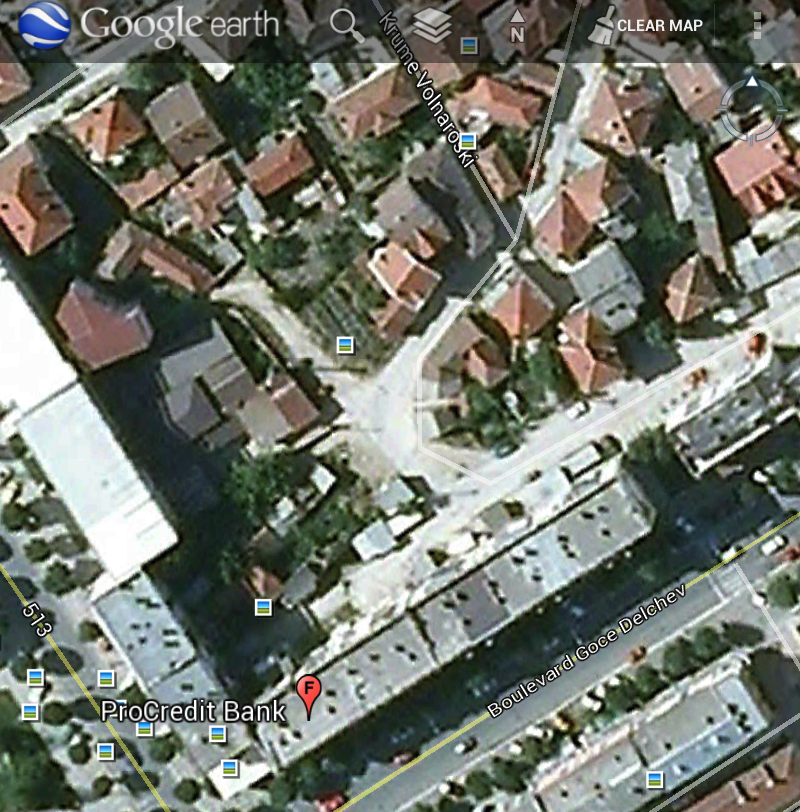
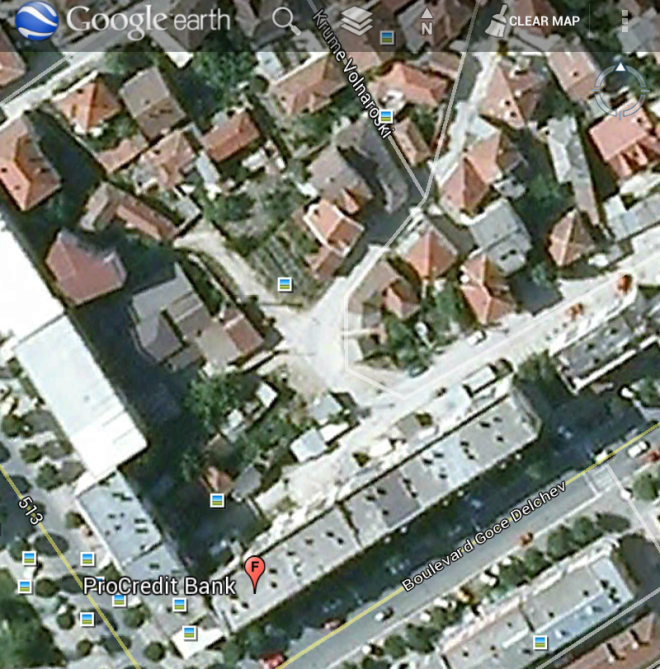
Well, I started in Serbia and ended up in Macedonia. I was able to identify ProCredit Bank on the corner and I figured orange trees grow far enough south in Macedonia that it just might be the place. That’s as far as I can get without some decent software so this is where I have to stop. Prilep, Macedonia:
Screenshot_2013-04-01-18-31-23

Another Eastern European country:

I recognized ProCredit bank instantly from my time spent in Moldova doing development work. Problem is, it’s a huge bank, and branches could be anywhere in the developing world. The combination of the fir tree in the back and the unique roof shingles narrow this location down to Eastern Europe (no major Asian countries have ProCredit banks, and those shingles are only found in a handful of countries outside of Asia). It looks like Romanian graffiti on the top of the white brick building, so we could be in Romania or Moldova (Moldovan is essentially Romanian). I’ll limit my Google Maps search to what I know: Moldova.

It doesn’t look like any of the major branches in Moldova (many of which are located in more urban housing than this). From the satellite, I’m guessing it’s possibly this branch: Ştefan cel Mare şi Sfânt 33, Soroca, Moldova.

Yet another:

You sent me on my first ever VFYW witch hunt, searching for ProCredit banks in Kosovo.  I could probably spend several more hours trying to pinpoint the locations, but I’m not sure I have the time or the energy (although it is kind of fun to see all the streets named after American politicians, like Eliot L. Engel St in Peja!).

Why my sudden VFYW participation?

A couple years ago, you had a picture of Cartagena, Colombia. I swore it looked familiar as I was planning a trip there for my friend’s wedding.  Of course I thought my hunch would have been thousands of miles off.  (During my trip, I actually took a picture of the window it was taken from). Then, a few months later, you had an entry from Mozambique.  This failure to go with my gut cut much deeper.  Not only was my friend the one who had submitted the picture, but I was the one who had advised him to submit something while he was working overseas.  After not entering my guesses those two times, I vowed to pursue any future leads.

Now, here I am with no confidence whatsoever in my guess fully aware that some other Dishhead will have pinpointed the exact home from which the picture was taken.  It kind of looks like it could have been taken from Haxhi Zeka, in Prizren Kosovo, but I really have no idea.

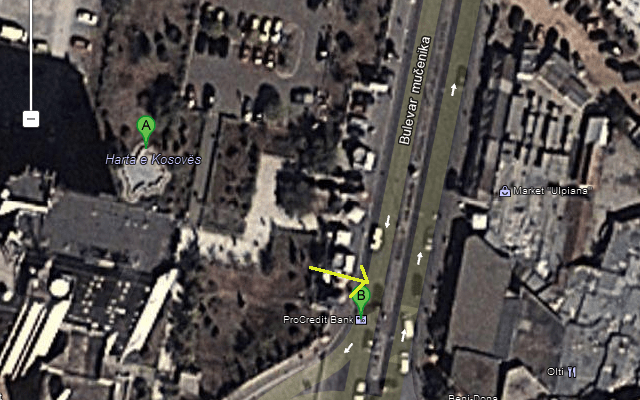
More coincidences from our contest here and here. Another Kosovo guesser:
VFYWLocation

Another gets the right country:

I noticed the graffiti on the apartment wall that says “Para Laci”. This appears to be a reference perhaps to the European football team from Laç, Albania. Laç is near an ancient church that is a destination of pilgrimage dedicated to St. Anthony of Padua. There is a dearth of photos and map details of the town. I can’t say for sure the photo is not from somewhere else such as Tirana, but I am going with Laç.

Another gets closer:

Going on the Laçi graffiti, I’m guessing it’s in Albania. There are two ProCredit Bank locations that Google Maps finds there, and one is next to the Hotel Lisus in Lezhe. So perhaps it’s a first or second story hotel window facing north.

Another nails the right city:

What a frustrating contest this week!  The more of these I do, I notice how we VFYWers have assembled a collective toolbox, and in this regard narrowing down to the country was mostly an beaact of standing on the shoulders of giants.  Those window units point me to eastern Europe and the geographically limiting orange tree pushes me south.  I figured out the commercial bank sign and went to its website to learn the scope of its worldwide footprint.  Grafitti confirms the usage of the Latin alphabet.  Google “Para Laci”, and the wisdow of crowds points you to … Albania, via links about fooball clubs and rappers, amongst others.  Less than an hour to confirm the country, and with the requisite shot of luck we have the city of Tirana, Albania inside another thirty minutes.
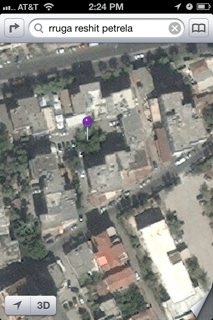
From there the toolbox disintegrates.  We look at every storefront photo of a ProCredit Bank, but none quite fit right.  Albania’s capital has not yet succumbed to the intrusiveness of Street View.  Aerial shots are as inscrutable as I wish my own home were.  But we’ve found that tallish brick building in a photo, we know we have.  But it’s across the street from a different ProCredit branch.  We think perhaps there’s another branch, or possibly an abandoned one across the street, but we can’t get behind the brick building to confirm.  After nailing the neighborhood in 1.5 hours, we spend 3 more trying to find the window.

Then despair – a mile down the road, another similar brick building, adjacent to another ProCredit branch.  It all crumbles.  I still believe in Tirana, but I have no confidence in my specifics.

Another Tirana guesser:

A lot of the aerial views of Albanian towns show red-tiled roofs like the one in the photo. And when you go on ProCredit’s Albanian website – whose webmaster is probably wondering why they’ve been getting so many hits this past weekend – you see a lovely picture of this smiling man in a blue shirt:

ProCredit Albania

This is exactly the same image that you see hanging in the window of the ProCredit bank in the VFYW.

A group effort:

So here’s how my weekend went: I had all these plans to catch up on homework for my master’s program. Then the weekly VFYW contest started on Saturday, and my entire afternoon and night were completely shot. Here’s what I did: my girlfriend, a mutual friend, and I all scoured the photo for any evidence. I was the first to realize that the bank was a ProCredit Bank (I googled “ProC” and saw what came up in the AutoComplete box). Then we went to the bank’s web site and started eliminating countries. My girlfriend noticed that the guy on the advertisement on the window of the bank was the same guy that appeared on ProCredit Albania’s web site, so we had a country match.

Since that time, we spent hours and hours on Google Maps and Street View (turns out, satellite imagery of Albania is not quite what it is in, say, New York). We especially focused on Lac, since graffiti on the building on upper left says “para laçi.” Anyway, the point to all this is: we still don’t know which branch it is. Damn ProCredit and its all-too-convenient branches.

So I’m guessing Tirana. Because it seems like the kind of place that might have both a ProCredit Bank branch AND a backyard orange tree. So there.

Another nails the right building:

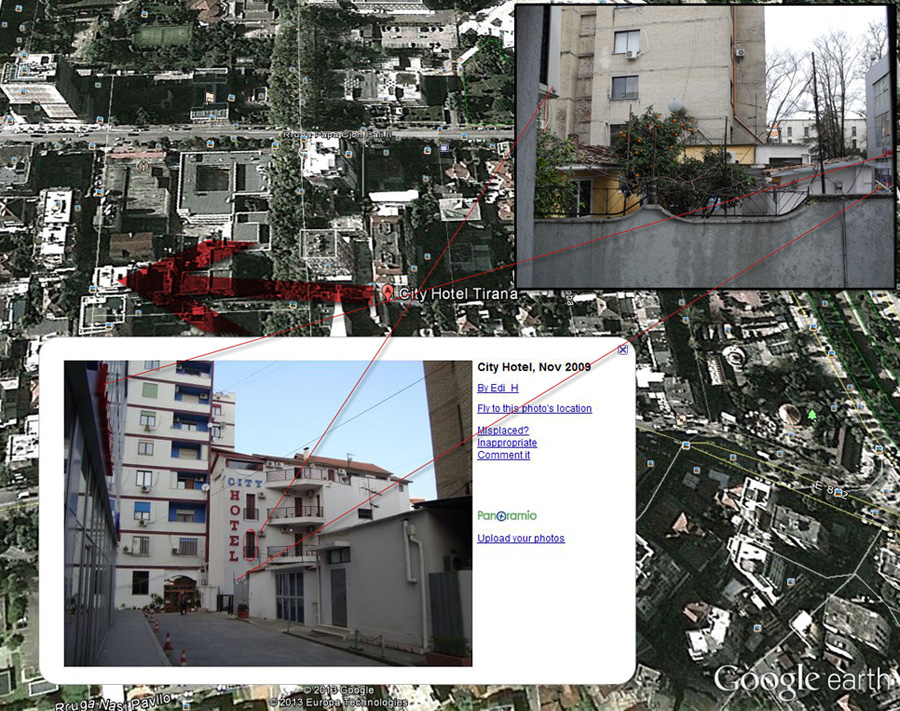
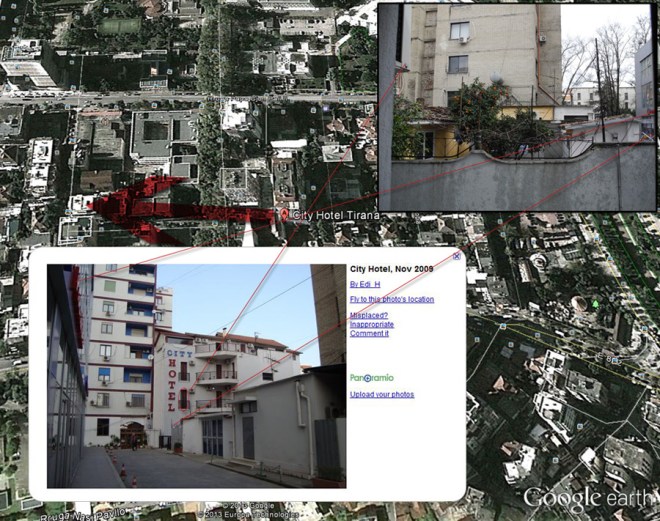
This week’s “View From Your Window” is located in Tirana, Albania. Of this I am 100% positive. I am also about 99.5% sure that this picture has been taken from the City Hotel Tirana on Rruga Ismail Qemali. If I had to be more specific, I’d say it was taken from the second floor window next to the “E L” in “hotel” on the southern side of the building, facing the alley.
VFYW_033013_Screenshot

In the event of multiple correct guesses (as is likely; I’m guessing 50-60 correct hotel-level guesses), this is my fifth correct guess. Previous correct guesses include Queenstown, New Zealand; Sausalito, California; Anchorage, Alaska and Kagoshima, Japan.

The number of correct hotel guessers was actually ten (all of whom will now be on the “Correct Guessers” list, which will give them an edge in future contests). But only one of them has guessed more prior views than the above reader without yet winning.  That reader’s entry:

That persimmon tree initially had me thinking Asia. But the sign for ProCredit Bank – a surprisingly large network of microloan and retail banking establishments through Eastern Europe, Latin America, and Africa – quickly redirected me toward SE Europe.

Let this be said: While there may be more Rodeway Inns and local police stations in North America than ProCredit branches in the Balkans, there are still plenty of the latter. What’s more, they’re represented pretty spottily in Google Maps. Most of Serbia’s and Kosovo’s show up in map view, for instance, but you won’t find any in, say, Bosnia-Herzegovina that way.

I had a good feeling about Albania (Wikipedia singles the country out as a regional leader in persimmon cultivation, for whatever that’s worth), but even on ProCredit’s Albanian website, a lot of the branches had no photos available. Google apparently has no Albanian Street View database, and its grasp of exact addresses there is a little shaky. Thank goodness some kind folks took photos in the vicinity of one of the several Tirana branches, this one on Ismail Qemali St.:

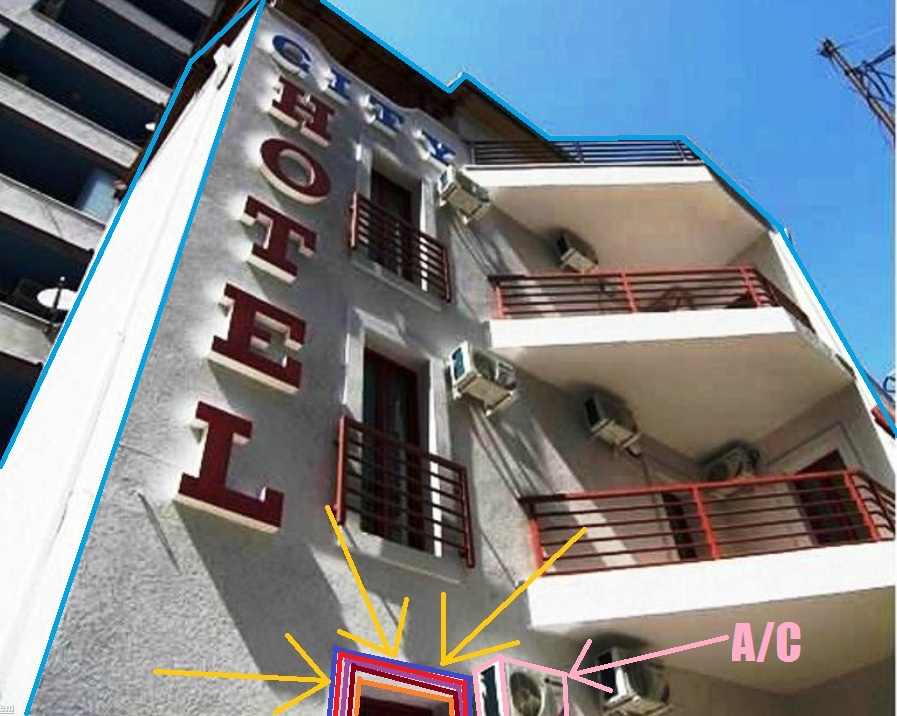
A

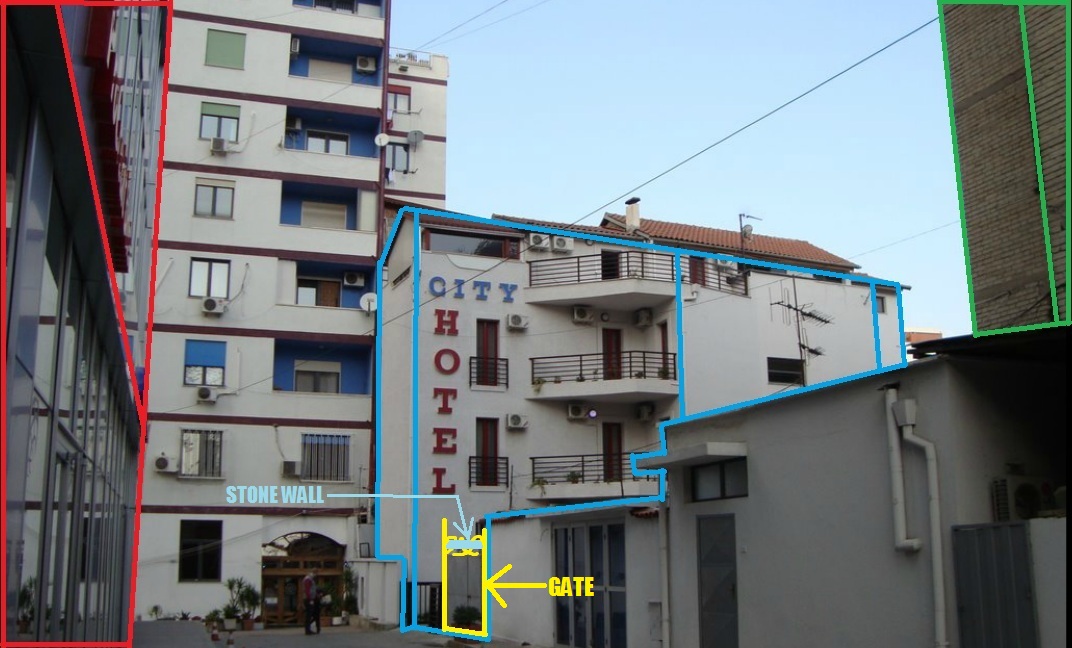
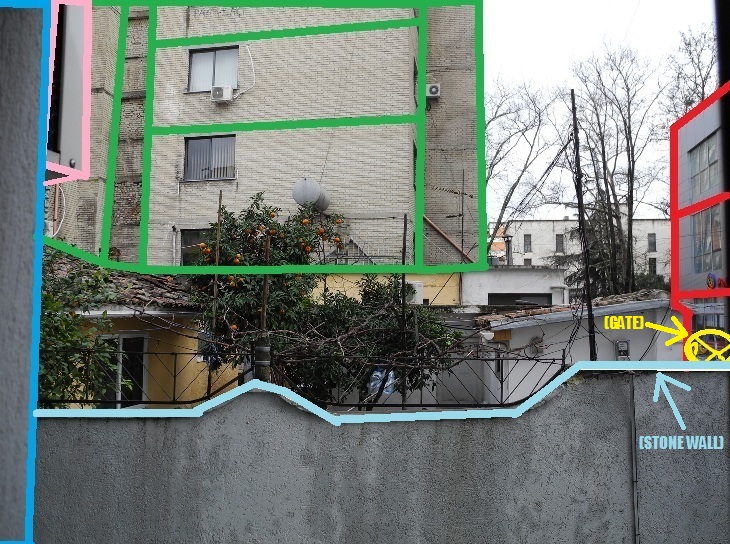
The colored outlines correspond to the same on the original VFYW and the Google map view:
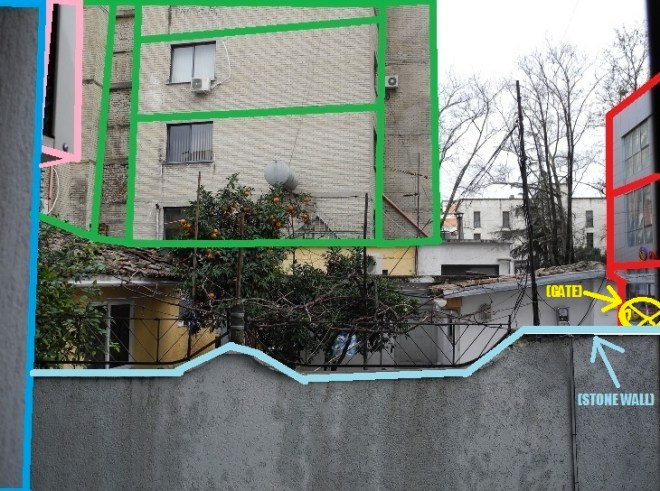
B

The first floor seems the most likely, given the position of the stone wall (light blue) and gate (yellow). And as this image shows, there’s a ventilation unit (in pink!) by the first floor window, southwest corner, matching the one in the original image:

D

From the photo’s owner:

On a recent trip to Albania for work, I stayed an extra few days to check out Tirana and the surrounding areas. I stayed at a small hotel on a side street that was recommended by a friend called City Hotel on Rruga Ismail Qemali, Nr 8/1. It was taken from the first floor, room #2. I quite liked the orange tree in the yard outside my window and thought I’d share it.

Congrats to that colorful reader on the tough win. This was truly one of the most impressive contests yet. I had picked what I thought would be a really tough photo because I knew I would be especially busy this week with Andrew on vacation and I wanted to cut down on the submissions. Silly me: there were close to 150 entries, half of which were of Albania. Readers still continue to amaze me when it comes to this contest, after nearly three years of running it. As one reader puts it:

The VFYW contest is creepy. Seriously.  How can these people – from just ONE random photograph – pinpoint the EXACT location down to the apartment unit it was taken from?!  It’s creepy.

(Archive)

Lessons Not Learned

by Doug Allen

Jackson Diehl defends his interventionist stance on both Iraq and Syria:

Iraq was unquestionably costly and painful to the United States — in dollars, in political comity and, above all, in lives, both of Iraqis and Americans. It hasn’t turned out, so far, as we war supporters hoped. Yet in the absence of U.S. intervention, Syria is looking like it could produce a much worse humanitarian disaster and a far more serious strategic reverse for the United States. … The tragedy of the post-Iraq logic embraced by President Obama is that it has ruled out not just George W. Bush-style invasions but also the more modest intervention used by the Clinton administration to prevent humanitarian catastrophes and protect U.S. interests in the 1990s.

Larison scoffs:

One lesson from Iraq that many war opponents have learned is that the U.S. shouldn’t be waging unnecessary wars that serve no discernible U.S. interest. That isn’t the wrong lesson to learn. It’s one that Diehl simply ignores, which is probably why he never really addresses how it would serve U.S. interests to go to war in Syria.

Another lesson is that forcibly collapsing a regime creates far more instability and chaos than leaving it in place would. There is no likely scenario in which hastening regime collapse would have limited the loss of life and displacement of civilians in Syria. …

Military interventions almost always take longer than expected, and that’s always true for interventions that are sold to the public by emphasizing how low-cost and easy they will be. Take an interventionist’s original estimate for how long a given military action will take, and then multiply it by ten or fifteen and you’ll be closer to the real figure. One of the reasons no one trusts the promises of Iraq war hawks is that they were promising a swift and easy war in 2003, too, and all that many of them can say after an eight-year debacle is that it “hasn’t turned out, so far, as we war supporters hoped.”

Why Not Hillary?

by Patrick Appel

Frum claims that Hillary winning the 2016 nomination will be bad for the Democratic party:

After eight years in the White House, a party requires a self-appraisal and a debate over its way forward. Bill Clinton offered Democrats just such a debate in 1992 with his “New Democrat” ideas. Barack Obama offered another in 2008 with his careful but unmistakable criticism of Clinton-era domestic policies and Hillary Clinton’s Iraq war vote. But if Hillary Clinton glides into the nomination in 2016 on the strength of money, name recognition, and a generalized feeling of “It’s her turn,” then Democrats will forgo this necessary renewal.

Kilgore pushes back:

I’m all for fresh talent and helpful intra-party debates, but I’d say what Democrats probably want and need most is a 2016 victory to consolidate the policy achievements of the Obama administration while perhaps convincing Republicans the vicious obstructionism they’ve been exhibiting since 2009 is a dead end.

Agreed. The Democrats have their differences but the party is more ideologically unified now than it has been in decades and the Democratic coalition is basically sound.

Truthiness Serum, Ctd

by Chris Bodenner

A reader adds a first-hand perspective to a recent post:

I have no idea whether narcoanalysis will be useful as a psycho-diagnostic technique or as a law enforcement or intelligence gathering device, although it does seem less onerous than waterboarding. I do know that it can be very useful to the criminal defense attorney in certain limited instances. In the early part of my career I defended more than 50 homicide cases and found the technique to be very useful in three cases. I was fortunate to have the services of an experienced psychiatrist who had used it in treating what we now call PTSD in WW2 veterans suffering from repressed memories of traumatic events.

My first and most helpful experience was with a man who had undoubtedly shot and killed his wife but could not recall exactly how or why. When pressed to recall the event he could do so up to a point and then would start belching – a rather bizarre response. He was under indictment for second-degree murder under circumstances that suggested an execution-style killing. He had come back from a visit to the factory where he was employed while it was on strike.

The first indication that he was being truthful while undergoing the amytal interview came when he contradicted an earlier account of the reason for his visit to the strike scene. Before the medicated interview he said he had gone there to see how it was going. Under amytal he said he had gone there to try to get on television.

At the crucial point in the interview, for the first time he described how while he was pointing the gun at his wife to try to get her to admit a marital indiscretion, she grabbed the gun and jerked it downward, causing it to discharge. The 15-degree downward angulated entrance wound suggested she might have been on her knees begging for mercy without the revered memory he had suppressed.  I played the recording of the interview for the grand jury, who returned a superseding indictment for manslaughter, based on causing death while in the commission of the unlawful act of threatening her with a gun.

On another occasion I used the technique to gain some confirmation of my client’s claim that although he had gone along on a burglary, it was his partner who suddenly displayed a gun and killed two elderly people. His account of this was accompanied by the emotional response one would expect under these circumstances. He still went to prison for murder, but his partner was sentenced to death.

In another case the client admitted the complicity of another that he had refused to acknowledge even when confronted with evidence that only made sense if another was involved. More that admitting the involvement of another, he identified the person, which he confirmed when confronted with the tape recording.

All these people were of modest intellect. It is accepted that a thoroughgoing sociopath can lie even under  the influence of amytal. Ordinarily, an attorney would not bother to use the technique with that kind of defendant.

The above video is a scene from John Huston’s Let There Be Light, a 1946 documentary about the experimental treatment program for traumatized WWII veterans that employed hypnosis and sodium amytal. From the film’s Wiki page:

The film, commissioned by the United States Army Signal Corps, was the final entry in a John Huston trilogy of films produced at the request of the U.S. Government. This documentary film follows 75 U.S. soldiers who have sustained debilitating emotional trauma and depression. … The film was controversial in its portrayal of shell-shocked soldiers from the war. “Twenty percent of our army casualties”, the narrator says, “suffered psychoneurotic symptoms: a sense of impending disaster, hopelessness, fear, and isolation.” Apparently due to the potentially demoralizing effects the film might have on recruitment, it was subsequently banned by the Army after its production, although some pirated copies had been made.

Containing The Congo

by Brendan James

The UN is putting some teeth on its peacekeeping mission in the DRC, authorizing a 3,000-strong “intervention brigade” to put down militia violence in the eastern part of the country. David Bosco reminds us that the last attempt to do so turned ugly, fast:

In 2006, a group of Guatemalan special forces soldiers assigned to the peacekeeping mission attempted to hunt down units of the Lord’s Resistance Army operating in Congo’s Garamba National Park. The operation turned into a disaster. Several U.N. soldiers were killed (likely by friendly fire), and the LRA forces escaped. In early 2009, U.N. forces began actively supporting the offensive operations of the Congolese armed forces. But that collaboration was dialed back as criticism of Congolese army tactics mounted.

He argues these missions are almost always hobbled by inadequate forces sent with ambitious goals:

Part of the problem with offensive U.N. operations is that the training and resources of the forces doing the fighting often doesn’t match the mandate. It’s one thing for the Security Council to authorize offensive operations from New York; it’s quite another thing for peacekeeping commanders to manage them successfully on the ground. During the U.N.’s Bosnia operation in the 1990s, that gap between the Council’s proclamations and the actual work of peacekeepers grew to tragic proportions.

On Holiday With Hyperinflation

By Zoe Pollock

Graeme Wood ventured out to the Iranian resort island of Kish to understand the effect of American sanctions on Iran’s economy:

The Iranian rial trades semi-openly, and as this magazine went to press, its value was hovering under 40,000 to one U.S. dollar, weaker by nearly half compared with six months earlier. Authorities tried to ban currency trading for a few weeks in October, when the inflation rate peaked, but they failed. Finally they just asked money changers not to advertise the depressing new rates in their windows.

Wood’s First Rule of Budget Travel applies here: where there is runaway inflation, there are great deals for travelers with hard cash. … The first sign of rising prices was the hotel rate card. I had agreed over the phone to pay 370 dirhams, or about $100, for a night at a five-star hotel, including breakfast and lunch. (I had originally been told that the hotel had no vacancies, but when I asked again in English, with the implication of payment in foreign currency, a room materialized.) The rates for Iranians were quoted in Iranian rials, and to me—I had not been in Iran in more than three years—they looked not high but simply wrong. A zero in Persian writing is represented by a dot, and here I saw dots leading far off to the right, as if someone had left an ellipsis on the rate card instead of the full price. The Iranian price was 1.8 million rials.

Max Fisher has mixed feelings about taking a hyperinflation vacation:

Imagine the money in your wallet suddenly increasing value by a factor of four and a half — your nightly hotel budget rising from $70 to the equivalent of $340 — and you can see the appeal of a hyperinflation vacation.

Still, it feels a little weird to profit off of someone else’s pain. In this case, that someone is the entire Iranian middle and lower class. (Something Wood is very aware of and discusses with great care in his article.) The Post’s Jason Rezaian has reported from Tehran on the pain that ordinary Iranians feel from inflation, with everything from food to medicine becoming tougher to afford. And Wood points out that wealthy Iranians — those more likely to be affiliated with the regime, and thus desired targets of the economic sanctions driving so much of the inflation — are actually able to profit off of the inflation, for example with well-timed imports or by taking out the fixed-interest loans available only to those with political connections.

(Chart of the official Iranian rial-U.S. dollar exchange rate and the black market rates diverging by Steve H. Hanke of CATO)

The Politics Of Immigration Reform

by Patrick Appel

Ezra examines them:

Elections really are zero-sum affairs. For one party to win, the other has to lose. … Immigration reform, however, sits at the center of an unusual convergence of forces that have made it positive-sum politics. Democrats believe in the policy, but they also believe that it’s good — even essential — politics to deliver on the number-one priority of the growing Hispanic electorate. Many Republicans also believe in the policy, and almost all Republicans believe that if their party is to prosper, they need to agree to immigration reform to show Hispanic voters that the GOP isn’t hostile to their interests.

Josh Marshall Brian Beutler argues that either Republicans or Democrats must be wrong:

A majority of new citizens will either be Democrats or Republicans. To the extent that the new GOP position on immigration reform changes existing voters’ minds about politics, only one of two parties will be on the winning side of that realignment. Some important Republican strategists and opinion makers recognize this, and worry the GOP has picked a loser.

Donald Trump, of all people, makes related points. How Brian Beutler sees the issue:

[T]he math looks very different in the near term than in the medium and long term. When President Obama won in November, immigration reform was destined to be on the national agenda this year. And though killing it might make sense for the GOP’s longer-term viability, for the immediate purposes of making gains in 2014 and securing the White House in 2016, it would be a grave error — particularly because Republicans haven’t responded to Democratic gains by offering up anything else that might appeal to Democratic voters. Supporting immigration reform isn’t exactly a sign of Republican panic, but that they think it’s their least bad course of action right now.