Cannabis Lite, Ctd

A reader counters a previous one:

“Unlike alcohol, where the proof is written on the bottle and assured by regulators, you can only gauge THC levels through trial-and-error or your dealer’s sales patter.” That’s another artifact of prohibition.  I work for an edibles company here in Colorado, we’ve developed a method of adding very precise amounts of active THC in food that’s already been prepared. Our big sellers are bags of 25 candies that each have just ten milligrams of THC in them.  An equivalent to e-cigarettes have also become popular among patients, which you can use to take very tiny puffs of vapor until you feel medicated enough and even the potency of the extract you vaporize can be controlled to some degree.  Both my company (as well as all edibles manufacturers) and companies filling cartridges for vapor pens are byproducts of a thriving and regulated cannabis industry; neither is practical for the black market and neither can be done at home.  Another byproduct of an industry is that there are a couple labs where I think anybody can take a sample of something to be tested for cannabinoid content.

Your reader is also incorrect in his supposition about the potency of black market pot.

It’s actually quite hard, and quite expensive to produce marijuana with much about 16% THC; 12% or 13% would be more likely for street weed, you might get as much as 8% in Mexican brickweed.  It’s impossible to go above that in an outdoor grow, and indoors getting a plant to its full potential potency requires growing them inches from thousand watt floodlights but not letting them get above 75 degrees with the lights on.  Not only does the expense produce diminishing returns but the air conditioning is incredibly conspicuous.

Further, the strains that can produce high potency tend to have much lower per-plant yields and black market growers grow for yield above all else.  Breeding really has increased potential potency but high-end growing/breeding like that and black market growing are two very different worlds that don’t actually intersect much.  The only major overall increase in the potency of black market marijuana happened when sinsemilla – growing only unpollinated female plants so they spend their energy creating THC-laden resin rather than seeds – became the standard, and that happened in the ’70s. Everything about increased potency on the street since then has been pure propaganda.

Update from a reader:

I thought the reader was not actually contradicting either of the points in the previous post (lack of dosage information and increased potency of weed since the 1970s are artifacts of prohibition), but he too casually dismisses as “propaganda” the notion that black market pot has increased in purity.

It’s common knowledge that cannabis quality and availability has increased steadily since the 1970s. The reader confuses the THC content of the plant with the purity of the product. In 1993, a New Yorker buying weed in Washington Square Park was likely to get a few grams of junk, seeds, and stems mixed in with his baggie. Today, black market product in the city is sold by reputable delivery services who compete to provide quality and variety. Whether this is a result of increased crop yields or increased THC content in the cannabis plant is immaterial: you will get a much larger dose of THC from a gram of 2013 delivery weed than from the same gram purchased on the street 20 years ago. A similar – and much more dangerous – phenomenon has occurred with harder drugs like heroin, where overdoses can lead to death.

The View From Your Window Contest: Winner #146

Screen Shot 2013-03-23 at 4.11.37 AM

As all of you contest fanatics noticed, we didn’t post the results yesterday at the normally scheduled time, due to the nonstop coverage of the SCOTUS hearings. But wait no longer:

I thought this one was going to be easy – just match up the design on the police cars and voila! After plumbing the endless world of local patrol car detailing, I still got nothin’. Champion, who manufactured the window through which the photo was taken, apparently distibutes only within the US, east of the Mississippi. Based on the landscape, my heart cries mid-Atlantic states. It’s a sizable river, so let’s say it’s the Susquehanna. It’s a small town, so let’s say, at random, Nescopek, PA.

Another reader:

I know I am probably thousands of miles off, but this looks like Atchison, Kansas, birthplace of Amelia Earhart. Atchison sits on the banks of the Missouri River.  The police cars look familiar, the last remnants of shoveled snow from a recent snow storm remain and, well, it just looks like the place I am desperately trying to recall from memory.  I figured why not guess?

Another:

First time I can at least muster even a half-assed guess. As an Omahan, I think it looks like a shot from somewhere along the Nebraska side of the Missouri River.  Looks like a beautiful gloaming on the Loess Hills of Western Iowa.  Unfortunately, a quick Google Earth trip up the Muddy Mo revealed no such location.  On the bright side, following that great river from satellite photos is fascinating. The Flood of 2011 is evident and, despite its destruction, eerily beautiful.  A hybrid view that includes state lines seems to indicate that some land may have changed hands too! (Though, I suppose these maps are only somewhat accurate.)  At any rate, reading VFYW guesses on Tuesdays is something I always look forward to. I am happy to experience a VFYW from the Saturday end of things for once!

Another:

I think it is a view from the top level of the Livermore Falls, Maine town hall. Either the main lobby or one of offices behind the service counter. I’ve done some business there. The Androscoggin river is in the background.

Another:

Oh the hours I’ve spent Google-map-riverboating down every river in North America. Started up-river from Pittsburgh, headed all the way down the Ohio, then switched over to the Hudson, and then went over to the upper Mississippi … you get the idea. I sure hope someone was able to see the lettering on one of the two cop cars. And they say March Madness wastes valuable work time!

My guess: Second floor room of the No-Tell Motel, facing south, overlooking the Oil City Police Department impound lot, next to the mighty Allegheny River. Wrong, but I have to submit SOMEthing after all those hours!

Another:

This looks like Southeastern Ohio to me and given recent news, I would guess Steubenville. I would look for the exact location, perhaps the Juvenile Court Building, but I have to get my teams ready for the collegiate National Debate Tournament next week. It is sort of like March Madness, but for the cool kids.

Another gets on the right track:

First-timer here. Would do more research but I’m leaving tomorrow on a trip. That is absolutely a picture of the east side of the Hudson, probably somewhere in Westchester County. I’m going to guess it’s Tarrytown, and that the building near the water tower might be part of the abandoned GM plant there. If you were to stand near the police car, you would probably see train tracks – the Hudson Line of Metro-North – running along the river. The amount of snow also maps with what’s been going on in the area lately. It’s the remnants of the snowstorm we had on March 19.

Another:

I’m pretty sure the window is on the western side of the Hudson River. So I will go with Highland Falls, NY, outside of West Point.

Another nearly gets it:

This strongly resembles the Palisades, as seen from the NY side, just north of NYC. The police car’s logo is identical to the ones in my village, across the river. I will take a guess and say it’s Yonkers, since that is where the Palisades are highest – though it could also be Dobbs Ferry or Hastings on Hudson.

Another nails it:

As someone who lived in NYC for 12 years, I instantly recognized the Hudson River and the Jersey cliffs beyond, so I just scrolled up the Hudson until I saw the unmistakable slanted roofs of the factory sitting right on the shore of Hastings-on-Hudson. And while it is fun trying to investigate a VFYW photo clue by clue, scouring Google Maps for hours, I have to admit a certain thrill when you look at a photo (here, of a place I haven’t even visited) and just feel in your gut you know where it is:

Screen Shot 2013-03-23 at 9.17.15 AM

Makes me miss New York.

Another:

I know exactly where this is.  The town on the east bank of the Hudson where this must be from is Hastings-On-Hudson. Every time I go hiking upstate, I take the Metro-North Hudson Line from Grand Central. In the last year noticed the remnants of a rock slide on the New Jersey side of the Pallisades, which is described in this article.

Another points to a local news report of the slide on YouTube. Another sends the photo seen to the right. Another writes:

vfyw 23-mar-2013 picture 2Sometimes you get lucky. On Monday, I took a very scenic train trip along the east bank of the Hudson River from Rhinecliff, NY into New York City. I was looking out the window when I saw the most distinctive feature of this VFYW: the recent scar of a rock slide along the Hudson Palisades. After recognizing that, the rest was easy.

By the way, I would like to share just one fact that my mother told me about the Hudson Palisades: It’s a fjord. How cool is that?

More than 150 readers correctly answered Hastings-on-Hudson, but only three of them have gotten difficult views in the past without yet winning. The most accurate entry of those three is the following:

hastings_on_hudson1I’ve spent hours on previous windows without making any progress, and so it was with great satisfaction that I recognized this week’s view the moment I saw it!  I live in California these days, but I grew up in New York, and it’s hard to forget the Palisades.  That light-colored streak in the cliff marks the site of a major rockfall in May of 2012.  The fall liberated roughly 10,000 tons of rock from the cliff, the largest such event in at least the last 25 years.

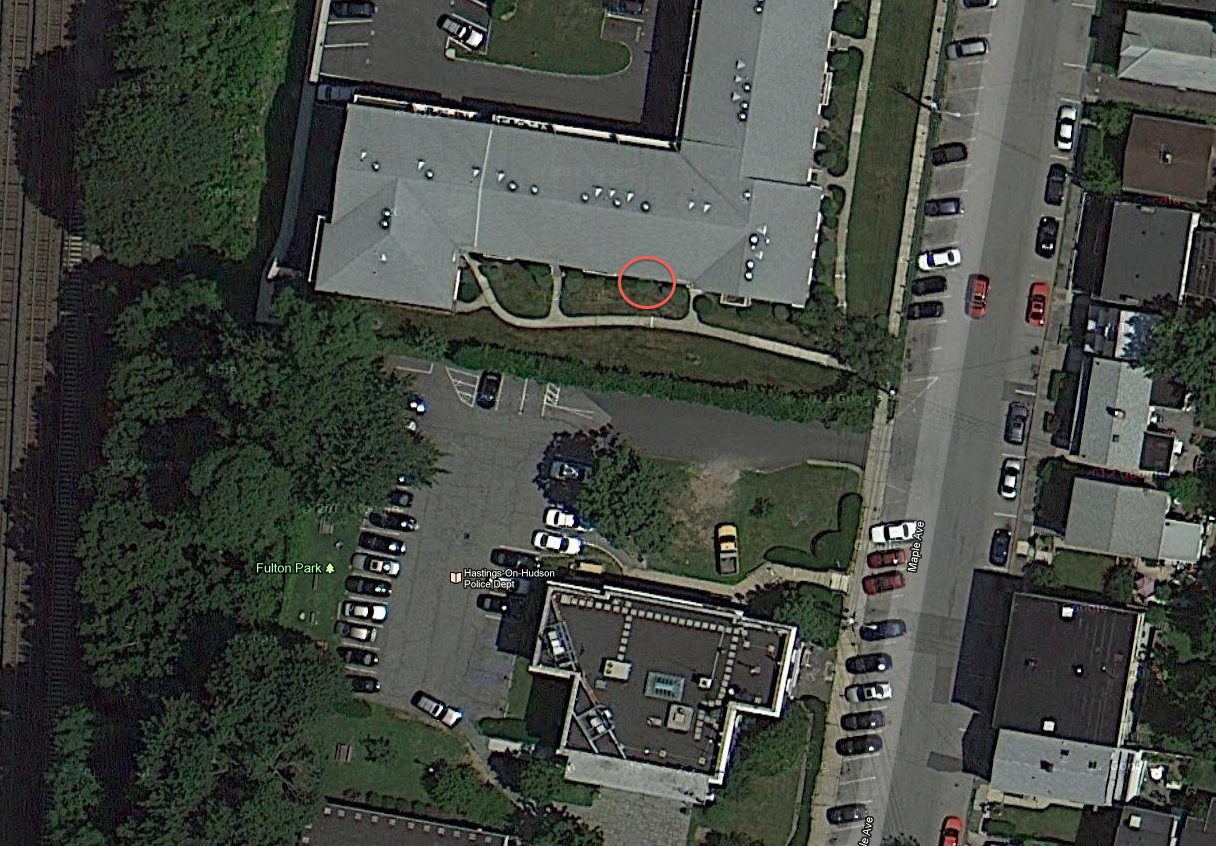
On to the actual window.  The photograph was taken from the third floor (also the top floor) of the River Edge Apartments, looking south west across the Hudson River.  I’ve attached an aerial view of the apartment complex and circled the correct window in red, but it’s partially obscured by the overhang of the roof and some tree hastings_on_hudson2branches.  Sorry, best I could do.  I’ve also attached a street level view of the south-facing side of the building, but the correct window is again largely obscured, this time by the fire escape.  The correct window is visible looking through the bars of the fire escape.  I’ve done my best to circle it in red.

This marks my sixth correct entry in seven weeks.  I’m sure you’ll have many correct entries from New Yorkers (and beyond) this week, but hopefully I’m moving up in the tie-breaker rankings!

And into the winner’s circle. From the submitter, for the record:

3rd floor of the building.  I’m a Hastings resident.  By the way, the Hastings farmer’s market moves back outside to the parking lot shown in my photo on April 13!

(Archive)

Does This Photo Make You Faint?

Bleeding_finger

Then you’re definitely a blood phobic. As a former one himself, John Sanford was curious about the physical response associated with the fear:

Observing blood seep from a wound, flow into a syringe or spatter on the ground, blood phobics initially will respond like other phobics — that is, their heart rate and blood pressure will increase. But then something else will happen: Their heart rate and blood pressure will suddenly drop, causing dizziness, sweatiness, tunnel vision, nausea, fainting or some combination of these symptoms. … why would the sight of blood, or for that matter the sight of being stuck by a hypodermic needle, trigger a physiological response that is so different — practically diametric — to that of other phobias? This is the mystery.

Rachel Nuwer examines some possible reasons:

Some say that fainting at the sight of blood may be the human equivalent of playing opossum—pretending to be dead so that a dangerous predator will lose interest. Others think that the physiological reaction some experience at the sight of blood may be an evolutionary adaptation. If a caveman got stabbed in the foot while out on a hunting trip, Sanford explains, he may have a better chance of surviving if his blood pressure drops, helping him to avoid bleeding to death. … So besides being useful for dramatic effect in the movies, it seems blood phobia—perhaps like the appendix or wisdom teeth—is an evolutionary throwback that has largely outlived its usefulness.

(Photo from Wikimedia Commons)

Another Hacker Hounded By The Feds, Ctd

A reader writes:

The analogy made by your software developer reader is misleading. The vulnerability is not like forgetting to lock your door, allowing someone to rummage around in your house. It’s like having a household policy that anyone who calls you on the phone, and asks for a specific family member’s email address, can have it. You don’t publicize the number, but millions of people have the number in their phones. So Auernheimer’s friend called the number millions of times, guessing at family names, and gave Auernheimer the resulting emails, which he then publicized. If you use a database to look up the emails when someone calls, is the caller illegally “accessing” (much less “hacking”) your database? Should someone who publicized those emails go to jail for several years?

Another:

Your reader misses the point about the nature of the data. This was not AT&T’s data; it was the data of their customers. Companies have an extra responsibility when it comes to data of their customers. They should be held liable for loosing that data, just as your insurance company will not pay out when you leave your door unlocked. Experience also shows that companies like AT&T would have done shit if Auernheimer had politely pointed out the security leak. Naming and shaming is the only way that works. He provided a public service – for free – and got jailed for it. Meanwhile, AT&T has not been held accountable for its lack of care of its customer’s data. Is that right?

Another:

Your reader’s analogy to “locking your house” is ridiculous, as most analogies between digital and physical spheres are.

AT&T didn’t forget to lock the door; they publicly posted the emails in a way that anyone could access them, and that anyone with computer know-how could copy them all.  There were no passwords or other security that would prevent someone unauthorized from accessing the email addresses.  Nothing was hacked.  Weev accessed ill-designed public websites in a way that AT&T didn’t like.  Think the opening scenes from The Social Network, only Zuckerberg is going to jail for several years and we never get Facebook.

The ability of the government to turn anything that a website owner doesn’t like into a felony is a problem with the computer crime laws, not a fun feature.  Beyond whether what Weev did in this case was right, the government shouldn’t be able to turn accessing public information or any misuse of a website into a crime, as it just opens up a whole can of worms criminalizing ordinary conduct.  Giving a site a fake email address?  Jumping on another computer so you don’t have to worry about your “read more” limit?  All potential felonies under an expansive view of the CFAA.  If this is a crime, it’s an example of why we need to reform the CFAA, and so far the government has moved in the opposite direction.

For more on the case and the technical/legal details look at this post by Orin Kerr, a computer crime expert representing him on appeal pro bono.  There are lots of other serious issues with the government’s theories, including a fun way of interpreting the law to make every CFAA violation a felony, despite Congress explicitly including a distinction between misdemeanor and felony violations.

“Standing”

The best legal summary for the argument that the opponents of Proposition 8 have no standing in federal court to reverse the state court’s ruling is here – Walter Dellinger’s (pdf). A reader chimes in:

As a proud, native Californian, I’ve thought a lot about the standing question (nerdy as that is). And I think your inclination on standing misses the key point: Politics.

You say, “But if a state’s elected leadership refuses to intervene to defend a popular initiative, doesn’t that make a mockery of the entire system?”

No, it doesn’t. The elected leadership are all political actors, and make political calculations, pretty much for a living. The decisions not to defend Prop. 8 were not made casually, and each one was made knowing that that politician would be subject to future elections.

I can’t see how that’s not an incredibly important fact. “The entire system” includes the proponents and the voters, and the politicians who represent all of the people. If the politicians make a decision that is widely rejected, they run a risk of not being reelected, a risk that gets higher as the rejection of their position increases.

Our governor and attorney general, and others, made their decisions not to defend Prop. 8, and if they are wrong about that, they have put their own jobs on the line. That, too, is the system. I think they made, not only the right decision based on the principle of equal protection, but as a matter of their own political survival. But no matter what, they are accountable.

So if the court rules that this particular set of citizens doesn’t have standing to defend Prop. 8 (in federal court only, remember — they had full standing to challenge it in our state courts, and did so), it’s not as if they are without remedy. Yes, it would involve extra effort to get those damn politicians out of office, but that is the same remedy we all have, all the time. And, in California, in addition to the initiative, we also have the recall, specifically to get rid of politicians prior to the next election, if that’s what we want. We got rid of a governor that way not so long ago.

Who Won The Argument?

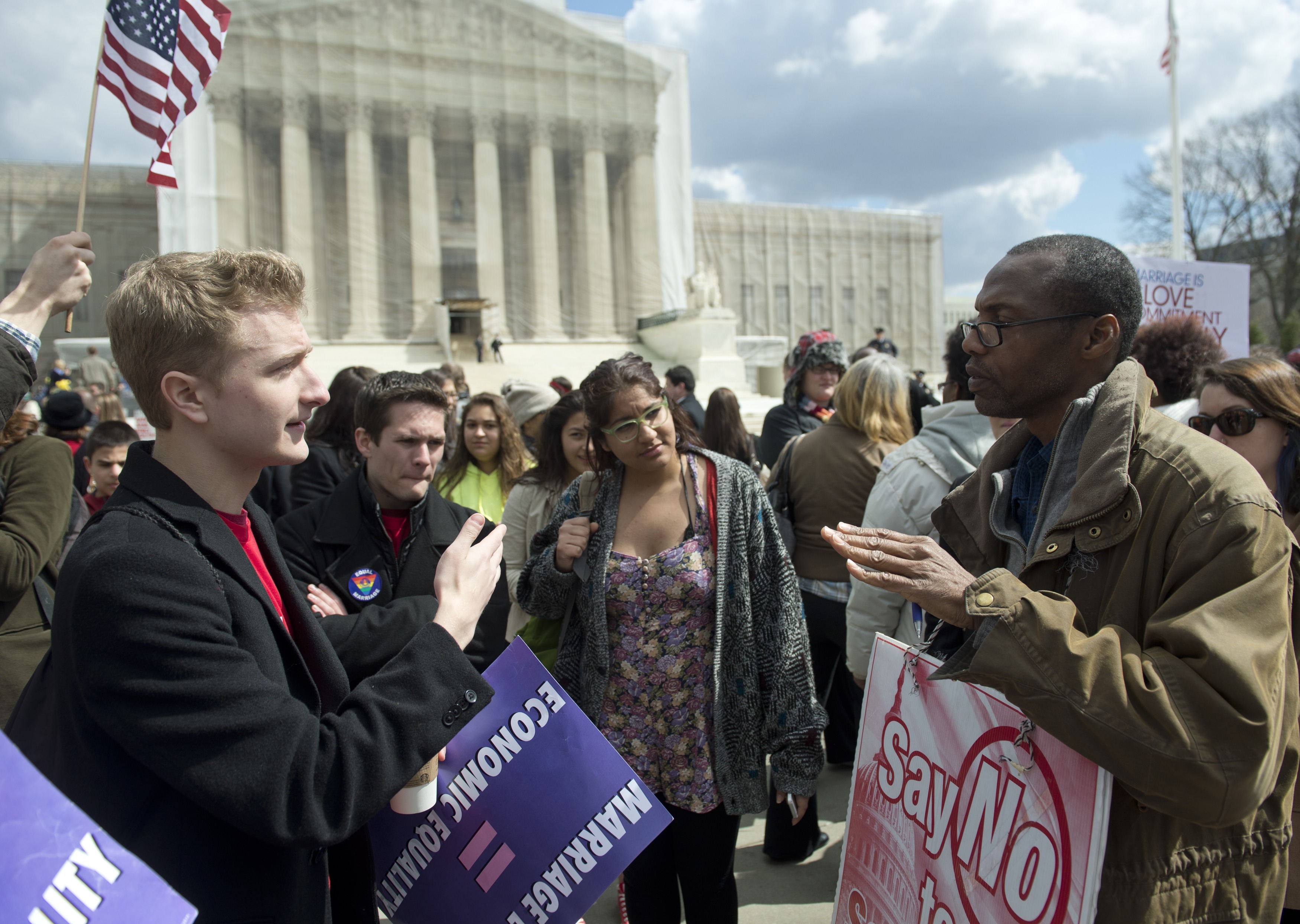
US-JUSTICE-GAY-MARRIAGE

As we know, it’s foolish to predict a decision based on oral arguments (pdf). So I won’t. But since I’ve been arguing this question most of my adult life, I figured it would make sense to see who I think got the better of the case. Some of the issues are beyond my skill-set: I’m not qualified to answer on the somewhat esoteric issue of standing – except that it is clearly at issue here and may give a deadlocked court a way out.

This exchange was the most clarifying on that matter:

JUSTICE SOTOMAYOR: — Justice Scalia proffered the question of the Attorney General. The Attorney General has no personal interest.

MR. COOPER: True.

JUSTICE SOTOMAYOR: He has a fiduciary obligation.

But no such obligation exists for the five (now four) individuals claiming to be harmed by the striking down of Proposition 8. Here is how Olson responded to that argument:

TED OLSON: What is missing here, because you’re not an officer of the State of California, you don’t have a fiduciary duty to the State of California, you’re not bound by the ethical standards of an officer of the State of California to represent the State of California, you could have conflicts of interest. And as I said, you’d be — could be incurring enormous legal fees on behalf of the State when the State hasn’t decided to go that route.

But if a state’s elected leadership refuses to intervene to defend a popular initiative, doesn’t that make a mockery of the entire system? Solicitor General Verrilli gave this response:

VERILLI: We do think that with respect to standing, that at this point with the initiative process over, that Petitioners really have what is more in the nature of a generalized grievance and because they’re not an agent of the State of California or don’t have any other official tie to the State that would — would result in any official control of their litigation, that the better conclusion is that there’s not Article III standing here.

I found myself oddly persuaded that there is standing here, simply because if there isn’t, I don’t see how any initiative would matter if the executive branch simply refused to defend it if it were subsequently struck down. It seems an affront to democracy not to defend a popularly successful initiative. But that is obviously not a legal argument – just an intuitive inference from the to-and-fro.

Next up, the core argument of those defending Proposition 8 remains … yes, procreation. Here’s the part of the argument I thought came closest to the nub of it:

JUSTICE BREYER: What precisely is the way in which allowing gay couples to marry would interfere with the vision of marriage as procreation of children that allowing sterile couples of different sexes to marry would not? I mean, there are lots of people who get married who can’t have children …

JUSTICE KAGAN: Well, suppose a State said, Mr. Cooper, suppose a State said that, because we think that the focus of marriage really should be on procreation, we are not going to give marriage licenses anymore to any couple where both people are over the age of 55. Would that be constitutional?

MR. COOPER: No, Your Honor, it would not be constitutional.

JUSTICE KAGAN: Because that’s the same State interest, I would think, you know. If you are over the age of 55, you don’t help us serve the Government’s interest in regulating procreation through marriage. So why is that different?

MR. COOPER: Your Honor, even with respect to couples over the age of 55, it is very rare that both couples — both parties to the couple are infertile, and the traditional -­ (Laughter.)

JUSTICE KAGAN: No, really, because if the couple — I can just assure you, if both the woman and the man are over the age of 55, there are not a lot of children coming out of that marriage…

I’d say that Cooper was destroyed in that exchange. So he tries a different tack:

MR. COOPER: It’s designed, Your Honor, to make it less likely that either party to that — to that marriage will engage in irresponsible procreative conduct outside of that marriage. Outside of that marriage. That’s the marital — that’s the marital norm.

The procreation argument then becomes an argument that civil marriage should be restricted to heterosexuals because only heterosexuals can commit adultery and thereby create children. So monogamy is more important to them than to homosexuals, and sexual monogamy is the core definition of civil marriage. This argument might have made sense before contraception, but it’s a pretty thin reed thereafter. You can see how the pill changed everything. It made adultery much safer. It made marriage non-procreative, if that’s what the couple wanted. Again, the case collapses.

We then arrive at the question of how including gay couples in civil marriage would harm the institution as a whole:

JUSTICE KAGAN: What harm you see happening and when and how and — what — what harm to the institution of marriage or to opposite-sex couples, how does this cause and effect work?

MR. COOPER: Once again, I — I would reiterate that we don’t believe that’s the correct legal
question before the Court, and that the correct question is whether or not redefining marriage to include same-sex couples would advance the interests of marriage as a -­

JUSTICE KENNEDY: Well, then are — are you conceding the point that there is no harm or denigration to traditional opposite-sex marriage couples? So you’re conceding that….

MR COOPER: No, your Honor, no. I’m not conceding that … Consider the California voter, in 2008, in the ballot booth, with the question before her whether or not this age-old bedrock social institution should be fundamentally redefined, and knowing that there’s no way that she or anyone else could possibly know what the long-term implications of — of profound redefinition of a bedrock social institution would be.

That is reason enough, Your Honor, that would hardly be irrational for that voter to say, I believe that this experiment, which is now only fairly four years old, even in Massachusetts, the oldest State that is conducting it, to say, I think it better for California to hit the pause button and await additional information from the jurisdictions where this experiment is still maturing…

The point I am trying to make, and it is the Respondents’ responsibility to prove, under rational
basis review, not only that — that there clearly will be no harm, but that it’s beyond debate that there will be no harm.

I would simply notice the slipperiness of Cooper’s point. He goes from arguing that allowing gay couples to marry would harm the institution – but because he cannot really find an argument for that, he ups the ante. He doesn’t have to prove a positive; his opponents have to prove a negative “beyond debate.” That’s simply impossible. What is reasonable, it seems to me, is to argue that given the relatively new nature of this institution, some patience may be prudent – but may also be directly harmful. Here the common sense of one Justice sticks out like a new crocus budding in the earth:

JUSTICE KENNEDY: We have five years of information to weigh against 2,000 years of history or more. On the other hand, there is an immediate legal injury or legal — what could be a legal injury, and that’s the voice of these children. There are some 40,000 children in California, according to the Red Brief, that live with same-sex parents, and they want their parents to have full recognition and full status. The voice of those children is important in this case, don’t you think?

Maybe Kennedy is more concerned about the status of the children – and their stigmatization by being denied the stability of married parents – than the rights of the adults. It was an interesting digression. Then we arrive at the Scalia view that we shouldn’t be talking about this at all, because the Founders didn’t:

JUSTICE SCALIA: You — you’ve led me right into a question I was going to ask. The California Supreme Court decides what the law is. That’s what we decide, right? We don’t prescribe law for the future. We — we decide what the law is. I’m curious, when -­ when did — when did it become unconstitutional to exclude homosexual couples from marriage? 1791? 1868, when the Fourteenth Amendment was adopted? Sometimes — some time after Baker, where we said it didn’t even raise a substantial Federal question? When — when — when did the law become this?

MR. OLSON: When — may I answer this in the form of a rhetorical question? When did it become unconstitutional to prohibit interracial marriages? When did it become unconstitutional to assign children to separate schools.

JUSTICE SCALIA: It’s an easy question, I think, for that one. At — at the time that the Equal Protection Clause was adopted. That’s absolutely true. But don’t give me a question to my question. (Laughter.)

JUSTICE SCALIA: When do you think it became unconstitutional? Has it always been unconstitutional?

MR. OLSON: When the — when the California Supreme Court faced the decision, which it had never faced before, is — does excluding gay and lesbian citizens, who are a class based upon their status as homosexuals — is it — is it constitutional –

JUSTICE SCALIA: Okay. So I want to know how long it has been unconstitutional in those -­

MR. OLSON: I don’t — when — it seems to me, Justice Scalia, that -­

JUSTICE SCALIA: It seems to me you ought to be able to tell me when. Otherwise, I don’t know how to decide the case.

MR. OLSON: I — I submit you’ve never required that before. When you decided that — that individuals — after having decided that separate but equal schools were permissible, a decision by this Court, when you decided that that was unconstitutional, when did that become unconstitutional?

JUSTICE SCALIA: 50 years ago, it was okay?

MR. OLSON: I — I can’t answer that question, and I don’t think this Court has ever phrased the question in that way.

JUSTICE SCALIA: I can’t either. That’s the problem. That’s exactly the problem.

But the answer is surely that these forms of discrimination became unconstitutional once the collective consciousness of Americans recognized that the discrimination was unjust – and sometimes before. When Loving vs Virginia was decided, there was far more popular support for maintaining anti-miscegenation laws than there is now from keeping gays out of legal marriage. And once you’ve opened up equal protection beyond race, your only reliable guide is public consciousness and consensus. This is anathema to Scalia. But a constitution that cannot adapt to the constantly-changing society it regulates is, in the words of Scalia himself, “dead, dead, dead.” There was a more interesting exchange with Verrilli, representing Obama:

JUSTICE SCALIA: So your — your position is only if a State allows civil unions does it become unconstitutional to forbid same-sex marriage, right? …

GENERAL VERRILLI: Our position is — I would just take out a red pen and take the word “only” out of that sentence. When that is true, then the Equal Protection Clause forbids the exclusion of same-sex marriage, and it’s an open question otherwise.

For what it’s worth, I thought that the Obama argument that providing all the substantive benefits of civil marriage, while withholding the name, was less constitutional than banning all of the substance entirely, fared poorly in the exchanges. It seemed “a very odd rationale” to Kennedy and counter-intuitive to Sotomayor. But Roberts got to the heart of it:

CHIEF JUSTICE ROBERTS: So it’s just about — it’s just about the label in this case.

MR. OLSON: The label is -­

CHIEF JUSTICE ROBERTS: Same-sex couples have every other right, it’s just about the label.

MR. OLSON: The label “marriage” means something. Even our opponents -­

CHIEF JUSTICE ROBERTS: Sure. If you tell — if you tell a child that somebody has to be
their friend, I suppose you can force the child to say, this is my friend, but it changes the definition of what it means to be a friend. And that’s it seems to me what the — what supporters of Proposition 8 are saying here. You’re -­ all you’re interested in is the label and you insist on changing the definition of the label.

MR. OLSON: It is like you were to say you can vote, you can travel, but you may not be a citizen. There are certain labels in this country that are very, very critical. You could have said in the Loving case, what — you can’t get married, but you can have an interracial union. Everyone would know that that was wrong, that the — marriage has a status, recognition, support, and you — if you read the test, you know … this Court is the one that has said over and over again that marriage means something to the individual: The privacy, intimacy, and that it is a matter of status and recognition …

I think Olson wins that one. I don’t get Roberts’ “friend” analogy. No one is saying that those who oppose married gay couples must be forced to accept that, or to believe that their marriage is now different than it once was, no more than a devout Catholic is required in his or her life to recognize the morality of a second marriage, following a civil divorce. What it’s about is the state‘s legal description of the arrangements of couples under its jurisdiction, and carving out a separate but equal category for people who qualify for the right in every respect except their sexual orientation. And the history of the Court on the importance of that term “marriage” is unequivocal and deep and strong.

Lastly, we get the inevitable polygamy argument. And Olson nails it:

TED OLSON: [I]f a State prohibits polygamy, it’s prohibiting conduct. If it prohibits gay and lesbian citizens from getting married, it is prohibiting their exercise of a right based upon their status. It’s selecting them as a class, as you described in the Romer case and as you described in the Lawrence case and in other cases, you’re picking out a group of individuals to deny them the freedom that you’ve said is fundamental, important and vital in this society, and it has status and stature, as you pointed out in the VMI case.

All in all, a very interesting exchange of some of the core issues. My sense is that SCOTUS will try to find a way to rule in as narrow a way as possible – but I have no idea what form that could take. Which suits me just fine. Either Prop 8 falls and its implications do not extend beyond that state, or SCOTUS narrowly upholds Prop 8, and Californian voters get to vote again soon. For my part, I’d like to win this in the most enduringly legitimate way – in the democratic process, where we are winning more quickly than some of us ever dreamed of.

(Photo: Same-sex marriage supporters and same-sex marriage opponents argue their points in front of the US Supreme Court on March 26, 2013 in Washington, DC, as the Court takes up the issue of gay marriage. By Saul Loeb/Getty.)

Exchange Of The Day

From Balkin:

JUSTICE SCALIA: When did it become unconstitutional to ban same-sex marriage? Was it 1791? 1868?

TED OLSON: When did it become unconstitutional to ban interracial marriage?

JUSTICE SCALIA: Don’t try to answer my question with your own question.

Scalia has nothing. And he knows it. Update from a reader:

Balkin’s paraphrase is deeply misleading. Here’s the whole exchange, from the transcript:

JUSTICE SCALIA: You — you’ve led me right into a question I was going to ask. The California  Supreme Court decides what the law is. That’s what we  decide, right? We don’t prescribe law for the future.  We — we decide what the law is. I’m curious, when -­ when did — when did it become unconstitutional to  exclude homosexual couples from marriage? 1791? 1868, when the Fourteenth Amendment was adopted? Sometimes — some time after Baker, where we said it didn’t even raise a substantial Federal  question? When — when — when did the law become this?

MR. OLSON: When — may I answer this in the  form of a rhetorical question? When did it become  unconstitutional to prohibit interracial marriages?  When did it become unconstitutional to assign children  to separate schools.

JUSTICE SCALIA: It’s an easy question, I  think, for that one. At — at the time that the Equal  Protection Clause was adopted. That’s absolutely true. But don’t give me a question to my question. (Laughter.)

The argument goes on, that it become unconstitutional when society evolved, making Scalia’s point that there’s no basis in the constitution for this decision.  If we value having a written constitution constraining the court’s veto power over our democracy, this could be an ugly precedent.

SCOTUS Tweet Reax

This means that California will now join the other states in granting marriage equality: a vast step forward.

The WSJ On Marriage

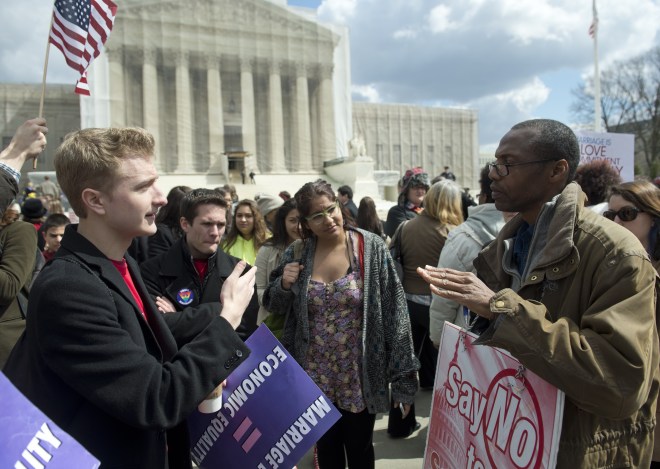
US-JUSTICE-GAY-MARRIAGE

If you watched Charlie Rose last night, you’ll know that my position on the cases in front of the court today and tomorrow is not a hope for a sudden 50-state Loving vs Virginia-style resolution. If I had my druthers, the perfect outcome would be dismissing the challenge to the ruling striking down Prop 8 on “standing” grounds, thereby allowing civil marriages to continue in California, striking down that part of DOMA which forbids the federal government from recognizing a state’s valid legal marriage licenses, on federalism grounds, and on heightened scrutiny grounds, striking down the “separate-but-equal” segregation of civil unions which are substantively identical to civil marriage.

The end result would be 17 states with marriage equality recognized by the feds, and the debate could then continue democratically as it should state by state. This is close to where the Journal comes out, with some critical differences. Here are my dissents. First off, the word “liberal,” as in:

Liberals do not merely contend that laws based on sexual orientation lack any “rational basis.” They also claim the only motivation for such laws is prejudice against gays. They therefore want the Court to designate homosexuals as a legally protected group like minorities or women and apply to Proposition 8 the highest levels of constitutional protection, called strict or heightened scrutiny.

Is Ted Olson now a liberal? Is Ken Mehlman a liberal? The argument that government discrimination against a tiny, long-persecuted minority could be viewed as worthy of heightened scrutiny is not restricted to liberals. And marriage equality was kick-started in part by gay conservatives. Just as some leftists have tried to air-brush the role of gay conservatives out of this movement (check out the far left smear artist here) so now some straight conservatives are too. They are both lying – for purposes of propaganda, left and right.

Second, since when do conservatives believe that the federal government should dictate to states what marriages should be?

The answer to that, of course, is 1996, when conservatives abandoned any pretense of being federalist and the Christianist right, aided and abetted by the most substantively anti-gay president in history, Bill Clinton, passed DOMA. Here’s the WSJ’s argument for the federal government stomping on states’ rights in 1996:

Doma doesn’t usurp state prerogatives or outlaw experimentation, or else those nine states could not have legalized gay marriage since Doma passed. In the Constitution’s system of dual federal-state sovereignty, each coequal sovereign has the power to define marriage for its own sphere.

Some scholars of federalism claim Doma was meant to express a policy judgment about gay marriage that is not supported by the federal government’s enumerated powers. But Doma embodies federalism at its best by keeping the channels of democracy open. Section 2 says one state does not have to accept another state’s definition under the Constitution’s full faith and credit clause, preserving each sovereign’s right to decide for itself.

How many times does one have to repeat this before it sinks in? The full faith and credit clause does not now and never has required one state to recognize another state’s marriages. Even today, there are very different standards – age, consanguinity, etc – that make marriages different in various states. For centuries, the federal government tolerated diversity in the states with respect to inter-racial marriage, and simply respected those inter-racial marriages that were legal in their respective states. That is federalism. The breach was not Hawaii’s aborted attempt to provide gay couples with equal protection – but DOMA itself, which says the federal government should recognize only those state marriages it approves of. This was the unprecedented move – the anti-conservative move, the first ever attempt of the federal Congress to distinguish between various states’ marriage licenses.

Overturning DOMA is to overturn radicalism not conservatism, and restore the traditional balance between the federal government and the states on civil marriage. The feds have no role in this apart from recognizing whatever a state wants to do. Period. DOMA was a mixture of panic, misinformation, political opportunism (Rove, Bush, Morris and Clinton) and yet another betrayal of conservatism by the fundamentalist wing of the GOP. Repealing it is the conservative thing to do.

(Photo: Supporters of same-sex marriage gather in front of the US Supreme Court on March 26, 2013. By Jewel Samad/AFP/Getty Images. )

Are Prenups Pernicious?

W. Bradford Wilcox is against prenuptial agreements:

My research suggests that couples who embrace a generous orientation toward their marriage, as well as those who take a dim view of divorce, are significantly more likely to be happy in their marriages. A National Center for Family and Marriage Research study finds that couples who share joint bank accounts are less likely to get divorced. In fact, married couples who do not pool their income are 145 percent more likely to end up in divorce court, compared to couples who share a bank account.

So, the kind of partners who wish to hold something back from their spouse in a marriage — emotionally, practically and financially — and to look out for No. 1 instead are more likely to end up unhappy and divorced. If that is your aim in marrying, go ahead and get a prenup.

Erik W. Newton, on the other hand, argues that every “married couple has a prenup, whether they want one or not” because the “laws covering marriage and divorce in every state are nothing more and nothing less than premarital agreements”:

For the majority of couples, a state’s default prenup is perfectly sufficient. It has been crafted over hundreds of years both through common law and common sense. That said, a couple can’t know if it works for them unless they take the time to explore the law. We enter into a nuptial contract when we say “I do” but not very many of us know the exact terms of it.

A couple should use the existence of a “state prenup” to discuss finances before getting married. Challenging topics will inevitably arise during a marriage. Many of these topics are addressed in the law, but some might be more delicately handled with a customized prenup.