Tracy McNicoll suspects that the real purpose of the ISIS propaganda video showing Abdul-Rahman (Peter) Kassig’s severed head was to feature its expanding cast of foreign fighters, some of whom are seen taking part in the synchronized beheading of 18 Syrian military personnel. One of the executioners has been identified as 22-year-old Frenchman Maxime Hauchard:
Hauchard is the first of the unmasked executioners in the ISIS video to be positively and publicly identified, although French authorities have said a second young French Muslim convert’s appearance may be authenticated shortly. As intelligence services around the world are working to identify any other foreign fighters among the band of killers in the gory new video, speculation also surfaced that another of the killers is 20-year-old Welsh jihadist Nasser Muthana, but that has yet to be confirmed.
Indeed, analysts agree one of the video’s key functions for ISIS is to illustrate how far the group’s seductive reach is extending globally. As France took in the shock news that one of its own sons may be a throat-slitting, decapitating terrorist, the Islamist specialist Romain Caillet told Le Monde, “In putting forward soldiers from the four corners of the world, Da’esh [as the French call the group, using the Arabic acronym for ISIS] is looking to create a ‘United Colors of Jihad’ effect. The message is simple: there are hundreds of Jihadi Johns.”
I’m still kinda agape at the idea of a 20 year old Welsh Jihadist. But I fail to be intimidated by that kind of ludicrous Western loser. They seem as evil as they are ridiculous. Simon Cottee reflects on why ISIS makes a point of showing off its beheadings:
The conventional wisdom holds that ISIS’s savagery will be its undoing—that it will alienate ordinary Muslims, and that without their support the group cannot succeed. But what this view overlooks is that ISIS’s jihad, as its progenitor Zarqawi well understood, isn’t about winning hearts and minds. It is about breaking hearts and minds. ISIS doesn’t want to convince its detractors and enemies. It wants to command them, if not destroy them altogether. And its strategy for achieving this goal seems to be based on destroying their will through intimate killing. This, in part, is what the group’s staged beheadings are about: They subliminally communicate ISIS’s proficiency in the art of the intimate kill. And this terrifies many people, because they sense just how hard it is to do.
Cottee’s analysis squares with a new UN report on the jihadists’ reign of terror, which also concludes that it serves a strategic purpose:
There’s a terrible logic at work here. “By publicizing its brutality,” the UN concludes, “the so-called ISIS seeks to convey its authority over its areas of control, to show its strength to attract recruits, and to threaten any individuals, groups or States that challenge its ideology.” Such violence isn’t rare in war zones. According to Stathis Kalyvas, a Yale professor who studies civil wars, rebel groups understand that civilian defection is an existential threat to their rule. Their violence is generally targeted to coerce civilian cooperation with the group — which is why ISIS labels the people it publicly executes as traitors. The message: defect to the government or a rebel group, and you’ll pay.
Meanwhile, Rodger Shanahan notices something odd about the timing of these videos:
Note that the latest video showing the beheading of Peter Kassig and Syrian military personnel was released a day or two after the fall of the town of Bayji to Iraqi government forces. … This is part of a broader pattern. A day after the Turkish parliament authorised military action against ISIS (not good news for ISIS), video of the beheading of British aid worker Alan Henning was released. And if we hark back to the recapture of Mosul Dam by Kurdish forces backed by US air support in mid-August, the beheading of US journalist James Foley followed shortly after.
None of these actions are designed to dissuade Western military intervention in Iraq or Syria, or even to goad the West into becoming decisively committed on the ground, because ISIS understands this is unlikely to occur. Rather, it has a much more short-term aim: to get ISIS’s military and political setbacks out of the media cycle and replace them with bloody imagery that demonstrates ISIS is still a force.
But they somewhat detract from that message, don’t they? They seem desperate and the last one rushed.
It’s good to see you continuing address this issue, regardless of how you are attacked by the illiberal left. It’s pretty sad how they’ve turned into the censorious, judgmental sticks in the mud that liberals have always accused the right of being. While I don’t consider myself a conservative (as per GOP definition), I really cannot stand the intolerant left. As a person of color, I’ve dealt with the standard right-wing bigots, but it’s at least with them, it was open and you could, you know, get them to treat you as a regular joe with enough interaction. With the illiberal left, if I’m not with them, then I’m either patronized as being a child with no agency, or they find some other term (misogynist is the current favorite) that can allow them to ignore you and get your views hounded off any public sphere.
Identity politics is really one of the most divisive problems on the left. For those of us who value freedom (of speech, of religion), the fervor with which these people are trying to shut down any disagreements is really mind-boggling.
A black lesbian and “something of a conservative lefty” writes:
I come to my belief in equality of opportunity the honest way, by which I mean my prior commitment is not to feminism or to anti-racism or to the gay rights movement but to a larger principle that it is morally repugnant to treat an individual person as nothing more than a representative sample of some group or another.
That prior ethical commitment is the only wholly secular means by which one can stand up for the rights of one’s own group but also wish for others those same rights or, at absolute minimum, recognize that the rights of others might need to be protected from you. Me being treated as nothing more than a walking representative of the categories “black”, “woman” and “lesbian” is wrong, and so treating you as nothing more than representative of “white”, “gay” and “male” is also wrong. Anti-racism, feminism, being in favor of gay rights all naturally flow from that.
If, on the other hand, I start from the premise that racism against black people is wrong or that sexism is wrong or that anti-gay sentiments are wrong, without first grounding it in the principle that not only do I not deserve to be ill-treated this way, but no one deserves to be so treated, it invites the kind of theological responses that you get. It is not that you have (entirely justified) reservations about the way that feminism is advanced rhetorically online. No, you are deemed irredeemably hostile to the advancement of women in society. You are, therefore, opposed not only to equal pay but to women’s education and you wish to put us under a regime so regressive that even Saudi Arabia will look at us and say “Dayaaam, we put our desire to constrain women’s lives second to none but we bow before your teachings…” I mean how could it be any other way?
Likewise, if you question the wisdom of gay couples pressing straight proprietors of public businesses who refuse to take their gay money because of religious beliefs, then you are somehow secretly in favor of sending us back to the pre-Stonewall regime – the regime that robbed the world of the brilliant light that was Alan Turing’s mind. Again, how could it be any other way?
The latter stance destroys any possibility for civil dialog. How do you negotiate with someone who is malevolent in thought and deed? You really can’t.
There is one salutary effect I think may come out of this. I am as much a social democrat as the next West coast Democratic voter, but increasingly I’m finding myself becoming something of a conservative lefty. By that I mean that as a matter of policy, I would like to see a strong social safety net, a public primary education system that is the envy of the world, a public secondary education system that is also the envy of the world, and I believe in the progressive income tax and that corporations should not be rewarded for laying people off and/or sending jobs over seas.
But I’m becoming increasingly conservative in the sense that Roger Scruton uses the term because there is much that I think the left is attacking that we need. In fact, I think that the identity politics that lies behind all of this Internet political kabuki is a malign influence in the academy and in the larger culture. It makes civil discussion and discourse upon which republican citizenship depends impossible. It undermines the one thing tying all 300 million Americans together, and that is our shared ideology and ideals. It tells the people who have the most to lose from rejecting mainstream values and the most to gain from doing so that they should not do so. That there is no need to do so.
It is a malevolent force in our national politics because it undermines the ability to deploy facts in order to influence policy. It simply no longer matters if Obamacare has a line in it mandating the summary execution of every white, heterosexual Christian over the age of 70. Fox News will report that it does. They will have experts on who will talk about how this phantasm will do its devil’s work. The non-FOX media will report “Fox News reports that Obamacare has death panels in it, the Obama administration denies this…” and not once ever ask the obvious question “why is Fox News saying something that is manifestly untrue’. The critical theorists do not believe that there are facts, only power narratives. But facts are the way we can know if our policies are effective or if the best policy is no policy.
As an American, as a Westerner, I reject the idea that my being a black lesbian makes me somehow a stranger to my culture. I reject the idea that the culture of the Anglophone world isn’t my home culture because of my race. When I was born, I don’t think that would have made me a conservative, but I think it makes me a conservative today but not in the right-wing republican mode. More in the sense that I look at my civilization and all its works and see much worth preserving that the current ideological critical theory/social justice left wishes to destroy. I can’t sign on for that. It took a lot of long hard struggle just to get to the English and Scottish Enlightenment. It took yet more long and hard struggle for the Enlightenment to include the likes of me within the circle of people rational enough to be given the honorific “citizen”. It enrages me that, in my name, just as society has said “this ladder is yours to ascend by your own efforts and to your own comfort” the social justice left wants to take that ladder, break it into kindling, set fire to it and then lament how I, as a black woman, couldn’t get any higher because the white, capitalist patriarchy would not allow it. That, I think, makes me a species of conservative.
A Burkean Liberal? A Rawlsian Conservative? I don’t know. That’s thin lemonade to make out of so big a lemon but it’s the best I can do. Keep up the good fight.
Another points to “Exhibit A of feminism eating its own”:
If you want to link to an example of how feminists shame beautiful women, look what Keira Knightley got in exchange for taking a very feminist stance of refusing to be photoshopped: This nasty Daily Beast column, where Knightley is accused of “arguing for diversity from an extremely privileged and exclusive platform.” Rather than acknowledge that this is a step toward progress, the writer says, “Unfortunately, it’s hard to win a war over diversity and inclusion when the only women who are being given the mainstream platforms to speak out are the white warriors who have been deemed hot enough to merit a topless photo shoot.”
Womp womp. If you’re Knightley, who happens to be insanely talented and smart, why would you want to be on the same team as women like this who take you out at the kneecaps? Fuck that.
Heh, it also contains an old quote from Lady Gaga: “I’m not a feminist… I love men.” If international superstar women think that the two concepts are mutually exclusive, you miiiiiight have a bit of a public perception problem.
Another sends a civil dissent:
I am lapsed subscriber on the fence till recently, but I now know I renew, in part because of your efforts on the recent gender threads, though I mostly disagree with your takes. The reason is, I’m a male of Indian descent who is a Sikh religiously, and these threads allow me to see you come by your blind spots honestly regarding points of view informed by these origin-points of mine. I better understand you as you have dug in your heels, and I can see you mean no malice, though in important ways, you do not see things that are important to see to really understand the topics you are speaking on.
What you are not seeing is the people of goodwill you are opposing are coming from a real point of view and reacting from that point of view and you are removing the context in a way that does you no service. It is fairly apparent (no offense meant) that you do not really understand these points of views either intellectually or from lived experience.
If you are not able to run the thought experiments, sincerely take a page from one of your readers and consult a woman you trust, as you do, in a way, regarding race with Ta-Nehisi Coates. You as much as anyone else know you do not bestow favors on Coates when you refer to him in posts; you do yourself a favor because he really can teach on a point of view you lack familiarity with. No one has to agree with him, but he provides a really valuable education. You would do well to have an interlocutor or teacher regarding these issues.
Reading through six near-identical accounts of women who publicly testify that he drugged and raped them, it seems clear to me, at least, that he is a serial sexual abuser and rapist. Does he deserve the benefit of the doubt? In a court of law, absolutely. In the court of public opinion? Not at all. The odds of all these women lying – when they have nothing to gain and a certain amount to lose from telling the truth – is close to zero. Or as Ta-Nehisi Coates puts it:
Believing Bill Cosby does not require you to take one person’s word over another—it requires you take one person’s word over 15 others.
Here’s the latest version from Janice Dickinson:
And the fact that he got away with this abuse is not at all surprising. In Britain, we now have a flurry of cases where stars in the era of peak network TV were treated by almost everyone as demi-gods: unimpeachable, untouchable, and beyond any human accountability. And they thereby got away with the rape of children, of women, of the mentally ill, and even of corpses in plain sight. Only decades later have they been called to account, but in Jimmy Savile’s case not till after his death.
That this entire issue only resurfaced because of a man’s comedy routine is also disturbing. I take Barbara Bowman’s point seriously:
Only after a man, Hannibal Buress, called Bill Cosby a rapist in a comedy act last month did the public outcry begin in earnest. The original video of Buress’ performance went viral. This week, Twitter turned against him, too, with a meme that emblazoned rape scenarios across pictures of his face.
While I am grateful for the new attention to Cosby’s crimes, I must ask my own questions: Why wasn’t I believed? Why didn’t I get the same reaction of shock and revulsion when I originally reported it? Why was I, a victim of sexual assault, further wronged by victim blaming when I came forward? The women victimized by Bill Cosby have been talking about his crimes for more than a decade. Why didn’t our stories go viral?
I don’t know. I wasn’t really aware of any of this till recently. But it seems to me the least we can do to honor these women – and accord them some way overdue respect – is to treat Cosby differently in public life.
My heart goes out to your reader. We opted not to circumcise our son, only to have him develop the same non-retraction problem at age three. We tried a variety of topical treatments and visited a number of doctors. We were told that the problem might resolve with time, but if it didn’t, we’d be looking at circumcision of an even older child. That seemed untenable to us, so we went ahead with the procedure, which required a visit to an outpatient facility, general anesthesia, and several hundred dollars out of pocket.
He’s now almost seven and doing just fine, but it was a sad experience for all of us. To this day he talks about the time “when Mommy was crying so hard.” I’d tried to put the antibiotic ointment on his incision and he ran away screaming. I was emotionally worn out and worried about infection but also hoping and praying that he wouldn’t get a complex from having a wound on his penis that his parents had to slather with ointment several times a day.
As much as my husband and I couldn’t stomach the thought of a newborn undergoing this procedure, what our son experienced was more traumatic. Would we have done it differently had we known? Probably, but that’s the problem – there’s no way to know ahead of time if your child will develop this issue.
Another got his penis sliced much later than age three:
Having read about your reader’s dilemma regarding his child’s circumcision, I’d recommend that he go ahead and do it. I had issues with phimosis in adolescence and actually needed a circumcision, but I had to wait until I had health insurance to get one. I remained a virgin through college because I was too afraid of something bad happening during sex, which I will forever regret, even though I am happily married now.
One of the first things I did after getting healthcare coverage through a job was to get a circumcision. I was 24 then, and I can attest as to how terrible it is. Imagine getting multiple shots of local anesthetic on your johnson, feeling the sutures being sewn because the anaesthetic is wearing out, and having the whole thing witnessed by four nurses, presumably because of the sheer novelty of an adult circumcision. The recovery is equally horrendous, with painful mid-sleep boners and the skin of my glans getting chapped and flaking off. I took three days off work when I was told one would suffice.
When all was said and done, I had a scarred dick that lost a lot of its sensitivity, but that was mitigated by the lost fear of actually using my penis.
So having experienced circumcision as a grown man, I can attest that it is a barbaric experience. Performing it on a newborn child does not change that. I do not plan on having my children circumcised, if I have any. Still, if it is an issue of medical necessity – which it can be – the sooner it gets dealt with, the better. Once puberty hits and shame becomes inevitably correlated with private parts, a lot of damage can be done.
Another suggests a novel solution:
Why do stories on circumcision never discuss the “dorsal slit” procedure, which leaves the foreskin intact? This simple procedure combines the health benefits of circumcision with all the pleasure of remaining intact. While I do not advocate routine mutilation, this neatly resolves the issue for anyone with retraction problems. Those seeking middle-ground might consider this compromise.
A colleague of a reader seems to have done just that:
The image that came to me when I read your post was when I was working in a very busy neonatal unit. The head of the department did the circumcisions if the child did not have a pediatrician yet. I came on to work one morning and was so shocked when I pulled back the diaper to reveal something – to my eyes – that was horribly wrong. It looked like a mutilation, and I have seen lots of circs (performed by the pediatricians on their patients – this was the first one I saw that the neonatologist had performed).
I immediately went to find him and asked him to come and take a look. I thought he would really want to know – thinking that there was swelling or infection or some thing gone awry. He made a rather sniping comment – that I had been to Paris and seen the best or something to that effect. What I learned about this doctor is that he did not like to do circumcisions and so he performed a “mini circ” – essentially just nipping a bit off. Everybody is happy.
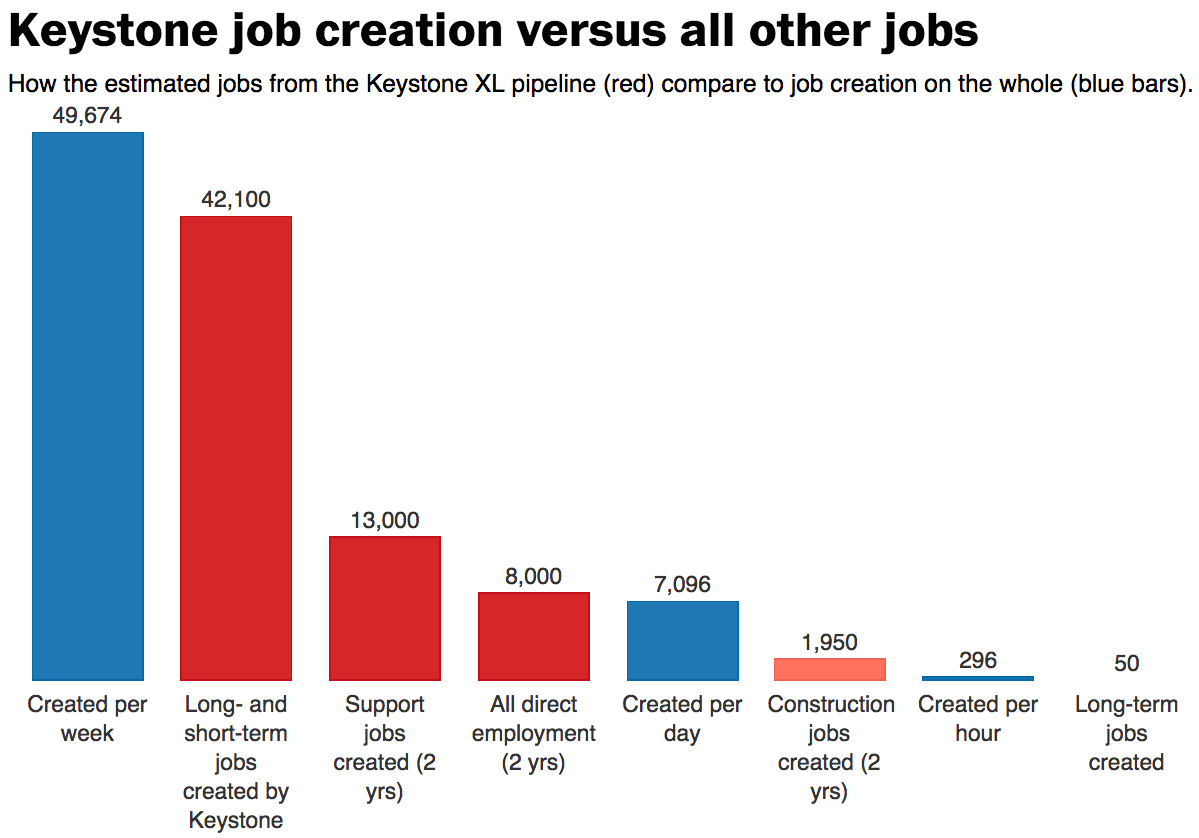
Citing the State Department final environmental impact statement, the lawmakers say the project would create 42,000 jobs. But it takes the economy less than a week to create that many permanent jobs. What’s more, these pipeline jobs wouldn’t be permanent. The State Department report uses the notion of “job years.” So the project, which is expected to take two years to build, requires 3,900 job years for the construction workforce, or 1,950 jobs that last over a two-year period. Another 26,000 jobs (or 13,000 over twoyears) would go to suppliers of goods and services.
Once the project is completed, operations would require 35 permanent employees and 15 temporary contractors, the State Department report says.
Philip Bump illustrates those numbers with the above chart:
For those out of work — a difficult and frustrating experience — the creation of any job that could offer a salary and benefits is worthwhile. The question for lawmakers is how to balance the jobs that would be created by the pipeline — either 42,000 or 50, depending on your feelings about the project — with other considerations, such as the environmental effects of increasing tar sands oil production. If we’re talking about adding the same number of jobs by 2017 that would be added by building a Target, for example, that likely shifts the calculus.
Chait sees the GOP’s Keystone fixation as a way to avoid having a real jobs plan. Which puts Obama in a bad negotiating position:
Republicans need to have a jobs plan. They’re much better off blaming Obama for standing in the way of the huge number of construction jobs that would be made available to hardworking Americans being blocked by the left-wing environmental agenda than they are taking credit for the pipeline. Republicans don’t like cutting deals with Obama even when he offers them something they want. In this case, the trade value of Keystone is negative. Which is to say, Republicans aren’t going to give him squat.
The USA Freedom Act was voted down last night. Ronald Bailey is disappointed in Rand Paul, who voted against the bill because it didn’t go far enough:
Paul and the rest of his fellow citizens may well come to rue the day that he allowed the perfect to get in the way of the merely better.
Julian Sanchez likewise finds it “hard to see how blocking this particular set of reforms makes it any more likely that other important changes to the law will be passed”:
Ending the bulk collection of communication records under one group of authorities may only be the first step on a long road to more comprehensive surveillance reform, but taking that step enables privacy groups and civil libertarian legislators to devote their full focus to building consensus around subsequent steps, like amending (if not eliminating) the general warrant authority created by §702 of the FISA Amendments Act of 2008.
Sen. Paul’s primary objection thus far has been that the USA FREEDOM Act “reauthorizes the PATRIOT Act,” which is rather misleading. The vast majority of the PATRIOT Act is, alas, permanent and in no need of reauthorization. Three provisions will, in fact, expire in 2015: The §215 business records authority under which the NSA’s bulk telephony program is operating, the never-used “lone wolf” provision blessing the use of intelligence tools against foreigners suspected of terrorism but unaffiliated with any larger group, and the “roving wiretap” authority giving analysts discretion to intercept a target’s communication across multiple communications channels without specifying them in advance to a court.
However, Trevor Timm anticipates that “the the USA Freedom Act’s failure could backfire on its biggest supporters”:
As I’ve mentioned before, Section 215 of the USA Patriot Act – the law that was re-interpreted in secret to allow for mass phone metadata surveillance in the first place – comes up for renewal next summer. It has to be reauthorized before June, or it will disappear completely.
And even though the Republicans will be in control next year, they won’t be able to pull the same stunts they did on Tuesday. Everyone knows getting “no” votes is a lot easier than getting a “yes”. And this time they’ll need 60 “yes” votes, plus the support of the House of Representatives, where we know already there are likely enough votes to kill an extension of the Patriot Act.
The USA Freedom Act is now dead until the next session. Leahy moves to the minority, which means Chuck Grassley will have to take up NSA reform starting in January, putting its direction under Republican control. Rand Paul will probably like that result less than this effort, and it will be interesting to see whether Republicans can make up whatever votes they lose in the Democratic caucus from within their own without Paul’s endorsement.
Greenwald, meanwhile, believes “the last place one should look to impose limits on the powers of the U.S. government is . . . the U.S. government”:
The entire system in D.C. is designed at its core to prevent real reform. This Congress is not going to enact anything resembling fundamental limits on the NSA’s powers of mass surveillance. Even if it somehow did, this White House would never sign it. Even if all that miraculously happened, the fact that the U.S. intelligence community and National Security State operates with no limits and no oversight means they’d easily co-opt the entire reform process. That’s what happened after the eavesdropping scandals of the mid-1970s led to the establishment of congressional intelligence committees and a special FISA “oversight” court—the committees were instantly captured by putting in charge supreme servants of the intelligence community like Senators Dianne Feinstein and Chambliss, and Congressmen Mike Rogers and “Dutch” Ruppersberger, while the court quickly became a rubber stamp with subservient judges who operate in total secrecy.
The Wikipedia entry for “Disruptive Innovation” is well over 4,000 words. Native Advertising is considered a Disruptive Innovation.
That’s rich. And ironic. Because it is designed to not be “disruptive”. It is designed to blend in, deceive. And it is not an “innovation”. Branded “native” print editorial content has been around for over 100 years.
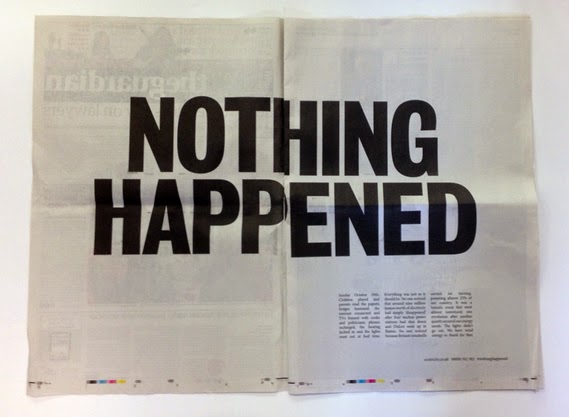
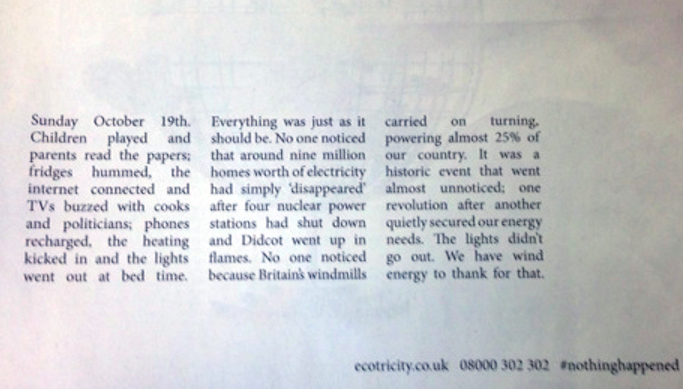
This ad [above and below] ran in the November 7th issue of the Guardian (click to enlarge):
In case you don’t understand what you’re looking at, that’s a double full-page spread ad (you know, the paper kind). How many people—do you think—who saw that headline didn’t read the copy? Sorry digital gurus, there are no exact metrics for you to study and put into one of your priceless decks. But let me give you a ballpark figure: ZERO.
This is a brilliant example of what social media dipshits try—and fail at—every day: newsjacking. Except, ecotricity (Britain’s leading green energy supplier) actual had some pretty big news to report, as I’m sure you’re reading about right now.
I see something like this, and I think—momentarily and warily—that just maybe, advertising creativity might survive this stupid generation.
Judith Shulevitz explores the growing evidence that trauma can be inherited – yes, biologically. The controversial implications:
At the frontier of this research lies a very delicate question: whether some people, and some populations, are simply more susceptible to damage than others. We think of resilience to adversity as a function of character or culture. But as researchers unravel the biology of trauma, the more it seems that some people are likelier to be broken by calamity while others are likelier to endure it.
For instance, studies comparing twins in which one twin developed PTSD after trauma, and the other never had the bad experience and therefore never received the diagnosis, have uncovered shared brain structures that predispose them to traumatization.
These architectural anomalies include smaller hippocampuses—which reduce the brain’s ability to manage the neurological and hormonal components of fear—and an abnormal cavity holding apart two leaves of a membrane in the center of the brain, an aberration that has been linked to schizophrenia, among other disorders. Researchers have further identified genetic variations that seem to magnify the impact of trauma. One study on the mutations of a certain gene found that a particular variation had more of an “orchid” effect on African Americans than on Americans of European descent. The African Americans were more susceptible than the European Americans to PTSD if abused as children and less susceptible if not.
Another theory, even more uncomfortable to consider, holds that a particular parental dowry may drive a person to put herself in situations in which she is more likely to be hurt. Neuropsychologists have identified heritable traits that push people toward risk: attention deficits, a difficulty articulating one’s memories, low executive function or self-control. The “high-risk hypothesis,” as it is known, sounds a lot like blaming the victim. But it isn’t all that different from saying that people have different personalities and interact with the world in different ways. As Yehuda puts it, “Biology may help us understand things in a way that we’re afraid to say or that we can’t say.”
If just one more Democrat had voted for the measure, it would have gone to President Obama’s desk—and likely been promptly vetoed. The bill was already going to die. The suspense was simply over the identity of the executioner.
In the end, most Americans wouldn’t notice Keystone’s impact—both good and bad. Landrieu’s own constituents have no direct stake in the project either, since it does not run through the state. It won’t noticeably impact gas prices and only creates a few dozen permanent jobs. Americans certainly won’t notice the greenhouse gas pollution associated with Keystone and the crude oil it will carry from the Canadian tar sands. Keystone has become a rallying point for climate activists precisely because of this invisible impact (the troubling image of a massive pipeline running through six states helps, too).
The irony is that, after six years of debate and deliberation, the Keystone decision comes when the economics surrounding the pipeline have largely made the issue irrelevant. Oil prices have dropped sharply, an American boom in natural gas and oil production have lessened foreign demand, and companies have proposed alternative pipelines and rail transport to carry the oil from Canada.
Keith Johnson contends that “Keystone has proved crucial neither to the development of Canada’s tar sands nor to getting it to market”:
Despite the years of delays on Keystone, Canadian oil sands production has continued steadily upward. In 2008, Canada produced about 1.2 million barrels a day from its tar sands. Last year, even without Keystone, production had jumped to 2 million barrels a day. Most forecasters expect Canadian tar sands to top 3 million barrels a day by 2020.
Plumber looks at other ways Canada is getting its oil to market:
These projects don’t mean the Keystone XL pipeline is pointless. TransCanada insists that Keystone XL would still be the cheapest way to ship Alberta’s oil to refineries in the Gulf. And if it’s blocked, that could ultimately constrain the size of the oil sands industry somewhat. An analysis by Maximilian Auffhammer of UC Berkeley estimated that blocking Keystone XL would force Canada’s oil-sands producers to leave 1 billion barrels underground by 2030 — even if rail expanded and all the other pipelines got built.
But Keystone XL isn’t the only game in town.
(Photo: Protesters participate in an anti-Keystone pipeline demonstration in New York’s Foley Square on November 18, 2014 in New York City. By Spencer Platt/Getty Images)
A reader provides “some perspective from a Midwestern family”:
Our college age son is expecting a baby and his 19-year-old girlfriend is undocumented. She has lived in the USA since she was four and is a high school graduate. She’s bright, mature, goal oriented, and resilient – but has had little opportunity to advance economically or attend post secondary school due both to her undocumented legal status and the fear that has prompted her parents to limit their overall assimilation. Being undocumented, neither she nor her parents have ever held jobs providing health insurance or had bank accounts. She’s grown up moving continually as her parents follow work.
Being undocumented, she can not obtain even unsubsidized health insurance through the ACA. Being undocumented she can not obtain a drivers license/state ID or credit. Should she live in our home state of Indiana, she is ineligible for any Medicaid coverage for prenatal or post natal medical care. In California, her home state, where my son now lives, MediCal provides basic prenatal care but only for 30 days at a time – so, our son takes a day off of work (unpaid) every month to escort her to a social service department so she is approved for the next 30 days of prenatal care. She is eligible for WIC but her family can not apply for food stamps.
Both my husband and I have always believed that we live in a big country with room for everyone, and morally we believe this teenager has the right to this nation’s opportunities just as our ancestors did – but it’s been an abstract position until now, and our position was never the norm in our Midwestern suburban community.
Now we’re terrified to think that this lovely girl could be deported pregnant with our son’s child, or that as a parent, she could be consigned to living on the scraps of a menial labor force. The issue is no longer abstract, as I’ve spent the last several weeks researching immigration law and the benefits of President Obama’s 2012 executive orders affecting Dreamers. We’re facilitating and paying for our son’s girlfriend’s DACA application (not an inexpensive or easily documented endeavor), and after the baby arrives, we will retain an immigration attorney to initiate the long and uncertain process for her to perhaps acquire ultimate residency.
My husband I have been slapped by the realization of what being undocumented means to our family. In the last few months, we’ve frequently wondered how many American babies will be born to mothers without access to reasonable prenatal care? How much will state Medicaid programs spend on NICU support for unnecessarily premature infants? How much will school systems spend for special education programs to support children born with preventable learning or developmental disabilities? How many Dreamers grow up in the U.S. without memory of their home countries but are denied access to state tuition at public universities, or just simply can’t be hired for jobs that provide a basically livable wage and dignified entry onto the labor force? How much of a contribution to social security and Medicare would an additional 10 million wage earners provide today? In 20 years as their often large families exponentially hit the payrolls?
I suspect that our family represents the precipice (at least in our corner of the cornfield) of what will eventually impact many Americans who are currently hostile to immigration reform. Because their kids, like our kids, are meeting, marrying, and socializing with a hugely diverse generation of peers. And when things hit home and people open whatever closet door they’ve forced others into, light seeps in.
Another reader:
I am a native-born American. Over the years as a pastor, I’ve worked with any number of immigrants from several different countries. Republican rhetoric is always about securing the border and what to do about the “illegals.” They seem not to realize the immigration system is SO MUCH MORE than border security and people in the US without permission. And our entire immigration system is badly broken. Refugees are immigrants. International students are immigrants. International business persons are immigrants. Foreign-born spouses of US citizens are immigrants. Foreign-born family members of US citizens are immigrants.
A member of my church is married to a French national. They were married in the US. He wants to represent his father’s business in the US. It will take two years and hundreds of dollars in fees for them to be considered for a visa for him. Her parents are working on it from this end and they are so frustrated.
As I understand it, a significant percentage of “illegals” are students and tourists who have overstayed their visa. Could we not establish a readable card issued upon arrival or at a consulate? Set up card readers in post offices, libraries, public buildings. Once a week you have to swipe your card. The reader reports your location to a regional or national monitoring center. It also tells you how many days you have left, or gives instructions about contacting INS/ICE. This is not difficult. But as long as immigration is a way to scare people and raise money for your campaign, we won’t have a solution.
My favorite immigration story is from a friend in Belgium. He met a man in Oregon over a social network website and they fell in love. My Belgian friend visited the US to see his love once a quarter and stayed for a month. On the third trip in a year, the immigration officer at the airport began to question him. It appeared to the officer that my friend was coming to conduct business on a tourist visa. My friend was concerned that if he revealed that it was a male-male relationship, he would not be allowed in. He tried two or three not-quite-false-but-not-full-disclosure explanations. They were not working. Finally he told the officer he had fallen in love with a man in Oregon. All these trips were to see him and make plans for him to move to Belgium where they could get married. He waited. The officer stamped his passport, handed it back, and said “Good luck to you both.”
They are now married and living in Brussels. My Belgian friend simply cannot move his business to the US, even if they wanted to. The immigration hurdles are simply too high.
Another lends his expert input:
I’m an immigration attorney. We’ve all been discussing much of what POTUS may do. Here are my two cents:
(1) Whatever Obama does, it will necessarily be very very limited. In essence, all he can do for the undocumented is formally state that he’ll defer acting to remove a certain class of such individuals. He is free to change his mind, or a future president is free to reverse that order. That’s not much in the way of legal protection, especially since to benefit from this decision, an undocumented immigrant must present themselves to the government. Imagine if the Mayor of New York said “for a period of two years, we’ll not prosecute anyone who engages in casual acts of prostitution, provided this person comes forward and registers with us.”
(2) If the GOP truly is outraged at Obama on the grounds that he is abusing his authority and should be enforcing the law much more, there is an “easy” fix. Just pass a bill which (a) details the enforcement they want and (b) appropriates the money for it. Then Obama has no more discretion. But I’m not holding my breath …
My complicated views on the matter here and here. Blogger input here.

 The Dish