The Unofficial Dedication Page

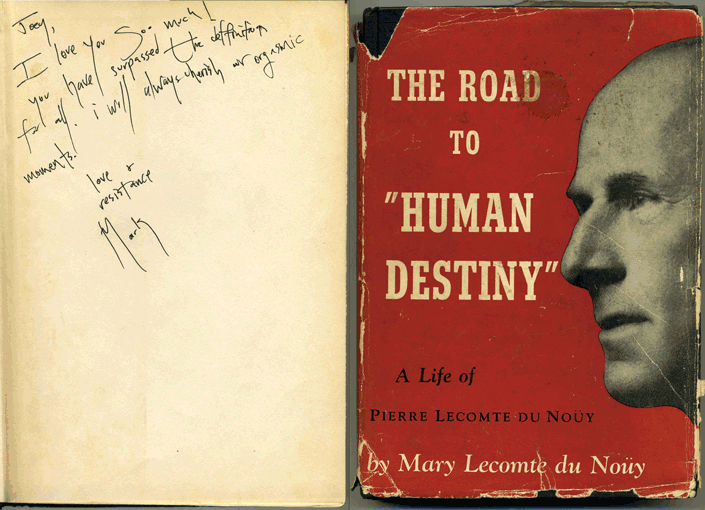
The Book Inscriptions Project began in 2002 when Shaun Raviv found the following note in The Road to ‘Human Destiny’: A Life of Pierre Lecomte Du Noüy by Mary Lecomte Du Noüy:

“Joey, I love you so much!
You have surpassed the definition
for all. I will always cherish our orgasmic
moments.
love + resistance
Mark”

For whatever reason, I happened to open the book and saw the message from Mark to Joey.
Something about that note, handwritten by an unknown to an unknown of whose whereabouts,
gender and relationship I was unaware, struck me as both tragic and powerful. …

Maybe someday this book will again find its way to Mark or Joey and I’ll get to meet them, and ask them if it worked out, if their orgasmic moments were enough to survive life’s difficulties.

Another from the archives:

Jimmy-

Like a sunburnt satellite
I circle the globe in lost
orbits, searching the most
appropriate destiny in the
dense fog of fate, but knowing
that I may touch down at
home, and we can resume our
story exactly where we left it……

All the best for the
3rd year of the techno-
millennium.

Rickey T.

January 2003

Sputnik Sweetheart by Haruki Murakami

Thanks to Danielle, who says, “I found this at a used bookstore in Kamloops, B.C.
and can’t stop wondering if they ‘resumed their story’…”

The Evolving Business Of Books

In a wide-ranging essay on the history and future of publishing, Richard Nash illustrates how literature has always been subject to the whims of the market:

Books not only are part and parcel of consumer capitalism, they virtually began it. They are part of the fuel that drives it. The growth of the chain model in books offered everyone the opportunity to decry the groceryfication of the bookstore, utterly belying the reality, as [Ted] Striphas outlines in his excellent The Late Age of Print, that the bookstore is in fact the model for the supermarket:

In the history of shop design, it is bookstores, strangely enough, that were the precursors of supermarkets. They, alone of all types of shop, made use of shelves that were not behind counters, with the goods arranged for casual browsing, and for what was not yet called self-service. Also, when brand name goods and their accompanying packages were non-existent or rare in the sale of food, books had covers that were designed at once to protect the contents and to entice the purchaser; they were proprietary products with identifiable authors and new titles.

Meanwhile, Betsy Morais investigates digital publishers:

The world of digital publishing start-ups brings to mind blogging in its nascent stages. The guiding principle seems to be: if anyone can scribble on the Internet’s wall, anyone can become an author, and any text can become a book. Online, a book’s form warps into something more malleable, and fired-up digital publishers are trying to figure out how to turn that into a business—even if it means a proliferation of books that might as well have been blog posts.

She spoke with Peter Armstrong, who runs a serialized book company called Leanpub:

Armstrong suggests that a book and a start-up are each “a risky, highly creative endeavor undertaken by a small team, with low probability of success.” In either case, he says, you can go into “stealth mode”—which, he contends, will easily result in creating something that nobody wants. “To say you’re going to go off in a room and write the perfect thing without getting feedback from anybody is—I don’t want to say ‘arrogant’—but I couldn’t do it.” Editors, he adds, “function as a good proxy for readers”—but are not as effective as readers themselves. And so, it follows that the solution is to begin a project—in this case, a book—and let the people have at it. He calls this Lean Publishing, or “the act of publishing an in-progress book using lightweight tools and many iterations to get reader feedback, pivot until you have the right book and build traction once you do.”

Go here if you missed readers’ recent praise for Amazon’s digital business and its empowering of independent authors.

Face Of The Day

Las Fallas Festival In Valencia

A ‘Ninot’ (puppet) depicting German Cancellor Angela Merkel burns during the last day of the Las Fallas Festival on March 20, 2013 in Valencia, Spain. The Fallas festival, which runs from March 15 until March 19, celebrates the arrival of spring with fireworks, fiestas and bonfires made by large puppets named Ninots. By David Ramos/Getty Images.

More on the Falles and ninots from Wiki:

Formerly, much time would be spent by the Casal faller preparing the ninots (Valencian for puppets or dolls). During the four days leading up to 19 March, each group takes its ninot out for a grand parade, and then mounts it, each on its own elaborate firecracker-filled cardboard and paper-mâché artistic monument in a street of the given neighbourhood. This whole assembly is a falla.

The ninots and their falles are constructed according to an agreed upon theme that has traditionally been, and continues to be, a satirical jab at anything or anyone who draws the attention of the critical eyes of the falleros—the celebrants themselves. In modern times, the whole two week long festival has spawned a huge local industry, to the point that an entire suburban area has been designated the City of Falles – Ciutat fallera. Here, crews of artists and artisans, sculptors, painters, and many others all spend months producing elaborate constructions of paper and wax, wood and styrofoam tableaux towering up to five stories, composed of fanciful figures in outrageous poses arranged in gravity-defying architecture, each produced at the direction of the many individual neighbourhood Casals faller who vie with each other to attract the best artists, and then to create the most outrageous monument to their target.

Our Opinionated Media

1-On-MSNBC-Opinion-Dominates-Reporting

The Pew Research Center’s Project for Excellence in Journalism recently released their annual “State of the Media” report, which finds that opinion reporting on the big three cable networks is up:

On cable, the news structure of the three channels—the mix of interviews, packaged segments and live coverage—has changed. After relying on significantly distinct formats five years ago, the three rivals now look strikingly similar. … CNN, which has branded itself around reporting resources and reach, cut back between 2007 and 2012 on two areas tied to that brand—in-depth story packages and live event coverage. Even so, CNN is the only one of the three big cable news channels to produce more straight reporting than commentary over all. At the other end of that spectrum lies MSNBC, where opinion fills a full 85% of the channel’s airtime.

Paul Waldman argues that the decline of “straight reporting” isn’t necessarily something to worry about:

If MSNBC decides that analyzing, discussing, and debating the news is going to be their thing, and people watch it, that doesn’t do any harm. And indeed, you’ll learn more from an episode of one of MSNBC’s better talk shows than you will from a dozen reported packages about this week’s Trial of the Century or the latest snowstorm moving through the Midwest.

In Yglesias’ view, news consumers have never had it better:

Just ask yourself: Is there more or less good material for you to read today than there was 13 years ago? The answer is, clearly, more. Indeed, one thing the Pew report correctly emphasizes is that (as we at Slate are well aware) it’s hard to make lots of money selling ads online. But it’s hard primarily for the same reason that the Internet is such a bonanza for readers: There’s lots of competition and lots of stuff to read. A traditional newspaper used to compete with a single cross-town rival. Time would compete with NewsweekTime doesn’t compete with Newsweek anymore: Instead it competes with every single English-language website on the planet. It’s tough, but it merely underscores the extent of the enormous advances in productivity that are transforming the industry.

Ed Kilgore, meanwhile, zooms in on local coverage:

[I]t’s the data on local TV that’s really alarming. According to Pew, coverage of politics and government now accounts for an average of 3 percent of the airtime on local television “newscasts,” less than half the proportion registered in 2005. By comparison, 71% of newscast airtime is absorbed by crimes (or trials), traffic and weather, sports, and accidents/”bizarre events”/disasters. When combined with the cutbacks and disappearances afflicting print media, and the relatively small proportion of online content devoted to state and local government developments, you’ve got a host of governments operating virtually in the dark.

(Chart from the Pew Report)

From The Archive: The First Hathos Alert

I wrote on June 20, 2001:

John Derbyshire’s uncategorizable advice to his timid son is now up on National Review Online. Who else would encourage his offspring to fight back against a bully by bribing him with ice-cream and the words: “But I want to see the blood. Ice cream for blood.” The piece ends with the injunction that anyone who advocates single motherhood as a lifestyle option should be “sewn into a heavy leather sack with lots of broken glass and rolled down a l-o-n-g slope.” Leather? Have I created a monster? Derb has also just written what must be one of the weirdest discourses on fellatio I have ever read in New York Press. It begins: “I have been thinking about fellatio. No, no, don’t hit the back button. This is serious stuff. I have issues.” On that last sentence, I think we can all agree.

A colleague of mine – I can’t remember who, maybe they’ll email me to remind me – once coined the term “hathos” for the compulsive need to read something you find horrifying, yet irresistible. Read these pieces and you’ll know what I mean.

Obama’s Charm Offensive In Israel

President Obama's Official Visit To Israel And The West Bank Day One

Beinart sees the president’s trip to Israel as a belated attempt to improve his image in the country:

[T]his week’s trip will involve, if nothing else, a lot of talking to the Israeli people. In addition to visiting Yad Vashem, Israel’s Holocaust museum, and the graves of Theodor Herzl and Yitzhak Rabin, Obama will give a public speech in Jerusalem at which the White House has requested the presence of at least 1,000 Israelis. The idea is that by wooing ordinary Israelis first, Obama will find a more receptive audience when he unveils another initiative for Mideast peace. Administration aides are well aware that Netanyahu surrendered his first prime ministership after resisting demands for territorial withdrawal by Bill Clinton, a president widely admired in Israel. And they know that Yair Lapid, Netanyahu’s chief political rival, has criticized him for mismanaging the Obama relationship. A charm offensive, in other words, may do more to push Israel’s government in the direction of two states than a hard line.

Last week, Goldblog detailed the administration’s thinking:

During the first term, Administration thinking held that there was no point in sending the President to meet with Israelis and Palestinians on their home turf unless there was real progress in negotiations. Last year, this thinking shifted: Visiting the region while it was relatively quiet, without carrying a specific political agenda, grew to seem like a smart idea, in particular because many Israelis had grown suspicious of his intentions and would therefore benefit from direct exposure to the man, rather than his caricature.

Janine Zacharia believes that Obama’s campaign won’t make much headway:

Just as Defense Secretary Chuck Hagel—whose nomination was held up by those who worried he wasn’t pro-Israel enough—wasn’t running for Israeli defense minister, Obama isn’t running for Israeli office (or any office for that matter). And anyone who knows Israelis and their current mindset on the Palestinians (Palestinians, who?) knows that a little ego stroking isn’t going to get that population behind a peace deal. That doesn’t mean the trip couldn’t do some good. While the president is there ostensibly repairing the relationship with Israelis who’ve felt jilted, Obama may be sending an important signal to Tehran. The message: Just because I can’t stand Bibi doesn’t mean I won’t stand with him in preventing you from getting a nuclear weapon.

Aaron David Miller doesn’t expect much either, but doubts there will be another dust-up between the president and Bibi:

Netanyahu — much weakened in the new coalition government by two upstarts who have shifted the agenda from security to social and economic issues — may want to keep foreign policy prominent. And for this, he needs Obama. While he and Obama have differed over whether a military strike on Iran’s nuclear facilities is wise, there is still a good chance for coordination. The Israelis don’t want to strike unilaterally. Netanyahu is hoping that either through a credible deal on restricting Iran’s uranium enrichment or through U.S. military action, the Iranian nuclear program will be constrained, if not undermined, and Israel won’t have to act alone.

Another topic that’s sure to come up is what to do about Syria’s chemical weapon stockpile. Meanwhile, Steven Cook zeroes in on the ever-shrinking space for negotiations, especially on Jerusalem, still a central component of any negotations for a peace process:

There is nothing to negotiate. No longer can one look at the city and say, as an old Israeli friend declared to me in the early 1990s, “It’s clear. One part of the city is ours and the other part is theirs. We should share it.”  In the ensuing two decades, the Israelis have done everything possible to make the predominantly Arab parts of East Jerusalem little more than an enclave of Palestinian residents in a greater Israeli and Jewish municipality. Piece-by-piece the Israelis have filled in a jigsaw of new neighborhoods that ring the eastern part of the city.

Jay Newton-Small previews Obama’s next stop after Israel:

The President will wrap his tour in Jordan, where he’ll try to convince King Abdullah not to close his borders to Syrians fleeing the two-year-old civil war, even as Jordan’s economy buckles under the strain of 400,000 refugees with twice that number expected by year’s end. Jordan’s economy has also taken a hit as tourism has fallen off due to regional unrest and the perception of insecurity. To promote Jordan, Obama will play tourist for a day, visiting the ancient site of Petra with 500 international journalists in tow, demonstrating how safe – and appealing – Jordan’s tourist attractions remain. Jordan also hopes for more pledges of support from the U.S. for the Syrian refugees and for their own economic reforms.

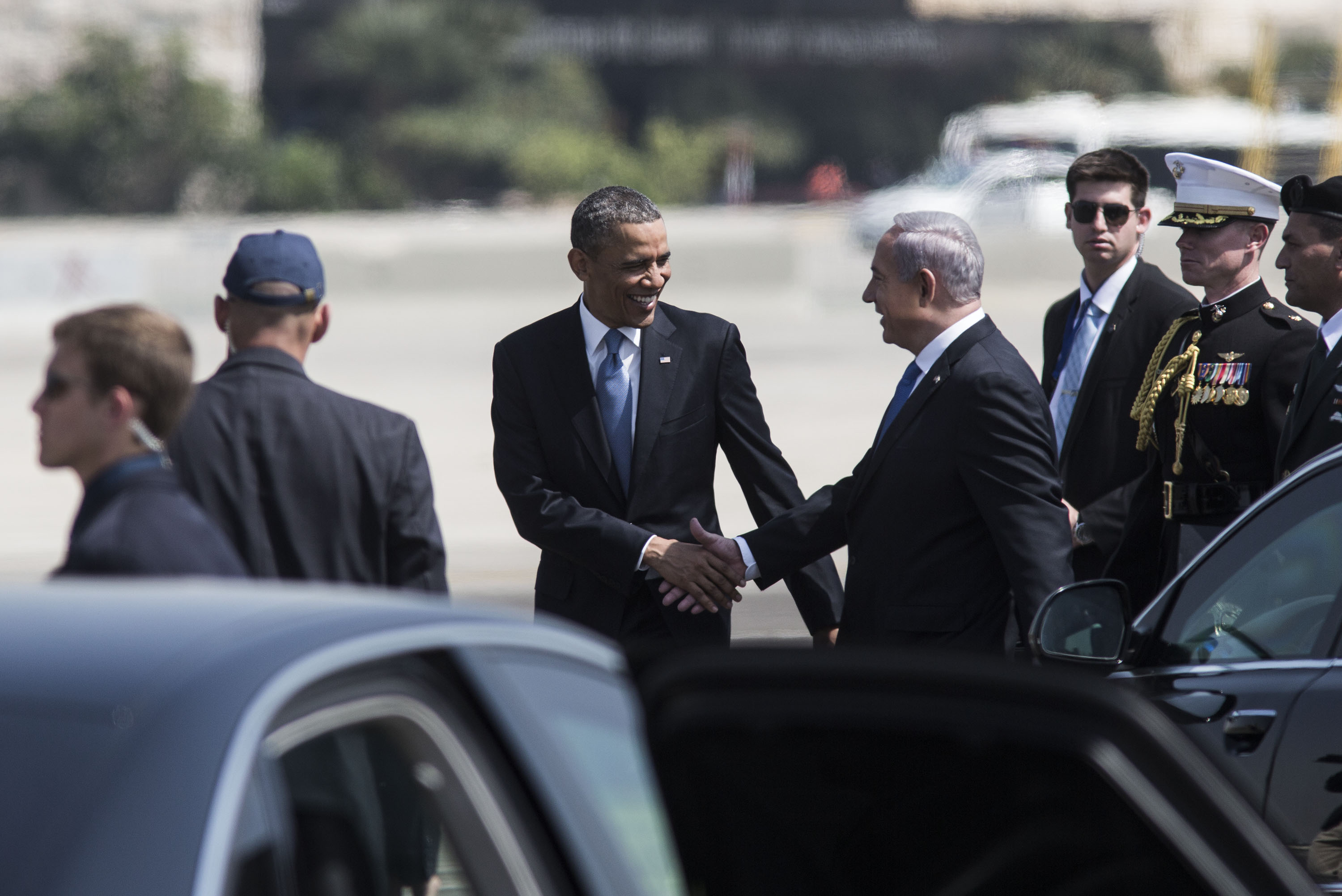
(Photo: US President Barack Obama shakes hands with Israeli Prime Minister Benjamin Netanyahu during an official welcoming ceremony on his arrival at Ben Gurion International Airport on March 20, 2013 near Tel Aviv, Israel. By Ilia Yefimovich/Getty Images)

Netflix Adultery

Maureen O’Connor confesses:

Three weeks ago I cheated on my boyfriend. He was perhaps twenty feet away from me, sleeping in my bed with the door open while I betrayed his trust on the living room sofa. At one point, he woke up and walked right by. “You’re not watching House of Cards without me, are you?” he asked. “No,” I lied without hitting pause. With my ear buds in, you could say Netflix was actually inside of me as my boyfriend returned to bed. I stayed in the living room and kept watching.

A few days later I confessed my crime. “But when?” he asked, at first in disbelief. “Wait, that night you stayed up late? And I asked what you were doing, and you said ‘working’? Mauree-ee-een!” Feebly, I offered to re-watch the episodes. “It won’t be the same,” he said. Overwhelmed with guilt, I lied again: “I only watched two episodes! You can catch up!” I had watched five episodes in one night and finished the season.

Yes, my husband committed adultery while I was traveling recently in exactly the same way. But he made up for it by watching it with me again. Speaking of House of Cards, readers offer feedback on my recent review of the series. One quotes me:

“It has some clumsy compressions, some melodrama, and a main character so close to Shakespeare’s Richard III I wonder whether Kevin Spacey’s breaking the fourth wall isn’t some sly reference to Richard’s chillingly fun soliloquies to the audience.” Have you not seen the BBC original?  There, the Shakespearean models are patent.

“MacBeth” is evoked in the Scottishness of Ian Richardson’s Francis Urqhardt and the chilling complicity of his wife.  The direct address to the audience is even more pronounced, and it excites the same conspiratorial engagement that the device does in “Richard III.”  What’s more, Richardson’s performance is more comical/cynical and seductive/sexy than Spacey manages (or dares).

I can only imagine the American producers played down these aspects for an audience they thought would be less familiar with the Elizabethan precursors and less likely to appreciate a theatrical device on television.  It is the loss of the Netflix version.  It strikes me as perverse to jettison an aspect that made the original series so novel. We’ve seen any number of Shakespeare plays cast in modern dress, but far fewer modern political drama presented in Shakespearean drag.

Another:

For the life of me, I can’t recall if you had mentioned seeing Kevin Spacey as Richard III when he played the role in a traveling production of the Shakespeare play, or if you were aware that he had. Spacey and/or the writers are no doubt drawing on the experience. I had the good fortune to see the play in San Francisco. He was fantastic in the role.

Another:

Not subscribing to Netflix, I haven’t seen the new House of Cards. But your comments on this series reminded me of the greatness of the British original. I own a DVD set of the original series and watch it every few years. In the British version, the anti-hero, Francis Urquhart (“FU” – subtle, huh?) seems to me to clearly be a Tory. The genius of the show is the breaking of fourth wall, as you mentioned. But this occurs most effectively early in the series, when FU is taking us into his confidence. He’s truly delighted to be so clever, and his delight sweeps the viewer along, in effect making the viewer a co-conspirator. Of course, by the end he’s not the one who’s quite so clever or ruthless.

What The Hell Just Happened In Cyprus? Ctd

CYPRUS-ECONOMY-FINANCE-EU

The Cypriot legislature has rejected the EU’s bailout deal, which would have levied a tax on savings accounts to prevent bank insolvency. The crisis has taken a Hollywood twist:

It’ll be days before banks open back up, and even then, it’s unclear if Cypriots will be able to make withdrawls. Money is so tight that the British government airlifted 1 million euros, about $1.3 million, to the tiny Mediterranean nation. That’s a lot of cash, so much that the Royal Air Force used its biggest plane, the Voyager, for the task. But this is no charity mission, and that money is not Mother England’s way of giving its one-time protectorate some milk money. (Cyprus is still a member of the Commonwealth.) It’s actually for the British soldiers stationed there, who might otherwise miss a paycheck due to the clusterfuck that is Cypriot financial system right now.

Felix Salmon runs down the options available now. He thinks Cyprus leaving the EU would be the worst result:

If you think that taxing deposits is a bad precedent, just wait until you see what happens when the world learns that a country can leave the eurozone after all.

So a lot of people are going to spend a lot of effort trying to avoid it. And judging by recent European history, some last-minute deal will manage to get cobbled together somehow. But this whole situation is horribly messy — it reminds me of the Argentine political chaos in March 2001, a few months before the country finally defaulted.

The big problem here is that there’s no overarching strategy on the part of the EU. An interviewer from Greek TV asked me yesterday whether the agreement with Cyprus represented an important change in the Eurogroup’s attitude towards peripheral countries. I had to say that it didn’t, just because that would imply that the Eurogroup has an attitude towards peripheral countries, which can change. Instead, it’s all tactic and no strategy, and the tactic is a dreadful one: wait until the last possible minute, and then do whatever’s most politically expedient at the time. It’ll probably work, somehow, in Cyprus. But it won’t work forever.

(Photo: Cypriots show their palms reading ‘No’ during a protest against an EU bailout deal outside the parliament in Nicosia on March 18, 2013. By Patrick Baz/AFP/Getty Images)

Today In Counterfactual History

A combo shows (L): Iraqi ringing a rope

Bobby Ghosh believes that Saddam would have survived the Arab Spring:

Saddam forbade satellite dishes, and economic sanctions–in place since his troops were kicked out of Kuwait in 1991–meant Iraqis could have neither personal computers nor cell phones. That meant no Facebook, no Twitter, not even text messages. And no al-Jazeera to spread the word from Baghdad to other cities. Unlike Ben Ali and Mubarak, Saddam would have had no compunction ordering a general slaughter of revolutionaries; and unlike the Tunisian and Egyptian military brass, the Iraqi generals would swiftly have complied. They had already demonstrated this by killing tens of thousands of Shi’ites who rose against the dictator after his Kuwaiti misadventure.

Max Fisher thinks that possibly “the most apt comparison for how Saddam Hussein’s Iraq would fare in the Arab Spring isn’t Syria, but Algeria”:

Though Algeria is ruled by an authoritarian, nationalist, military-aligned government, and though popular discontent appears high, there has been no revolution. There are many theories for why this might be, but one of the most persuasive comes down to uprising exhaustion. The county endured an awful civil war from 1991 to about 1999, which the regime won. In the thinking of some Algeria analysts, the legacy of that conflict has left the would-be protesters too tired, too wary of bloodshed and too weak to rise up again. In this thinking, the case for Hussein’s survival isn’t that he would crush an uprising, but that the uprising, like in Algeria, would never really happen.

(Photo: A combo shows (L): Iraqi ringing a rope around a giant bronze statue of toppled Iraqi president Saddam Hussein in Baghdad’s al-Fardous (paradise) square on April 9, 2003. (R): Iraqi women sitting under the newly erected ‘Statue of Hope’ at the square that has taken the place of the former statue of Saddam. By Ramzi Haidar (L) and Timothy A. Clary (R) /AFP/Getty Images)

The Reputation Economy

Om Malik wonders what effect the ability to rate everything will have on employer-employee dynamics. He notes that freelance drivers for Uber, the app that connects people to luxury car service, protested after their “accounts were deactivated because of passenger feedback”:

It is easy to understand [Uber co-founder and CEO Travis Kalanick’s] standpoint – our customers don’t like these drivers, so we are cutting them out. And I can understand the drivers’ point of view: They have never been rated and discarded like this before, and are rightfully angry. … In the industrial era, labor unrest came when the workers felt that the owners were profitting wrongfully from them. I wonder if in the connected age, we are going to see labor unrest when folks are unceremoniously dropped from the on-demand labor pool. What are the labor laws in a world where workforce is on demand? And an even bigger question is how are we as a society going to create rules, when data, feedback and, most importantly, reputation are part an always-shifting equation?

Meanwhile, in an effort to highlight the benefits of this “state of connectedness,” Ryan Lawler points to a recent case in which an Uber driver was accused of sexual assault:

Do a quick search on Google or Google News for “cab driver rape” and you’ll find no shortage of articles detailing such cases. What stands out about the news stories in those links is the unfortunate and sad truth that sexual assaults by taxi drivers are not as unusual as they should be.

But Uber’s got something that regular taxi or limo services don’t have. So do SideCar and Lyft. They have an identity system that connects a driver to a ride. They have rating systems to help determine which drivers are doing a good job, and which aren’t. They have feedback systems through which unhappy passengers can report something that went wrong. And, in the case of a crime, they have time, date, and ride logs so they can quickly identify perpetrators. Which means, if you were a criminal and somehow got through the pre-vetting process for any of these new services, you’d have to be an absolute idiot to commit a crime while on the job.