In the most recent crime data released by the FBI, only 40 percent of documented rape cases ended in “clearance.” Clearance indicates that officers were able to close a case, either via an arrest, or in some cases due to victim non-compliance – this latter method is called an “exceptional” clearance. This percent of rape cases cleared has declined sharply since 1995, while clearance rates for murder and aggravated assault have held steady.
But the reality is far more troubling than these numbers suggest.
Earlier this year, law professor Corey Yung released a lengthy paper providing evidence that police departments are systematically undercounting rape in large cities across the country. His numbers, which he calls “conservative,” suggest that “an additional 796,213 to 1,145,309 forcible rapes of women have been reported to authorities, but police have hidden them from the public record, thereby feeding the myth of the ‘great decline’ in rape.”
On Monday, Amanda Hess hoped that reporting will soon improve:
Last year, the FBI finally updated the definition for the modern era. Rape is now defined as “penetration, no matter how slight, of the vagina or anus with any body part or object, or oral penetration by a sex organ of another person, without the consent of the victim.” Now, the FBI hopes that the statistics will finally reflect “a long list of sex offenses that are criminal in most jurisdictions, such as offenses involving oral or anal penetration, penetration with objects, and rapes of males” that had previously been erased from the big picture. The new definition also drops the “forcible” qualifier in favor of “without the consent of the victim,” encouraging jurisdictions to report rapes perpetrated without a show of physical force.
Today, the FBI released Crime in the United States 2013, its first annual report to rely on this more inclusive definition of rape. The agency estimates that when crimes involving male victims, oral and anal rape, and sexual assaults committed with objects are included, the numbers of sex offenses reflected in the UCR program could increase by more than 40 percent. That hasn’t happened yet: Because “not all state and local agencies have been able to effect the change in their records management systems” to reflect the new terminology, the 2013 numbers actually reflect an estimated 6.3 percent decrease in rapes, as calculated by the old definition.
Dara Lind further unpacks what the definition change means:
[T]he FBI now has to consider unreported rape of men. Rape of men is a tremendous problem, especially in US prisons. Some estimates have indicated that, because of prison rapes, more men are actually raped in the US than women. But prison rape is especially likely to go unreported, and it looks like that’s a huge issue for the FBI. Among the 14 states that sent detailed reports to the FBI last year, there was one rape of a male for every 44 rapes of females. So if the FBI’s definition of rape is going to include rapes of men in practice, not just in theory, it’s going to have to figure out how to get a better handle on prison rape.
If you haven’t already, take some time this weekend to read David Remnick’s article on Israeli President Reuven Rivlin, the shaky status of the two-state solution, and the resurgent chatter about an alternative. Remnick explores the history of the one-state idea and interviews a wide range of Israeli and Palestinian figures – from Sari Nusseibeh to Caroline Glick – on why it’s in the headlines again. No excerpt quite captures the substance of the piece in its entirety, but here’s the gist of it:
The one-state/two-state debate is highly fraught not least because of proximity. Too much history, too little land. This is not India and Pakistan; the map of Ireland is a veritable continent compared with Israel and the Palestinian territories. Gaza is about as close to Herzliya as Concord is to Hanover; the West Bank, as Israelis are quick to point out, is seven miles from Ben Gurion Airport. Any two-state solution with a chance of working would have to include federal arrangements not only about security but also about water, cell-phone coverage, sewage, and countless other details of a common infrastructure. Talk of a one-state solution, limited as it is, will never be serious if it is an attempt to mask annexation, expulsion, or population transfer, on one side, or the eradication of an existing nation, on the other. Israel exists; the Palestinian people exist. Neither is provisional. Within these territorial confines, two nationally distinct groups, who are divided by language, culture, and history, cannot live wholly apart or wholly together.
Meanwhile, escalating violence in Jerusalem and elsewhere – centered as usual on the Temple Mount/Haram al-Sharif – has raised fears that a third Intifada may be afoot.
The situation in the city got precarious enough last week that Israel temporarily restricted access to the holy site, leading to widespread protests and prompting an emergency meeting of Netanyahu, John Kerry, and Jordan’s King Abdullah (the restrictions were lifted today):
Jordan recalled its ambassador to Israel last Wednesday in protest at what it described as “the increasing and unprecedented Israeli escalation in the Noble Sanctuary and the repeated Israeli violations of Jerusalem,” the Jordanian state news agency reported. Netanyahu called Abdullah last Thursday, assuring him that Jordan’s special status regarding the Temple Mount and the Muslim holy places in Jerusalem, as specified in the peace agreement between the two countries, would be preserved.
Like many of Remnick’s sources, Daniel Gordis is bearish on prospects for peace at the moment, especially after the latest Gaza War:
There is simply no incentive for Israelis to compromise. What’s in it for them? they ask. Would a deal neutralize Iran’s quest for a nuclear weapon? Would it stop Islamic State? Then why move the border closer to Israel’s capital and international airport? France may soon recognize a Palestinian state, as Sweden recently has, but none of that will change life for ordinary Palestinians. Israelis and Palestinians have lost all goodwill. The Israeli administration detests Obama and believes that a renewed poisonous attitude to Jews and Israel in Europe makes European capitals anything but fair arbiters. And with the Arab street ever more radicalized, the other side is no more inclined to be accommodating.
And Mazal Mualem wonders how long Netanyahu’s popularity can last, given the state of things:
The Protective Edge campaign that lasted 50 days and undermined the personal security of Israeli citizens from the Gaza envelope to the Tel Aviv area put the veteran prime minister in a new situation. He can no longer flatter himself that there was no war during his term of office, versus Olmert, who fought two. Netanyahu is now responsible for the longest round of fighting in Gaza, a campaign that brought no clear victory and did not tilt the balance.
Netanyahu faces what is emerging as a third intifada. Soldiers and young Israelis are being murdered in central Israeli cities in stabbing and vehicular terror attacks; Jerusalem is burning while concrete blocks and police are posted in bus and train stations. The atmosphere in Arab localities within the Green Line is tense, explosive. What will Netanyahu tell Israeli citizens in the coming election campaign that will probably take place in 2015? That he defeated Hamas? That he brought security? That he “forged a secure peace”?
No, nothing to do with Social Justice Warriors; the Dish has covered the subject of diversity in the superhero genre since the summer. The latest: Breaking Bad director Michelle MacLaren is in top contention to direct the upcoming Wonder Woman movie. Jesse David Fox notes that “MacLaren would be the first female director in the recent history of major comic-book movies.” Homeland’s Lesli Linka Glatter and The Babadook‘s Jennifer Kent are also in contention. Sean O’Connell speculates on the challenges a female director could face with the project:
The pressure to deliver on the superhero front is being given as a reason why one female director, Lexi Alexander, says she’d never accept the Wonder Woman gig that’s currently being set up at Warner Bros. Alexander hasn’t been offered the job, even though her name is frequently attached to wish-list features (like one we ran recently) because of the work she did on the gritty, bloodthirsty Punisher: War Zone. But in an interview with Fast Company, she spells out why the pressure to deliver on the first female-driven superhero film would be too much to get her into the director’s chair:
We finally get Wonder Woman with a female director: imagine if it fails? And you have no control over marketing, over budget. So without any control, you carry the fucking weight of gender equality for both characters and women directors. No way.
Not exactly a profile in courage. O’Connell continues:
Who will fanboys blame if Wonder Woman isn’t good? If Lexi Alexander feels this way and willingly shares this concern, is it possible that other qualified contenders like Jane Goldman or Michelle MacLaren share this early concern and don’t want to step off of that ledge? I certainly hope this isn’t the case.
I’d like to believe that there are big enough ideas at play in a possible Wonder Woman movie that any director – male or female – could dial in and turn the material into a hit. Audiences are extremely receptive to superhero films, at the moment, and even “failures” like The Amazing Spider-Man 2 earn north of $700 million at the global box office. Wonder Woman seems destined to succeed, just off the curiosity factor, alone. If the studio goes ahead as planned and makes it a period piece – a la Captain America: The First Avenger – the interest level could even be higher than expected.
At the same time, any director contemplating the solo Wonder Woman movie has to deal with a handful of unknowns at the moment. They haven’t see [lead actress] Gal Gadot in action. They don’t know, fully, how the character will be introduced in Zack Snyder’s Batman v Superman: Dawn of Justice. And they don’t know how the movie landscape will change between now and 2017. But that isn’t about being a female director trying to get a foot in the door of the comic-book genre. That’s about being part of the mysterious process of building a Cinematic Universe… and that comes with it’s own unique forms of pressure.
There’s no rule that says that a Wonder Woman movie being about a woman means it has to be directed by a woman. Down that road lies ache; down that road lies “well, then I guess Kathryn Bigelow can’t direct an Aquaman movie, nyah.” The issue is more, for me, that I’ve lost all belief that they’re anywhere close to entrusting a male superhero to a female director, so it’s either this or nothing for the indefinite future.
Anybody tells you different, politely get up and excuse yourself from the room, walk briskly to the elevator, and then sprint out of their building (unless the person is your boss, then just sit there and nod your head like one of those toy dogs in the back of a car).
Josh Marshall makes the point that he didn’t set out to specifically execute a content marketing strategy. That push came after looking at the marketplace. It’s about something all good journalists know, what he calls “high information,” even if the ad information is plainly commercial: “Content marketing is something we fit into this concept. Content marketing is part of high information messaging, and high information ad creation.”
If you have any idea what he’s talking about, you’re, well, far more worldly and better informed than I. But it’s winning:
Making good on a base-baiting campaign promise, Wisconsin Governor Scott Walker plans to push forward with a law that would impose stringent drug testing requirements on welfare recipients:
In Wisconsin, an estimated 836,000 people receive FoodShare benefits, about 40 percent of them children, according to the state Department of Health Services. As of last week, 39,958 people had filed weekly unemployment compensation claims, according to the Wisconsin Department of Workforce Development.
Gillespie calls Walker’s crusade morally repellent, but that’s not the half of it:
Walker is supposed to be tight with a penny, right? That’s part of his, er, charm. Yet his sort of drug-testing is not only repellent on ethical grounds, it’s a clear waste of money.
If a recent program in Missouri is any indication, Wisconsin will be collecting urine by the bucketful to catch very few bad actors (and that assumes smoking dope, say, should be a reason to pull somebody’s benefits). Last year, Missouri started testing suspected drug users (note: suspected, meaning there was at least some hypothetical reason to think a person was using drugs). The state ended up spending $500,000 to test 636 people, of which 20 were found to be using. So around 3 percent of suspects tested positive and each test cost around $786. Before courts ruled Florida’s drug-testing regime illegal, the Sunshine State spent $115,000 on piss tests and ended up coughing up $600,000 in reimbursements to applicants who had been denied benefits.
The Dish has previously covered why these drug testing laws are terrible ideas. Alan Pyke reviews further evidence that they have no basis in reality:
While food stamps recipients are a bit more likely to use drugs casually than the general population according to one study, age is a far better predictor of drug use than economic status or public assistance enrollment. And the raw numbers are too low to justify a dragnet policy of testing everyone who applies, according to critics at the American Civil Liberties Union (ACLU) and the Centre for Addiction and Mental Health in Canada. Just 3.6 percent of welfare recipients qualify as having a drug abuse or dependence problem according to 2011 data. About 8 percent of Americans and 9 percent of Wisconsin residents used drugs in the past month, according to the National Survey of Drug Use and Health.
A federal judge struck down Florida’s infamous drug testing law in January on the grounds that it violated the Fourth Amendment. Even Noah Rothman admits that what Walker is proposing is likely unconstitutional:
Unlike Walker’s union reforms, which inspired a similar level of apoplexy in his Democratic opponents, these reforms may be a legitimate violation of constitutional rights. The state Supreme Court vindicated Walker’s collective bargaining reforms, but the conservative reformer may be setting himself up for a rebuke from the courts with his latest move. While states have slightly more freedom to experiment with similar reforms, federal law prohibits drug testing prospective beneficiaries. In September, Walker told the Milwaukee Journal-Sentinel that he welcomes a fight with the federal government over his proposed reforms. “We believe that there will potentially be a fight with the federal government and in court,” Walker said.
Why would Scott Walker want to set up a fight with the courts and the federal government? The answer seems clear. These reforms are rather popular with base Republican voters, and the institutions which would oppose Walker’s reform are not. This is a pretty clear indication that Walker is interested in translating his successes in Wisconsin into the Republican presidential nomination.
The faux outrage you are drumming up is ridiculous. People are ignorant because Gruber (and Bill Maher) are right: the American public is stupid. All you have to do is look at Jimmy Kimmel’s skit about Obamacare vs the Affordable Care Act or “keep your government hands off my Medicare.” Why do the individual pieces of the ACA poll so well, but the overall law does not? It makes no sense, and no the answer is not the Dems didn’t educate; the answer is people are too effing lazy to learn the truth and are too easily manipulated by nihilists and liars because they choose to remain uneducated. The only thing stupid here was Gruber deciding to pull back the curtain; it would have been better keeping the rubes in the dark.
America should be run by elites. No, that does not mean rich or wealthy, but it does mean smarter and more knowledgeable. It is beyond reason why I, as someone who takes pride in my thirst for knowledge (see reading your blog daily), have to deal with morons who are intellectually lazy yet have the ability to thwart basic and good things that would help me, people I care about, and worse, the people too stupid to understand they are actually being helped. I hate liberal paternalism as much as you do, but sometimes you just need to get shit done.
Another shares that disdain for most Americans’ intelligence:
I would say the fact that the elite journalists treat America as smarter than they are is a big problem. At this point, if the American people don’t understand Obamacare, it is on them. You have the following statistics coming from your gloriously under-appreciated smart public:
According to a survey by the Kaiser Foundation just last year (April), 42 percent of Americans didn’t even know Obamacare was still a law on the books. Some (12 percent) thought it was already repealed by Congress while others (7 percent) believe the Supreme Court overturned it. So why even lie about something that many likely still believe doesn’t exist in the first place? Here’s a few more fun yet disturbing findings to chew on:
– 65 percent can’t name a single Supreme Court justice (Annenberg Public Policy Center). Best part: 27 percent knew Randy Jackson was a judge on American Idol.
– 36 percent of Americans can’t name all three branches of government. Best part: 35 percent can’t name a single branch, period (Annenberg)
But I guess Obama holding a joint session of Congress to explain Obamacare while being called a liar in public is just him not explaining it right.
The point of messaging on this kind of thing is that it should be constant, clear and endlessly repeated. You can’t just give one big speech and expect people with busy lives to keep it in their heads. It can be done – and must be done if this democracy is to mean anything. Another is a bit more nuanced:
Voters are stupid. I would have used the word irrational, but stupid gets the point across. I’m stupid, you’re stupid, most everyone is stupid. One common example of the particular brand of stupidity that economists love to ridicule is loss aversion; if I gave you ten dollars then demanded five back, you would be much less happy then if I just gave you five dollars. If you ask people if they’d rather have a mortgage rebate (free money for owning a house!), or a tax penalty for those people that do not own a home, there would be a pretty clear split. But as long as the government’s books eventually balance, those are the same thing.
Gruber seemed to be saying that people respond irrationally to how things are phrased, so the ACA decided not to raise everyone’s taxes and then give people a rebate for having insurance, even though that would be completely equivalent to the mandate. They also chose not to just tax healthy people and send checks to the less healthy, even though that would have some of the same effects as ending preexisting conditions. You could argue that one way is more or less honest (personally I think the mandate makes sense to the extent that having insurance is a social obligation), but it’s fine to choose the way that most people are comfortable with.
Another reviews some recent history:
One point, somewhat cynical, that I see no one making about the Gruber statement is the fact that whatever misleading arguments were trotted out in support of the ACA while it was being debated in Congress, at least as many misleading arguments were proffered in opposition. The Politifact page for health care is illuminating on this subject, and a good refresher if you fail to recollect how disingenuous the campaign against the bill was.
There was all sorts of general talk about socialized medicine and a government takeover of a sixth of the American economy that is deeply misleading, much more so in my opinion than the esoteric debate over what is a tax and what is a mandate. But beyond generalizations, there were a number of VERY SPECIFIC claims made about the bill, from the notion that it contained “death panels” set up to deny care to elderly patients deemed no longer useful to society, to the assertion that abortions would be directly paid for by tax dollars in contravention of the Hyde Amendment, to Allen West’s bizarre claim that the health care law allowed the federal government to take over education. My favorite of course is the lie that the bill covered the healthcare of undocumented workers, so pervasive that President Obama had to reference and deny it in a speech to a joint session of Congress, only to have a Congressman, falsely, shout “You Lie!” on national television.
These statements did not come from policy experts not directly connected to the ACA or Congress. They came from elected representatives, party officials, and others who should be held to a much higher standard than Jonathen Gruber.
Look, I would have loved nothing more than to have an honest debate in this country about the benefits and trade-offs of the ACA. I would have loved to have had a serious discussion of alternatives, either the ephemeral conservative version or even actual, single-payer socialized medicine. I believe the country would have been much better served, and much less divided, by an honest assessment of the existing situation and exploration of various policy fixes, but that was just never, ever in the cards.
Since the opposition to the bill was ideological, rather than pragmatic, there was just no constructive discussion to be had. And you can’t have that kind of debate when only one side is engaged. You can’t have one side saying “LARGEST TAX INCREASE IN AMERICAN HISTORY” while the other side says, “well, technically not the largest, but in the top dozen or so, if you count the mandate, which isn’t quite right but probably fair, and hey, it’s not like you get nothing in return. Listen…” That’s just lousy politics.
So yes, the President and his allies, Gruber included, sold the best possible (self-serving) narrative to the American voter. This was at at times misleading. The most prominent examples are the “if you like it, you can keep it” fib and the repeated Gruber Gaffes, but in a political environment where much of the oxygen was spent debating ludicrous, unhinged assertions about jack-booted thugs, a sober cost-benefit analysis just wasn’t going to cut it, if the goal was to improve the lives of uninsured Americans, rather than winning on points in Debate Club.
The AP reported yesterday that leaders of ISIS and Jabhat al-Nusra, al-Qaeda’s Syrian affiliate, have agreed to set aside their intra-jihadi feuds and cooperate against their enemies:
According to [a source], two decisions were reached: First, to halt infighting between Nusra and IS and second, for the groups together to open up fronts against Kurdish fighters in a couple of new areas of northern Syria.
This merger, along with growing signs that Washington is resigning itself to Bashar al-Assad’s long-term presence, could be an indication that the overlapping and intersecting battle lines in Syria are starting to clarify themselves. At the moment, the U.S., the Kurds, Iraqi Shiites, and—whether the Obama administration will admit it or not—the Syrian government are on one side, and ISIS and al-Qaida are on the other. The big loser in all of this is likely to be the U.S.-backed rebels.
In addition to ISIS and Nusra finding common cause, there are reports this week that the White House is considering revamping a Syria strategy many senior officials have come to see as unworkable. That strategy, which involved focusing primarily on rolling back ISIS in Iraq and didn’t involve strikes against Assad, never sat well with the rebels. A new one, which could involve a new diplomatic push for a cease-fire deal whose terms would likely be very disadvantageous to the Syrian opposition, would be even worse.
But Aymenn al-Tamimi recommends taking these reports with a grain of salt:
The rift between JN and IS is too great to heal at this point beyond the highly localized alliance between IS and JN in Qalamoun that reflects an exceptional situation where neither group can hold territory alone and both contingents are geographically isolated from members of their groups elsewhere in Syria, in addition to being preoccupied with constant fighting with regime forces and Hezbollah. At the broader level, IS still believes that JN is guilty of “defection” (‘inshiqāq) from IS in refusing to be subsumed under what was then the Islamic State of Iraq [ISI] to form the Islamic State in Iraq and al-Sham [ISIS] back in April 2013. The zero-sum demands of IS have only solidified with the claimed Caliphate status since 29 June demanding the allegiance of all the world’s Muslims. In turn, JN refuses even to recognize IS’ claim to be an actual state, let alone a Caliphate.
In response to this and other recent developments, Gopal Ratnam hints that the Obama administration is “edging closer to establishing a safe zone in northern Syria” for our “moderate” rebel allies:
Setting up such safe zones inside Syria will also address a key demand by Turkey, which sees the Assad regime as a greater threat than the self-proclaimed Islamic State, and has been pushing the United States to set up such areas as a condition for fuller participation in the coalition against the Sunni militant group that is also known as ISIS and ISIL. “If these safe havens are not established in northern Syria, the rebels will be effectively squeezed out by the Assad regime in a short time,” said Soner Cagaptay, director of the Turkish research program at the Washington Institute for Near East Policy. “So this is a last call to maintain and preserve rebel presence in northern Syria.”
Meanwhile, rumors that “caliph” Abu Bakr al-Baghdadi had been injured or even killed in an airstrike were thrown into doubt with the release of a new audio recording of Baghdadi that refers to recent events:
The timing of the recording was unclear, but it referred to Barack Obama’s recent decision to send a further 1,500 US military advisers to train the Iraqi army and to a pledge of allegiance by Egyptian jihadis to the Islamic State last weekend.
In a triumphant survey of what he described as the group’s growing influence, the speaker also mentioned support from Saudi Arabia, Yemen, Libya, Algeria, Tunisia and Morocco. In Saudi Arabia, singled out in the message as the “head of the snake and stronghold of disease”, people were urged to “draw their swords” to fight and to kill Shia Muslims – referred to in pejorative sectarian terms as “rafidah”. Shia worshippers were indeed attacked in a terrorist shooting in the country’s Eastern Province 10 days ago.
The behemoth distributor and the small publishing house settled their long-running dispute over e-book pricing in a deal announced yesterday. While the details of the agreement weren’t made public, David Streitfeld reports that it “broadly follows a deal Amazon recently worked out with Simon & Schuster”:
A source with knowledge of that deal said it was negotiated relatively quickly and gave the publisher control over most of its pricing but offered incentives to sell at lower prices. Amazon got increased co-op funds, the payments for placement on the retailer’s website. Simon & Schuster declined to confirm the terms.
James L. McQuivey, a Forrester analyst, said that if Hachette won in the short term, it would be a different story in the long run. “Hachette got Amazon to allow them to control pricing while also cutting the amount of money Amazon takes if the publisher does engage in discounts, which appears like a victory,” the analyst said. “But in the end this all cements Amazon’s ultimate long-term role in this business, which will only put Hachette right back in this situation every time they are up for renegotiation.”
The deal is undoubtedly good news for Hachette’s authors, but Hillary Kelly is disappointed that the publishers “forfeited all of the gains they had made in the larger battle against Amazon”:
While it certainly would have hurt Hachette in the short-term to keep up the battle, they should have. What’s at stake here is much bigger than the price of e-books. If Amazon continues to interfere in publishers’ pricing decisions, publishers will be forced to produce more and more high-revenue yielding books, which means decisions about who gets published and who doesn’t will trend even further toward who can sell a lot of books and who can’t. That means the variety of books in the marketplace diminishes even further, and readers see fewer and fewer high-risk, high-reward books on physical and digital shelves.
Amazon has proven they can turn off the faucet whenever they please. Hachette could have proven that, with enough support from their friends in the publishing industry, they can force Amazon to keep the water flowing. But they missed their opportunity.
Krugman insists that the “agreement between China and the United States on carbon emissions is, in fact, a big deal”:
[T]he principle that has just been established is a very important one. Until now, those of us who argued that China could be induced to join an international climate agreement were speculating. Now we have the Chinese saying that they are, indeed, willing to deal — and the opponents of action have to claim that they don’t mean what they say. Needless to say, I don’t expect the usual suspects to concede that a major part of the anti-environmentalist argument has just collapsed. But it has. This was a good week for the planet.
Douthat, on the other hand, downplays the importance of the agreement:
Symbolism and public leadership do matter in international affairs, even if they don’t necessarily matter as much as climate hawks (like other sorts of hawks) persistently believe. But nothing about this widely-hailed bargain as yet invalidates the basic case for skepticism about the quest for a global climate regime, because nothing about China’s actions as yet invalidates the argument that the globe’s diverse group of developing-world actors are only ever likely to act to explicitly cap emissions when it seems to be in their immediate national interest (or when, as in this case, that “cap” may just a description of a trend), and that they are therefore very unlikely to be meaningfully bound by international rules or regulations that in any way directly constrain their ability to emit as their economies seem to require.
Being skeptical of climate change regulations in this sense does not mean believing that no developing nation’s emissions will ever level off or fall, or that no developing nation will ever take steps to limit their emissions. Indeed, the skeptics assume that both will happen, as those nations get richer, technology advances, domestic constituencies for environmentalism develop and so forth. They’re just doubtful about the power of diplomacy and international treaties and carbon regimes to meaningfully accelerate this process (as such regimes have mostly notto date in contexts far more promising than the People’s Republic of China). And with that doubt, in turn, comes a skepticism about the wisdom of having the United States take steps on its own that don’t necessarily pass a domestic cost-benefit test in order to somehow set up a larger process that probably isn’t going to work anyway, and that our rivals will have every incentive to seek to game in order to gain at our expense.
But Ryan Cooper thinks China has good reason to act:
China is very seriously vulnerable to climate change. It could gut the nation, taking the ruling Communist Party down with it. Fifty million or more Chinese citizens could be displaced by rising seas in the coming decades. Drought and desertification, both fueled by climate change, will cause havoc with China’s water supply and farmland, which are both already insecure. Additionally, China’s reliance on filthy coal power is responsible for jaw-dropping environmental problems, causing a reported 670,000 deaths annually, and many times that number of respiratory illnesses.
All this points towards a massive Chinese self-interest in slashing emissions as fast as possible.
Looking at the previously announced energy and climate policies of both the U.S. and China, the new pledges appear to add little to their existing plans to reduce their emissions. The new Obama pledges basically track the reductions that would result from the administration’s plan to boost automobile fuel economy standards to 54.5 miles per gallon by 2025 and the Environmental Protection Agency’s new scheme to cut by 2030 the carbon dioxide emissions from electric power plants by 30% below their 2005 level. Xi was no doubt aware that a week earlier an analysis of demographic, urbanization, and industrial trends by Chinese Academy of Social Science had predicted that China’s emissions peak would occur between 2025 and 2040.
Supporters hope that the joint announcement is the prelude to a “great leap forward” to a broad and binding global climate change agreement at Paris in 2015. Perhaps, but the U.S. and China left themselves plenty of room to step back if their pledges become inconvenient.
Ben Adler doesn’t want to “let the enemy be the perfect of the good”:
Senate Republicans have made it impossible for Obama to sign a binding treaty to reduce emissions, because they wouldn’t vote to ratify it. So now that Obama has made a non-binding agreement with the world’s largest carbon polluter, they criticize it for … not being a binding treaty. Speaking on Fox News, Peter Brookes of the Heritage Foundation cynically asked, “How are you going to monitor it? Is there any enforcement? Will the Chinese abide by the agreement?” No sir, there is no enforcement mechanism, because your favored party would never vote for an agreement that contained one. But we can track progress — as China builds wind farms and solar arrays, they won’t be invisible.
And Elizabeth Economy thinks the “real win for U.S. President Barack Obama is keeping China in the tent or, in political science speak, reinforcing Beijing’s commitment to the liberal international order”:
The real takeaway from the Obama-Xi meetings at the Asia-Pacific Economic Cooperation (APEC) summit is that China has put itself back in the U.S. game. The entirety of the package—extending visas, establishing rules of the road for maritime and air encounters in the western Pacific, reducing or eliminating tariffs on as many as two hundred information technology goods, and pledging to do more on climate change—is a win for the United States. That doesn’t mean it is not a win for China too; it is. It is just a win that binds China more deeply to U.S.-backed international security, trade, and environmental regimes.
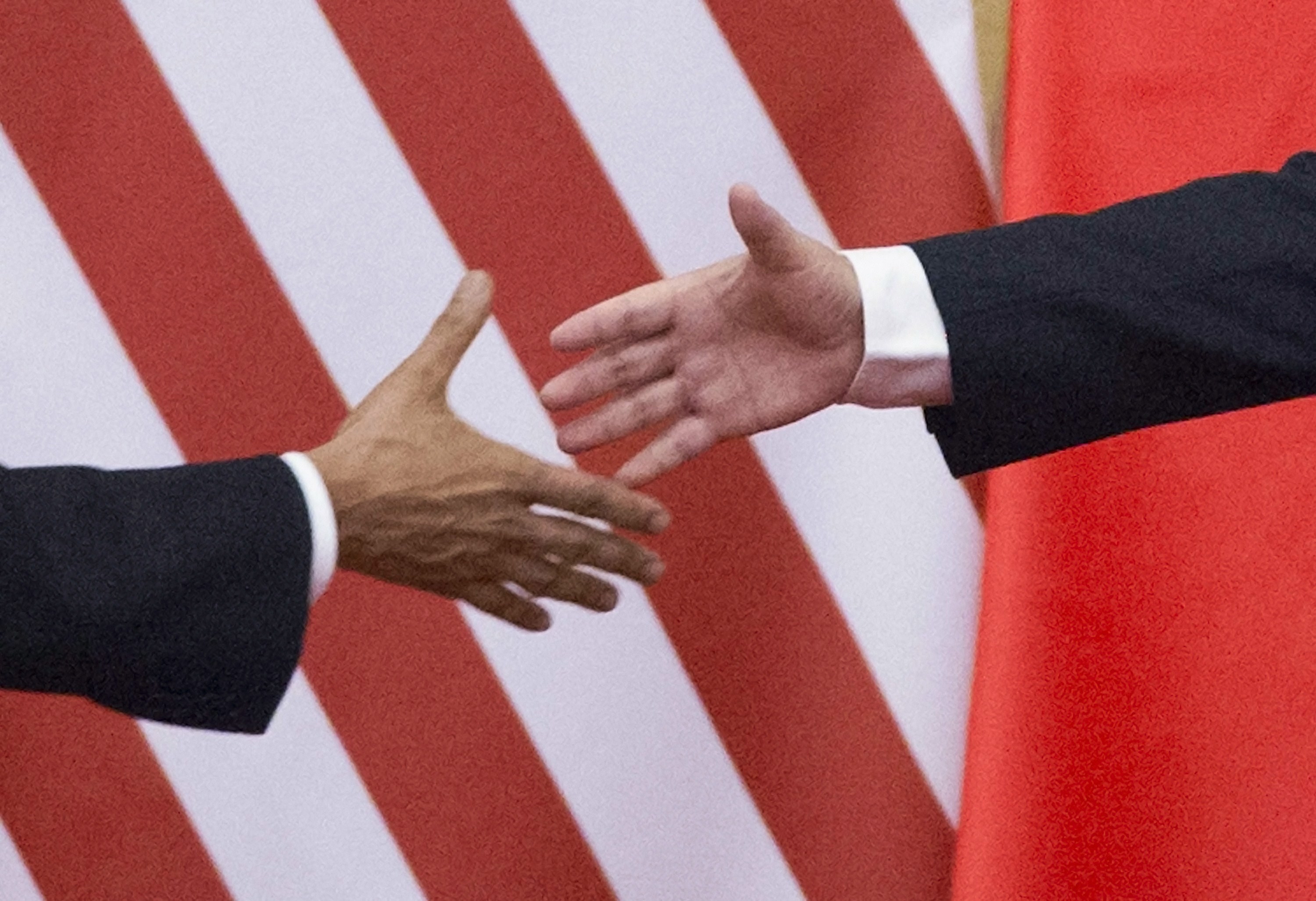
(Photo: US President Barack Obama and China’s President Xi Jinping reach out to shake hands following a bilateral meeting at the Great Hall of the People in Beijing on November 12, 2014. By Mandel Ngan/AFP/Getty Images)
Yesterday, administration officials leaked that Obama still intends to go ahead with executive action on immigration, and may roll out his order as soon as next week:
One key piece of the order, officials said, will allow many parents of children who are American citizens or legal residents to obtain legal work documents and no longer worry about being discovered, separated from their families and sent away. That part of Mr. Obama’s plan alone could affect as many as 3.3 million people who have been living in the United States illegally for at least five years, according to an analysis by the Migration Policy Institute, an immigration research organization in Washington. But the White House is also considering a stricter policy that would limit the benefits to people who have lived in the country for at least 10 years, or about 2.5 million people.
All in all, the NYT reports, up to five million undocumented immigrants could be protected from deportation. Waldman sees the logic behind the plan:
What’s significant about that isn’t just that it covers millions of people, but where the focus is: keeping families together.
Obama could have gone farther and extended protection to people without children who had been here a certain length of time, but it’s no surprise that he would want to lead with changes to the immigration system that stand a strong chance of getting wide support among the public. Nobody likes to see families broken up, and if you’re looking for a sympathetic face of undocumented immigration, you can’t do much better than an American kid who is terrified that his parents will be deported.
Needless to say, Republicans are apoplectic. John Boehner is considering tacking immigration onto his proposed lawsuit against Obama, and yesterday’s revelation gave several of the GOP’s 2016 hopefuls the opportunity to slam the president on this issue once again:
Sen. Marco Rubio (R-Fla.) is calling the plan a “terrible idea,” warning it would badly damage any possibility of compromise on immigration legislation. “As someone who supports immigration reform, that wants to see us achieve something, I believe it will set us back. I believe it will make it harder for us to achieve the sorts of reforms our country needs,” Rubio told reporters on Thursday. “It will be deeply divisive. I’ve been saying that for months, and I’m glad others are beginning to say the same thing because it’s true. If he takes executive action, I believe it will make it harder, even impossible in the short term, to achieve what we’re trying to achieve in immigration reform.”
Mataconis believes “the President’s current position is politically unrealistic if the he really wants Congress to pass an immigration reform bill”:
Whether he likes it or not, the bill that passed the Senate is dead. It probably would not have passed the House in any case, but it most certainly would not pass during a lame duck session. More importantly, it would not pass the new Senate that will take office in January. Rather than setting up a confrontation based on a bill that will be dead once the current Congress ceases to exist, the answer will be to start over in a new Congress. Which means that the new bill will have to be something that can pass both the House and the new Senate. That is a political reality that the President doesn’t seem to recognize. Of course, that assumes that he is making this threat because he wants to see Congress act. I don’t think he does. I think that, like every other Democrat, he wants to keep the immigration unresolved so that his party can continue to exploit it to appeal to Latino voters.
Continetti suggests how Congressional Republicans should strike back:
Boehner and McConnell can announce a simple rule: No immigration reform if Obama commits such a brazen and unconstitutional act. No piecemeal bills. One bill: border security legislation authorizing the construction of an actual wall (call it infrastructure spending) and making E-Verify compulsory. Such measures do not preclude legalizing the population of illegal immigrants. They are prerequisites for it. They are not anti-immigrant. They are anti-illegal immigrant. They are not part of the corporate agenda of comprehensive reform, fast-track authority, and corporate tax cuts. They are part of a middle class agenda of family tax relief, sound money, and replacing Obamacare. Nor is that a weakness. It’s a strength.
Boehner and McConnell call a press conference flanked by Marco Rubio, Rand Paul, Ted Cruz, and Paul Ryan. If any Republican governors eyeing 2016 want to attend too, they’re invited — Christie, Walker, Jindal, Jeb Bush, whoever. At the presser, B&M make a short statement: The GOP intends to challenge Obama’s amnesty in court as an unconstitutional infringement on separation of powers. If, however, they lose that suit, they’ll encourage any Republican successor to O to use the amnesty precedent in other areas of policy, starting with tax reform. … The point, obviously, is that the practice of dubious executive power grabs at Congress’s expense can work for both parties. And will.
But Cillizza figures Obama is just past caring at this point:
No matter what congressional response McConnell and Boehner craft — and they are undoubtedly looking at their options right now — the most obvious and predictable outcome of Obama’s move on immigration is that any hope of bipartisanship on much of anything in the 114th Congress is probably now out of the question. Obama knows that. And it would seem he doesn’t care. Or rather, he has made the calculation that the chances of genuine bipartisanship on virtually anything was so low in the first place that it didn’t make sense to not do what he believes is the right thing.
I urge the president to delay his executive order on immigration here.


 The Dish