The Government Shuts Down: Tweet Reax

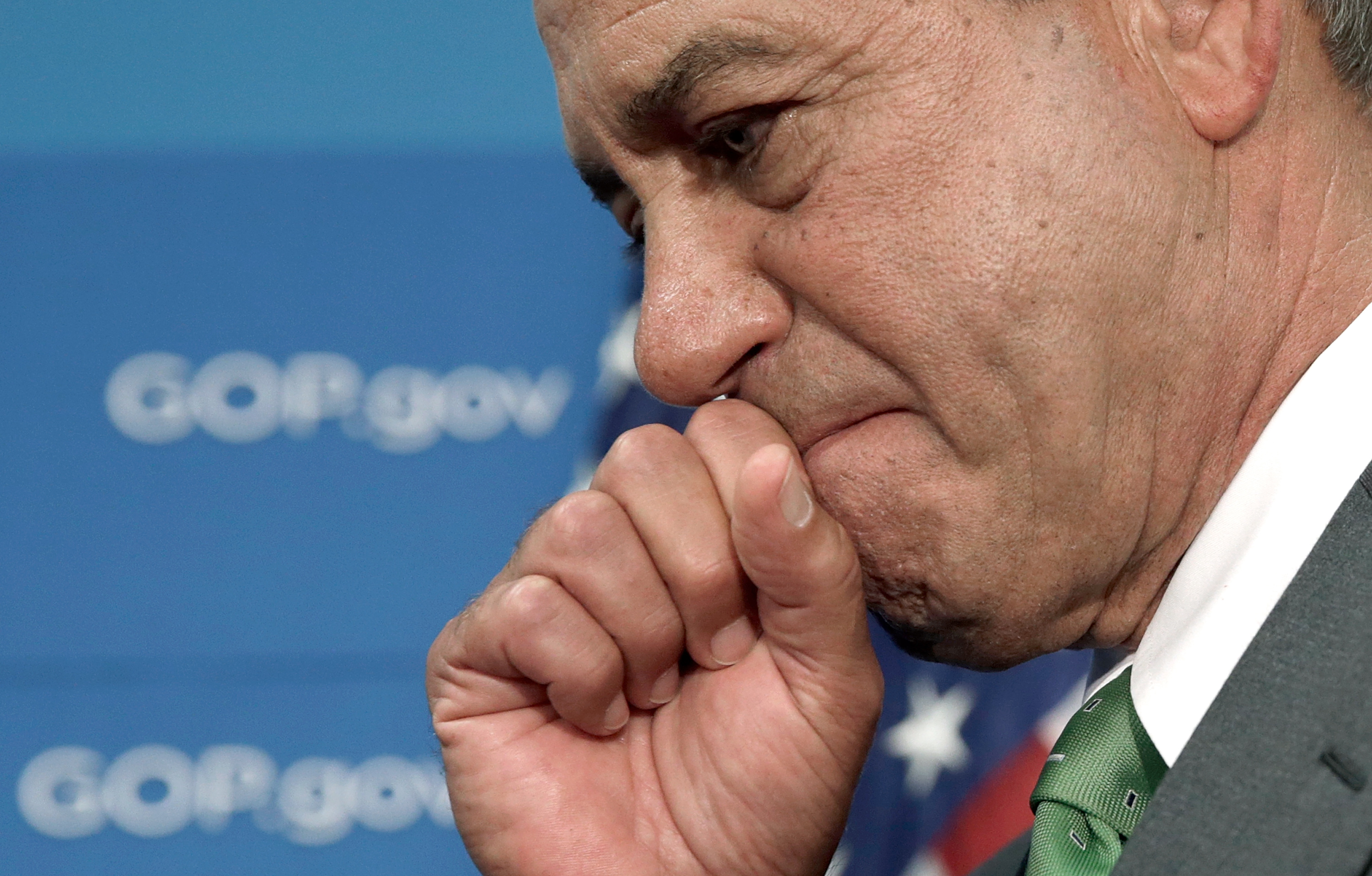
Face Of The Day

Congressional Showdown As Government Shutdown Looms

Protester Scott Osberg holds up a sign behind Republican members of Congress while they hold a press conference on the Vitter Amendment as Congress remains gridlocked over legislation to continue funding the federal government on September 30, 2013. Senate Majority leader Harry Reid has said the Senate would not vote on any legislation passed by the House to continue funding the federal government unless the legislation was free of Republican added amendments. By Win McNamee/Getty Images.

No More Mister Nice President?

Obama’s frustration with the House GOP was palpable near the end of his statement on the looming government shutdown:

http://youtu.be/SWxPT5X1BEU

David Corn had hoped that Obama would get mad:

Obama has long eschewed the partisan rancor of Washington, and maintaining an above-the-fray status has often served his political interests. But he’s never going to run for president again—avoiding the angry-black-man trap is now not as important—and desperate times do demand reconsideration of assumptions and behavior. This could well be the moment in his presidency that demands a strategic flash of anger and/or derision. Obama ought to tell us how he really feels about the House Republicans willing to close the government or trigger a default in order to undo his signature domestic law. Whatever the political impact of such a statement, it would sure have the benefit of being the truth.

The Tea Party’s Powerful Allies

Reihan fears that they are damaging the Republican party:

My sense is that the disarray and dysfunction currently on display in Congress flows from campaign finance regulations that have weakened broad-based, national political parties while strengthening solo political entrepreneurs. Many of us hope that some future Republican presidential nominee will be able to impose order on the GOP’s congressional wing. But it is just as easy for me to imagine a popular Republican president facing ferocious attacks from a minority of opportunistic legislators aided by allied independent expenditure groups.

Carney explains how outside groups apply pressure:

In Washington, it’s called the “inside-outside game”: Beltway players reach out to the grassroots to apply pressure to elected officials. When Cruz and friends do it, I call it the Tea Party Whip Operation. … Often the Tea Party Whip Operation involves outside groups such as the Senate Conservatives Fund, Heritage Action, the Club for Growth, and FreedomWorks. And these groups’ involvement is what really upsets other Republicans.

Dickerson thinks the actions of these groups helps explain why Cruz is loathed by so many of his collegues:

Cruz says he has not attacked Republicans specifically, but in his alliance with Jim DeMint, the former South Carolina senator and now president of the Heritage Foundation, he has done something more powerful. He has helped raise money to run advertisements against incumbent Republican senators.

Zeke Miller profiles Heritage Action:

Republican leadership fears it will bear the blame for government shutdown, endangering vulnerable Republicans in 2014. But for Heritage and its allies, the resonance of their message is more than a moral victory. “I think that this campaign has already been very successful in the sense that we’ve driven the narrative in the last two months about how Obamacare is literally falling apart,” Needham says. “There’s been huge national attention in the media and the grassroots. That’s a great thing for the country and a great thing for us.”

The Debt Ceiling Lacks A Shutoff Switch

A government shutdown won’t significantly delay hitting the debt ceiling:

Unlike the last government shutdowns, which came in December 1995 and January 1996, the current showdown comes at the start of a new fiscal year. October and November are important months for federal spending, with large mandatory expenditures. [Steve Bell, the senior director of economic policy for the Bipartisan Policy Center] said that regardless of a shutdown, he expects the Treasury’s extraordinary measures, which have allowed the government to manage its debt without raising the debt limit, will become insufficient to meet the government’s obligations between October 18 and November 5.

Ezra hopes that powerful interests, such as Wall Street, will force the GOP to make a deal:

One way a shutdown makes the passage of a debt limit increase easier is that it can persuade outside actors to come off the sidelines and begin pressuring the Republican Party to cut a deal. One problem in the politics of the fiscal fight so far is that business leaders, Wall Street, voters and even many pundits have been assuming that Republicans and Democrats will argue and carp and complain but work all this out before the government closes down or defaults. A shutdown will prove that comforting notion wrong, and those groups will begin exerting real political pressure to force a resolution before a default happens.

Drum asks, “what will it take to end the debt ceiling crisis?”:

Here’s a guess: a stock market crash. If we really and truly breach the debt limit without a resolution, markets will probably go crazy. In fact, they might go especially crazy because they seem so sure that it won’t happen. But that’s the one thing that always seems to get everyone’s attention. You can have failing banks, massive ranks of the unemployed, and auto giants going bankrupt—and Congress will twiddle its thumbs. But let the Dow fall a thousand points or three, and suddenly they spring into action. There are lots of ways this could end, but I wouldn’t be surprised if that turns out to be the winner.

Threatening To Destroy America Is No Way To Negotiate

Yglesias makes an apt analogy regarding negotiation with the GOP:

The whole reason Obama neither will nor can negotiate with John Boehner is that Boehner has the equivalent of the The Bomb. He’s threatening the destruction of the American financial system unless Obama implements policies that he favors. The government of Iran doesn’t have the power to make a similar threat, but the government of Russia does. Vladimir Putin could hold a press conference tomorrow and say that nuclear-armed ballistic missiles will destroy Houston, Chicago, and Indianapolis tomorrow unless Obama agrees to his list of demands.

Would it be reasonable for Obama to open a negotiation on those terms? Of course not! The content of the demands isn’t even relevant. The threat is too crazy to indulge.

Ezra weighs in:

If the Republicans just wanted negotiations, the Obama administration would be happy to oblige them.

The White House, after all, has repeatedly said they’re willing to negotiate with the Republicans over the deficit, over jobs, over sequestration, and much else. Republicans haven’t been interested in those kinds of negotiations for some time. Indeed, after the fiscal cliff, Speaker John Boehner told Republicans that he was finished negotiating directly with Obama.

The reason Republicans aren’t interested in those negotiations is they don’t want to give anything up to get the things they want. That’s why they like negotiating over the debt ceiling: Since they also don’t want the the U.S. to lose its creditworthiness and fall back into financial crisis, raising the debt ceiling is not actually giving anything up. It’s releasing a hostage they never wanted to shoot.

Norman Ornstein argues that there “is one area where Obama could and should be willing to negotiate with Republicans—to take the default option, the full faith and credit of the United States, off the table permanently”:

Institutionalizing the McConnell Rule [which allowed the president to unilaterally extend the debt limit in 2011] would be valuable enough that it should extract some real concessions from the president to achieve it. Of course, those concessions would not include any delays in the core parts of the Affordable Care Act. Mitt Romney himself made it clear what a one year delay in the individual mandate was all about, when he said to CNN on Friday, “I think there’s a better way of getting rid of Obamacare—my own view—and that is, one, delaying it by at least a year.” But there are compromises on Obamacare that make more sense. Ending the employer mandate in Obamacare, now only postponed for a year and never either an essential part of health reform nor a good idea, would be one chip to give up. Agreeing to some malpractice reform, if it aimed at reducing defensive medicine, might be another. I could even see throwing in the Keystone pipeline to get this kind of outcome.

Cowen thinks a smaller, attainable victory for the GOP would be good politics:

The GOP, from its budget strategies, might manage to repeal the medical devices tax.  Repealing a tax, and chipping away at ACA, is in this setting a major victory for them, especially given that right now they are not winning so many victories.  It doesn’t matter so much that the medical device tax repeal would be relatively small in its impact.  “We forced the repeal of one part of Obamacare” is a big symbolic victory.

This Isn’t Politics As Usual

Fallows describes what is happening on the Hill as “a ferocious struggle within one party, between its traditionalists and its radical factions, with results that unfortunately can harm all the rest of us — and, should there be a debt default, could harm the rest of the world too”:

As a matter of politics, this is different from anything we learned about in classrooms or expected until the past few years. We’re used to thinking that the most important disagreements are between the major parties, not within one party; and that disagreements over policies, goals, tactics can be addressed by negotiation or compromise.

This time, the fight that matters is within the Republican party, and that fight is over whether compromise itself is legitimate. Outsiders to this struggle — the president and his administration, Democratic legislators as a group, voters or “opinion leaders” outside the generally safe districts that elected the new House majority — have essentially no leverage over the outcome. I can’t recall any situation like this in my own experience, and the only even-approximate historic parallel (with obvious differences) is the inability of Northern/free-state opinion to affect the debate within the slave-state South from the 1840s onward. Nor is there a conceivable “compromise” the Democrats could offer that would placate the other side.

Josh Marshall’s related thoughts on the extremism of the GOP:

For all the ubiquity of political polarizing and heightened partisanship, no honest observer can deny that the rise of crisis governance and various forms of legislative hostage taking comes entirely from the GOP. I hesitate to state it so baldly because inevitably it cuts off the discussion with at least a sizable minority of the political nation. But there’s no way to grapple with the issue without being clear on this single underlying reality. …

Many people say that the danger is that the Democrats, reasonably enough, will adopt the same tactics once they are back in a comparable position. I worry about that too. But not that much. I think the reality is that they won’t because the sociology and mores of the parties are just different.

It has become so pervasive that I believe it’s lost on many of us just how far down the road of state breakdown and decay we’ve already gone. It is starting to seem normal what is not normal at all.

The Republican Rift

Boehner, House Leaders Speak To Press After Republican Conference Meeting

Robert Costa and Jonathan Strong report on the debate within the GOP House:

The leadership … is worried about the likely public takeaway from any shutdown: Leaders fear that national press would harp on Republicans’ supposed intransigence rather than the Senate’s responsibility. Boehner’s contingent seems almost resigned to the mutual suspicion between the leadership and a group of about 30 conservative members. Sources say distrust is as high as it’s been since Republicans won the House in 2010, and they predict that a sizable bloc would obstruct any watered-down plan.

That aura of Republican infighting will create an interesting dynamic if Tuesday morning comes without an accord. While Boehner and other leaders will be defending the GOP’s position in front of the cameras, there may be a subtle effort to use the episode — and what many expect to be its disastrous political results — as a means of discrediting the hardliners who give the speaker headaches. Conservatives, meanwhile, will try to show that the tactic is helping focus public attention on Obamacare.

Noam Scheiber expects the GOP to lose the shutdown because “unrelenting criticism from fellow Republicans and conservatives is inevitable in these episodes, and it is completely crippling”:

Some commentators have pointed to the fact that, in the weeks leading up to the likely shutdown, Republicans senators and pundits have already been scathing in their opposition to the Tea Partier strategy—Senate conservatives like Tom Coburn and Richard Burr, among others, have been deriding it as idiotic. If this didn’t dissuade the House Republicans, these commentators argue, it’s hard to imagine them being dissuaded post-shutdown.

To which the proper response is: Are you kidding? As 2011 showed, the pre-showdown and post-showdown worlds bear almost no resemblance to one another. Before the two parties plunge into an all-out confrontation, the story mostly resides inside-the-Beltway, followed primarily by well-informed, politically engaged voters. These are the people who would know that Republican Senators like Coburn and Burr (and their reliably anti-Tea Party colleagues, like John McCain and Bob Corker) have been critical of House conservatives. But once the battle is joined—once we’re officially into the payroll tax standoff or the shutdown—the media covers it breathlessly, and like a national story, not a political one. It leads the evening news (both national and local); it seizes newspaper headlines across the country; it works its way into late night talk-show routines. The amount of damage you sustain when members of your own party are sniping at you amid this sort of media glare is simply impossible to imagine beforehand.

(Photo: By Win McNamee/Getty Images)

Shutdown As Reality Check

Josh Green is rooting for a shutdown. One of his reasons why:

One powerful driver of Washington dysfunction is the certainty among partisans of both camps that Americans secretly agree with them and would rally to their side during a shutdown. In April 2011, when Republicans first demanded concessions to pass a continuing resolution, many hoped for a shutdown because they thought the Tea Party movement that had rebuked Democrats in the midterm elections would rise up once again. Today, many Democrats want a shutdown because polls show Republicans would be blamed. Some Republicans disagree. “I think Americans would side with the people who are fighting against a law they know is unfair,” says Heritage Foundation President Jim DeMint, the godfather of the “defund Obamacare” movement … A shutdown would make clear who is right and who is wrong, removing the temptation for another showdown.

CNN’s latest polling finds that, should a shutdown occur, Americans are more likely to blame House Republicans:

According to the poll, which was conducted Friday through Sunday, 46% say they would blame congressional Republicans for a government shutdown, with 36% saying the president would be more responsible and 13% pointing fingers at both the GOP in Congress and Obama.

The GOP Prepares To Commit Political Suicide

elephant-tightrope

Frum feels that the GOP has suffered a “breakdown in the party’s ability to govern itself”:

Even when pressed to do something overwhelmingly likely to end in disaster, as this shutdown looks likely to do for Republicans, the party has no way to stop itself. It stumbles into fights it cannot win, gets mad, and then in its anger lurches into yet another fight that ends in yet another loss.

Republicans who want to fight smarter are called squishes; Republicans who wish to fight less are called RINOs—and both have been hunted pretty near to extinction. Instead of effective opposition, we see those doomed spasms. And out of these spasms, Obamacare looks sturdier than ever—and any hope of negotiating to fix its worst elements seemingly further out of reach than ever.

Suderman also expects a shutdown to do serious damage to the GOP:

Republicans have said over and over that they are determined to fight Obamacare, and reduce the debt, and hold down government spending. But by opting for meaningless talk and poorly chosen, poorly planned showdowns, they have actually committed themselves to losing.

Larison agrees:

Cruz has railed against Republican defeatism, but in practice Cruz has made himself the leader of what one might call the defeat caucus.

(Photo by Thomas Subtil. More of his work here.)