Who Is Ted Cruz?

Veterans, their families and supporters hold a rally at the WWII Memorial to protest its' closing, in Washington, DC.

A reader writes:

On the Ted Cruz ego vs. paranoia discussion, I will say I knew him pretty well in college, law school, and beyond, and it’s hard to believe that he’s actually become someone who believes this stuff. He’s incredibly well-educated, and at least used to have a circle of friends that included people very different from his general conservative bent. Sarah Palin, for instance, wouldn’t have survived a day at Princeton, and certainly not as an editor on the Harvard Law Review. My sense is that being in the Senate has taken him too far outside his natural skill-set. He has always been a debater at heart – someone who enjoys taking extreme positions – not because he believes them necessarily, but because it’s fun.

Being a lawyer was a great fit in that way because you are paid to take a side, knowing that you are not tasked with crafting the outcome, but instead are playing your part in an adversarial system. Making policy, on the other hand, requires a very different mindset, and rewards different skills. I didn’t watch the filibuster, but having heard about it, it’s completely in his comfort zone, and exactly the kind of thing he knows how to do – talk for hours about why an extreme position actually makes a lot of sense because working out compromises with fellow legislators, or considering the actual consequences of taking such extreme positions – not naturally his strong suit, and not what he enjoys doing.

Honestly, I think Obama could figure him out in five minutes. Hell, Obama probably managed people much like Ted when Obama was editor of the Harvard Law Review. More importantly, Obama’s natural strong suit – using the rope-a-dope strategy – is perfect for sending Ted back to the private sector (where he would probably be happier anyway). There is no limit to the extremism of the positions Ted would take, given the chance, and the right encouragement. He treats every political discussion like a college-style debate, and the more ordinary people see of his scorched-earth argument style, I think the less they’re going to like it.

Update from a reader:

Back in 2007 or 2008 when Ted Cruz was the Texas Solicitor General, he came to speak at my law school. He was already then seen as a star in conservative legal circles, and I think many safely assumed he would have a very rapid political ascent. One anecdote that he shared, which I still remember vividly today, speaks volumes. He was a young member of the Bush legal team in Bush v. Gore, and he told us that the night before the Supreme Court argument he led a small group of Bush attorneys in a recitation of the St. Crispin’s Day speech from Henry V. As he recounted the story and a recited a few lines of the speech for us, it was quite clear that this was for him a very fond and proud memory.

Isn’t it clear to all, by now, that Ted Cruz relishes being one of the “few, we happy few?” When Cruz has been spouting off nonsense, many have asked whether he isn’t smart enough to know better. From everything I’ve heard, Ted Cruz is smart enough to know better as a matter of policy. But smarts are no guarantee of a lack of hubris, and Cruz’s prideful side is busy telling him that the crazier he is, the more alone he is in his positions; and the more alone he is in his positions, the more attention he alone will receive. It’s exactly as Henry V said: “the fewer men, the greater share of honour.”

(Photo: Cruz makes his way through a crowd of veterans, their families and supporters holding a rally at the WWII Memorial to protest its closing on October, 13, 2013. By Bill O’Leary/The Washington Post via Getty Images)


Will Cruz Put Up A Fight?

Beutler doubted it. Josh Green isn’t so sure:

In my talks with Cruz allies over the past couple of days, a clear theme emerged: Republicans were losing because those RINOs in the Senate wouldn’t man up and fight. To pin this defeat on others, Cruz will have to do everything he can to heighten this distinction.

In all likelihood, there’s no reason to panic if Cruz decided to keep tilting at windmills. According to the Congressional Budget Office, the U.S. wouldn’t risk missing a payment until sometime between Oct. 22 and Oct. 31 if the debt ceiling isn’t lifted, and Cruz couldn’t possibly stall for that long. So any delaying tactic would be a make-believe effort to force default in the same way that Cruz’s 21-hour talkathon before the shutdown was a make-believe filibuster. Afterward, he could declare another make-believe victory, while the rest of us got on with our lives.

The Speaker’s Job Is – Amazingly – Safe

US-POLITICS-ECONOMY

Or so it would appear:

Despite the aborted coup that momentarily threatened Boehner’s re-election as Speaker in January, House hardliners have described the past few months as Boehner’s finest. And why not? He gives them every opportunity to take the stands they need to secure re-election, while ultimately cushioning them from the consequences of economic catastrophe. Moreover, there are few credible candidates waiting in the wings—the threat posed by the ambitious Majority Leader Eric Cantor, which hung over the 2011 debt ceiling negotiations, has receded—and even fewer who would actually want the job.

Bernstein thinks “it’s extremely likely that most House Republicans blame the radicals, Ted Cruz, and Jim DeMint a lot more than they blame John Boehner.” Again, I have to keep scratching my head. I understand Bernstein’s narrow point about the Congressional GOP, but from the country’s point of view, Boehner has been unable to get even his own caucus to any kind of majority consensus, rendering the House effectively neutered, apart from its ability, now possibly weakened, to blow the whole system and economy apart. Since when does a Speaker who cannot even do that get to carry on in his job?

From the country’s point of view, that means total stalemate for another year, as immigration reform languishes, infrastructure crumbles, and future entitlements and taxes remain untouched. More to the point, Boehner has been exposed as lacking any core convictions himself. He’s not a leader; he’s a rag-doll tossed around by roiling factionalism in his own ranks. He commands no wide public support; and his entire job is essentially keeping his own job. To my mind, that is unacceptable and after this disaster, he should quit, if he has any self-respect.

Jon Cohn is on my side:

[Boehner] may not command the power of his predecessors, who were able to parcel out earmark spending projects. He may have an unusually petulant and impractical caucus on his hands. But he still has some power to push back—to challenge his critics, to rally his own supporters, and to appeal to the public at large. Standing up to his party’s right wing would have meant risking ouster, but sometimes that’s what leaders do—they take controversial stands and dare their followers to undermine them. Boehner didn’t do that. Instead, he accommodated the Tea Party and waited until the very last minute before defying them, in the hopes they would understand he had no choice.

The gambit will probably work for Boehner, just as it has before: He’ll get to keep his job. But the rest of the country is paying a price.

And this is not leadership. It’s simply pathetic.

(Photo: Saul Loeb/Getty)

The Sabotage Has Already Happened

public-sector-jobs

Ezra wants recognition of the less obvious damage being done to America:

Spectacular crises aren’t the only way a political system can fail. A Congress that can’t avoid own-goals like sequestration, that can’t routinely legislate to address problems like aging infrastructure, and that misses opportunities like immigration reform will, over time, meaningfully harm the country’s growth prospects. And it will do so in a way that’s hard to notice, and thus hard to fix: People don’t much miss the three-tenths of a percentage point worth of growth they didn’t have that quarter. But compounded over time, it’s a disaster.

The shutdown has also impacted the mortgage and the home construction markets negatively. And the result of the default psycho-drama – by which I mean a drama badly choreographed by psychos – remains tight controls on discretionary spending via the sequester and still no long-term debt relief through any sort of coherent bipartisan bargain on taxes, defense and entitlements. Added to this has been the massive loss of public sector jobs, largely by Republican governors, that prolonged the recession and made Obama’s re-election less likely (see above from Calculated Risk). Beinart makes the point rather tightly:

In early September, a “clean” CR—including sequester cuts—that funded the government into 2014 was considered a Republican victory by both the Republican House Majority Leader and Washington’s most prominent Democratic think tank. Now, just over a month later, the media is describing the exact same deal as Republican “surrender.”

Drum highlights a Macroecomic Advisors report that details the economic consequences of recent US fiscal policy. Drum’s bottom line:

[T]he combined effect of past budget deals + sequester + fiscal cliff + debt ceiling crisis is probably a reduction of about half in our economic growth rate this year.

And one suspects that for some Republicans, that’s the point. Pure, spiteful sabotage of a presidency because they have no viable alternative to offer that could begin to command a majority of Americans.

Has The Right Learned Its Lesson?

Senate Holds Confirmation Hearing For Chuck Hagel For Secretary Of Defense

Despite the continued denialism of Goldberg and Hewitt, there are some glimmers of hope. The Houston Chronicle, for example, has recanted its endorsement of Ted Cruz over Kay Bailey Hutchison [see reader clarification below]. Money quote:

When we endorsed Ted Cruz in last November’s general election, we did so with many reservations and at least one specific recommendation – that he follow Hutchison’s example in his conduct as a senator. Obviously, he has not done so. Cruz has been part of the problem in specific situations where Hutchison would have been part of the solution. We feel certain she would have worked shoulder to shoulder with Sen. Susan Collins, R-Maine, in crafting a workable solution that likely would have avoided the government shutdown altogether.

I remain skeptical that a party in this deep an ideological hole – with so many forces still arguing for more digging even up against a national default – is able to climb even slowly out. But this horrible political disaster for them must surely have some impact on purely political animals. Rarely has such a radical move been so definitively quashed (even if at the last minute) – and abhorred so broadly by the American people. That’s why Chait thinks we are making progress:

We can’t be certain Republicans will never hold the debt ceiling hostage again; but Obama has now held firm twice in a row, and if he hasn’t completely crushed the Republican expectation that they can extract a ransom, he has badly damaged it. Threatening to breach the debt ceiling and failing to win a prize is costly behavior for Congress — you anger business and lose face with your supporters when you capitulate. As soon as Republicans come to believe they can’t win, they’ll stop playing.

Allahpundit’s view:

If the point of all this from Democrats’ perspective was to teach the GOP a lesson about not using shutdowns and the debt ceiling as leverage for policy concessions, I’m … pretty sure that that lesson has now been learned.

It might have been learned in different ways — e.g., tea partiers may conclude that what they need is a change of Speaker, not a change of tactics — but right now the thought of another round of brinksmanship and RINO/tea party recriminations makes me feel like Alex in “A Clockwork Orange” hearing Beethoven after the Ludovico technique. That is to say, I don’t think Reid needs to worry about sending the wrong message if he accepts a token GOP concession or two in exchange for raising the debt ceiling. Everyone knows who lost. Boehner won’t try this again soon.

But Weigel doubts the base will recognize its mistake:

[Y]ou can already see how the conservative base will remember this episode. It won’t be a story of Republicans making a huge strategic error and bumbling into an Obamacare-defunding fight without the votes to ever win. It will be a story of wimpy party leaders selling out. The shutdown would have been winnable if they hadn’t sold out.

I think Weigel has the better grasp of the fundamentalist denialism of the GOP base. And one has to wonder: if this fiasco does not deter them from their fanatical purism, what would? And if that is the case, and they continue to determine the future of the GOP, should the majority of the country not unite to consign that toxic faction to electoral oblivion?

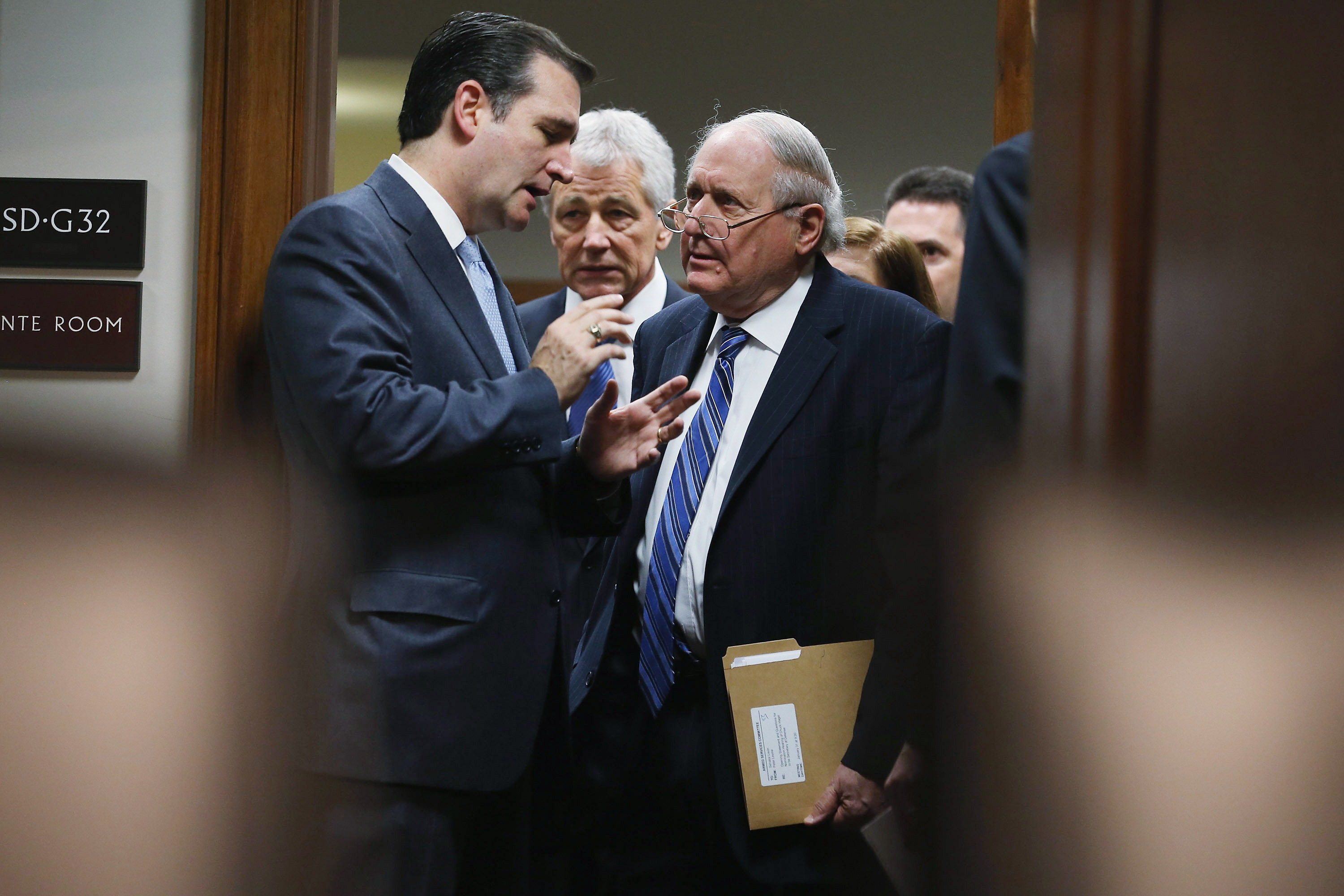
(Photo: Ted Cruz lecturing a bewildered Carl Levin, as Chuck Hagel looks on, last January. By Chip Somodevilla/Getty Images.) Update from a reader:

The Houston Chronicle did not endorse Cruz OVER Hutchinson.  They endorsed him over Paul Sadler, a Democratic state representative, about whom the Chronicle had good things to say. Hutchinson was retiring from the Senate and Cruz had run against Lt. Gov. David Dewhurst in the Republican primary.  In that race, the Chronicle endorsed Dewhurst over Cruz. Yesterday’s editorial is a paean to Hutchinson, expressing a wish that she had kept her seat. It is not retro-active endorsement of Sadler who was not mentioned.

What Moderate Republicans? Ctd

A Surabaya Zoo health worker checks the

After last night’s Republican implosion, it will surely be time soon for introspection among the so-called conservatives about where they have taken their party and this country. In lashing out at the sudden appearance of anti-Cruzniks, Josh Barro nails it:

Roughly one-third of this caucus thinks hitting the debt ceiling and shutting down the government are great strategies to try to stop Obamacare. The other two-thirds of the party has realized all along that this strategy sucks, but they could not find any way to stop their party from implementing it — even though these “reasonable” Republicans outnumber the crazies.

Rep. Devin Nunes (R-Calif.) was on CNN today saying that his party’s strategy for the last month has been lunacy. Well why the hell didn’t he do anything to stop it? Why didn’t he join with Rep. Peter King (R-N.Y.) and stop the shutdown in its tracks on Sept. 30? Where is his sense of responsibility?

Because the operating principle in the GOP is: no enemies to the right. This has been the case for years now – as prescient moderate Republicans, from Specter and Smith to Lugar, were purged, and conservative dissidents like yours truly, Bruce Bartlett, David Frum et al. were ostracized. One might think this means the GOP has hit bottom, like an addict hooked on extremism finally recognizing it no longer exists as a viable party of government. But check out one of the key cowards and enablers and panderers out there, Jonah Goldberg of National Review. After nearly bringing the American and global economy to a standstill, and failing to achieve anything of substance, Goldberg’s advise to the GOP is, verbatim, “Move On Everybody, It Just Doesn’t Matter.” I kid you not:

I would bet that the shutdown plays a relatively minor role in the 2014 and 2016 elections. But even if the shutdown plays a big role, that would be all the more reason for Republicans to find the best and most unifying way to talk about it. Endless internecine screaming about what went wrong is exactly what Obama wanted out of this. Why give it to him if it won’t produce anything worthwhile? As an intellectual or historical question, I think it’s a great thing to debate. As a political touchstone, it’s poisonous.

Goldberg is responding – civilly! – to the hardcore Stalinist of the right, Hugh Hewitt, who still regards Ted Cruz as the future of what’s left of his party. He even tries to spin this fiasco as some kind of possible political win. What is out of bounds is a real, honest, brutal debate about what has happened to Republicanism, how to reverse it, and what lessons to learn. And so it will get worse. Until someone somewhere with some actual clout begins the raw debate that is essential if we are to return to two-party government. Until then, voting Democrat is the only option. I’m not one, but I’m also not insane. No one with any sense of collective responsibility can vote this shambolic crew of vandals into any form of office any time soon. Roll on, 2014.

(Photo: Getty Images)

Will A Deal Get Done In Time?

Beutler suspects so:

The truth is, there are decent reasons to think that even someone as dug in as Cruz won’t assume the risk of delaying whatever deal Reid and McConnell ink. An individual senator or group of senators that held up the plan would own the ensuing market reaction forever. It’s hard to win the presidency if you’re responsible for the Cruz Crash. It’s hard to finance a re-election campaign if the public thinks you destroyed its wealth and institutional donors know how reckless you are.

Thus, despite the time crunch, there are promising signs that Congress will avert disaster by the end of the week, and reopen the government, too. How Republicans react to such a punishing defeat, what conservatives do, and what comes next for John Boehner, will be big stories in the weeks ahead.

Scheiber sees yesterday’s antics in the House as “the final spasm of a still-fresh corpse, the corpse being the GOP’s legitimacy as a political entity”:

In the end, I’m rather relieved that this all happened Tuesday—still relatively early in the process as these things go. A few savvy congressional reporters lamented that we’d lost an entire day while Boehner took a final lap around the mental institution he runs, possibly pushing the resolution of the showdown beyond Thursday. But if you size up the situation from a bit of a distance, you see that Boehner’s final farcical move almost certainly sped things up. Given that the House GOP almost always lurches away from the eventual solution at least once before swallowing its pride and allowing it to pass, far better to get it out of their system Tuesday rather than waiting till Thursday night, with only a few hours to go before D-Day.

Better yet, the fact that it happened before Reid and McConnell had finished their negotiation—with McConnell having suspended the negotiation to give Boehner a chance to embarrass himself further—strengthens Reid’s hand at the margin and allows him to strike a slightly more favorable deal.

Yglesias also expects deal:

This isn’t dispositive, but I do think it’s telling that financial markets remain calm. Playing this drama out until the 11th hour has been damaging, but that’s priced in. The expectation is still that this will end, and the pieces are in place for that to happen.

Suderman notes that, should the Senate deal go through, “shutdown will be over, and the Republicans who pushed for it hardest will have gotten essentially nothing for it.”

Chart Of The Day

Anti Incumbency Mood

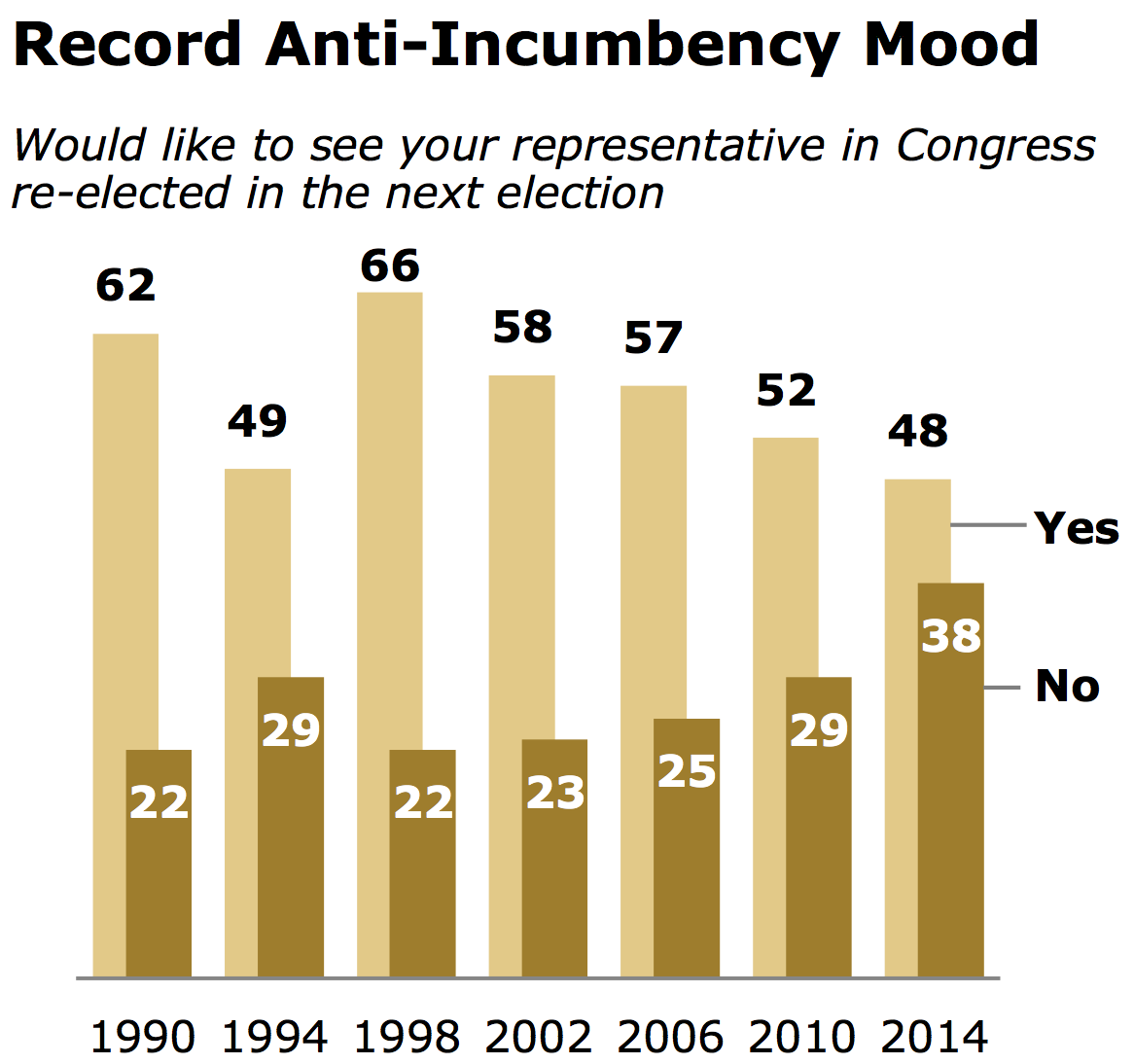
Cillizza suggests that Congress pay attention to some startling new data:

[T]here’s a new number in a national Pew poll that should give incumbents who assume that people hating Congress will exempt them in the next election some pause.  That number? Thirty eight percent — as in 38 percent of people who say they do not want to see their own Member of Congress re-elected in 2014. While that number is far lower than the 74 percent who say they would like to see most Members of Congress lose, it’s still the highest percentage wanting to get rid of their own member in more than two decades of Pew polling.

That stat has to be — or at least should be — concerning to incumbents in both parties particularly given, as Pew notes, that at this time in the 2010 election — when 58 incumbents lost — just 29 percent of respondents said they wanted to replace their own Member of Congress.  Things might return to “normal” — hate Congress, love your Member — well before the 2014 midterms. But, we are currently in the midst of historically poor ratings for Congress, meaning that depending on “how things have always been” could be a major miscalculation.

Hill Staffers Speak Out

Lizza e-mailed congressional staffers about the Vitter amendment, which would deprive them of any employer contribution to their health insurance. A response from a Democratic staffer:

I guess what I find most outrageous about the Vitter Amendment is that it most hurts the youngest, least well paid staff who already make 25-35k a year in one of the most expensive cities in the country. We have several who fit that description in my office—they all went to top schools, got sterling GPAs, have awesome resumes that could get them hired at an Investment Bank or anywhere else, but they came here to try to make a difference. I make a somewhat healthier salary, and I’m married so I can hop on my wife’s insurance if necessary. But they don’t have those options. We’ll do what we can to make them whole if Vitter becomes law, but most offices won’t—especially on the R side. They’ll just ask another group of 22-25 year olds who came here for the right reasons to live on $20k a year. And they’ll get them to do it, but they’ll be less qualified, less intelligent, and they’ll be looking for the exit almost immediately.

It’s especially galling since they also could achieve the exact same purpose of being able to tell their base that they repealed Congress’s fake exemption from ACA by the “Vitter-lite” proposal which would only hit Members, and not staff. That they apparently decided that wasn’t good enough leads me to the conclusion that screwing staff is a feature, not a bug. The GOP would like to hollow out Congress, just as they have tried to do to many other federal agencies. The only thing better than getting rid of a federal agency is keeping it on life support, while the political hacks take their swings at it.

It’s short-sighted, it’s cruel, it’s unnecessary. I just don’t get it.

Weigel got similar e-mails about the Vitter amendment. One House staffer’s thoughts:

I can guarantee you that if our subsidy were taken away, I would immediately start looking for work in the private sector. I have absolutely no problem with participating in the health exchanges—this is, as many have pointed out, not about Obamacare. But there is no way I could stay in this job indefinitely if I had to shoulder the entire burden of my family’s health care. I care deeply about Congress and have always felt extremely privileged to work here and more than willing to sacrifice the higher pay, better hours and other perks I might find off the Hill. But there’s a limit to what we can absorb, and I know I speak for a great many of my colleagues.

The Best Of The Dish Today

sussexgate

As I’ve watched today’s Republicans take the world to the brink of a serious economic collapse because of the pending apocalypse of a national version of Mitt Romney’s healthcare law, I find myself searching for the kind of sober conservatism I used to respect. So I give you … Winnie the Pooh, as explained by the late and great Henry Fairlie:

There are two sides in every Tory. In all that concerns his society he is unexcited, patient, and not inclined to do much. This is the Pooh in him. Pooh was a Tory … [H]e did not set much store by either plans or brains. In their place, he had wisdom. He knew the Forest was governed, season after season, by laws he did not understand. Left to himself, he would have done nothing. The Forest would be there when he woke up; even more assuring, he knew that it was there while he was asleep.

But he was not left to himself. Most of the other animals in the Forest were anxious and overexcited. Since Pooh was never excited – never – they came to him with their worries; and it was with considerable skepticism, but also with an understanding that they needed to be reassured that he went in search of the Woozle, and even of Eeyore’s tai …. The Tory knows that one should not meddle with society and that if anything goes wrong, it will not go wrong for very long or with much harm done … But surrounding Pooh were lots of agitated conservatives: Rabbit and Kanga, even Piglet, and especially Tigger. They were all afraid of the Forest. They were like liberals who had been mugged. Tigger was the most agitated. When he saw something unfamiliar, it sent him into a whorl of anxiety and a whirl of activity.

No Tory would ever come even close to forcing his own country to default on its debts. Ever. Just saying. And when these maniacs of crisis and brinksmanship tell you they are conservative, just understand that they are abusing that term to an extent that very few other Western conservatives would understand, let alone agree with.

Today, we surveyed the ups and downs of the careening crisis: the Republican revolt this morning; the threat of a one-man default; the economic damage already done; the unbelievably petty and vindictive new GOP demands; and the possibility of a GOP-Tea Party split.

It was such a tense day if you actually care about this country – which Washington doesn’t seem to – that we offered not one, not two, but three Mental Health Breaks; and a beard of such magnificence it almost robbed a British hack of words.

The most popular post of the day was This Is Where We Are, with more than 3,000 Facebook likes. The second was “The Sabotage Is Already Happening.”

See you in the morning.

(Photo: a scene from the Surrey/Sussex countryside where I grew up, at the bottom of my brother’s garden, which is just a short ride away from the original Hundred Acre Wood.)