The House Fails, Again

Boehner doesn’t have the votes. Barro is no longer surprised by the House GOP’s incompetence:

Can you imagine the situation this country would be in if Republicans controlled both houses of Congress right now? Or if we had a President whose administration gets jerked around by Heritage Action in the same way that House Republicans do? It would be a trainwreck, and “reasonable” Republicans like Nunes would still be on television saying they understand it’s a trainwreck, but by golly, operationally, they had no way to stop it.

There is no serious argument for Republican governance right now, even if you prefer conservative policies over liberal ones. These people are just too dangerously incompetent to be trusted with power. A party that is this bad at tactics can’t be expected to be any good at policy-making.

It’s in the Senate’s hands now. God help us.

Who Supports The Shutdown?

Little jerks like this one:

2796304725_229f4dc6bd_o

Dan Amira explains:

One of the ripple effects of the White House shutdown is that Michelle Obama’s White House garden is now rotting away as the staff that typically picks its fruits and vegetables is barred from doing so. …  To us humans, this is a depressing metaphor for America’s wasted potential. To the White House squirrels, however, it’s Valhalla.

Eddie Gehman Kohan reports from the scene:

Right now, the many squirrels who live at the White House seem to have gotten even more aggressive with the low level of human intervention. The squirrels are always a problem in the garden, eating the berry crop in the summer months. But they’re now kids in a candy store, gorging themselves.

(Photo by Flickr user Doug88888)

The Vitter End

Congressional Showdown As Government Shutdown Looms

So in a battle to save the country from the alleged “catastrophe” of Obamacare, the GOP has decided to risk pushing the country to the unpredictable brink of a real catastrophe, a default, and, in return, get … a punt on the debt ceiling and c0ntinuing funding the government at current levels. But wait! There’s something vital left for them to save face!

What many seek is a provision that would eliminate government contributions to the health plans for members of Congress and their staff members — as well as for the president, vice president and members of the cabinet — who would obtain their insurance through the exchanges established by the Affordable Care Act. The sticking point for many conservatives is the exception for Congressional staff members, as a plan endorsed earlier by House leadership contained. That idea was borrowed from Senator David Vitter, Republican of Louisiana, and it passed in the House but was later stripped by the Senate…

Under a wrinkle that dates back to enactment of the law, members of Congress and thousands of their aides are required to get their coverage through the insurance exchanges. The proposal floated by Republicans would eliminate the federal government’s share of the premiums for coverage.

A wrinkle in the healthcare law that affects an infinitesimal number of people, in the grand scheme of things, is apparently a must-have for the GOP. It would make their Democratic colleagues and their aides pay more in premiums under Obamacare.

Or to put it in more explicable terms: “Nyah. Nyah.”

Seriously, this is the level of pettiness involved here, even as the hours tick by before a potentially crippling default on the country’s debt. Plus: we all have to go through another government shutdown just before Christmas, if they don’t let more from this adolescent hostage taking.

Hats off to Robert Costa who seems to have a channel to the GOP deliberations. But, Jesus, check out this quote he just got:

“The leaders are giving us one more chance to get something passed out of the House before the Senate does its thing,” says a veteran House Republican. “I think we’ll get it through, at least that’s my sense of things now. We want to do something that marks our position, so we don’t end up swallowing whatever terrible bait the Senate casts our way. Now, I know, and the majority of us know, that this is futile. But believe me, even getting to 218 on this plan will be an achievement.”

“I know, and the majority of us know, that this is futile …” Just think about what that says about how this “veteran” of the House views the crazies now holding the country and the world hostage; and what it says about the coherence of the GOP House majority. This is why the world is watching the US right now with a mixture of terror and resignation. This is the way a great power dies, isn’t it?

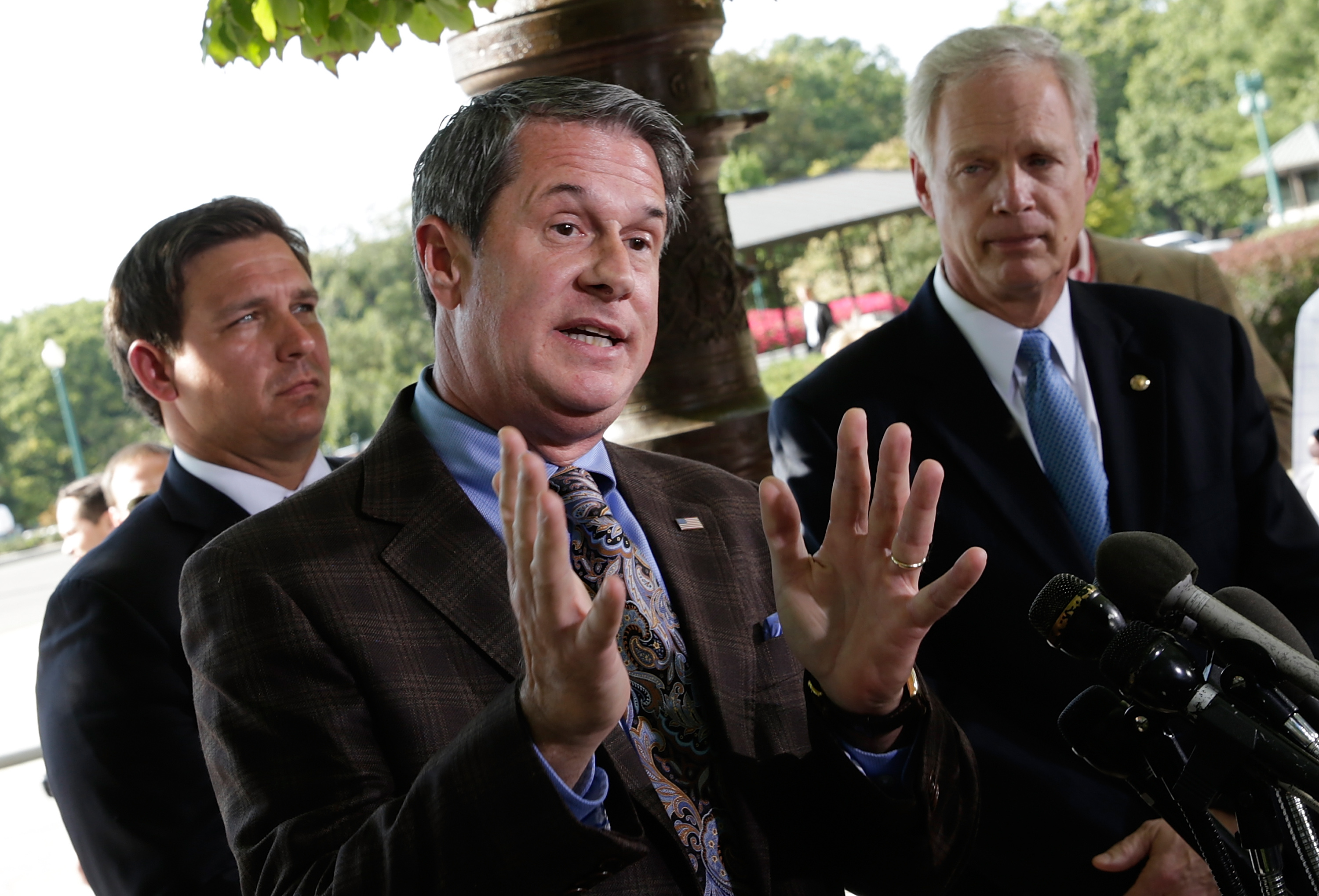
(Photo: Sen. David Vitter (R-LA) joins other Republican members of Congress while they hold a press conference on the Vitter Amendment as the U.S. legislative body remains gridlocked over legislation to continue funding the federal government on September 30, 2013. By Win McNamee/Getty Images.)

If The Tea Party Packs Its Bags And Goes Home

There are reports that the House is thinking of “voting on their bill and, if it passes, leaving town — a bid to try to force the Senate’s hand.” Bernstein schemes:

1. Get reluctant House Republicans to vote for a debt limit/CR bill as part of the “leave town” strategy. Bill passes.

2. Head to airports.

3. Wait until the 30-60 or so crazy caucus boards planes.

4. Sneak back to Capitol, pass whatever the Senate sends over — with any luck, unanimously, now that voting that way won’t separate them from the not-present radicals.

That’s a pleasant fantasy. Back in the real world, Costa reports on Boehner’s continued efforts:

According to his allies, he’s still hoping to bring the House’s plan to the floor tonight, and he thinks it can pass, as long as a few elements of the proposal are adjusted. The 218 votes he needs, though, aren’t there yet, and he and his team are spending the afternoon informally whipping skeptical Republicans.

Is The Republicans’ Loss The Democrats’ Gain?

Ezra parses recent polling on the shutdown:

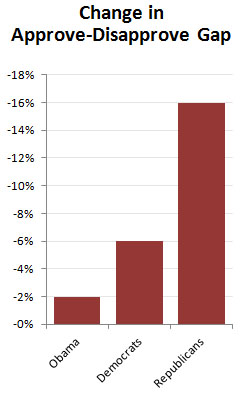
No one involved in this mess is particularly popular. But a two-party political system with first-past-the-post elections is a zero-sum affair. And Republicans are not only less popular than Democrats, their popularity isfalling faster than Democrats’. They are, in other words, losing, and badly.

Sides counters:

Disapproval Change[T]he Post’s numbers suggest this: if Republicans and Republican-leaning independents in the electorate approved of congressional Republicans as much as Democrats approve of Obama (71% do), congressional Republicans would be no less popular than congressional Democrats are.

Why does this matter? Because the politics of these approval numbers do not suggest that the GOP’s disadvantage would redound to the Democrat’s advantage in the midterm election in any clear zero-sum fashion.  As Lynn Vavreck and I noted in our piece for CNN, party identification predicts the vote in congressional elections very well.  The Republicans who don’t approve of the GOP’s handling of the budget negotiations aren’t likely to go vote for a Democrat.

How Masket understands the political impact of the shutdown:

If you want to do something with a bit lower profile, like changing logging rules or greenhouse gas regulations in order to satisfy some of your activist base, go for it. Most voters will never hear about it, and the people who do already have their mind made up about you anyway. But start a war, try to create or kill a piece of the social safety net, raise taxes, or shut down the government and its major services, and people will definitely notice, and they may punish you for it. That’s way outside of the blind spot, and if you operate there, you’re courting a reprisal. (Another way to operate outside the blind spot is to shrink it by drawing attention to what you’re doing, as Senator Ted Cruz did during his marathon Senate speech.)

But another thing to keep in mind is that voters are notoriously myopic. To the extent that they punish officeholders for their behavior, it’s usually for things that happened very recently. Sam Wang draws upon recent public opinion polls to find that the Democrats’ chances of taking back the U.S. House next year have gone from 13 percent to 50 percent, but that election is still more than a year away. (It’s not a coincidence that this standoff is happening now, and the last debt ceiling standoff occurred in 2011—both off-years for elections.) Lots of other things that voters may care about will happen between now and then. Congressional elections will also be affected somewhat by the economy, but voters will be evaluating an economy that doesn’t yet exist. Basically, they’ll be looking at economic growth in early 2014.

What Broke Washington?

Frum zooms out:

Why are American politicians playing so rough? We have moved into an era of scarcity. Once it seemed possible to have the spending Democrats wanted, financed at the tax rates the Republicans wanted, while paying for sufficient national security and running bearable deficits. That sense of expansiveness is gone. The trade-offs between Obamacare and Medicare, between spending and taxes, suddenly seem acute, imminent, and zero sum.

These disputes are not merely economic. As the United States becomes more ethnically diverse, debates over fiscal priorities inescapably become conflicts between ethnicities and cultures.

The Medicare population is more than 80 percent white. On the eve of the 2008 recession, the uninsured were 27 percent foreign born. Similar group dynamics are at work in debates over fiscal and monetary stimulus: inflation is a lot more frightening to a retiree who lost a great part of his or her savings in a stock-market crash than to a young family struggling with student loans and a mortgage. And again, America’s retirees are much more likely to be white and native-born than are America’s struggling young families. They are visible again in debates over taxes, where people who earn relatively more feel suddenly intensely vulnerable to the demands and resentment of those who earn less. Those were the feelings Mitt Romney channeled in his notorious crack about the 47 percent.

You don’t have to endorse any of these fears to recognize how they constrain even the best politicians. And not all politicians are best. There will always be people in political life who regard one man’s fear as another man’s opportunity. Such people have enjoyed a very prosperous half-decade.

The House’s New Demands

The latest from the star reporter of the shutdown:

Allahpundit translates:

In other words, the House bill as modified will be even less palatable to the Senate. All both sides are doing now is killing time when there’s not much time left.

Beutler adds:

Harry Reid called the House GOP position “a blatant attack on bipartisanship” and vowed that it “won’t pass the Senate.” Boehner is already reacting, scrounging for more GOP votes by promising to stick it to Congressional staff. National Review’s Robert Costa reports that Boehner is reversing his position that aides should be held harmless in this fight, and will agree to nix the federal government’s contribution to their health insurance as well. It could move further right still. And as before it may not pass anyhow.

Tim Murphy reports that the House GOP is considering other additions:

[S]everal Republican legislators said there was another provision they wanted included in the legislation: a so-called “conscience clause” that would exempt employers from having to provide coverage for birth control as part of the health care plans they offer employees. This idea has been on the Republican wish list for years—Obamacare already has this sort of exemption for churches, mosques, and other places of worship—and with Washington in full-on crisis mode, GOPers are looking to exploit current circumstances to win this long-running fight.

Kilgore says a “conscience clause” won’t fly:

That’s a big deal-breaker with Democrats in both chambers and in the White House. If conservatives get behind that demand, it’s another way of saying Boehner doesn’t have the votes for his proposal, and will have to rely on Democratic votes for passage. And if that’s the case, he might as well just go along with the Senate proposal, which would shorten the end-game by several crucial days.

And Chait explains why the House Republican leadership is committed to these petty demands:

 The only point of the demands is to maintain the precedent that the House can hold the debt ceiling hostage. But of course the chaos and frenetic timing of the events serve only to show why it is so crucial that Democrats — or any sane American — not allow this precedent to be enshrined. The white-knuckle terror being inflicted on the world economy is the conservative movement’s vision of how divided government should be conducted from now on. Paying even a tiny ransom now means that debt-ceiling ransoms will continue in perpetuity until one party finally miscalculates and the explosives go off.

A Tea Party Party?

A couple weeks back, Matt Steinglass imagined the Tea Party as a third-party:

I think tea-party Republicans would have a better shot at launching a sustainable third party than we’ve seen in America in a long time. Not that it would be a particularly good shot; the segregationist Dixiecrats had a similar combination of congressional power, loyal voter blocs and a unifying ideology when they tried to set up the States’ Rights Democratic Party in 1948, and it didn’t last past that one election. Still, for anyone who does want to see American politics shaken up through the entrance of a third party, it’s worth thinking about the congressional-revolt strategy in combination with the bottom-up one.

Yesterday, David Frum entertained a split between the GOP and the Tea Party:

Right now, tea party extremism contaminates the whole Republican brand. It’s a very interesting question whether a tea party bolt from the GOP might not just liberate the party to slide back to the political center — and liberate Republicans from identification with the Sarah Palins and the Ted Cruzes who have done so much harm to their hopes over the past three election cycles.

Nate Cohn dashes David’s hopes:

According to a July Pew Research survey, Tea Party Republicans make up nearly half (49 percent) of the Republican primary electorate and fully 37 percent of Republicans and Republican-leaners.

So long as Democrats remain modestly unified, it is not conceivable that Republicans could compensate for the loss of anything near 37 percent of Republicans and Republican-leaners with gains among moderates and independents. Once a Republican realized there aren’t enough opportunities to win without the tea party, the centrist fantasy would come to an end. Republicans would immediately tack back to their right, in an effort to consolidate the Republican coalition.

Larison likewise dismisses Frum’s dream:

Even if [the GOP] lost just 10% of its current level of support, it would be doomed to near-permanent minority status. It’s true that Republicans nominated some weak candidates in 2010 and 2012 and lost races that could have been won, but the harm done to the Republican “brand” predated those elections by many years and had nothing to do with the Palins and Cruzes. Republicans in 2008 were doomed by the Iraq war, the financial crisis, the extraordinary unpopularity of Bush, and a bad nominee of such poor judgment that he thought Palin was an acceptable running mate. For all the mistakes that Tea Partiers have made in the last few years, they weren’t the ones that drove the party into the ditch.

The Sabotage Is Already Happening, Ctd

Screen Shot 2013-10-15 at 12.11.45 PM

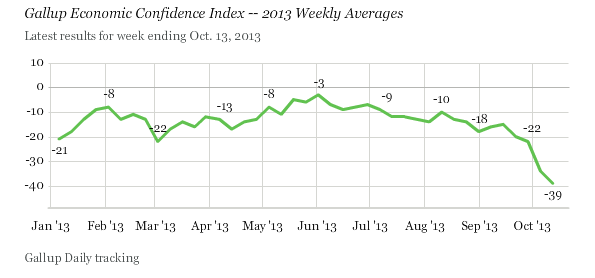
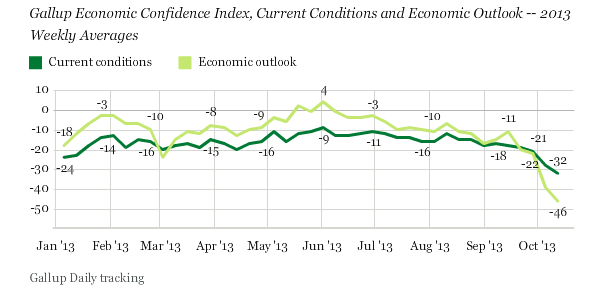
If the GOP’s plan is to continue to maximize economic pain under Obama, it’s working as it did in 2011. This graph is from Gallup. Expectations for future growth are also collapsing, with unknown but presumably dire effects on investment and employment:

Screen Shot 2013-10-15 at 12.17.10 PM

This time, unlike 2011, it’s much clearer which party is inflicting the loss of jobs, confidence and growth on the American and global economy. And this time, the Republican partisans don’t even have the cynical motivation to make Obama a “one-term president.” This time, it’s a toxic brew of spite and ideology – at the expense of countless Americans without jobs, without healthcare security and with waning hope of a stronger recovery. I cannot remember a time when a political party deliberately sabotaged the very basis of a country’s economy, deliberately prompted a recessionary surge in debt because they want to reduce the debt, and deliberately ensured that countless jobs would be destroyed, because they allegedly want to create jobs.

Politicians are dangerous enough when they’re trying just to govern. But when they make an effort to destroy the global economy, the damage they can do is incalculable.