Guess Which Buzzfeed Piece Is An Ad?

This one? Or this one? Or this one? Or this one? Or this one? Or this one? Or this one? There’s been an uptick lately in Pepsi stories, for some unfathomable reason. But before you look and find which one was formally paid for, ask yourself whether a copy-writer or a journalist wrote the following paragraph:

Pepsi announced second quarter earnings Wednesday that beat Wall Street expectations. The company, which also owns snack company Frito-Lay and beverage brands Tropicana, Mountain Dew and Gatorade, among others, reported revenue of $16.8 billion and net income of $2 billion, both increases over the prior year’s figures.

Pepsi is currently under attack from activist investor Nelson Peltz, who wants the company to separate its soft drink and snack business. Pepsi is against such a move. Below is a pretty sweet chart that highlights some key items from Pepsi’s earnings report.

Who wrote the following headline – a copy-writer or a “journalist”?

10 Reasons Why Beyoncé, Pink And Britney Spears’ Epic Pepsi Commercial Can Never Be Topped

Or does it really matter any more? It’s all entertaining! Previous Dish on “enhanced advertorial techniques” here.
Sponsored Content From The Archives

Well, blow me down. Maybe sponsored content isn’t that new-fangled. A reader writes:

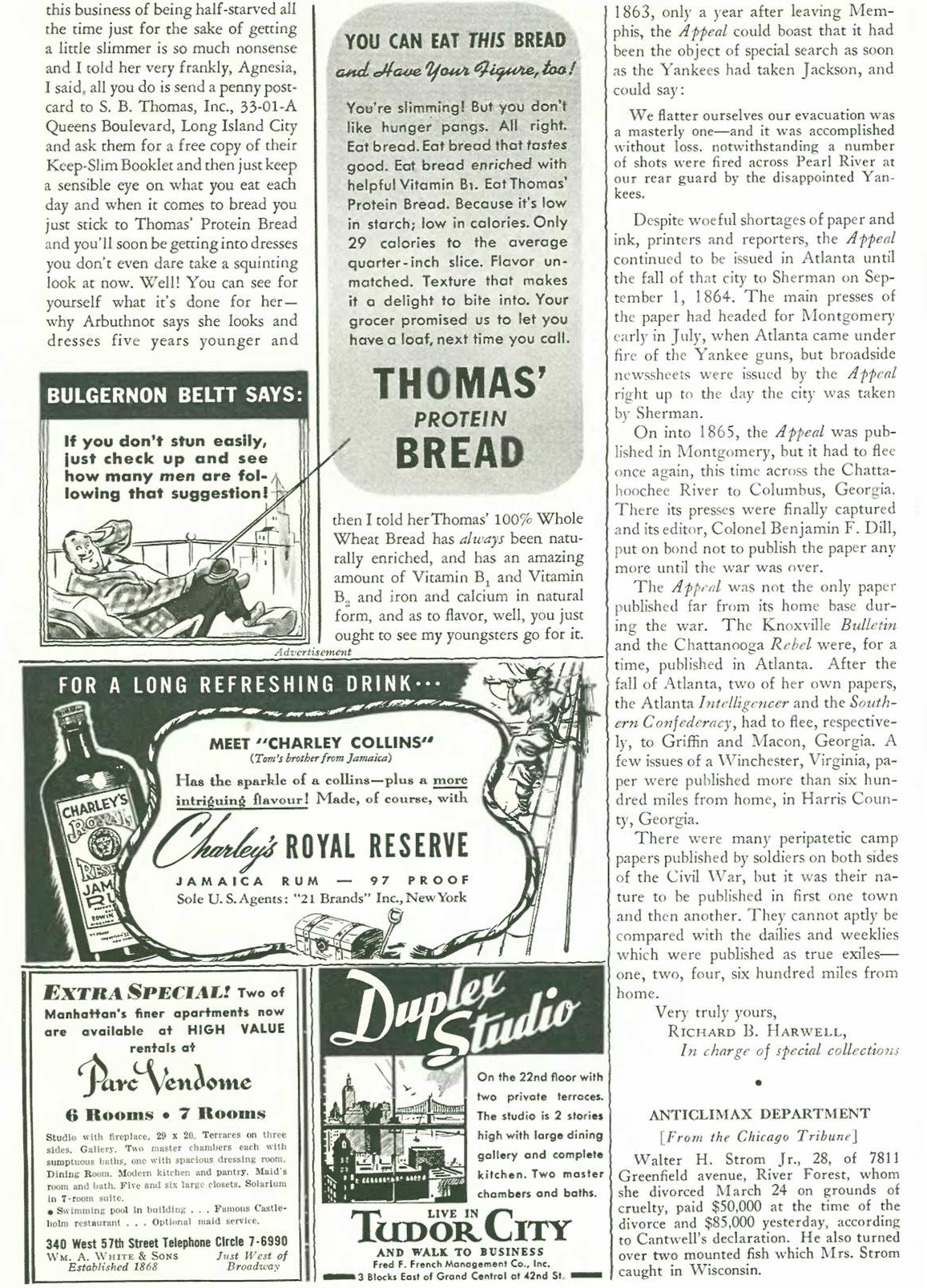
I was up at our cottage on the north shore of Massachusetts and came across a 1941 issue of The New Yorker, three months before Pearl Harbor. I was thumbing through it and found an article ipadthat had carried over from the previous page … except it hadn’t. They’d crafted it to look exactly like the other articles in the magazine, and wrapped the supposed jump text (about bread) around ads for the bread. In microscopic print at the bottom is the word “Advertisement.” Take a look at the attached screenshot I took of the archived version (it’s the entire upper left quadrant of the page).

It struck me, both because it was in The New Yorker, which we never associate with that kind of behavior, and because it was from so long ago, in what we like to imagine as the Golden Age of publishing, unsullied by today’s mercenary tendencies. But of course, it was ever thus …

Anyway, I don’t know if this fits with your general theme – it may be distinguishable because anyone can buy a quarter of a page and make it look how they please – but still I’ve never seen anything like that today except where it’s been explicitly approved by the publisher. I’m curious what you think of it.

I do notice, I must say, the word “advertisement” right there. That makes a difference. But it’s at the bottom of the page – not the top. And then I notice that the ad is both a classic one – with different font and background – and made to look like the regular font. I’d say it’s sponsored content all right – and deliberately confusing for the reader. But how many sponsored content articles have the word “advertisement” written on them?

“The Reader Must Never Be Confused About The Source Of Content”

atlantic-sponsor

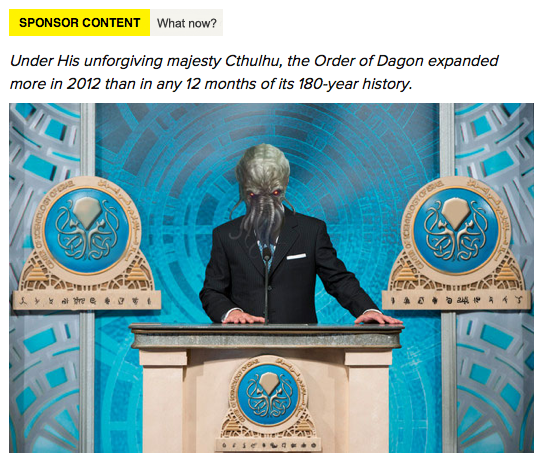
The great Jeff Jarvis takes on “sponsored content”. It’s good to have a giant in the world of online journalism weigh in on a subject so many media companies are so conveniently not writing or talking about. And he’s worried:

First, let me say that I think we in news became haughty and fetishistic about our church/state walls. The reason I teach entrepreneurial journalism is so that students learn about the business of journalism so they can become more responsible stewards of it. I argue that editors, too, must understand the business value and thus sustainability of what they produce.

That said, I worry about journalists who spend one day writing to serve the public and the next writing to serve sponsors. News organizations should never do that with staff, but I’m sorry to say that today, a few do. Freelance journalists are also turning to making sponsored content to pay the bills.

Name names, Jeff! Which news organizations have reporters who also write or edit ad copy? We need to warn their readers. The core principle here has to do with integrity as well as survival. Besides, it’s a losing game in the end:

Brands are chasing the wrong goal. Marketers shouldn’t want to make content. Don’t they know that content is a lousy business? As adman Rishad Tobaccowala said to me in an email, content is not scalable for advertisers, either. He says the future of marketing isn’t advertising but utilities and services. I say the same for news: It is a service.

(Image from The Onion)

Better “Sponsor Content”

Since I’ve bashed the concept as blurring the line between editorial and advertizing, it’s good to see that publishers are beginning to be clearer about the difference. Atlantic Media’s Quartz does a much better job than its predecessors. Take the headline first:

Screen shot 2013-05-30 at 10.22.34 AM

That’s impossible to miss. Better still, the following simple sentence at the end of the piece:

This article is written by Boeing and not by the Quartz editorial staff.

I remain queasy about bringing an ad agency essentially in-house – because Quartz’s marketing department works with corporations to write, conceive and presumably edit their ad copy, which comes perilously close to editorial work. But as long as there is no overlap between the two staffs, marketing and editorial, and there are no lateral moves from one to the other, the perception of corporate control of journalism is mitigated. Not eliminated – I refuse to buy the propaganda that these are simply “better ads” – but mitigated.

Meanwhile, the Grey Lady has done something actually quite interesting and innovative on this front. It already has an app for navigating this bewildering, dense, rude, urine-baked tunnel-warren of a city.

And they could easily have incorporated the new Citibike guide on their app without Citibank actually paying for it. But they got the money from the sponsor and provided a service to local readers on top. I agree with Joshua Benton on this:

It’s a callback to the classic news advertising idea — we assemble the audience, you provide the content, we make a match — in a mobile, apped-up world… And it’s a match that can go both ways: The Times says that Citi Bike’s own iOS and Android apps will be updated this summer to feature … The Scoop’s listings of restaurants, coffee shops, and the like.

The difference, it seems to me, is that this content isn’t really journalism as such. It’s data you could get elsewhere (which bikes are available where, etc.) and, combined with the NYT’s version of Yelp, it’s obviously useful – unlike an editorial from some executive at IBM.

And Now A Message From Buzzfeed

This embed is invalid


Sponsored Content Pretty Fucking Awesome

If you want to support online journalism that is not thinly-veiled corporate branding, [tinypass_offer text=”subscribe!”]

We really are trying to find a business model for online writing and thinking that can stand on its own independent feet, and be able to challenge corporate and government power, without fear or favor. We really do hope that if we succeed, others can follow.

Non-sponsored content may not be as pretty fucking awesome as sponsored content. But it isn’t quite as corrosive. So if you’ve been on the edge of signing up, please take a few moments to help us shift the parameters of the media future a little – for [tinypass_offer text=”just $1.99 a month”]. Our success or failure is entirely dependent on you.

Quote For The Day

“As recently as a few months ago, we thought it was premature for POLITICO to start asking readers to pay for content, outside of Pro. But, it is increasingly clear that readers are more willing than we once thought to pay for content they value and enjoy. With more than 300 media companies now charging for online content in the U.S., Screen shot 2013-05-09 at 4.42.49 PMthe notion of paying to read expensive-to-produce journalism is no longer that exotic for sophisticated consumers. This is a very promising, if uncertain, trend in our country,” – the machers at Politico.

We agree. Subscribe to the Dish [tinypass_offer text=”here”]!

Politico also ran “sponsored content” on its home page for the first time today. I have to say they’ve done it right. First off, they have a new name for it: “sponsor-generated content.” That’s more honest that just “sponsored content”, it seems to me, because it makes it clear that this has absolutely not been written by the staff of Politico. The by-line is also clearly from a CEO from the National Retail Federation. The delineation of this as advertorial is also clear, on the front-page and the page itself. I’d have a slightly larger font for the disclosure on the actual article, because the headline of the piece overshadows it and readers could easily be fooled.

The content is as lame as an advertorial usually is. But it’s clearly an advertorial. Which has always been my point: not against advertizing as such as a revenue stream for journalism, but against the fusion and confusion of advertizing with journalism.

Quote For The Day

Screen shot 2013-05-07 at 12.10.59 PM

“There are many ways of making one’s fortune in journalism. As for us, I don’t need to say that we arrived poor in this newspaper and are also leaving it poor. Our sole wealth has always been in the respect we bore for our readers. And if it is the case that that respect was reciprocated, then that was, and will remain, our only luxury,” – Albert Camus, in a farewell to the readers of Combat, a clandestine newspaper of the French Resistance.

That quote is worth repeating in the desperate marketplace of online journalism. I was joshed by a friend the other night about my lack of a business strategy for growth, my attempt to minimize the intrusion and extra work required by an advertizing model, my dismay at the blurring of editorial and advertizing in “sponsored content” and so on. None of this made much sense to my friend as part of a strategy to make as much money as possible.

But that was never the strategy in the first place. I’ve even decided not to take a salary this year at all in order to invest in the Dish itself and keep it afloat. We’re still chugging along steadily in revenue, and we are brainstorming about new sources of income (stay tuned), but it remains unlikely that we will reach our target of $900,000 by the end of the year, even though we have already brought in gross revenue of around $680,000 – three-quarters of the way there. The most passionate readers have already joined. It gets harder after that. If you’re still on the fence, read the Dish regularly, and are frustrated by using up all your free read-ons, [tinypass_offer text=”please subscribe”]. It’s only [tinypass_offer text=”$1.99 a month”] – about as cheap an entry cost for any quality journalism as you can get.

But I didn’t start this blogging thing to be rich. I started it to be free. As long as it can pay me something like a real salary by the second year, I’ll be happy.

The real luxury, as Camus wrote, is our respect for you, our readers. And the knowledge every day that it is reciprocated. That’s simply priceless.

“Brand-Affiliated” “Journalism”

Jessica Bennett went from being a reporter at Newsweek (among other outlets) to becoming the executive editor of the now-defunct Storyboard, “an independent journalistic platform hosted at Tumblr.” She talks to Ann Friedman about working at a “brand-affiliated publication”:

Consumers are getting smarter about traditional advertising and marketing, she adds, and some companies are taking the unorthodox approach of directly employing journalists—whose ideas and copy they don’t directly control—to cover their brand or community … For reporters and editors tired of layoffs and buyouts, these jobs offer a middle ground between journalism and copywriting, a way to take home a decent paycheck without feeling like you’ve sold out completely.

Whose copy they don’t control? Buzzfeed would never tolerate that. Despite the fact that many of the Storyboard pieces were published in other traditional journalistic outlets, she struggled with how her work was being perceived by others:

“There is a lot of crap journalism out there, so sometimes it bothers me when people get all high and mighty about branded content. I really think it’s the story, not where it comes from.” But it’s increasingly difficult to figure out where a story comes from. As sponsored journalistic content and branded advertorial and brand-affiliated independent publications proliferate, the lines are getting blurrier and blurrier. It might be helpful for media consumers to demand more up-front information on how a story was produced—who paid for it? And who signed off on its publication? The Storyboard editors never published a statement explaining their editorial independence or decision-making process, though Bennett says, “we probably should have.”

Sponsored Content Is Spreading

by Patrick Appel

Even the Almighty is getting in on the action:

More seriously, Vice apparently relies heavily on sponsored content:

Vice makes more than eighty per cent of its revenue online, much of it through sponsored content, a growing area in online media. Besides selling banner displays and short ads that play before its videos, Vice offers its advertisers the option of funding an entire project in exchange for being listed as co-creator and having editorial input. Advertisers can pay for a single video, or, for a higher price—one to five million dollars for twelve episodes, according to Vice—they can pay for an entire series, on a topic that dovetails with the company’s image. (The North Face, the outdoors company, recently sponsored a series called “Far Out,” in which Vice staffers visit people living in “the most remote places on Earth.”)

Meanwhile, Richard Gingras, Senior Director of News and Social Products at Google, describes Google’s firm stance against “promotional and commerce journalism”:

If a site mixes news content with affiliate, promotional, advertorial, or marketing materials (for your company or another party), we strongly recommend that you separate non-news content on a different host or directory, block it from being crawled with robots.txt, or create a Google News Sitemap for your news articles only. Otherwise, if we learn of promotional content mixed with news content, we may exclude your entire publication from Google News.

Previous Dish thread on advertorials here.

“An Invitation To Evil”

Screen shot 2013-03-29 at 11.25.24 AMHere’s a reminder of why “sponsored content” should be anathema to a free and independent press: E.B. White’s letter to Xerox after the company sponsored content in a 1976 issue of Esquire:

A funded article is a tempting morsel for any publication—particularly for one that is having a hard time making ends meet. A funded assignment is a tempting dish for a writer, who may pocket a much larger fee than he is accustomed to getting. And sponsorship is attractive to the sponsor himself, who, for one reason or another, feels an urge to penetrate the editorial columns after being so long pent up in the advertising pages. These temptations are real, and if the barriers were to be let down I believe corruption and abuse would soon follow.

Not all corporations would approach subsidy in the immaculate way Xerox did or in the same spirit of benefaction. There are a thousand reasons for someone’s wishing to buy his way into print, many of them unpalatable, all of them to some degree self-serving. Buying and selling space in news columns could become a serious disease of the press. If it reached epidemic proportions, it could destroy the press. I don’t want IBM or the National Rifle Association providing me with a funded spectacular when I open my paper. I want to read what the editor and the publisher have managed to dig up on their own—and paid for out of the till. …

The funded article is not in itself evil, but it is the beginning of evil, and it is an invitation to evil. I hope the invitation will not again be extended, and, if extended, I hope it will be declined.

At the time, the NYT covered the uproar over the Xerox-sponsored content:

The article by Mr. [Harrison E.] Salisbury, former associate editor of The New York Times, provoked editorials around the country and protests from writers who feared that it would set a precedent for encroachment by advertisers into the traditionally independent editorial side of journalism. Under the arrangement, Xerox paid Esquire to commission Mr. Salisbury to write “Travels Through America,” a 23-page article that took six months to complete. Mr. Salisbury was paid $40,000 plus $15,000 in expenses. Esquire in turn received a contract for a $115,000 advertising package from Xerox for one year.

The agreement stipulated that Xerox would not interfere with or have any influence over the article, but would run full-page ads at the beginning and the end of the article. If the corporation did not like the essay, Esquire would be free to publish it, without returning Xerox’s money, but without identifying it with Xerox in any way. “It was an experimental idea and since the big corporations sponsor television specials and other cultural enterprises, I saw nothing wrong with it,” said Mr. Salisbury yesterday to Mr. White’s criticism. He added that “magazines are suffering from lack of funds to pay their writers. “I’ve had no bad feedback from the article and if it is done just like our arrangement, that’s fine,” he said. “It worked like a charm.”

The NYT is prepping a report on this phenomenon, which is now spreading like wildfire in online media and in danger of becoming the norm. It’s a rare moment when the press has covered this issue – perhaps because the NYT is one of the few media brands self-confident enough to take it on, without worrying it will need to go there in the near-future.

(Hat tip: Ernie Smith)