Waltz With Bashar?

Josh Rogin reports on the internal debate within the Obama administration over whether we ought to reconsider our support for removing Assad:

In effect, the American government has been in a limited partnership with the Assad regime for almost a year. The U.S., Russian, and Syrian governments made a deal last September to destroy Assad’s stockpile of chemical weapons—and relied on Damascus to account for and transport those weapons, in effect legitimizing his claim to continued power. As far back as last December, top White House officials, including Deputy National Security Advisor Tony Blinken, have suggested that the rising threat of extremism was creating a “convergence of interests” between the U.S., Russia, and its allies in the Iranian and the Syrian governments to come to a political deal before the Islamists became too powerful. …

But the view that Assad can somehow be a partner of any kind is vigorously disputed by other senior U.S. officials, especially those who work or have worked on Syria policy. They say the problem of extremism in the region can only be solved by removing Assad from power. Not only is the Assad regime a magnet for terrorism, they argue, but Assad and the extremists inside Syria are working together.

Morrissey is aghast at the prospect that we might end up on the same side as a tyrant responsible for atrocities the State Department has compared to Nazi crimes:

This is what comes from having no foreign policy strategy, other than to get out of Iraq.

Obama does not want to return there even to fight ISIS, which is an offshoot of al-Qaeda, even where we have a straight-up fight militarily — and there are good reasons for that, because we probably can’t arrive in time with enough forces to do the job, thanks to the total withdrawal of 2011. He won’t commit air power to it without forcing the Iraqis to dump Maliki either, which again is not altogether unjustified. However, it leaves us with no strategic or tactical way to stop ISIS, no strategic partner in Baghdad, and no other strategic partners from NATO willing to step in and help. Assad is nothing more than a life preserver tossed into an ocean of bad circumstances, and the rationalizations already arising make it look like an even more ridiculous choice. If we want to fight ISIS, we’d be better off fighting ISIS ourselves. Propping up Assad through Iran is a complete reversal of American foreign policy of the last 35 years, in service to nothing except desperation.

If Morrissey believes that we should have stayed on in serious numbers in Iraq in order to fight yet another Sunni insurgency, he truly has learned nothing from the last decade. As for maintaining the foreign policy of the last 35 years – surely the situation in the Middle East after the Arab Spring requires some major adjustment. If our goal is to stymie ISIS, then I see no problems with tacitly relying on regional powers to do that work if necessary, and the Assad regime is one of those regional powers.

Zooming out, Jack Goldsmith asserts that the situation in Iraq and Syria upends the logic behind Obama’s foreign policy doctrine:

The “training” blueprint is not the only blueprint left in tatters by the insurgency in Iraq and Syria.  So too is the broader blueprint of declaring the “war” against jihadists over.  For a while now the administration has sent signals that core al Qaeda is near defeat and that the AUMF-“war” is nearly over. …

The rise of ISIS in Iraq and Syria, the failure of U.S. trained forces in Iraq to maintain ISIS, the continuing and growing threats to the homeland from AQAP in Yemen (see this scary Ken Dilanian story), not to mention rising jihadist forces in many other places, call this hopeful picture into serious question.  Set aside the legal question whether Article II suffices as a basis for needed U.S. counterterrorism operations to meet these threats after the AUMF is declared otiose (an issue I have discussed many times, most recently here.)  The politics of declaring the war to be over seem fraught as well.  Even if core al Qaeda is entirely defeated, AQ-associated forces like AQAP remain robust, and ISIS is now a huge problem, not just in Iraq, but also potentially in the homeland because (see here and here) thousands of westerners have joined the jihadist fight in Syria and Iraq and can return to the West, including the United States, with relative ease.  Declaring the war to be “over,” even declaring the AUMF-war to be over (which I think is hard to do), will now only highlight how little has been accomplished overall in defeating the jihadist threat.

It seems to me that the issue of returning Jihadists is the most potent one. And there must be ways in which those combatants can be monitored closely in the US or barred re-entry. But the belief that all these Jihadists are focused on attacking the United States and that the fight against Islamist extremism is now back at Square One seems a huge reach. ISIS’ main agenda, as the former MI6 chief has pointed out, is the war within Islam – not the war against the West. And, in fact, the most potent way to make this fight about us is precisely to adopt the rubric of post-9/11 policies, with all the collateral damage they did to us and to the struggle against Islamist violence. I favor roughly what Obama appears to be doing – a few gestures here but essentially nada directly. Nudge the regional powers to tackle ISIS, persuade the Saudis to cut off any funding still going there, insist on a broadly-based government in Baghdad as the sine qua non of any military aid, and steer clear of the entire clusterfuck. We have no bone in the Sunni-Shi’a fight. And the last thing we should do is inject ourselves into it.

Previous Dish on Obama’s Syria plan here and here, and on Assad’s machinations in Iraq here.

Washington And Tehran’s Eleven-Dimensional Chess Game

In an interview with Chotiner on Iran’s role in the Iraq crisis, Vali Nasr argues that Iraq now has a stake in the Iranian nuclear negotiations:

[I]t could hurt Iraq first of all if the U.S. and Iran stop talking to each other altogether and there’s no more positive momentum in the process. It’s much more difficult to say, “ok let’s forget about this gargantuan issue on which we failed, let’s focus on this other issue.” So you’re gonna make it much more difficult. The nuclear issue has now become the pivot of U.S.-Iran relations: It either creates an environment in which they can have constructive engagement more broadly, or not. Iran is going to follow its own policy, completely separate from the United States. But the irony is, unlike Syria, in Iraq, Iran’s independent policy is much more in line with the United States’, whereas in Syria they were clearly on opposite sides. …

But Nader Hashemi argues that there is “no connection whatsoever” between the nuclear and Iraq/Syria tracks when it comes to American-Iranian relations:

For 35 years, the two sides have been so distant. Getting to a nuclear deal—if we can actually get there—will be a huge accomplishment. I don’t think it necessarily means that there is going to be an agreement on any other regional issues.

Now it’s pretty clear that because of what’s happening in Iraq today there is a convergence of interests between the US position and the Iranian position. They both want to see ISIS defeated. You’re even seeing, for the first time, American senators saying, “Look, during World War II we allied ourselves with Stalin to defeat Hitler, maybe we can do the same thing in the context of Iraq.”

I don’t see anything coming of that. The United States may, at most, just look the other way while Iran’s Revolutionary Guards play a role.

That’s my hope as well. It seems blindingly obvious to me that, if the president wants ISIS to fail, the last thing on earth he should be doing is funding or training their “moderate” allies. What he should be doing is shifting toward Assad in the Syrian civil war by not arming the rebels. Assad, after all, is the main force taking on the Jihadist loons. Les Gelb is as smart as ever on this:

Instead of capitalizing on Mr. Assad’s anti-jihadi instincts, the Obama team now proposes to do what it has resisted doing for almost three years — to send hundreds of millions of dollars in arms aid for the Sunni rebels battling the Assad government. This move has American priorities backward. It will turn Mr. Assad away from the jihadis in Iraq, and back to fighting American-backed rebels in Syria.

The greatest threat to American interests in the region is ISIS, not Mr. Assad. To fight this enemy, Mr. Obama needs to call on others similarly threatened: Iran, Russia, Iraqi Shiites and Kurds, Jordan, Turkey — and above all, the political leader with the best-armed forces in the region, Mr. Assad. Part of the deal would need to be that the Syrian regime and the rebels largely leave each other alone.

Hashemi’s colleague Danny Postel adds that the nuclear talks actually hindered Washington from engaging Iran more actively on Syria:

Kenneth Roth, the Executive Director of Human Rights Watch, has argued that the United States might have been able to work with Iran and Russia to nudge the Assad regime at least on humanitarian issues—allowing food and medicine in to besieged areas, for example. But because of the nuclear negotiations, the U.S. was not willing to push either Russia or Iran on anything related to Syria, because getting that nuclear deal done is so precarious, it faces such opposition in both the US Congress and among the hardliners in Iran, and this might be the only chance, with a reformist in Tehran, and a liberal in Washington, maybe in a generation, when this could happen.

One of the senior Iranian foreign policy leaders, a former nuclear negotiator, said that had the United States bombed Assad last summer after he used sarin gas in Damascus, that Iran would have broken off the secret nuclear negotiations that were taking place in Oman.

In a wide-ranging interview the Dish linked to last week, Tom Ricks expressed doubts about US-Iran cooperation on Iraq, because Iran has already gotten pretty much everything it wants out of its neighbor:

I think Iran has played the long game very well and in 2002 and 2003, they faced the ugly prospect of having American surrogate states, American supported states, on their western border and eastern border. And they have managed, through diplomacy and through the Revolutionary Guard’s actions, to ensure that that didn’t happen. I’m told that they basically went around and threatened a lot of Iraqi politicians in recent years. “You mess with us, and you may leave with an accident.” I’m told that they paid a lot of people a lot of money to ensure that the Status of Forces Agreement would never pass the Iraqi parliament. And I think Iran has achieved its goals. It doesn’t want to control Iraq. And if it winds up with control of a Shiite rump state and all of Iraq’sor most of Iraq’snon-Kurdish oil, that’s not a bad deal for Iran.

Obama’s Budding Syrian Warriors

Syrian Civil War

Those above are our guys, apparently. Pity their machine gun just blew up. But Michael Crowley still manages to argue that the president is “finally getting serious” about Syria in his decision to seek $500 million from Congress to train “moderate” rebel groups there:

Obama … still wants Assad gone. He just doesn’t want him toppled by ISIS. It’s not exactly a simple plan. And it will unfold slowly. If Congress approves Obama’s plan, it will be months longer before a Pentagon training program gets underway—and more time still before it forges enough skilled fighters to shape the Syrian conflict.

What’s clear is that Obama understands the status quo in Syria is a disaster, one that is creating what the recently-departed United Nations special envoy, Lakhdar Brahimi,called a “failed state” prone to “blow up” the wider region. And so Obama may be admitting he’s wrong. After months of arguing that taking serious action in Syria is too risky, Obama is signaling that the consequences of inaction — now unfolding across northern and western Iraq — are too dangerous to tolerate.

Or perhaps too dangerous to avoid appearing to do nothing, while not exactly doing much – for the exact reasons we have not done much before. No one has ever shown how aid could be sent to some rebels and not get purloined by the crazier ones – no one. The premise of Mike’s argument is that somehow this wasn’t and isn’t the case – but it is, as Juan Cole explains:

Training given by the US to “moderates” will be shared with ISIS and other radicals.

It is obvious that the training the US Central Intelligence Agency gave Afghan Mujahidin in northern Pakistan in the 1980s, in how to form covert cells and how to plan and execute tactical operations flowed to the Arab volunteers who were allied with the Mujahidin. In other words, US training helped to produce al-Qaeda when the training was shared by trainees with allied radicals.

There is little doubt that any special training given Syrian Sunnis by the US will be acquired by members of al-Qaeda affiliates for use against the US. It will be acquired because out on the battlefield US-trained moderates will be de facto allies of ISIS, and so will need the latter and will fight alongside them, sharing techniques. It will also be acquired when the moderates defect to the al-Qaeda affiliates.

Keating also questions the logic behind the intervention:

Given the atrocities he has committed, it is an unpalatable notion, but we may be fast approaching—if we haven’t already passed—the point at which the humanitarian and regional stability consequences of continuing to support the fight against Assad outweigh those of accepting that he will remain in power.

I would also hope that before authorizing these funds, Congress presses the administration to explain why the $500 million given to the rebels to fight ISIS will be more effective than the billions spent on training and equipping the Iraqi army that crumbled before them this month. The question becomes even more pressing given the nearly $5 billion that the president wants to fund counterterrorism training in several countries. (Remember when we were pivoting away from the Middle East?)

My faint hope is that all this activity is a ruse for doing very little. But my hope is fading, as the hegemonist impulse remains.

(Photo: Two Free Syrian Army (FSA) members injured after a machine gun exploded while shooting outside the Aleppo prison on May 26, 2014. By Salih Mahmud Leyla/Anadolu Agency/Getty Images.)

Uh-Oh …

President Obama – in a huge and epic U-turn – wants $500 million to train “moderate” Syrian rebels:

Previously, US aid to the Syrian opposition that is fighting dictator Bashar al-Assad focused on non-lethal provisioning, while the Central Intelligence Agency focused on sending small arms and missiles to what the US calls the “vetted” Syrian moderates. Yet the Gulf Arab states have established an arms pipeline giving a substantive military edge to jihadist groups fighting Assad and one another. … US military training for the Syrians, three-and-a-half years into a conflict that has killed more than 150,000 people and recast the boundaries of the Middle East, is likely to take place in Jordan, where the US military already trains its Iraqi counterparts. It is also in line with Obama’s desired template for counterterrorism, as unveiled at West Point, in which the US trains foreign security forces to assault terrorists themselves.

Lisa Lundquist reviews why this is a terrible idea:

At this point, it is not entirely clear which vetted elements of the Syrian opposition can be relied upon to keep the arms out of the hands of the jihadists groups who dominate the battlefield, including the Islamic State of Iraq and the Sham (ISIS), and al Qaeda’s branch in Syria, the Al Nusrah Front.

As The Long War Journal has documented over the past year at least, in numerous instances previous US efforts to equip ‘moderate’ Syrian rebels have been compromised by the frequent partnering of ‘moderate’ and Islamist forces, as well as by the sheer power of the Islamist forces themselves. [See Threat Matrix report, Arming the ‘moderate’ rebels in the Syrian south.]

It is difficult to see how throwing another $500 million into the Syrian morass will effect a positive outcome. Jihadist forces currently control virtually all of the border crossings into Syria from Turkey and Jordan (not to mention Iraq) through which Western aid would flow. It is a well-known fact that these jihadists determine the distribution of such supplies once they come into Syria.

Also, the FSA’s leadership was apparently just sacked. Aren’t these the ones we’d theoretically be helping? Or maybe it was a precondition:

Syria’s opposition government sacked the military command of the rebel Free Syrian Army late Thursday over corruption allegations, as the White House asked lawmakers for $500 million for moderate insurgents. A statement by the opposition government said its chief Ahmad Tohme “decided to disband the Supreme Military Council and refer its members to the government’s financial and administration committee for investigation”.

The decision came amid widespread reports of corruption within the ranks of the FSA, which is backed by Western and Arab governments in its battle to overthrow the regime of President Bashar al-Assad. The government in exile said it was also sacking FSA chief of staff Brigadier General Abdelilah al-Bashir.

There’s one silver lining. The initiative, as neocon Gary Schmitt argues, “has all the appearances of being a strategy for appearing to do something without actually doing much of anything”:

Five hundred million is a pittance when it comes to these kinds of operations. Much like the one billion for new defense initiatives in Eastern Europe in the wake of the Russian invasion of Ukraine, it amounts to a smidgen here, and a smidgen there.

The truth of the matter is that the Obama team has let things get so out of hand in Syria that they have little interest now in actually removing Assad from power. Indeed, with ISIS on the move in Iraq, Assad, along with Iran, has in effect become an ally in that conflict. At best, this new effort is a campaign to keep the killing going so that no one group is finally successful. But of course conflicts are not like backfires, in which a fire is deliberately set in the path of an oncoming fire with a goal of having the oncoming fire burn itself out. These kinds of “fires” will jump that line and typically increase the conflagration—as we have already seen in the case of Syria over the past three years as the conflict has spread to Lebanon, Iraq and perhaps soon, Jordan.

Schmitt sees that as a bad thing, of course. But then he can write phrases like “the Obama team has let things get so out of hand in Syria” as if this entire crisis is simply a function of whatever America decides – or doesn’t decide – to do. Maybe Obama’s initiative is a way to fob off the hyper-ventilating hegemonists and buy some time. I sure hope so. The last thing we should want is for this kind of meddling to be in any way impactful.

Syria Intervenes

On Wednesday, Jassem Al Salami flagged evidence that Syria, and quite possibly Iran as well, were carrying out airstrikes against ISIS in Iraq:

[Tuesday morning,] unidentified jet fighters bombed a market in the Islamist-held city of Al Qa’im in northwestern Iraq. The city, which recently fell to militants from the Islamic State of Iraq and Syria, is near the Syrian border, so we’re assuming the bombers were Syrian—an eastward extension of Damascus’ brutal air war against rebel forces. At approximately the same time as the market exploded, Iraqi social media users reported contrails over Baghdad heading from west to the east. The contrails didn’t match the usual twin pattern of civilian airliners or military cargo aircraft, indicating fighters.

Four separate air arms are now active over Iraq, which is fighting a desperate battle against invading ISIS militants coming from Syria. Iraq, Syria and—possibly—Iran have bombed ISIS. And the U.S. Navy and Air Force are flying reconnaissance missions. We’re pretty sure the contrails over Baghdad weren’t from American planes.

Maliki confirmed this yesterday, saying that Syrian planes were indeed striking the militants and that he was pretty happy about it. The Syrian government is denying it, but “a Syrian source” provides Mohammad Ballout with a detailed account of what areas the air force is targeting and why:

In the past six days, Syrian warplanes conducted air operations to support Iraqi forces in their moves against ISIS and slowed down the advancement of ISIS to the Jordanian borders. ISIS has already taken over the strategic city of Ratba, which opens the way to the Saudi-Jordanian triangle and Terbil crossing and leads to Jordan.

A Syrian source reported that squadrons of Syrian military aircraft in the eastern regions, especially in Deir ez-Zour and Tabaqa, raided six Iraqi regions in coordination with the Iraqi army, two days after the ISIS attack on Mosul. Moreover, the Syrian warplanes targeted the ISIS locations in Ratba, Qaim, Mosul, al-Waleed, Baaj and al-Ramadi.

The Syrian warplanes intensified their efforts in Raqqa to strike the supporting bases of ISIS. They are also trying to destroy the organization’s main gatherings in al-Shadadi, south of Hasakah, which ISIS had transformed into spots to collect weapons and spoils that it had confiscated in Iraq.

Ian Black connects the airstrikes to Assad’s calculation that ISIS has changed from a useful propaganda tool to a security threat:

When Assad freed hundreds of hardened Salafi fighters, in 2011 and 2012, many of whom had previously been allowed, with the help of the Syrian Mukhabarat intelligence service, to cross into Iraq to fight US forces there, his intention was probably to bolster the narrative that Syria was engaged in a fight against violent extremism. Winning the propaganda war would ward off western help for the moderate opposition and cause damaging divisions in rebel ranks. …

The Syrian National Coalition, the main western-backed opposition group, dismissed those raids as “a ridiculous decoy” designed to rebuild trust with the international community after Assad’s clandestine relationship with Isis was exposed. But a plausible explanation could be that recent developments in Iraq have forced the Syrian president to take Isis more seriously than he has done so far. Tacit cooperation with a dangerous enemy may now be over. If war makes for strange bedfellows, neither party should be too surprised if, when the relationship outlives its usefulness, the other one simply kicks them out.

Along the same lines, Keating posits that Assad has been rehabilitated, at least partially, by dint of an enemy even scarier than himself:

For the most part, Assad tolerated the rise of ISIS in recent months in a bid to divide and stigmatize the rebels. He has now begun bombing them at the exact moment that the U.S. and Europe have become increasingly alarmed about the group’s rise.

A bit less than a year ago, it seemed extremely likely that the U.S. would drop bombs on Assad’s military. Today the U.S. is seriously considering dropping bombs on Assad’s enemies. And Assad has succeeded in this turnaround while continuing the wanton slaughter of Syrian civilians and possibly continuing to use chemical weapons. The Syrian leader’s actions may have plunged an entire region into irreparable chaos, but in terms of pure self-preservation, he looks pretty shrewd right now.

But still, Syria remains a humanitarian catastrophe, a fact for which Assad remains primarily responsible:

It is hard to fathom the humanitarian crisis in Syria getting any worse than it already has. But it is, with the number of Syrian civilians residing mostly beyond the reach of United Nations relief workers swelling from 3.5 million to about 4.7 million, according to new U.N. estimates. Those enduring the brunt of the misery are civilians trapped in rebel-controlled terrain, cut off from life-saving assistance by a dizzying array of bureaucratic regulations and subjected to a relentless barrage of indiscriminate barrel bomb attacks by the Syrian Air Force, according to the internal U.N. data as well as a June 20 report to the U.N. Security Council by U.N. Secretary General Ban Ki-moon. …

Over the past three months, humanitarian relief deliveries to opposition areas throughout the country have fallen by 75 percent compared to the quantities of aid delivered in the first three months of the year. According to Ban, the Syrian government has systematically blocked the delivery of medical supplies — particularly syringes and blood supplies — to civilians in rebel-held areas. Ban said that was “in clear violation of international humanitarian law,” Ban wrote. “Tens of thousands of civilians are being arbitrarily denied urgent and life-saving medical care.”

The Best Of The Dish Today

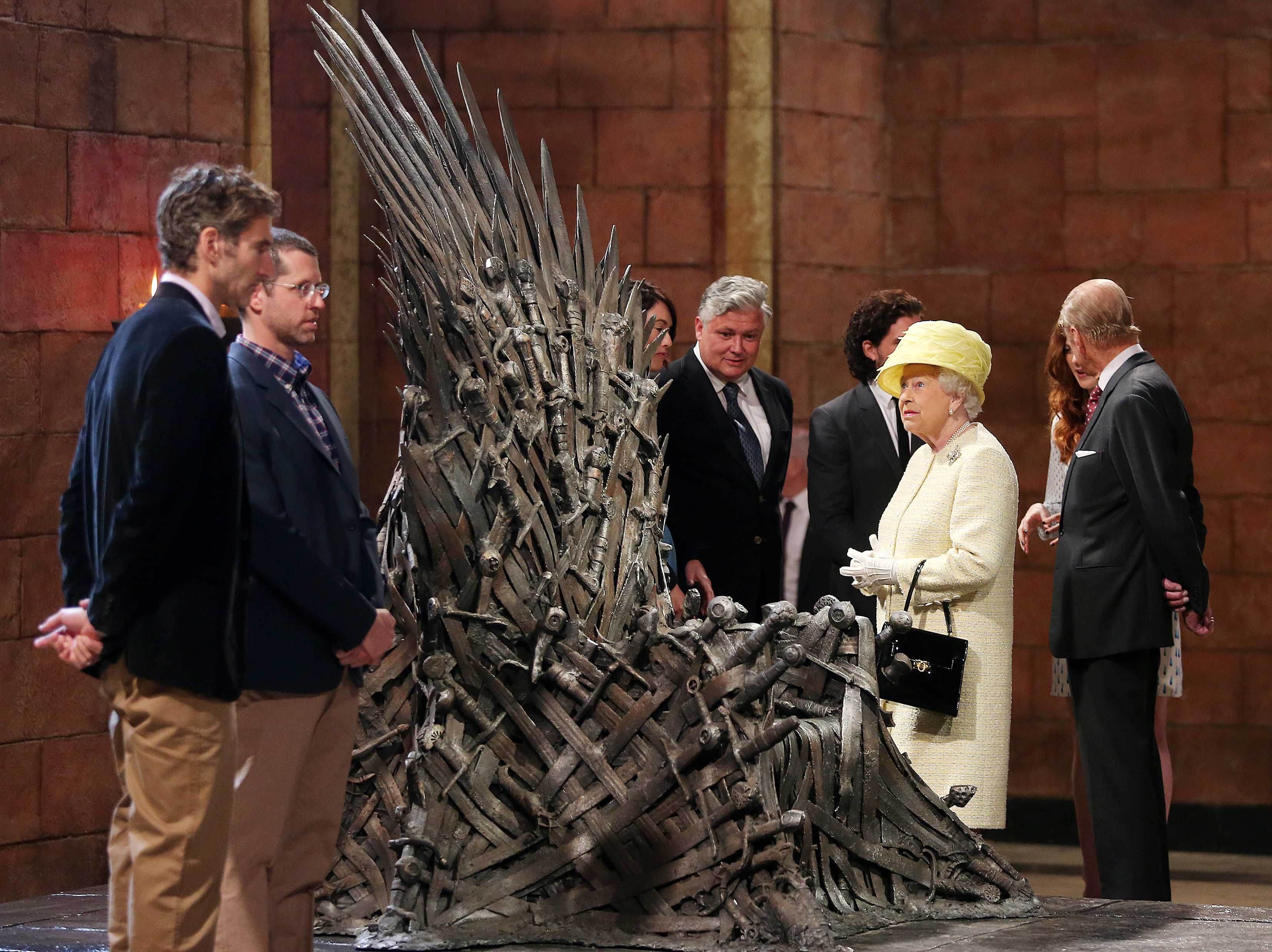
Queen Elizabeth II And Duke Of Edinburgh Visit Northern Ireland

Goldblog and the Dish – in some strange solstice convergence – are on (roughly) the same page again with respect to Iraq. Jeffrey fisks Elliott Abrams’ deranged piece in Politico called “The Man Who Broke The Middle East.” As an insight into the hermetically sealed neocon mindset, Abrams is always worth reading. As an insight into, you know, reality, not so much. Anyway, a great fisk, Goldblog! Money quote:

In reference to a “contained” Iran, I would only note that Iran in 2009 was moving steadily toward nuclearization, and nothing that the Bush administration, in which Elliott served, had done seemed to be slowing Iran down. Flash forward to today—the Obama administration (with huge help from Congress) implemented a set of sanctions so punishing that it forced Iran into negotiations. (Obama, it should be said, did a very good job bringing allies on board with this program.) Iran’s nuclear program is currently frozen. The Bush administration never managed to freeze Iran’s nuclear apparatus in place. I’m not optimistic about the prospects for success in these negotiations (neither is Obama), but the president should get credit for leading a campaign that gave a negotiated solution to the nuclear question a fighting chance.

Think of the careful and global coalition Obama assembled to isolate Iran on the nuclear question – Russia, France, Britain, the US, China all on the same page, leading to a successful preliminary agreement and coming to a conclusion soon on the second (or maybe not). Now remember Walter Russell Mead’s contention that

There is also the question of whether the earnest White House types who have piled up such a disastrous record in the Middle East could negotiate their way into a used car lot, much less handle a complex negotiation involving Russia, Iran, Assad, and a bunch of other canny operators.

Blogger, please. And notice one of Mead’s more hysterical moments of criticism – when Obama decided against striking Syria in favor of Putin’s offer to coordinate the extraction of all of Syria’s WMDs. Yesterday, the final shipment left Syria’s shores. We were all told this would never happen. It just did. Now ask yourself: if Obama had bombed Assad, do you think those chemical weapons would now be secure? And if they were still in Syria, with ISIS raging nearby, we’d have a real international crisis, wouldn’t we? Dick Cheney’s nightmare – Jihadists with WMDs – would be one step closer to reality. But, thanks to Obama (and not Bush) the threat of those WMDs from Syria has evaporated, and Iran’s nukes could be next. Without invading anywhere or torturing anyone.

I’m still trying to figure out how Rebekah Brooks was acquitted today, but the shoe that really dropped was the news that Scotland Yard will soon be formerly interrogating Rupert Murdoch himself about the widespread criminality on many of his papers over a long period of time.

Today, we also witnessed America’s initiation into the loss and grief of the World Cup; wondered if NATO expansion had made Europe less secure; noted the sudden lurch downward in Obama’s approval ratings; and continued the greasy, bacterial thread on grocery bags (now with GIFs!).

The most popular post of the day was Spurious Correlations from May (a gem); next up was my fisking of Walter Russell Mead, Raging Against Obama – And History.

Many of today’s posts were updated with your emails – read them all here.  You can always leave your unfiltered comments at our Facebook page and @sullydish. 15 more readers became subscribers today. You can join them here – and get access to all the readons and Deep Dish – for a little as $1.99 month. One subscriber writes:

It’s seriousness and sanity that Dishniks like me crave and value. Not for nothing, in other words, that you call them “Mental Health Breaks.” They feel like an intrinsic part of the sanity of The Dish, not a luxury option or frill. I’m going to get your brutal, naked self-examination of your position on the Iraq War, but I also get sloths as beards (and groan-worthy reader updates about beavers).

I skip over most but not all of your religion-themed posts (as one might expect from an atheist), but I’ll stop to marvel at the ingenuity of the VFYW contestants along the way. Then you’ll write something mildly infuriating about social constructionism or whatever it is you mean by “post-modernism” and I’ll begin a tart retort in high dudgeon, only to be side-tracked by one of your insightful assessments of the sanity of Obama … or by some shameless beagle-bait (you could do more of that, actually). And so I’ll be reminded once again that my redoubtable dudgeon switch can be safely disengaged. Dishness achieved once again; we now return you to your regularly scheduled program.

Which will continue in the morning; see you then.

(Photo: Queen Elizabeth II meets cast members of the HBO TV series ‘Game of Thrones’ Lena Headey and Conleth Hill as she views some of the props including the Iron Throne on the set of Game of Thrones in Belfast’s Titanic Quarter on June 24, 2014 in Belfast, Northern Ireland. By Jonathan Porter – WPA Pool/Getty Images.)

“The World’s Biggest Hegelians”

Matt Steinglass identifies a big problem with the way the US conducts foreign policy, particularly in the Middle East. Namely, we always seem to be looking for an ethically sound position that often doesn’t exist:

Over and over in the wars America conducts we attempt to create political entities that meet our ideological criteria, but have no natural constituency in the countries themselves. Maliki, Karzai, Diem: we become infuriated at the leaders we install when they fail Hegel_portrait_by_Schlesinger_1831to carry out our vision of progress. We are the world’s biggest Hegelians, analysing every conflict as a clash between two opposing principles that need to be resolved, and then trying to create that synthesis.

We have the same longing in domestic politics, for that matter. If only some great moderate could bridge the gap between the two parties, and bring us all together towards the reasonable consensus! We cannot seem to understand that if there were a constituency for that middle position, someone would be occupying that space; if there is no one in that space, it is because the middle position has no constituency. We keep trying to create a third force that does not exist. We need to stop it. The forces on the ground are the forces on the ground. If we support one side, we should back that side, and if not, not. If the two sides want peace, we can help them reach peace. If they want to fight, they will.

That’s a bit of a stretch from Hegel, but I take the point. We constantly seem to forget that the supremely smart and moral choices today can become deeply problematic tomorrow. So the CIA’s coup in Iran in 1953 seemed like a good idea at the time – until you realize the astonishing cost over the long run. Funding the mujahideen in Afghanistan as a gambit against the Soviets also seemed like an inspired way to win the Cold War without risking a global nuclear clash. But there’s a straight line from that decision to September 11, 2001.

What we don’t seem to be able to grasp is that there are realities in the world we cannot change, and some of them are not going to be completely beneficial for the United States or the West. But that doesn’t mean we have to fix them or indeed can fix them. We might try as an alternative to live with them, until they sometimes resolve themselves. It seems to me, for example, as if the West’s interventions in the Middle East – often well-intentioned – have done very little but slow or scramble that region’s natural historical development. Leaving alone, while guarding our own security, may lead to occasional bad results. But constant meddling only guarantees them – in an endless, fruitless and draining cycle.

Along those line, Chase Carter makes the case against continuing to support any Syrian rebels against Bashar al-Assad:

American idealism frequently clouds the judgment of our policy makers. We want to promote democracy everywhere, and we have a seemingly nonnegotiable aversion to dictators. But sometimes there simply isn’t a better alternative—toppling a despotic regime often creates more problems than it solves.

The United States is certainly creating more problems for itself in Syria by working against Assad. Obama said the United States needs to support moderates in Syria because they are fighting terrorists “who find safe haven in the chaos,” but arming the opposition to topple Assad is only prolonging the chaotic power vacuum that allows those terrorists to thrive.

Pointing to Pew’s most recent survey of the Middle East, Bruce Stokes adds that such meddling is not well received, even among those who would like to see Assad go:

[D]espite their fear of extremism spreading and their distaste for Assad, Middle Eastern publics voice no support for aiding those attempting to oust the Assad government. People in the region have seen the results of Western intervention in Iraq. And they may not relish the idea of other Arab states acquiring a taste for interfering in the domestic affairs of their neighbors. There was little support for aid to anti-government forces battling the Damascus regime in 2013, and there is even less backing in 2014.

Roughly three-quarters of Lebanese (78 percent), Tunisians (77 percent), and Turks (73 percent) are against Western nations sending arms and military supplies to the insurgents. (Respondents were not asked to differentiate between rebel groups.) And about two-thirds of Palestinians (68 percent), Egyptians (67 percent), and Jordanians (66 percent) agree.

Can we begin to listen to them for a change?

(Painting: G W Hegel, by Jakob Schlesinger.)

The War Beyond Iraq, Ctd

Nicholas Blanford sees ISIS’s Iraq campaign changing the Syrian regime’s war strategy, which in turn has implications for Lebanon:

Although sworn enemies on paper, ISIS has largely refrained from fighting the Syrian regime to focus on building an Islamic state in northern Syria and ousting more moderate rebel rivals. In return, the regime has left ISIS alone, allowing the Syrian military to concentrate on fighting the moderate rebel groups. At the same timeAssad also points to the brutal exploits of ISIS and other jihadist groups in the conflict to justify its argument to the international community that it is fighting Islamic “terrorists.” The Iraq upheaval appears to have changed that calculation. It has also injected uncertainty into Assad’s reliance on Iraqi Shiite fighters to seize the upper hand in Syria’s war. In recent weeks, “thousands” of Iraqi Shiite fighters who were in Syria to defend the Assad regime have left, according to a diplomatic report from a European embassy in Beirut. …

A drawdown of Iraqi Shiites could make Syria’s regime even more dependent on Hezbollah fighters, further straining the Lebanese group’s support base. Lebanese Shiites generally have supported Hezbollah’s intervention in Syria, especially when Shiite areas of Lebanon suffered suicide bombings last year by extremist Sunni groups. But the last car bombing occurred at the end of March, and since then Lebanon has enjoyed a period of relative calm. Now, there is a sense of unhappiness building among the families of Hezbollah fighters. They are increasingly asking how much longer their fathers, husbands, brothers, and sons will be sent to fight and die on the Syrian front.

Jean Aziz notes the anxiety of the Lebanese that this war will spread to their country in new and more dangerous ways:

With the progress made by ISIS in Iraq, there are once again Lebanese fears of the possibility of ISIS sleeper cells in Lebanon or at least the possibility that its progress in Iraq will revive hopes and illusions among other fundamentalists on Lebanese territory to join their “brothers” in jihad, even if they do not have an organizational link to ISIS. With more than 1 million displaced Syrians now on Lebanese territory, one cannot be certain that there are no fundamentalists among them.

Lebanese politicians opposed to the Damascus regime refer to a second source of concern. Recognizing the danger of these Sunni fundamentalists, they raise the possibility that Syrian troops might deliberately take advantage of the “erasing” of the international border between Iraq and Syriaby ISIS and resort to doing the same along the Syrian-Lebanese border. They believe that the Syrian army might initially carry out limited incursions, but then expand or legitimize them under the pretext of pursuing ISIS militants on both sides of the border between Lebanon and Syria. They fear that Damascus would dare take such steps in eastern and northern Lebanon because of possible international, in particular Western, indifference in blessing any step that targets Sunni fundamentalist terrorism.

Looking across the Gulf to the Arab petro-states, Keating imagines some anxious fidgeting:

Qatar has officially stopped giving aid to more radical groups under U.S. pressure, and Saudi Arabia has also backed off its support of the rebels, a process the culminated in the removal of spy chief and Syria point man Prince Bandar bin Sultan earlier this year, but private donations from Saudi Arabia and the Gulf states—notably Kuwait—have likely continued. For the last few months, the Saudi government in particular has been attempting, somewhat awkwardly, to both continue to fund non-extremist groups fighting Assad while combating the growth of al-Qaida and its affiliates and offshoots. The kingdom has good reason to fear the revival of an al-Qaida-like group with wide territorial ambitions. The government claims to have broken up a terrorist cell in May that had links to both ISIS and al-Qaida in the Arabian Peninsula. ISIS has also reportedly launched a recruitment drive in Riyadh. …

None of the likely outcomes in Iraq—a prolonged period of violent chaos in Iraq giving extremists a new base of operations, unilateral Iranian intervention, U.S.-Iranian cooperative intervention—is going to be viewed very favorably across the Gulf.

If You Thought Obama’s Syria Policy Was Bad …

Try Erdogan’s. The Turkish prime minister’s decision to go all-in against Assad, Henri Barkey remarks, has backfired pretty severely:

At the start of the conflict, Erdoğan presumed that by putting his weight behind the rebels he would be speeding up regime change in Damascus; in fact, he and many others were confident that change would occur within six months. Obviously, they were wrong. The costs to Turkey range from the ever-increasing numbers of refugees severely taxing the social fabric in certain locations—not to mention the financial burden—to the loss of face for Erdoğan at home and in the region to fragmenting relations with regional powers such as Iran and Saudi Arabia. According to a recent Brookings report, there are a million Syrian refugees, most of whom have blended into Turkey and do not reside in camps. The cost to the Turkish treasury has already exceeded $2.5 billion. Furthermore, the Syrian crisis touches all the hot buttons of Turkish politics: the sectarian differences between the majority Sunni population and the Shi’a offshoot Alevis and the ethnic divisions along Turkish-Kurdish lines.

Meanwhile, ISIS militants continue to hold hostage 80 Turkish citizens captured in Mosul, most of them diplomats and staff from the Turkish consulate and their families. Tulin Daloglu plays up the irony that Turkey is now threatened by the same jihadist elements it has been tacitly supporting in Syria for several years:

Turkey’s Foreign Minister Ahmet Davutoglu has been on the defensive for over a year about Turkey’s potential links to these radical extremist groups in their fight to bring down Syrian President Bashar al-Assad. Although it is improbable that Turkey directly provided support to these groups, it wasn’t until June 3 that Turkey finally designated Jabhat al-Nusra, another al-Qaeda spin-off group, as a terrorist organization. Turkey officially stated that the May 2013 Reyhanli car-bomb attack — the worst terror attack this country has ever seen, killing 52 Turkish citizens — was the work of the Assad regime, but the widespread belief was that it was an al-Qaeda attack.

Turkish authorities speaking on condition of anonymity, however, told Al-Monitor that the ruling Justice and Development Party could not admit it as such back then, and could not spell it out this time in Mosul. “They can’t say it because it would contradict the whole belief system of their core base,” one official said. “But the fact of the matter is that Turkey is certainly being threatened by al-Qaeda offshoots.”

Aaron Stein considers the manifold problems the implosion of Syria and Iraq has created for Turkey:

The major overland routes to Basra from Turkey run through Mosul. Ankara has already lost its ability to truck goods to the Gulf through Syria and may now have to deal with the same issue in Iraq. If  Turkey loses this route – and I think the taking hostage of 28 truck drivers may mean that this is inevitable – it could have some impact on Turkish trade with the region. In this regard, the importance of the KRG’s stability becomes even more paramount. In addition to the aforementioned security issues, the maintenance of a stable area of export is always near the top of the Turkish foreign minister’s agenda.

Turkey must also be concerned about the abysmal performance of the Iraqi security services. If Iraq descends further into chaos, Turkey will have to contend with two failed states on its borders. And in the absence of centralized authority, the expansion of ISIS territory could continue. However, in a perverse way, Turkey also does not want to see the rapid influx of advanced weaponry into Baghdad to support a fight against ISIS. Turkey is wary of Maliki’s sectarian agenda and does not want the Iraqi strongman to acquire the means to further solidify his hold on power. And any influx of modern weaponry erodes Turkey’s massive conventional superiority over the Iraqi state and could lessen Ankara’s air superiority over Kurdistan.

And, while the crisis may force a rapprochement between Turkey and Iran, Semih Idiz frames this as a product of Ankara’s weak position in the region:

It is no secret that Turkey and Iran are at odds over Syria, not to mention other issues, and have been engaged in what amounts to a proxy war, supporting opposing factions in that country’s sectarian civil war. The picture may be changing, however, with Syrian President Bashar al-Assad consolidating his power in regions under his control, while jihadist groups establish themselves in parts of northern Syria along the Turkish border as well as Iraq’s Nineveh province. …

Ankara and Tehran still disagree, of course, on Syria and Egypt, but it is Turkey that appears to be on weak ground in these respects. Ankara is therefore likely to be the party that gradually modifies its policies to match the reality on the ground. The belated designation of Jabhat al-Nusra as a terrorist organization, after numerous warnings from Washington and Tehran, already hints at change in this respect.

About That 88.7% …

Andrew Gelman passes along a good catch from Anatoly Vorobey, who shows that Syria’s election results were fraudulent:

They are too accurate. There’s 11,634,412 valid ballots, and Assad won with 10,319,723 votes at 88.7%. That’s not 88.7%, that’s 88.699996%. Or in other words, that’s 88.7% of 11,634,412, which is 10,319,723.444, rounded to a whole person. All the other percentages in the results are the same way, so given the magnitude of the numbers, it’s evident someone took the total number, used a calculator and rounded. This was first noticed, to my knowledge, by a Russian blogger Roman Tumaykin. The reason he looked at the vote counts in the first place was that a few weeks ago there was an identical case with a sham referendum in a Ukrainian province of Lugansk, controlled by separatists. The vote counts there were also all “correct” up to a rounding to a person.