Israel, Syria And Chemical Weapons

President Obama's Official Visit To Israel And The West Bank Day One

For a while there, I thought Netanyahu was being very shrewd, and unusually statesmanlike, in keeping a very low profile – and ordering his colleagues and compatriots to do the same. So this, if true, is deeply unfortunate:

Israeli officials close to the prime minister told Ynet he recently held talks with members of Congress, government officials and AIPAC officials, to explain the importance of American military action against the Assad regime.

The NYT has more this morning. Bibi would be better off, it seems to me, using his usual channels – like the Washington Post op-ed page – to make his case, rather than directly inter-acting with US members of Congress. That looks like truly inappropriate meddling in a properly domestic debate.

One other thing: this crisis has reminded us of a remarkable fact. There are just seven countries in the world who are not fully signed up to the Chemical Weapons Convention: Burma and Israel (signed but not ratified) and Angola, North Korea, Egypt, South Sudan, and, yes, Syria (AWOL). Here’s Wiki on the subject:

In 1993, the U.S. Congress Office of Technology Assessment WMD proliferation assessment recorded Israel as a country generally reported as having undeclared offensive chemical warfare capabilities. Former US deputy assistant secretary of defense responsible for chemical and biological defense, Bill Richardson, said in 1998 “I have no doubt that Israel has worked on both chemical and biological offensive things for a long time… There’s no doubt they’ve had stuff for years.”

Is it not passing strange that the country pushing for a war to end Syria’s chemical weapons threat and another war to end Iran’s nuclear capacity is also a rogue nation in terms of both nuclear and chemical weapons? Will this obvious point ever be raised? If Obama’s campaign really is to suppress the proliferation of such weapons, would it not be a good idea to predicate continued aid to Egypt and Israel on both countries’ adherence to the Chemical Weapons Convention?

I mean: if Assad has caved, why not Israel? One would think that poison gas would have a particularly profound stigma for the state that rose from the ashes of the Holocaust.

(Photo: Marc Israel Sellem, Getty Images.)
When Revolutions Collide

Jenna Krajeski chronicles the plight of Syrian refugees who took shelter in Egypt, only to end up as targets of the military junta after the coup:

In June, Morsi delivered a speech in favor of the Syrian opposition. Standing dramatically in front of a large Syrian flag, he vowed to cut diplomatic ties with Bashar al-Assad’s regime. The gesture, meant to garner Egyptian support for the Syrian opposition—and for the embattled Morsi—backfired. Syrians were now seen as aligned with the Brotherhood. And when Morsi fell and the Brotherhood was declared terrorists, Syrians became terrorists, too—enemies of the state to which they had fled. … I was told of Egyptian security forces swarming 6th of October and arresting Syrians inside their homes. According to Edward Leposky of the United Nations High Commissioner for Refugees, out of a hundred and forty-three arrested, fifty-eight have been deported, thirty-two released, and fifty-three remain in detention. Worst of all, the camaraderie Egyptians had shown toward Syrians—a solidarity cemented by the shared goals of the Arab Spring—seemed to have vanished overnight.

Don’t Rush Off To Homs Just Yet

Ann Friedman worries that freelance reporters are entering war zones without proper preparation or support:

I confess that I’ve been watching all the coverage of Amanda Lindhout’s book [profiled above] with a bit of chagrin. Lindhout, who traveled to Somalia as an aspiring journalist in 2008, was kidnapped along with her photographer companion and their guides. She spent 15 months in captivity before her family finally hired a private security firm and raised the ransom money. Later she collaborated with established journalist Sara Corbett – “we rented a really remote house in the Bahamas together and spent seven straight days in conversation” – to write a book about her ordeal. On Twitter she describes herself as an “adventurer,” but in much of the coverage, including a recent Today show appearance, she’s identified as a journalist.

“Why her and not me?” asks veteran journalist Robert Draper, who met Lindhout in a Mogadishu hotel before she was kidnapped, in an essay in ELLE. The answer seems pretty clear. She had traveled widely as a tourist but had zero institutional support and very little experience as a reporter.

As young journalists survey the professional landscape—the layoffs, the closure of foreign bureaus—just packing up and buying a plane ticket starts to seem like a viable option. As one guy wrote to me recently, “I am interested in getting to the Middle East as some sort of war correspondant [sic] or novice freelance frontline reporter. I believe I could find the connections with publishers to make the journey successful. What are some steps I could take to set up a trip and get a sponsorship loan on equipment in order to begin preparing for a deployment?” Every single hard-bitten war correspondent has had to start somewhere. It’s just that more and more of them are trying to get that start without the support or backing of an established news organization and without the mentorship of an experienced international reporter.

How Effective Is Air Power?

Ronald Bailey digs up data on the question:

[W]ill raining missiles down on Damascus stop Assad from gassing his people in the future? Quantitative research by Michael Horowitz of the Center for Strategic and International Studies and Dan Reiter of Emory University suggests that threatening such aerial attacks works about a third of the time. In their 2001 article “When Does Aerial Bombing Work?” in the Journal of Conflict Resolution, the two define coercion as “a threat to inflict pain on a target if the target does not accede to a demand.” The two identify and analyze all attempts to use air power to coerce countries between 1917 and 1999. “Of our 53 cases of air power coercion, 19 (36 percent) were successes and 34 (64 percent) were failures,” they report.

Horowitz and Reiter define air power coercion a “success” when a target changes its behavior as demanded without being attacked. (“Successful threats are those that do not have to be carried out,” as the economist Thomas Schelling wrote in his 1966 book Arms and Influence.) Clearly, the threat of U.S. air power has failed to dissuade Assad from poison gassing his people. The researchers also count air-power coercion as successful if a target yields shortly after being attacked. With regard to Syria, that kind of “success” is still up in the air, so to speak.

The Growing Opposition To War

Syria Pew Poll

The latest from Pew:

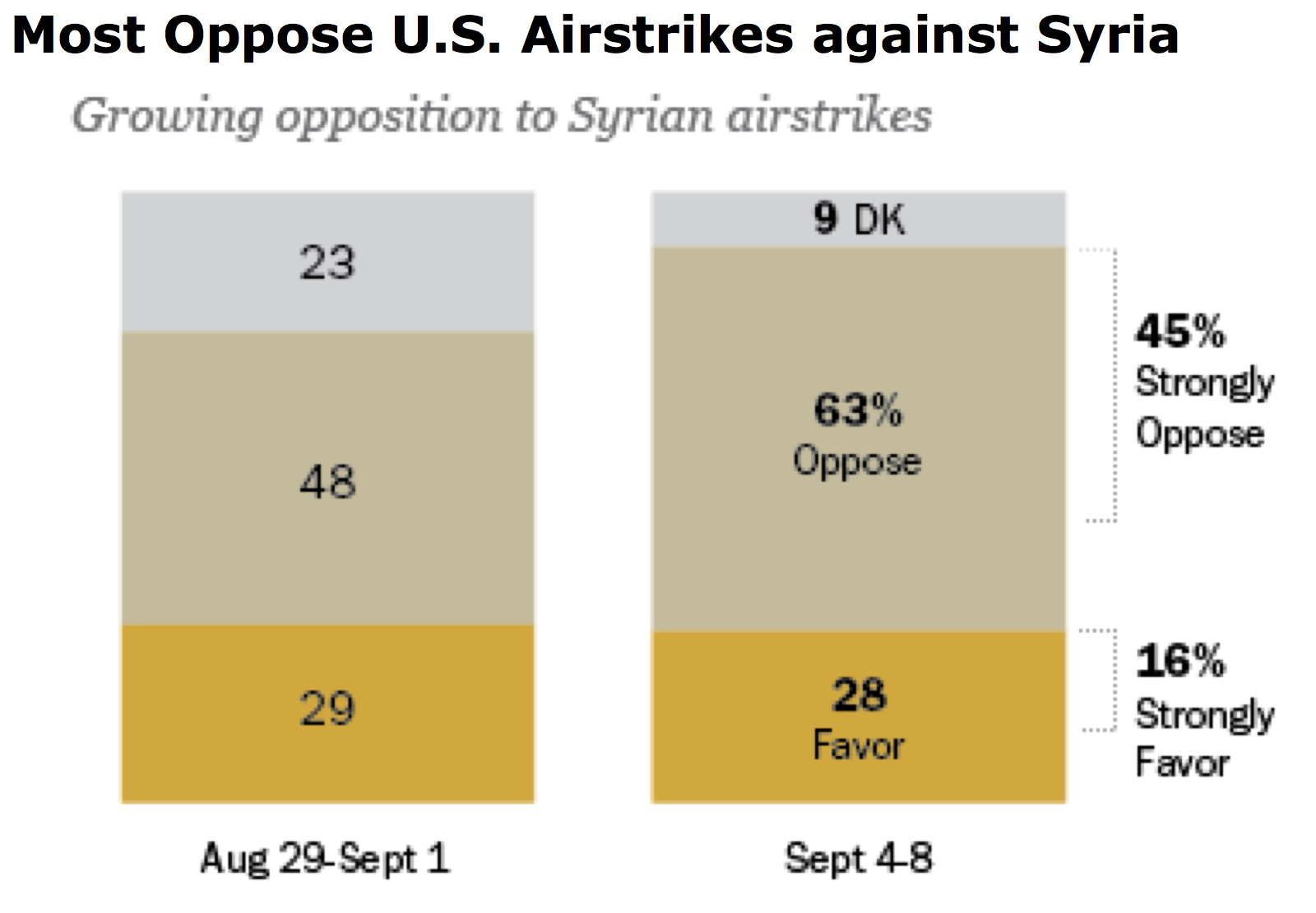
Over just the past week, the share of Americans who oppose U.S. airstrikes in Syria has surged 15 points, from 48% to 63%, as many who were undecided about the issue have turned against military action. By contrast, the share of Americans who support airstrikes remains virtually unchanged: Just 28% favor U.S. military airstrikes against Syria in response to reports that its government used chemical weapons.

Nate Cohn notes “the total collapse in Republican support”:

Back in April, when Pew asked voters whether they would support strikes if Syria used chemical weapons, Republicans were pretty supportive; 56 percent were on board, compared to just 24 percent opposed. By last week’s Pew Research survey–now simply asking voters whether they would support strikes now that Syria had used chemical weapons–Republicans were basically divided. But today, Republicans are overwhelmingly opposed by a 49 point margin, with just 21 percent in support and 70 percent opposed. There hasn’t been similar movement among Democrats.

Ed Morrissey parses a CNN/ORC International poll:

The only good news for Obama in this poll is that a majority of respondents say that their votes in the midterms won’t be impacted by the vote on the authorization (57%).  However, among those who will take that into account fourteen months from now, sentiment runs nearly 3:1 against at 11/31.  It’s 4:1 among independents at 9/36, and 5:1 in the West (7/38), where Democrats hoped to make gains against Republicans with social-libertarian policies.

“Expect Everything”

Chilling words from Bashar al-Assad to Charlie Rose and the American people:

This embed is invalid


How Denver Nicks describes the exchange:

In response to questions about how the regime would respond if attacked by the United States, Assad said Washington should “expect everything,” including terrorist attacks. “The governments are not the only player in this region. You have different parties, you have different factions, you have different ideologies, you have everything in this region now,” he said. When Rose asked him if he meant that a response could include the use of chemical weapons, he said, “That depends. If the rebels or the terrorists in this region, or any other group in this region have it, it could happen, I don’t know, I’m not a fortune teller.” Hinting at unforeseen consequences that could come from an attack in a region he described as “on the brink of explosion,” Assad said, “Nobody expected the 11th of September.”

How Marc Tracy interprets the dictator’s words:

If this seems familiar, it is because you have seen it in a dozen movies and television shows about the mob. Assad comes across as a thug. Nice legs you’ve got there—shame if you broke them. I’m not saying American bases will be struck if you attack Syria, but I sure wouldn’t do it if I were you. Lotta crazy people in this region.

Weigel parses more quotes from Assad regarding WMDs, terrorists and Iran.

“Unbelievably Small”

That’s how Kerry described the proposed military strikes against Syria:

Waldman comments:

This was an off-the-cuff remark that he’d obviously like to take back, but it was just an unfortunately exaggerated version of what the administration has been saying all along. It’s going to be limited in duration and scope! It’s hard to convince people that only a minimal effort is required at the same time you’re trying to convince them that this is so very critical.

Fallows focuses on the same disconnect:

The concern all along about the administration’s plans has been the gap between the problem it describes — moral outrage, gassing of children, overall carnage — and the response it is proposing. You can talk about that disconnection: Will an attack make a difference? Might it make things worse? I’ve tried to look into such questions in the posts gathered here. Or you could run back-to-back clips of the same Cabinet secretary saying “this is Munich” and “unbelievably small.” It’s unfair to the admirable and usually eloquent Kerry, but in a moment’s slip-up he crystallized a counter-argument.

Joshua Keating’s two cents:

I may not have much experience with brinksmanship, but it seems to me that threatening to hit someone becomes a lot less effective when at the same time you’re telling your friends,Don’t worry, I’m not going to hit him that hard. And convincing the public that this situation is analogous to the buildup to the largest war in human history is difficult when you’re also saying that an “unbelievably small” effort will be sufficient to deal with it. Given the blows the Assad regime has already absorbed over the last two years, it’s hard to imagine statements like these changing his thinking.

How Many Syrian Rebels Are Terrorists?

https://twitter.com/Partisangirl/statuses/365042816046489600

Michael Kelley touts the work of researcher Liz O’Bagy, a lobbyist for the rebels:

O’Bagy estimates that supporters of Jabhat al-Nusra and ISIS — the two main al Qaeda-linked groups — probably involve about 5,000 to 7,000 fighters while the number of rebels participating in offensive operations is about 80-100,000 rebels. So a subset of Syrian rebels are certainly linked to al Qaeda, but terrorists only make up about 10% to (at the very most most) 20% of the opposition.

The idea that we should accept as fact these self-serving notions is preposterous. We really shouldn’t be Chalabied again. Judis puts it more dispassionately:

Is the administration right about rebels? Or has it changed its line to accord better with the case it wants to make for military action in Syria? One cannot answer this question definitively. Reporters and independent researchers have very limited access to Syria; and the situation on the ground continues to shift. When I asked Yezid Sayigh, who is a senior associate with the Carnegie Middle East Center in Beirut, about the relative strength of the moderates and extremists, he said, “None of us really knows, not us outsiders and not most Syrians.” But this much can be said: There is at least as good evidence against the administration’s claim of rising moderation as there is for it.

Kerry Gaffes; The Russians Blink, Ctd

Josh Marshall advises the administration to “grab on to” the Russian proposal:

I’m not saying I think it will be easy or that the Russians are sincere. But getting all the regimes chemical weapons arsenal under international control would be no small achievement. Simply focusing on it would give the US something to apply leverage against (something it sorely lacks at the moment) and put the Russians in an awkward spot. The introduction of foreign forces of whatever sort is always something a regime trying to remain in power seeks to avoid. It would be a development that might well be used to leverage Assad out of power.

The key is that this potentially allows the US to reshuffle the deck and come at the problem on terrain which is inherently more favorable, given the Russian opening. Take the whole thing back to the Security Council. Have the Russians veto what they just proposed.

Jed Lewison adds that, “if Russia were actually able to get Syria to relinquish its chemical weapons, it’s hard to imagine a scenario where the administration would proceed with an attack”:

Of course, that’s the best case scenario. The flip-side is this: What happens if Russia and Syria say they are in the process of handing over weapons, but don’t take action quickly enough to satisfy the administration? Would the U.S. attack Syria at the same time that Russia was claiming to disarm it of chemical weapons?

Fisher is unsure whether Russia’s plan is legit:

[I]f Russia and Syria do go through with this plan, it would signal that both believe Assad can still win without chemical weapons. They would probably be correct. And it would significantly reduce the odds of any U.S. action against Assad, although it’s debatable whether that would be a good or bad thing for Syria. But, as Washington Institute for Near East Policy Executive Director Robert Satloff pointed out to me on Twitter, the “exit of chemical weapons would end any possibility of U.S./Western military action to balance the battlefield.” That’s a sign that Lavrov’s plan might be for real.

Drum weighs in:

[W]hat if the Russians aren’t playing games, but are seizing an unanticipated opportunity? It’s possible that for all their bluster, the Russians would actually like a way out of this that saves some face. It’s also possible, if you believe the latest reports in Bild am Sonntag, that Assad never wanted last month’s chemical attack to go forward in the first place. His generals did it without his go-ahead. So maybe he’d just as soon be rid of the stuff.

I doubt it. But it’s at least an intriguing thought.

Mataconis suggests that it “may not even matter if this Russian proposal is all that serious”:

The President’s request for authorization to use force is already in perilous trouble in Congress and even members of his own party are having a hard time getting in line behind him. If there’s a proposal sitting out there that could potentially avoid military action, which the Syrians have seemingly expressed a willingness to consider seriously, then it strikes me that it’s going to become all the more difficult to convince reluctant Members of Congress to get behind the President. The President has already said on more than one occasion that there is no imminent threat to the United States from Syria’s chemical weapons and that the attack that he has in mind can essentially be delayed indefinitely. He conceded that much by submitting the matter to Congress while at the same time insisting it was not an urgent enough matter that they needed to reconvene early. Indeed, it’s already been nearly three weeks since the attack which is supposedly the basis for the attack. If it was okay to wait this long, the reluctant legislator is likely to ask, then why not wait a little longer to see if this proposal pans out?

Dreher asks why the administration wouldn’t support this proposal:

Why would the Obama administration walk back Kerry’s statement, especially if the Russians are on board with it? I thought that the US goal here was simply to destroy Syria’s chemical weapons capabilities. If we can get a verifiable international operation to peacefully disarm Syria’s chemical stockpiles, why not?

Unless the Obama administration is using “chemical weapons” as cover for regime change.

Why Is Bombing The Something We Must Do?

I asked that question last night. Fallows is on the same page:

From what I can tell, approximately 100% of the pro-strike arguments have been devoted to proving what no one contests. Namely, that hideous events are underway in Syria, that someone (and most likely Assad) has criminally and horrifically gassed civilians, and that something should be done to reduce the ongoing carnage and punish the war crimes. And approximately 0% of the argument has addressed the main anti-strike concern: whether U.S. military action — minus broad support, any formal international approval, or any clear definition of goal, strategy, or success — is an effective response.

The Russian proposal is a start, don’t you think? Or what Congressman Chris Smith has suggested:

I think there is the potential to get China and Russia to agree to a [war crimes] tribunal, provided it applied equally to the rebels as well as the Syrian regime. This would be a non-lethal approach to Syria and would put them on the wrong side of justice for all and holding mass murderers to account. The pressure would be very profound. But it hasn’t even been tried. So why not try it before this bloodletting gets much worse?