Dissents Of The Day

Hijacked Planes Hit World Trade Center

A reader writes:

I’m a Republican subscriber to the Dish and a frequent yeller at my computer screen as a result – and I’ll stay an enthusiastic subscriber because you’ve got passion and smarts and personality, and that’ll more than do. But honestly, not one reference, throughout your ongoing commentary about the Senate torture report, to the 2,996 victims of the 9/11 attacks? They went to work that morning and died in horror and never knew why – surely there’s some mitigating context that deserves at least a mention alongside the allegations (and yes, ugly truths) about America’s security efforts in the wake of that attack.

Another quotes me:

All I want you to do is imagine if you were witnessing this scene in a movie. The interrogators would be Nazis, wouldn’t they? And now they are us.

No, they would not have be Nazis.  They could be Jack Bauer from 24, a critically acclaimed show that millions loved to watch for nearly 200 episodes.  Maybe you think that proves your point?  I say the opposite of course – that war is hell, that in every war bad things are done that MUST be done, and that the vast majority of decent Americans understand this as well, despite you’re preachy moralism on the Dish to the contrary. We do not, unfortunately, live in world where we get to decide between two ideals, but often we only get to decide between actions, and outcomes, that are “really bad” and “even worse”, and even then reasonable people will disagree on what should have been done. Thus some still call Truman a monster for dropping the bombs.     

Another criticizes us at length:

Dish reporting on the Senate report is not unlike Amanda Marcotte et al’s take on campus sexual assault: everything bad ever said about the CIA/Bush/Cheney is uncritically taken as true, any dissent or contradiction is dismissed/vilified out of hand.  All up, not the Dish’s finest hour. To clear up a couple of things:

1) Water boarding is torture.

2) Not all torture is the same.  Hot irons are not the same as slapping someone or verbal threats of physical punishment.  Plain and simple.  Loud music and cold-water immersion are not the same as wrenching off toe nails.  We aren’t talking nuance; we are talking intellectual honesty and reasoned examination.  It may be ugly, and it make be torture, but there levels, degrees, etc of abuse and pretending otherwise is effective only when preaching to the choir.

At least three glaring errors in the Dish’s side of this argument:

1) “Michael Hayden Unravels” – Ok, I watched it. He didn’t unravel. He did unravel the allegations in the Senate report.  This is an editing error, at best, or indicative of a very lax standard for criticizing the opposition.  You might say that Hayden was unresponsive in some respects.  That would be fair.  But that he unraveled?  No way.

2) You quote Larison, as follows, with approval: “Torture is absolutely wrong and absolutely useless, and demonstrating the truth of both statements will make clear how completely bankrupt its defenders’ arguments really are.”  The first part might be true, but the second part is debatable and by no means objectively established.  Repeatedly asserted but not objectively established.

More to the point, how does one establish that torture is “absolutely useless” without actually using torture on a systematic basis and finding out whether, in fact, it works (which itself is a subject analysis).  Because a Senate report says so?  Because others say so?  Crap.  We get that all the time, where there is some asserted, final word on some topic that turns out to be crap.  What is really at play here is a very desperate need by the Dish and its side to establish this “fact” as beyond question.  Why?  Because if torture, in some applications, does work, the absolutist argument becomes less compelling if innocent lives are in the balance and if the torture subject is shown to be in possession of valid intelligence.

I realize this is an unlikely and somewhat contrived scenario, but I am not the one making blanket statements.  If a blanket statement is universally true, then there shouldn’t be any demonstrable exceptions.  But regardless, the assertion that torture doesn’t work seems outright stupid to me.  It might not work on some people, but it will absolutely work on others.  For example, threaten my wife or my children and watch me puke up whatever you might want to know.  Truthfully, it would take less effort than that.  The fact that spies are created by blackmail indicates that relatively low levels of coercion are effective on some people.  For a different spin, imagine Peter King being able to maintain his position that water boarding isn’t torture after spending five minutes under the bucket.

3) Here’s another good one, from someone like me yet not like me: “You can be for torture, but you can’t be for torture and then claim that it’s somehow inappropriately barbaric for ISIS to crucify the innocent.”  Seriously?  So, if the only people being water boarded are known associates of ISIS John the Beheader and the sole purpose of the water boarding is to locate and neutralized ISIS John, that is really no different than randomly rounding up innocent bystanders and lopping off their heads?  Brilliant.

This isn’t a debate.  It isn’t a discussion.  It’s an echo chamber.

For the record, I think torture is wrong in almost nearly every application (and that, if used in exceptional circumstances, the law, not people, should say when and if some specified means of coercion may be applied – we don’t do any of that).  The process of asking for forgiveness in hindsight rather than permission in advance is wrong.  I think allowing one exception makes it easier to allow the next and easier still to allow the one after that.  I think the whole thing is a hellish conundrum and would rather debate marginal tax rates.

But what I don’t think is that it is as straight up clear cut as your howling would have it.  Like I said, not the Dish’s finest hour.

(Photo: A man falls to his death from the World Trade Center after two planes hit the twin towers September 11, 2001. By Jose Jimenez/Primera Hora/Getty Images)

Imaginationland Revisited

1204061padilla2

One aspect in the Senate Report that hasn’t gotten enough attention is its exposure of the actual “threats” that, we have been told, were so great that the US had to leave the civilized world and commit war crimes to defend itself. This threat would therefore have to be greater than the Nazis or the Japanese, because in the Second World War, the US never violated its core values as it did after 9/11.

So what exactly were these threats, according to the CIA? I mentioned the “Second Wave” plot earlier today. It was never operational – and in fact, one version of it had been canceled in December 2001. The other version of it never got a stage where it could even clearly be called “disruptive.” Now let’s go to the alleged “Dirty Bomb” plot – which permitted the government to seize and brutally torture an American citizen, Jose Padilla, with no due process at all. The NYT summarizes the CIA’s own findings:

For all the publicity the Bush administration gave Mr. Padilla, the committee revealed that the government never took his dirty bomb plot seriously. It was based on a satirical Internet article titled “How to Make an H-Bomb,” and the plot involved swinging a bucket full of uranium over one’s head for 45 minutes. One internal C.I.A. email declared that such a plot would most likely kill Mr. Padilla but “would definitely not result in a nuclear explosive device.” Another called Mr. Padilla “a petty criminal” and described the dirty bomb plot as “lore.”

We tortured a petty criminal to the point of his complete psychological and physical breakdown … because of a satirical Internet article? Adam Taylor provides more:

According to the CIA report, Padilla and Mohammed later told investigators that the dirty bomb plot was a ruse to get out of Pakistan and avoid fighting in Afghanistan. It doesn’t seem to have been taken seriously by al-Qaeda at any point.

Then there is the case of the alleged attempt to destroy the Brooklyn Bridge:

KSM said that he had once tasked Mr. Faris with finding tools to loosen the bolts of American suspension bridges, but that Mr. Faris had been unable to do so. The F.B.I. had already been following Mr. Faris at that point, and when agents approached him, he talked voluntarily, the report showed. Separately, C.I.A. officials played down the likelihood of the bridge attack. “We risk making ourselves look silly if the best we can do is the Brooklyn Bridge,” one official wrote in 2005.

The plot to attack Canary Wharf and Heathrow in London? Another dud:

The plot was labeled “not imminent” because Al Qaeda had not identified pilots for the mission.

Do you see a pattern here? Everything we were told about the imminence of terrifying terror attacks after 9/11 was a huge exaggeration of the actual risks we faced. Which means that the torture program was set up to prevent a fantasy built on fear and panic – not on real threats to the homeland, let alone thousands of American lives. What you get from this report is a clear sense that on 9/11, thanks in part to incompetence at the CIA, the Jihadists got lucky. That’s all. It was not the beginning of a wave of terror; it did not reveal the existence of a massive clandestine plot to attack the US with WMDs or flocks of suicide bombers. We were fighting a menace that was a pathetic shadow of what we actually believed. And the people who are supposed to have an adult assessment of the risks, the men in charge of the US government, threw out any skepticism, trashed any contrary analysis, and went head-first into this astonishing campaign of torture, bombing and invasion in what history will surely judge was the most grotesque over-reaction to a threat in American history.

Douthat also concludes that the threats against America were exaggerated:

I’ve read enough to be confident that torture is often ineffective, but also to doubt the (frankly, convenient) certainty with which that ineffectiveness is touted. But my point here is that whether those tactics gained us something or not, the absence of a single successful domestic attack in the years when they were employed is still a strong indicator that the decision to use extraordinary measures, at least one of them intrinsically torturous and some of them likely to be abused in ways that made them torturous in fact, was based on an overestimation of the threat we faced — and an even stronger indicator is the absence of a successful domestic attack in all the long years (eleven or ten or nine, depending on how you count) since they’ve been discontinued. …

Yes, maybe our intelligence agencies are miraculously maintaining a perfect record, relying on intelligence cleaned exclusively in a narrow window, against a genuinely fearsome foe. But the preponderance of the evidence, plus everything we know about American government, suggests that this perfection has to reflect our enemy’s weakness-cum-incompetence more than any extraordinary effectiveness on our part, and that whatever tactics we allow ourselves to use against him, our foe is just not so fearsome after all.

But the key thing about a torture program is that, once you have crossed the Rubicon into barbarism, it’s psychologically impossible to believe it was to defuse … basically nothing. So what happens is that you have leading figures simply denying reality. This is a function of the denialism all too common among torturers of all kinds. Froomkin:

A fascinating footnote to the Padilla case involves the CIA’s refusal to admit its error, even years later. In 2008, the Intelligence Committee sent the CIA a question: “Why was this information [related to Padilla], which was not obtained through the use of EITs, included in the ‘Effectiveness Memo’?”

Committee investigators found that one CIA official drafted a response admitting that the agency had “simply inadvertently reported this wrong. Abu Zubaydah provided information on Jose Padilla while being interrogated by the FBI.”

But someone higher up on the foodchain had that draft killed. The truth was simply too much of a threat.

Too much of a threat to the cognitive dissonance required to defend the indefensible. Seven years ago, trying to make sense of what we then knew, I wrote:

It is perfectly conceivable that the torture regime – combined with panic and paranoia – created an imaginationland of untruth and half-truth that has guided US policy for this entire war. It may well have led to the president being informed of any number of plots that never existed, and any number of threats that are pure imagination. And once torture has entered the system, you can never find out the real truth. You are lost in a vortex of lies and fears. In this vortex, the actual threats that we face may well be overlooked or ignored, as we chase false leads and pursue non-existent WMDs.

I’ve had occasion on this blog to note the many times I have been wrong about something. But on this, I was clearly right. And the CIA’s internal documents now prove it.

This is therefore an astonishing moment in American history. The rationale of an entire war has been debunked. There were no threats even close to existential, and none that were imminent. We invaded two countries, caused the deaths of tens of thousands of innocents, killed nearly 5,000 American servicemembers and maimed countless more, destroyed our moral standing in the world, and wrecked our alliances .. to prevent a few unrealised, often-amateur Jihadist plots. I struggle to think of any fuck-up in American history that rivals this. And none on this scale in which no one is held accountable.

(Photo: a rare glimpse of the total sensory deprivation inflicted on an American citizen Jose Padilla, a man tortured until his body and soul were broken because of a satirical Internet article.)

Silence, Audible, Ctd

Chris Christie opposed torture in 2002:

http://youtu.be/Y7baNO2NsVk

But, thus far, he has declined to weigh in on the Senate report:

Asked for his reaction by The New York Times, Mr. Christie said, “All I’ve seen, unfortunately, at this point, is some of the reporting from your newspaper, so I don’t think it would be responsible to comment based only on that.” He said of the report: “I’ll take some time to look at it. I don’t know about all of it. But I’ll take some time to get briefed on it for sure.”

Noah Rothman wants him to get off the sidelines:

If Christie believed that the Senate Intelligence Committee’s investigation was not as thorough as it needed to be in order to come to the politically fraught conclusions it reached, it would have been advantageous for him to say as much. Considering the number of sources making this same contention, Christie would not have been in bad company. If, however, Christie is predisposed to agree with the findings of the SSCI’s report, he should have made the time to be briefed on its conclusions within the first 24 hours of its release.

It’s still possible. The Clintons, meanwhile, say nothing in one of the most significant moments in America’s moral and constitutional history. Neither does Jeb Bush. Why am I not surprised? Update from a reader:

What has Pope Francis to say, I wonder?

What Did Bush Know And When Did He Know It?

For me, the question remains a fascinating one. The revelation that the first briefing that Bush got on waterboarding was in 2006 is a staggering finding. His own book contradicts this. But the CIA has no records of briefings other than that. And their internal response to his 2006 speech showed how distant they were. When he indicated that no inhumane practices were being used, the CIA wondered if their program had been suspended without their knowledge!

But Fred Kaplan doesn’t buy the claim that Bush didn’t know what was going on:

[L]et’s take a close look at the committee’s claim that Bush wasn’t briefed on the program until it had nearly run its course: “According to CIA records,” the report states, “no CIA officer, up to and including CIA Directors George Tenet and Porter Goss, briefed the president on the specific CIA enhanced interrogation techniques before April 2006.”

I’ve italicized two words in this passage, for emphasis. The second word is key: Bush wasn’t briefed on the “specific” techniques till 2006. Under the well-known rules of plausible deniability, he would not have wanted to know too much about these specifics. As indicated in the station chief’s presentation, it’s not that the CIA didn’t tell the president certain details; it’s that the president didn’t want the CIA to tell him.

I think that’s easily the best explanation. Bush was briefed the way we all were about “enhanced interrogation” in language designed to obscure the reality. “Long-time-standing,” for example, sounds relatively mild. It does not fully convey the fact that prisoners with broken legs and feet were put in stress positions – the kind of torture you’d expect from ISIS. But there was surely also a desire not to know, not to have direct and explicit knowledge of what was actually being done, because of the immense gravity of the crimes. Who protected him? Almost certainly Alberto Gonzales. Maybe Condi.

Here’s my best guess after puzzling about this for a decade. Bush made the fateful decision to waive core Geneva protections from prisoners suspected of terrorism early on. That was his signal. He told everyone in the CIA (and beyond) in a moment of extreme emotion that you could do anything to these prisoners you wanted. In that sense, Bush is completely and personally responsible for every act of torture on his watch. He is as responsible as the men who decided to waterboard a prisoner until hardened operatives choked up and walked away.

But he then disappears in the CIA records – and Obama refused to give the Senate Committee the White House records that could have cleared it up (another instance of Obama covering up evidence of war crimes). Cheney presumably handles it all – with Addington doing clean-up – giving Bush the reassurances that a) the torture was giving up vital information saving lives (a lie) and b) that it was all legal (only by making an ass of the law in memos that were subsequently rebuked and rescinded). I suspect that this was all Bush decided he wanted to know: it works and it’s legal. And the famously incurious president didn’t want to know any more. I remember in 2005 asking a very senior administration official if we were torturing prisoners. The carefully parsed response, after looking down and away from me: “The president doesn’t believe we’re torturing people.” They were crafting a way to insulate him from war crimes done in his name.

Serwer likewise finds it “hard to believe that the Bush administration couldn’t have had any clue about what was really going on at the CIA”:

Less than a week after the 9/11 attacks, Bush signed an order allowing the CIA to detain and interrogate terror suspects, and in February 2002, he signed “a memorandum stating that the Third Geneva Convention did not apply to the conflict with al Qaeda and concluding that Taliban detainees were not entitled to prisoner of war status or the legal protections afforded by the Third Geneva Convention,” according to a 2008 Senate Armed Services’ Committee investigation.

So: Mere months after the 9/11 attacks, the Bush administration was already rewriting the law to make it easy to torture detainees in U.S. custody. You don’t start declaring exceptions to the Geneva Convention if all you’re planning to do is play a competitive game of spades.

The CIA is not “a rogue elephant,” in the deathless phrase of Senator Frank Church, who ran the pioneering congressional investigation of the agency four decades ago. If the beast tramples people, it’s the mahout, the elephant driver, who is to blame. There was clearly one person driving this program, whether he knew what the elephant was doing in his name or not.

The mahout in the Senate report is the president of the United States.

And he stands accused of war crimes in front of the whole world.

Cheney Is Lying

In his deeply revealing interview on Fox News last night, former vice-president Dick Cheney was asked which plots were foiled using torture, thereby saving thousands of lives. The first and only case he cited last night was the “West Coast” “Second Wave” plot against buildings in Los Angeles. He’s cited this many times before. And here’s the thing: It’s a lie. It’s not true. And we now know it’s not true, because the CIA itself admitted it last year, after a decade of lying about it.

Cheney hasn’t read the report, although he knows it’s “full of crap.” What that tells you about this man’s integrity and honesty I’ll leave to you. But here is what he hasn’t read.

The CIA, from the beginning, cited this case as a critical piece of evidence for the efficacy of torture, in all its briefings to officials. To take one random example, here is a legal memo from Steven Bradbury, at the OLC, conveying what the CIA was telling him:

Screen Shot 2014-12-10 at 7.23.26 PMSo torture gave us the existence of the Guraba cell, which foiled the plot. The CIA told Bush the exact same thing:

Screen Shot 2014-12-10 at 7.30.58 PMThis was a lie. How do we know? Because CIA operational cables and internal documents tell a different story. The FBI arrested two operatives in August 2001, including a “suspected airline suicide attacker” and that provided the leads for further identification of al Qaeda operatives involved in the Gubara version of the attack. Another plot on similar lines by some Malaysian nationals, coordinated by KSM, was foiled when one Misran bin Arshad was arrested in January 2002, revealing, by the way, that the attack had already been canceled the month before. Arshad spilled the beans after legal and non-coercive interrogations. So, according to the CIA, torturing KSM gave us nothing that we didn’t already have; and agents deduced that what intelligence they did get from KSM about this was because he knew that Arshad had already been captured – not because he had been tortured.

And the CIA admitted as much last year:

The CIA’s June 2013 Response acknowledges that “[t]he Study correctly points out that we erred when we represented that we ‘learned’ of the Second Wave plotting from KSM and ‘learned’ of the operational cell comprised of students from Hambali.” Here’s the full section:

Screen Shot 2014-12-10 at 7.49.17 PMBut notice that they cannot quite admit what they have admitted. They accept that they misled the president, but called it “imprecision,” rather than untruth. Then they bizarrely continued to “assess this was a good example of the importance of intelligence derived from the detainee [torture] program.” Then they threw in another claim – that the capture of another figure, Hambali, had been critical to foiling the plot as well, and that his capture was a function of the torture program. But the CIA’s own documents show that Hambali’s capture was unrelated to to the program. After a while, when you read this report closely, you cannot avoid seeing that they’re flailing around. They’ve got nothing but bluster and bluff. And when you watch the amazing Cheney interview, you realize he has nothing else either. All he has is bluff. But what he said last night was wrong. The CIA itself has said it was untrue.

We have a former vice-president going on cable news and continuing to say things in defense of the CIA that the CIA itself admits are untrue. This is his p.r. strategy: asking the American people who they are going to believe: Dick Cheney or their own lyin’ eyes? More on the Cheney interview to come.

Team Torture

Noah Millman believes that our reasons for torturing weren’t based on torture’s effectiveness:

Willingness to torture became, first within elite government and opinion-making circles, then in the culture generally, and finally as a partisan GOP talking point, a litmus test of seriousness with respect to the fight against terrorism. That – proving one’s seriousness in the fight – was its primary purpose from the beginning, in my view.

It was only secondarily about extracting intelligence. It certainly wasn’t about instilling fear or extracting false confessions – these would not have served American purposes. It was never about “them” at all. It was about us. It was our psychological security blanket, our best evidence that we were “all-in” in this war, the thing that proved to us that we were fierce enough to win.

Larison agrees:

Because of the bias in our debates in favor of hard-line policies, preventive war and torture not only become acceptable “options” worth considering, but they have often been treated as possessing the quality–seriousness–that they most lack. The belief that a government is entitled to invade a foreign country and destroy its government on the off chance that the latter might one day pose a threat is an outstanding example of something that is morally unserious. That is, it reveals the absence or the rejection of careful moral reasoning. Likewise, believing that a government should ever be allowed to torture people is the opposite of what comes from serious moral reflection.

Update from a reader:

Thank you for your superlative torture coverage.  I am a writing to let you know of a revealing exchange I had recently on National Review Online. In reply to an article yesterday by David French accusing the torture report of being a “partisan mess,” and insisting on the usefulness of torture, I wrote the following:

If torture works, we want to be sure it works in the long run, not just the short run. I worry that even if via torture we foil a particular bomb plot in the short run, in the long run we will have just succeeded in making many more bombers, since the terrorists will successfully use the fact of American torture to recruit new terrorists.

One reply might be: so we should torture in secret. But that implies that everyone we torture must never tell about it. And the only way to guarantee THAT is to silence those we torture forever, by killing them or imprisoning them for life without trial. Is that where we really want to go as a country?

In reply, “Nightscribe” wrote:

I realize this is a waste of my time, but, the Republicans and I do NOT think interrogation/torture (if you like that word) is a recruitment tool for Islamic terrorists! It’s the WEAKNESS we show the world that we are willing to throw our military and their tactics under the bus for feeding them Ensure! For God Sake! Wake up!

And who gives a flying F*** if they tell anybody about it? We’re trading them off for deserters by the handful! They’re no doubt laughing so hard they can barely keep the blade straight on the next journalist’s neck!

I only hope the next torture tactic we use is eyeball with a grapefruit spoon! With VIDEO!

The rest of the comments contain many equally disturbing and deranged “hurray for torture!” claims. One common argument that crops up is the following:  (i) We are civilized; (ii) our enemies are not; so (iii) we should torture them.

Do such people really not see that (iii) refutes (i)?

The Torture Report Blowback

So far, it consists mostly of tweets:

One day after the release of the report, massive riots and violent attacks on American installations abroad have yet to materialize.

However, the less immediate fear that the Senate report could provide recruiters from jihadist groups, including the Islamic State, with additional propaganda material is being realized. On Wednesday, the SITE Intelligence Group, which monitors Islamic extremist activity online, collected a series of tweets from apparent jihadist supporters and sympathizers who sought to frame the torture report as proof that Americans are waging a global war against Islam. SITE also noted jihadist calls for retributive attacks against specific targets.

Erica Chenoweth can find “no real systematic evidence to suggest that revelations of brutality lead to more violence”:

There is considerable evidence, however, that actual brutality (i.e. human rights violations, military invasions, and other forms of state violence during occupations) is associated with subsequent increases in terrorist attacks. Many people have referred to this effect in Iraq and Afghanistan—cases where foreign invasions and human rights violations clearly exacerbated rather than reduced violence. But plenty more scholarly studies indicate that states that rely on violence (especially indiscriminate and/or extrajudicial violence) to combat terrorism almost always end up prolonging terrorist campaigns rather than rooting them out.

Research by James Piazza and James Igoe Walsh show that states that violate physical integrity rights experience higher levels of subsequent terror attacks. Seung-Whan Choi finds a similar effect with regard to civil rights practices in general. Laura Dugan and I find that in the Israeli case, from 1987-2004 indiscriminate repression generally increased Palestinian violence, whereas more conciliatory counterterrorism measures (such as offers of negotiation or even public admissions of government abuses of Palestinians) tended to reduce subsequent violent incidents. And several others have shown that while British military strategies in Northern Ireland generally increased dissident violence, negotiations effectively ended it. Still other studies convincingly argue that criminal justice measures against those who have actually committed criminal acts are perfectly adequate in combating and deterring terror attacks.

In other words, brutal state strategies to counter “terrorism” are usually unnecessary – and they are more likely to backfire than to succeed.

How Do Americans Really Feel About Torture?

Opinion on torture

Paul Gronke, Darius Rejali, and Peter Miller challenge the conventional wisdom:

Our analysis, which is summarized in our 2010 paper, is that the American political and media elite badly overestimated public support for torture, especially in the early years of the war on terror and after the publicized events at Abu Ghraib. In this piece, we argued that the political and media elite came to false consensus. This is a coping mechanism long known to psychologists whereby we project our views onto others. We developed unique survey items that clearly showed widespread projection effects regarding torture, especially among those who were most supportive of these techniques.

Brittany Lyte is correct that public support has trended upwards, albeit slowly, since 2004, but those data are pretty steady since 2010. … Furthermore, when Americans are asked about specific techniques that Senator John McCain says have “dubious efficacy” and “risk our national honor,” public support is far lower. A table from our 2010 paper, reproduced below, shows that 81% oppose electric shock, 58-81% oppose waterboarding, 84-89% oppose sexual humiliation, etc.

How You Know He Hasn’t Read It

“I don’t believe these are torture at all. For instance, waterboarding, there were medical personnel present during the whole time. It creates tremendous discomfort – there’s no doubt about it. It creates tremendous fear, but the fact is there was no lasting damage to these people and we got information from them, which is very helpful. … We’re not talking about anyone being burned or stabbed or cut or anything like that. We’re talking about people being made to stand in awkward positions, have water put into their nose and into their mouth. Nobody suffered any lasting injuries from this,” – Congressman Peter King.

The Truth About Torture, Revisited

[Re-posted from earlier today]

Nine years ago, Charles Krauthammer wrote an essay in The Weekly Standard defending the use of torture by the United States. I responded with the essay excerpted below in The New Republic. I went back and read that debate this morning, just to see how it holds up in the wake of the mass of evidence we now have from the CIA itself about the torture that the US actually authorized and practiced under the Bush administration.

And what strikes me is how admirably emphatic Charles was about the gravity of the issue nine years ago. Here is a sentence and a sentiment I have yet to read in the various commentaries on the right since the report was published yesterday:

Torture is a terrible and monstrous thing, as degrading and morally corrupting to those who practice it as any conceivable human activity including its moral twin, capital punishment.

It seems to me that in a civilized and decent society, this is not something open to much caviling. Even if you believe, as Charles did, that torture was defensible in some very exacting circumstances, it is still a monstrous, morally corrupting evil. And yet that sentiment is strangely nowhere to be found on the current right. Which is itself proof of the statement. What we once instinctively regarded with moral horror has, over the years, become something most Americans are comfortable with. This is what torture does. In the words of Charles Krauthammer, it degrades and morally corrupts those who practice it. And so it has:

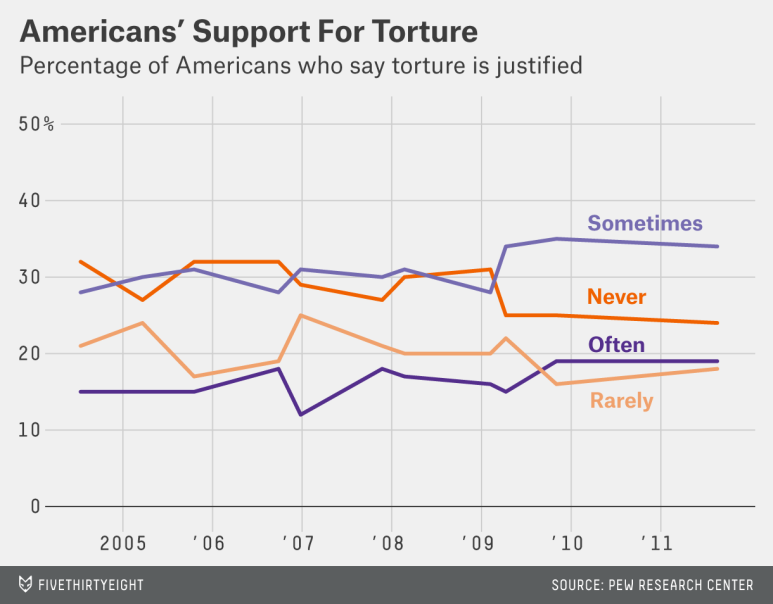
Torture Support

Notice that Krauthammer’s maximal position in 2005 is now dead last in public opinion: his view that torture should be used extremely rarely commands less than 20 percent support and is beaten by those Americans who now believe that torture should be employed often. Yes: often. And this, of course, is not an accident. When a former president and vice-president openly back torture, and when the CIA has been engaging in a massive p.r. campaign to argue – against what we now know are incontrovertible facts from the CIA’s own records – that it saved thousands of lives, it will affect public opinion. There are always atavist and repellent sentiments in war time. The difference now is that a huge section of the elite endorses them.

Whom should we torture? Krauthammer rules torture out of bounds for prisoners of war; permits it in the case of very few high-value terrorists; and then offers up a difficult category of torture victims – those with information about a “ticking time-bomb”:

Third, there is the terrorist with information. Here the issue of torture gets complicated and the easy pieties don’t so easily apply. Let’s take the textbook case. Ethics 101: A terrorist has planted a nuclear bomb in New York City. It will go off in one hour. A million people will die. You capture the terrorist. He knows where it is. He’s not talking … Question: If you have the slightest belief that hanging this man by his thumbs will get you the information to save a million people, are you permitted to do it? Now, on most issues regarding torture, I confess tentativeness and uncertainty. But on this issue, there can be no uncertainty: Not only is it permissible to hang this miscreant by his thumbs. It is a moral duty.

Now consider what we now know about whom we tortured under the torture program under Bush and Cheney. First off, we tortured 26 people who were cases of mistaken identity. We tortured 26 innocent people. This is so far outside any of the parameters that even Krauthammer allowed for that it beggars belief. Amy Davidson:

Footnote 32, the same one that outlines the motives for holding Nazar Ali, has a devastating litany, starting with “Abu Hudhaifa, who was subjected to ice water baths and 66 hours of standing sleep deprivation before being released because the CIA discovered he was likely not the person he was believed to be,” and including many others, such as,

“Gul Rahman, another case of mistaken identity.… Shaistah Habibullah Khan, who, like his brother, Sayed Habib, was the subject of fabrications.… Haji Ghalgi, who was detained as “useful leverage”…. Hayatullah Haqqani, whom the CIA determined “may have been in the wrong place at the wrong time”…. Ali Jan, who was detained for using a satellite phone, traces on which “revealed no derogatory information”.… Two individuals—Mohammad al-Shomaila and Salah Nasir Salim Ali—on whom derogatory information was “speculative”.… and Bismullah, who was mistakenly arrested … and later released with $[redacted] and told not to speak about his experience.”

It seems to me that proponents of torture should be horrified by this revelation. If torture is a monstrous thing, if it corrupts all who do it, as Krauthammer believes, what incalculable damage has been done by the US torturing innocents, in one case to death? Where was there any remorse – yes, remorse – expressed by the CIA yesterday for this compounding of a crime and a mistake?

Now consider Krauthammer’s view of who should be doing the torturing:

The exceptions to the no-torture rule would not be granted to just any nonmilitary interrogators, or anyone with CIA credentials. They would be reserved for highly specialized agents who are experts and experienced in interrogation, and who are known not to abuse it for the satisfaction of a kind of sick sadomasochism Lynndie England and her cohorts indulged in at Abu Ghraib.

We now know that the CIA contracted out the torture to two individuals without “specialized knowledge of al Qaeda, a background in counterterrorism or any relevant cultural or linguistic experience.”  They had never interrogated anyone – yet they got a $181 million contract to run the program. They were sadists:

John Rizzo, the acting CIA general counsel who met with the psychologists, wrote in his book, “Company Man,” that he found some of what Mitchell and Jessen were recommending “sadistic and terrifying.” One technique, he wrote, was “so gruesome that the Justice Department later stopped short of approving it.”

They had a pecuniary interest in the criminal enterprise. And they were making things up as they went along:

One email from a CIA staff psychologist said “no professional in the field would credit” their judgments. Another said their “arrogance and narcissism” led to unnecessary conflicts in the field. The director of interrogations for the CIA called their program a “train wreck” and complained that they were blending the roles of doctor and interrogator inappropriately.

So the architects of the torture program also violated a core part of Krauthammer’s defense of torture. And shockingly so. Why aren’t the defenders of torture horrified by this amateurism? Where are the Republican voices of outrage that a serious torture program was handed out to amateur contractors who had no idea what they were doing and no moral compass at all?

Krauthammer also described two torture techniques he would approve of. One was the injection of sodium pentathol – which, given the rank brutality of the actual torture sessions – would have been a mercy, but was not widely used (so far as we know). The second technique was waterboarding, the torture perfected by the Communist Chinese, and for which previous US servicemembers were prosecuted. But notice what Charles says waterboarding is:

Less hypothetically, there is waterboarding, a terrifying and deeply shocking torture technique in which the prisoner has his face exposed to water in a way that gives the feeling of drowning. According to CIA sources cited by ABC News, Khalid Sheikh Mohammed “was able to last between two and 2 1/2 minutes before begging to confess.” Should we regret having done that? Should we abolish by law that practice, so that it could never be used on the next Khalid Sheikh Mohammed having thus gotten his confession?

We now know that those CIA sources were lying. KSM was waterboarded 183 times over a matter of weeks. And the waterboarding was not just 2 1/2 minutes of panic. It was full-fledged, endless, soul-breaking, body-destroying torture of a kind practiced in the past by totalitarian or authoritarian police states:

Within days of the Justice Department’s approval to begin waterboarding the prisoner, Abu Zubaydah, the sessions became so extreme that some C.I.A. officers were “to the point of tears and choking up,” and several said they would elect to be transferred out of the facility if the brutal interrogations continued. During one waterboarding session, Abu Zubaydah became “completely unresponsive with bubbles rising through his open, full mouth.” The interrogations lasted for weeks, and some C.I.A. officers began sending messages to the agency’s headquarters in Virginia questioning the utility — and the legality — of what they were doing. But such questions were rejected.

Krauthammer argued that the torture should “not be cinematic and ghoulish.” I wonder if he regards the following as non-ghoulish:

The interrogators didn’t know the languages that would have been useful for real intelligence, but they did come up with a lexicon of their own: “walling,” which meant slamming a person against a wall; “rough takedown,” in which a group would rush into a cell yelling, then drag a detainee down the hall while punching him, perhaps after having “cut off his clothes and secured him with Mylar tape”; “confinement box,” an instrument to make a prisoner feel he was closed in a coffin (the box came in large or small sizes); “sleep deprivation,” which might mean being kept awake for a hundred and eighty hours before succumbing to “disturbing hallucinations”; the ability to, as the report put it, “earn a bucket,” the bucket being what a prisoner might get to relieve himself in, rather than having to soil himself or being chained to a wall with a diaper (an “image” that President Bush was said to have found disturbing); “waterboarding,” which often itself seems to have been a euphemism for near, rather than simulated, drowning; “rectal rehydration as a means of behavioral control”; “lunch tray,” the assembly of foods that were puréed and used to rectally force-feed prisoners.

This is what the talk of family could look like: “CIA officers also threatened at least three detainees with harm to their families—to include threats to harm the children of a detainee, threats to sexually abuse the mother of a detainee, and a threat to ‘cut [a detainee’s] mother’s throat.’ ” The interrogation of Abd al-Rahim al-Nashiri included “implying that his mother would be brought before him and sexually abused.”

What this report proves – not asserts, but proves – is that the torture the US inflicted on prisoners was of an uncontrolled, nightmarish quality whose impact was so great that even the junior grunts on the night beat at Abu Ghraib knew what they were supposed to do. Remember what so many Republicans said after Abu Ghraib? They were horrified, when they could blame it on someone at the very lowest rung of the totem pole. But when it was sanctioned by the very highest levels of the CIA – and inflicted on two dozen innocents – it was kosher.

In a civilized society, there really would be no debate over this. And before 9/11, there wasn’t. Ever since, this country has slid and then fallen out of the civilized world and out of the core American traditions of humanity and legal warfare. Krauthammer can be seen as emblematic of that slide – someone whose early abhorrence at torture and defense of it only in its mildest and rarest forms has slowly succumbed to a full-fledged defense of a program that violated every rule he said should be in place to protect us from the abyss. This is not surprising. When you start to torture, the sheer evil of what you are doing requires that you believe ever more in its value. You can never admit error, because it would mean you have committed crimes against humanity without even the defense of acquiring any useful intelligence. You are revealed as monsters – and you cannot accept that of yourself or of those you know. And so you insist – with ever-rising certainty – that the torture worked – even though that’s irrelevant as a matter of morality and of law, and even though your own internal documents prove that it didn’t.

And so you become the monster you were supposed to be fighting. And if you gaze long enough into an abyss, the abyss will gaze back into you.