Worst Ebola Outbreak Ever

by Dish Staff

Screen_Shot_2014-08-28_at_12.40.09_PM.0

Julia Belluz puts the West African epidemic in stark perspective:

The current Ebola outbreak in West Africa has now killed more people than all previous Ebola outbreaks combined. The latest World Health Organization data on this year’s Ebola outbreak in West Africa shows 3,069 probable and confirmed cases and 1,552 deaths. The number of cases continues to accelerate, with 40 percent of the total cases occurring in the last 21 days.

The WHO is warning that the epidemic could rage for another six to nine months, infect as many as 20,000 people, and cost half a billion dollars to contain. And yet, Chris Blattman cautions, “we must make sure the cure is not worse than the disease”:

All the negative hype will hinder, and might even destroy, Liberia’s economy for the next 5 or 10 years. Maybe the optimal response to a disease outbreak is overhype, to get the most resources possible. I’m worried about the aftershock. The cost to everyone who survives the disease looks to be very, very high in terms of lost growth, jobs, social programs, and the like. What might be the consequences of hype? Here’s a US survey that suggests 40% of Americans are concerned about an outbreak at home and that a quarter think their family might get it. And that was two weeks ago. Frankly that smells like it might be a poorly worded question or interpretation, but either way, I think “large scale irrational fears” adequately sums up the situation.

Leah Breen looks in on Liberia, where ebola has just made a bad situation worse:

According to the World Food Program, 64 percent of Liberians live in poverty. Infrastructure is poor—buildings in Monrovia that were looted during the war remain abandoned. Only 14 percent of Liberians attend secondary school. Liberians have good reason to believe that their government is not doing enough to increase quality of life in the country. Hospitals are often long distances from towns and villages, and the ones that do exist aren’t properly equipped. Citizens know that government officials often leave Liberia for the United States or Europe to seek medical attention. Since there are few clinics or hospitals outside of the capital, most Liberians have had little experience with the formal health system. When health workers appeared in communities to combat Ebola, citizens were skeptical of why the government was suddenly paying attention to them.

Sarah Kliff reports that a vaccine is starting human trials next month:

The NIH will start a Phase I trial in September with three volunteers who have already enrolled in the experiment. The NIH hopes to expand the trial group to 20 people, and report initial results about the vaccine’s efficacy by the end of the year. The new vaccine was developed in partnership between the federal government and GlaxoSmithKline, one of the world’s largest pharmaceutical companies. It comes as the Ebola outbreak shows no sign of abating, with the World Health Organization projecting Thursday morning the virus could infect as many as 20,000 people. “This public health emergency demands an all-hands-on-deck response,” said Anthony Fauci, director of the National Institute of Allergy and Infectious Disease. “We have accelerated the timeline for testing vaccines we have been working on for many years.”

But Kent Sepkowitz notes that a vaccine won’t do much to curb the current crisis:

Fauci was very careful to state that for the current outbreak in West Africa, the best approach will not be the vaccine or any new treatments, but rather the approach being used today and last week and last month and last year: early diagnosis, prompt isolation, and use of “personal protective equipment” including gowns, gloves, and masks. In other words, the vaccine being studied almost certainly will have no impact on the current West Africa crisis. Given the pace of useable science, even with the compressed, hurry-up-already system the candidate vaccine is being ushered through, preliminary results on safety and the vaccine’s ability to provoke a meaningful immune response will not be available until the end of the calendar year—at a point when the now 6-month long epidemic likely will have finally fizzled out.

Frank L. Smith III highlights the role military research played in the vaccine’s development:

Currently, most funding for biodefense comes from civilian sponsors in the United States, not the military. Aside from Zmapp, most of their therapies for other dangerous pathogens—like Marburg virus and Staphylococcal enterotoxin B—get funding from the U.S. National Institutes of Allergy and Infectious Diseases. Again, Zmapp may fail. Most experimental drugs do. But other medical countermeasures for Ebola relate directly to investments in biodefense, as well. For example, research into one Ebola vaccine began when the U.S. National Institutes of Health asked a Canadian company to reapply technology it had developed for anthrax to also fight Ebola. Several other potential therapies for Ebola—such as TKM-Ebola and AVI-7537—also resulted from private collaboration with USAMRIID. So did the GSK/NIAID Ebola vaccine that authorities have just approved for human trials. Therefore, what little hope there is for vaccines and therapies against naturally occurring Ebola depends in part on research and development for biodefense.

Susannah Locke relays the findings of research into the epidemiological origins of the current outbreak:

Using genetic sequences from current and previous outbreaks, the researchers mapped out a family tree that puts a common ancestor of the recent West African outbreak some place in Central Africa roughly around 2004. This contradicts an earlier hypothesis that the virus had been hanging around West Africa for much longer than that.

The data, on the whole, supports what epidemiologists have already deduced about how the virus spread into Sierra Leone. More than a dozen women became infected after attending the funeral of a traditional healer who had been treating Guinean Ebola patients and contracted the disease. One surprise from the paper is that two different strains of Ebola came out of that funeral. This suggests that either the healer was infected with two different strains or that another person at the funeral was already infected. As Ebola then traveled across Sierra Leone, a third strain of the virus appeared.

Nine-Year-Olds And Uzis Don’t Mix, Ctd

by Dish Staff

Beutler wants the full video of this week’s tragic shooting released:

Horrendous, unnecessary gun deaths are so common in the U.S. that some of them get caught on tape. The videos can have tremendous power to shape the way people think about public policy. Just last week, the filmed shooting death of Kajieme Powell by St. Louis, Missouri, police reignited a national debate about police training. The video of an Uzi destroying Charles Vacca’s life would serve as a visceral reminder of the fact that when a bullet enters the human body, that body is very likely to die.

Nicole Flatow points out that “a lack of age restrictions isn’t the only way gun ranges are safety-free zones, and potentially the sites of preventable deaths”:

Inside gun ranges, individuals can also “rent” a gun without any of the precautions that happen before an individual buys a gun. They don’t have to pass a criminal background check. There’s no check of their mental health records, although some require individuals to attest to their mental competence. Many gun rangesdon’t even collect names or identification. And that’s not even the worst part.

Even those gun ranges that want to check the backgrounds for rental customers are not permitted to. Stephen Fischer of the FBI’s Criminal Justice Information Services told Politico Magazine earlier this month that individuals who rent guns don’t actually “possess” them because they don’t take them off the premises. So federal background check law doesn’t apply, and the National Instant Criminal Background Check System (NICS) is not permitted to conduct a check. Many states, including Florida, take the same position that they will not conduct background checks for gun rentals.

She goes on to list numerous instances where this state of affairs has lead to deaths. Meanwhile, Dan Baum argues the benefits of teaching shooting to kids:

A single-shot .22, while easier to control than an Uzi, can kill you just as dead. So how can such rifles possibly be appropriate for use by children? Again, context is everything. Under proper instruction, shooting is a ritual. You do this for this reason and that for that reason, and you never, ever alter the process, because doing so is a matter of life and death. Learning to slow down and go through such essential steps can be valuable developmentally. The very danger involved gets children’s attention, as it would anybody’s. But there’s an added benefit to teaching children to shoot: it’s a gesture of respect for a group that doesn’t often get any.

Becca Morn pushes back:

The detail that boggles me, even among the gun aficionados who acknowledge it was criminally stupid to let a 9-year-old fire an Uzi on automatic, is how many insist that children need to be taught how to handle and shoot a gun safely. I’m sorry, but as a gun owner myself, and even given the family I grew up in, this is a bs statement.Very young children do not need to be taught how to ‘handle and shoot’ guns. Their first lesson with firearms should be: “Do not touch or go near a gun. If you see a gun, find an adult because these things are dangerous.”

When a minor is old enough to qualify for a hunting license, that’s another matter. (In many states, the age is 12 years and up.) Even then, questions of physical ability and mental fitness of the kid, and appropriateness of the specific firearm need to be addressed. I remember a time when my kid brother was demoted by our father to pack-carrier, because he carelessly wouldn’t pay attention to where the barrel of his 20ga was pointed. That’s how you teach a kid to use a gun.


Is Obama Fumbling Ukraine?

by Dish Staff

Christopher Dickey isn’t impressed with the president’s response to the Russian invasion, which he still won’t call an “invasion”:

Obama knows invasion is a “fightin’ word,” as they used to say in old Hollywood Westerns. And he knows — and we all know — a shootout in the Ukraine corral against the world’s other great nuclear power would be beyond foolish. But under the circumstances, even such a stalwart of administration policymaking as Ivo Daalder has run out of patience with the vague language coming out of Foggy Bottom and the White House. Daalder doesn’t recommend military action, certainly, but he does recommend NATO members step up their defense spending and deploy their vast military resources throughout the alliance in a way that makes the threat of force more credible. After all, Putin has shown his imperial appetite knows no bounds, and the tactics he’s used to shave off portions of Georgia, Moldova and Ukraine could be turned on the NATO-member Baltics. Daalder also calls on Western countries to supply advance weapons and a steady stream of intelligence to Kiev. And finally the U.S. and the E.U. need to impose full-scale economic sanctions on Moscow.

Noah Rothman faults Obama for tying his own hands diplomatically by revealing too much:

One never takes a tool off the table during a negotiation without reciprocity from the negotiating partner. To do otherwise is to set a bad precedent, one which a smart negotiating partner will make you repeat. President Obama insisted that the sanctions regime he has imposed on Russia is working, that he will not approve a military solution to the crisis in Ukraine, and that providing lethal aid to Kiev’s forces is not under immediate consideration. What, then, is on the table? Our options are increasingly limited while Moscow’s freedom to escalate or de-escalate as he sees fit remains robust.

Steven Pifer recommends an assertive response, including more sanctions and military aid to beef up the Ukrainian army:

First, the West should adopt additional economic sanctions on Russia. Those applied to date have had an impact, as evidenced by increasing capital flight, a rising inflation rate and an economy that teeters on the verge of recession. The prospect of additional economic pain will cause greater unease in Moscow and could press Putin to reconsider his course. Second, the United States and Europe should provide Ukraine with lethal military assistance, such as light anti-armor weapons and shoulder-fired surface-to-air missiles. The West cannot give Ukraine enough to defeat the far stronger Russian army, but it can enable the Ukrainian military to drive up the cost of aggression. The Kremlin has tried to cover up reports of Russian casualties in Ukraine. Although the Russian people have supported Putin’s policy toward Ukraine, polls show that an overwhelming majority do not want the Russian army there. That could be significant, especially if the number of Russian casualties grows, which could well erode the political support that Putin enjoys. That might push him to change his calculus.

But Marc Champion is not so sure that arming Ukraine is a good idea:

The U.S. and Europe have made it clear that they will not go to war with Russia — a nuclear superpower — to defend Ukraine’s borders. That may not be fair, but it is rational. And no matter how many weapons the U.S. and European allies supply to Ukraine, Russia will deploy more of them, wielded by better trained troops. The logical progression of a NATO armament program for Ukraine is broader conflict. Putin would proceed, knowing that, in the end, Ukraine’s allies would not have its back. The calculation could change if Putin decides to push his military deeper into Ukraine — realizing fears of a wider conflict while heightening the security concerns of nearby Poland. For now, however, a formal arms program seems unwise.

NATO, meanwhile, isn’t exactly speaking with one voice here:

All NATO members oppose Russia’s destabilizing role in Ukraine. But they don’t place the same priority on stopping it, nor have they agreed on a strategy to address it. The annexation of Crimea has sent tremors through the Baltics, and rightly so: Estonia, Latvia, and Lithuania are all home to sizable ethnic Russian minorities. Eastern European leaders have called on NATO for assistance, but the allied response has been mixed. Before arriving in Wales, President Obama will visit Estonia to “reassure allies in Central and Eastern Europe” and “reaffirm our ironclad commitment to [Article 5] as the foundation of NATO.” Meanwhile, Secretary-General Anders Fogh Rasmussen announced that NATO would begin building up its military presence along its eastern borders. But Germany, Italy, Spain, and France—far less vulnerable than the Baltics—are reluctant to further antagonize Moscow.

“The Problem Is I’m Black”

by Dish Staff

Dan Savage passes along the disturbing video above:

A man was sitting in a public place waiting to pick his kids up from school. He wasn’t breaking any laws. A shop owner asked him to move—which the shop owner had no right to do—and the man got up and moved. He was then stopped by a cop who asked him his name. He refused to give his name. “I know my rights,” the man said to the cop. And he did know his rights: he was under no obligation to identify himself to her. “Minnesota does not currently have a ‘stop and identify’ statute in place” that would give police the right to arrest someone for [not] identifying himself,” RawStory points out. The cop, unfortunately, didn’t know his rights.

Conor is rightly outraged:

The City Pages explains what happened after the arrest. “The man was charged with trespassing, disorderly conduct, and obstructing the legal process,” they write, “but those charges were later dropped. On Twitter, the St. Paul PD’s public information officers said no formal complaint has been filed in connection with the incident.” A police administrator who sees that video, which Lollie’s attorney brought to court, should not require a formal complaint from the victim to discipline the officers involved and acknowledge that they engaged in inept policing!

Yet the police department–which held on to Lollie’s phone, with the video on it, for 6 months–is defending the officers.

When Women Rebuff Republicans

by Dish Staff

Jake Sherman and Anna Palmer present the latest on women’s attitudes towards the GOP:

Women are “barely receptive” to Republicans’ policies, and the party does “especially poorly” with women in the Northeast and Midwest, according to an internal Crossroads GPS and American Action Network report obtained by POLITICO. It was presented to a small number of senior aides this month on Capitol Hill, according to multiple sources.

Jamie Fuller observes that this “is not a new problem”:

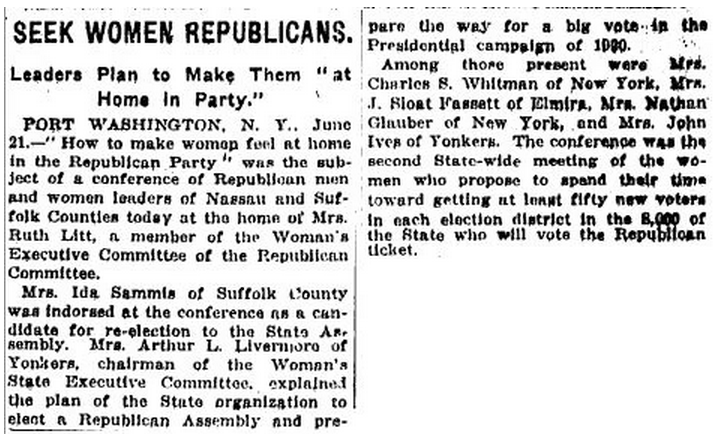
After the 2012 election, the Republican National Committee said the party needed to have a renewed focus on women-oriented policy and outreach if it wanted to succeed in the future. Republican outreach to women has been newsworthy for far longer than that, though — like 100 years longer.

Here’s a New York Times article from June 22, 1919, about a conference titled, “How to make women feel at home in the Republican Party.”

NYT Women

Amanda Hess offers a tongue-in-cheek interpretation, quipping that if “only the Republicans could explain to these women that they are wrong, their votes would come flooding in”:

Today, R.R. Reno, editor of First Things (a journal that promotes “economic freedom” and a “morally serious culture”), published a very helpful essay illustrating how this fresh new strategy might work in practice. Reno begins his piece with a richly-drawn portrait of a hypothetical female Democratic voter: She is a “single, 35-year-old McKinsey consultant living in suburban Chicago who thinks of herself as vulnerable and votes for enhanced social programs designed to protect against the dangers and uncertainties of life.” (Reno does not specify the number of cats she owns, but for the purposes of this discussion, let’s assume the answer is “several.”) …

In short, Republicans understand women plenty—it’s women who don’t understand themselves. Sounds like a promising strategy that will work with many, many sad single ladies that Republicans have invented in their brains. Next step: Finally granting imaginary women the right to vote.

Burning Earth

by Bill McKibben

California Drought Dries Up Bay Area Reservoirs

At Burning Man in the desert, where the proprietor of this blog, and Grover Norquist, and a lot of other people are gathered this week, they had a rare heavy rainfall, which “intensified the misery of people waiting in the will call lines” at the box office. That A similar soaking in the Mojave Desert meant that the area of California under severe drought conditions fell last week from 97.5 to 95.4%, but the effect of the ongoing record aridity keeps magnifying. On the grossest scale, the region has now lost 63 trillion gallons of groundwater, which weighs about 240 billion tons, which has caused the state’s mountains to grow half an inch taller.

But the drought in California is probably not the worst such crisis underway on the planet at the moment, in part because California is rich. In Central America last week Guatemala became the latest country to declare a state of emergency, as the worst drought in decades wreaks havoc with bean and corn crops. According to the AP:

In Guatemala, about 170,000 families lost almost all of their crops, while in El Salvador crops have completely been lost in two-thirds of the country.

In Nicaragua, where the drought has killed more than 2,500 cattle and left 600,000 people in a state of malnutrition, the government is asking international food agencies to help it feed 100,000 families in parched areas.

Gang violence is doubtless sending Central American children north to the border. Doubtless the drought is playing its part too. Drought, being slow-moving and undramatic, tends not to catch our imaginations like flood or storm. But it may be one of the most insidious results of a changing climate. Research has shown drought on the increase as temperatures rise, and a study this spring made it clear that the world was in for more and more drought–none of that should come as a surprise, given the basic physics. But researchers have also found, over and over, that drought helps breed conflict, in places from Sudan to Syria. Given the increasing centrality of the Syrian conflict, it’s worth taking a moment to remember that, as Brad Plumer points out in this Washington Post interview with regional expert Francesco Femia, during the period from 2006-2011 up to 60% of the nation experienced one of the worst droughts in history. Femia:

This drought — combined with the mismanagement of natural resources by [Syrian President Bashar] Assad, who subsidized water-intensive crops like wheat and cotton farming and promoted bad irrigation techniques — led to significant devastation. According to updated numbers, the drought displaced 1.5 million people within Syria.

We found it very interesting that right up to the day before the revolt began in Daraa, many international security analysts were essentially predicting that Syria was immune to the Arab Spring. They concluded it was generally a stable country. What they had missed was that a massive internal migration was happening, mainly on the periphery, from farmers and herders who had lost their livelihoods completely.

So if you want to know why some U.S. military officials call climate change the biggest threat to national security, this is one of the reasons. As Admiral Samuel Locklear, head of US Pacific forces, put it last year:

“We have interjected into our multilateral dialogue – even with China and India – the imperative to kind of get military capabilities aligned [for] when the effects of climate change start to impact these massive populations,” he said. “If it goes bad, you could have hundreds of thousands or millions of people displaced and then security will start to crumble pretty quickly.’’

(Photo: A car sits in dried and cracked earth of what was the bottom of the Almaden Reservoir on January 28, 2014 in San Jose, California. By Justin Sullivan/Getty Images)

The NFL Tackles Domestic Violence

by Dish Staff

The NFL announced (NYT) a new policy yesterday:

N.F.L. Commissioner Roger Goodell said Thursday that he had mishandled the Ray Rice case, in which the Baltimore Ravens running back was suspended for two games after being accused of assaulting his fiancée. … Goodell said that effective immediately any N.F.L. employee — not only a player — who is found to have engaged in assault, battery, domestic violence or sexual assault that involved physical force will be suspended without pay for six games for a first offense. Second-time offenders will be banished from the league for at least one year.

Ian Crouch states, reasonably enough, that “Thursday’s announcement should be the beginning of the N.F.L.’s response to domestic violence, not the end”:

The players need to be involved in the league’s attempts to combat violence against women, not simply as the potential recipients of fines and suspensions but as participants in its prohibition and enforcement.

In a recent column for ESPN, Jane McManus argued that owners and players should insert regulations relating to violence and sexual assault directly into the collective-bargaining agreement. (The current one doesn’t expire until 2021, but this particular change could be made without opening the entire document up for renegotiation.) The C.B.A. already includes rules against taking performance-enhancing drugs and driving while intoxicated. Adding the kinds of punishments that Goodell introduced today to a document that both players and owners have signed on to would demonstrate that all sides appreciate the seriousness of the problem within their own ranks, and also that they recognize the N.F.L.’s opportunity, as a major part of the culture, to be not just an object lesson but an advocate for change.

Kavitha A. Davidson’s take:

This came about purely because of the sustained backlash against the league’s paltry two-game suspension of Ray Rice, and despite numerous attempts to defend itself while hiding behind the lack of a comprehensive domestic violence policy. As [Jessica] Luther notes, this also means that the NFL must have talked and actually listened to advocacy groups that tout prevention over punishment. This happened because feminists, and especially feminist sportswriters including Luther and Jane McManus (who brilliantly outlined how the commish could get domestic violence written into the league’s disciplinary measures) simply wouldn’t go away.

She adds that, “Instead of patting Goodell on the back for his far-too-late admission that he “got it wrong,” we need to stay on his case to make sure he actually gets it right.” Last but not least, Alyssa Rosenberg considers how the NFL treats women more generally. She admits, “Being a female sports fan can be a difficult thing”:

There are little indignities, like the cheesy pink gear that suggests our enthusiasms are second to our wardrobe choices. There are bigger ones, like the ongoing employment of scantily-clad cheerleaders to act as inducement to presumptively straight male players and eye candy for presumptively straight, male crowds. And to add injury to irritant, these women are subject to wage theft and degrading employment conditions.

And beyond that, there is the challenge of the players themselves. It is one thing to think that bad men can make great art, or that bad men can throw beautiful spiral passes or lay down devastating hits. It is another to root for men who occasionally act in ways that suggest that they think women are garbage, or that the truest way for a woman to be a fan is to be sexually available. I hesitate a little every time I buy a new Patriots jersey, worried that the man whose name I emblazon across my back might end up acting in a way that casts shame on my enthusiasm for him. Most of the time, I pick out gear with nobody’s name on the back.

Darknet Visible

by Sue Halpern

grams

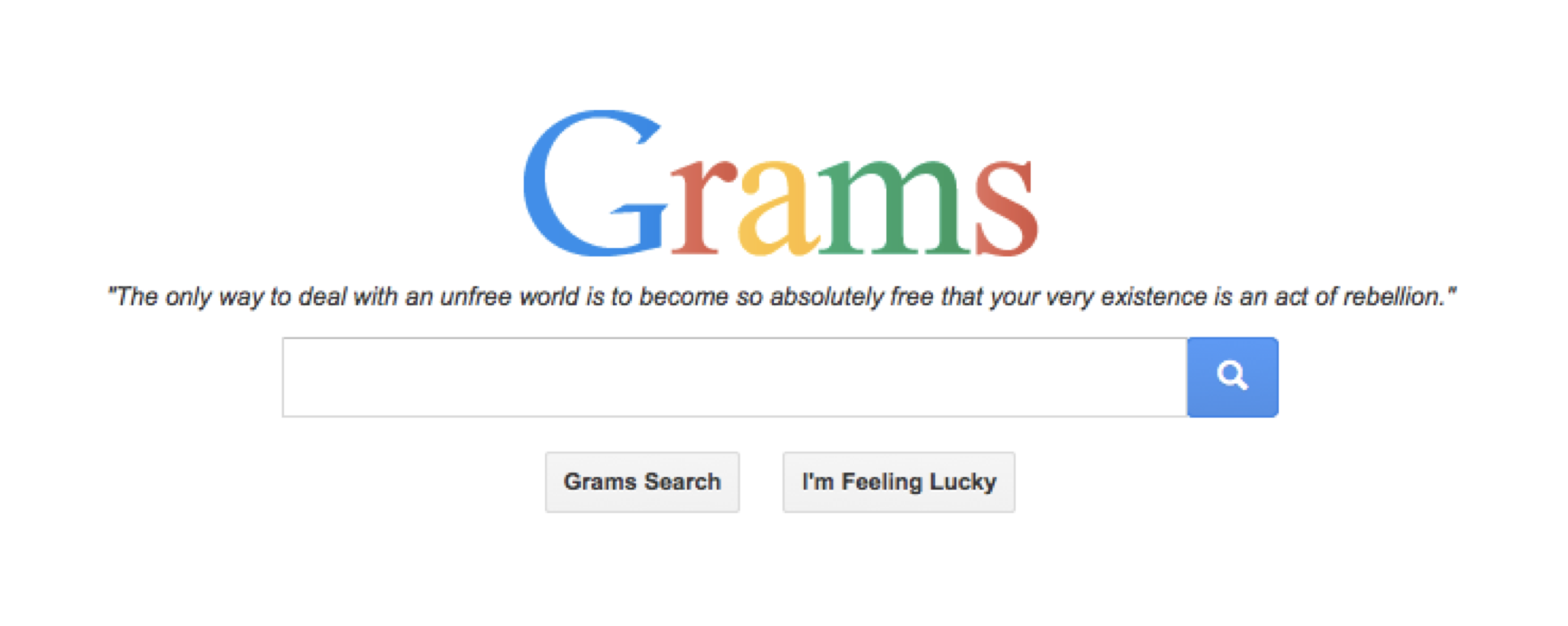
It turns out the NSA’s ICREACH search engine, the one that may be sharing the intimate details of your life among a thousand analysts, isn’t the only secret, Google-inspired search engine out there. Say you’re interested in buying  some of those credit card numbers that Russian hackers are so good at lifting from American banks like J.P. Morgan. Or some meth or heroin or the services of a hitman. All these things have long been available through the Internet’s “darknet,” but tricky to get at. They become much more accessible with the “GRAMS” search engine, which looks just like Google (and ICREACH) (why mess with a winner?), and works essentially the same way. Type in the word “weed” and you will be offered 5 grams of Santa Maria weed from a vendor in Germany, a pound of “chronic outdoor low grade” weed from a seller in the United States, and so on. Type in the word “handguns,” and the first two listings are for “The Terrorist Handbook” and “The Terrorist Encyclopedia” which are all about making explosives from various substances available at the hardware store. The third listing is for the latest CAD files for making 3D printed guns. Like eBay, each listing has a link for other items in the vendor’s virtual store and comments from buyers:

Stars Review Freshness
ok 1 day ago
Exceptional 1 day ago
Perfect, thanks ! 1 day ago
Great feedback! Recommend 1 day ago
got wat i paid for 1 day ago
Everything ok – honest seller as expected! Thanks! 1 day ago
Good service fast delivery. 1 day ago
Thanks mate. Great product! 1 day ago

To get to GRAMS, and to the Darknet more generally, you have to go through Tor, the anonymizing browser developed by the US Naval Research Laboratory, which is now an open source project. Because Tor hands off each message in pieces to many different relays–there are 3000 in all–it makes those messages very difficult to trace and to read in transit. As a consequence, TOR has been useful for journalists needing to shield a source, or dissidents working against oppressive regimes, or victims of domestic violence, or ordinary people concerned with government overreach.  It’s also been very good for cyber criminals, drug dealers and pedophiles.

You might expect that Tor traffic would be fertile ground for NSA spying, and it would be if it could crack the encryption and de-anonymize users, but it’s been challenging. One of the NSA documents leaked by Edward Snowden was called “Tor Stinks,” and detailed all the mostly failed attempts to get into Tor. But since the Snowden leaks, there have been lots of speculation about the NSA’s growing abilities to crack it. On July 4th, when Tor administrators warned users that the service had been breached, fingers didn’t point at the government directly, but at a group of computer scientists at a Carnegie-Mellon lab funded by the government. From the July 31 WSJ:

In a blog post, Tor said outsiders “affected” some users in the first half of the year.

“Unfortunately, it’s still unclear what ‘affected’ includes,” the post said. “While we don’t know when they started doing the attack, users who operated or accessed hidden services from early February through July 4 should assume they were affected.”

Users who act as Tor relays, or hop points, should update their software, the group said. At the Black Hat hacker conference in Las Vegas next week, the Carnegie-Mellon researchers planned to demonstrate a hack that allowed them to unmask some Tor users. They relied on techniques similar to the tactics unveiled by Tor on Wednesday. Lawyers for the university cancelled the talk last week.

Fast-forward to earlier this week when former Health and Human Services employee Timothy DeFoggi was convicted on child pornography charges after a lengthy investigation by the FBI, which had broken into a darknet website run by a man in Nebraska named Aaron McGrath:

The FBI installed malware remotely on the machines of visitors of McGrath’s websites which could identify computers’ IP addresses, as well as its MAC addresses, directly identifying PCs’ networking cards, and other identifying data.

The malware and other FBI techniques “successfully revealed the true IP addresses of approximately 25 domestic users who accessed the sites (a small handful of domestic suspects were identified through other means, and numerous foreign-based suspect IPs were also identified)”, prosecutors wrote in a court document.

DeFoggi, like many pedophiles, thought he was safe from view because McGrath’s site, “Pedobard,” was run through Tor. DeFoggi’s job at HHS? Chief of Cybersecurity.

“We Don’t Have A Strategy Yet”

by Dish Staff

That line from Obama’s address last night is garnering a lot of attention, especially from critics who say it encapsulates the core problem with his foreign policy in general and his approach to ISIS in particular. Ackerman reports on how US officials are interpreting the no-strategy strategy:

Some current and former administration officials, speaking on background, have expressed frustration with Obama for not yet forming a comprehensive approach to Isis, and especially for not attempting to take territory in eastern Syria away from the jihadi group. Others contend that the administration’s options are inherently limited if it seeks not to Americanize yet another Middle Eastern war. Still others have said they expect Obama’s military operations against Isis to eventually expand in scope, mission and geographic reach. Obama was initially reluctant about the Afghanistan surge, the Libya air war and the arming of Syrian rebels, only to eventually embrace all those options.

One reason for the lack of a strategy, Eli Lake And Josh Rogin report, may be that the cabinet can’t agree on one:

There were deep divisions inside the administration’s deliberations over Syria. One set of officials advocated for a campaign to decimate ISIS in both countries by striking ISIS targets across Syria. This camp pushed for hitting near Aleppo where they are advancing, and with at least some coordination with the moderate Syrian rebels. The group, which included officials from State Department, intelligence community and some parts of the military, came up with extensive targeting options for the president that included not only ISIS military assets, but their infrastructure, command and control, and their financial capabilities. Even the oil pipelines they use to export crude for cash were on the target list.

Another group of officials — led by White House and National Security staffers but also including some intelligence and military officials — favored a more cautious approach that spurned any cooperation with the Free Syrian Army and focused strikes inside Syria on targets near the Iraqi border. The objective: cut off ISIS supply lines to Iraq. That strategy would fall more squarely within the existing limited missions that Obama has already outlined for his war.

Mollie Hemingway provides the distilled attack from the right:

[T]he problem isn’t just the lack of strategy for a situation that should not have caught us by surprise but the decision to be extremely public about being tentative. There is just absolutely no reason to hand that kind of morale boost and public relations victory to all of your enemies. … Something tells me “no strategy” will stick to Obama in the same way that “read my lips” did to George H.W. Bush or “heckuva job” did to George W. Bush or “depends on what the meaning of is is” did to Bill Clinton. Sometimes there are phrases that so perfectly encapsulate what’s wrong with a presidency that they are forever linked. And while President Obama has always had clear personal political ambition and strategy for election or re-election, his foreign policy has been confused and aimless for the duration.

But Zack Beauchamp offers a more charitable interpretation of the line:

Viewed in context with the rest of his remarks, Obama’s point might be that there is no good strategy available for fully defeating ISIS in both Iraq and Syria — which is both consistent with his approach the crisis in those countries, in which he has primarily avoided risky escalation, and perhaps true. Throughout Obama’s addresses on ISIS, including this press conference, he’s emphasized the need for a political strategy to defeat ISIS, one that focuses not on Washington but on Baghdad and, in an ideal world, Damascus. Barring political reform in the Iraqi government, and the development of some sort of peace in Syria, it’ll be really hard to fully defeat ISIS. In a changing, complicated situation, Obama’s thinking has long seemed to be, it’s better not to prematurely commit to a specific problem that might not fit the changing situation. You can’t have a strategy for what can’t be done, in other words.

And Beinart argues that Obama does indeed have a strategy, specifically one of “fierce minimalism”:

Understanding Obama’s fierce minimalism helps explain the evolution of his policy toward Syria and Iraq. For years, hawks pushed him to bomb Assad and arm Syria’s rebels. They also urged him to keep more U.S. troops in Iraq to stabilize the country and maintain American leverage there. Obama refused because these efforts—which would have cost money and incurred risks—weren’t directly aimed at fighting terrorism. But now that ISIS has developed a safe haven in Iraq and Syria, amassed lots of weapons and money, killed an American journalist, recruited Westerners, and threatened terrorism against the United States, Obama’s gone from dove to hawk. He’s launched air strikes in Iraq and may expand them to Syria. As the Center for American Progress’s Brian Katulis has noted, the Obama administration is also trying to strengthen regional actors who may be able to weaken ISIS. But the administration is doing all this to prevent ISIS from killing Americans, not to put Syria back together again. Yes, there’s a humanitarian overlay to Obama’s anti-ISIS campaign: He’s authorized air strikes to save Yazidis at risk of slaughter. But the core of his military effort in Iraq and Syria, and throughout the greater Middle East, is narrow but aggressive anti-terrorism.