Not All Were Silent I

In the wake of final proof that the US became a nation of torture under president Bush, it is worth recalling two brave souls who told the truth when it counted and stood up in a climate of intense fear and Rovian intimidation. The first is a young man championed by this blog years ago now, who wrote a letter to Senator McCain, based on his horror at what he saw in front of him: a policy of torture and abuse of prisoners that was endemic throughout the military commanded by George W. Bush until the Abu Ghraib scandal forced Bush to ratchet the torture back in and concentrate it in his own hands. Here is Ian Fishback's letter from September 2005:

Dear Senator McCain:

While I served in the Global War on Terror, the actions and statements of my leadership led me to believe that United States policy did not require application of the Geneva Conventions in Afghanistan or Iraq.

On 7 May 2004, Secretary of Defense Rumsfeld's testimony that the United States followed the Geneva Conventions in Iraq and the "spirit" of the Geneva Conventions in Afghanistan prompted me to begin an approach for clarification. For 17 months, I tried to determine what specific standards governed the treatment of detainees by consulting my chain of command through battalion commander, multiple JAG lawyers, multiple Democrat and Republican Congressmen and their aides, the Ft. Bragg Inspector General's office, multiple government reports, the Secretary of the Army and multiple general officers, a professional interrogator at Guantanamo Bay, the deputy head of the department at West Point responsible for teaching Just War Theory and Law of Land Warfare, and numerous peers who I regard as honorable and intelligent men. Instead of resolving my concerns, the approach for clarification process leaves me deeply troubled.

Despite my efforts, I have been unable to get clear, consistent answers from my leadership about what constitutes lawful and humane treatment of detainees. I am certain that this confusion contributed to a wide range of abuses including death threats, beatings, broken bones, murder, exposure to elements, extreme forced physical exertion, hostage-taking, stripping, sleep deprivation and degrading treatment. I and troops under my command witnessed some of these abuses in both Afghanistan and Iraq. This is a tragedy.

I can remember, as a cadet at West Point, resolving to ensure that my men would never commit a dishonorable act; that I would protect them from that type of burden. It absolutely breaks my heart that I have failed some of them in this regard. That is in the past and there is nothing we can do about it now. But, we can learn from our mistakes and ensure that this does not happen again. Take a major step in that direction; eliminate the confusion.

My approach for clarification provides clear evidence that confusion over standards was a major contributor to the prisoner abuse. We owe our soldiers better than this. Give them a clear standard that is in accordance with the bedrock principles of our nation. Some do not see the need for this work. Some argue that since our actions are not as horrifying as Al Qaeda's, we should not be concerned.

When did Al Qaeda become any type of standard by which we measure the morality of the United States?

We are America, and our actions should be held to a higher standard, the ideals expressed in documents such as the Declaration of Independence and the Constitution. Others argue that clear standards will limit the President's ability to wage the War on Terror. Since clear standards only limit interrogation techniques, it is reasonable for me to assume that supporters of this argument desire to use coercion to acquire information from detainees. This is morally inconsistent with the Constitution and justice in war. It is unacceptable.

Both of these arguments stem from the larger question, the most important question that this generation will answer. Do we sacrifice our ideals in order to preserve security? Terrorism inspires fear and suppresses ideals like freedom and individual rights. Overcoming the fear posed by terrorist threats is a tremendous test of our courage. Will we confront danger and adversity in order to preserve our ideals, or will our courage and commitment to individual rights wither at the prospect of sacrifice?

My response is simple. If we abandon our ideals in the face of adversity and aggression, then those ideals were never really in our possession. I would rather die fighting than give up even the smallest part of the idea that is "America." Once again, I strongly urge you to do justice to your men and women in uniform. Give them clear standards of conduct that reflect the ideals they risk their lives for.
With the Utmost Respect,

-Capt. Ian Fishback
1st Battalion,
504th Parachute Infantry Regiment, 82nd Airborne Division,
Fort Bragg,
North Carolina

And McCain, as we now know, capitulated to Rove and voted to allow the US to use the torture techniques once used on him in order to ensure he had a viable chance to lead the GOP in the 2008 elections.
The Banality Of Evil, Ctd

"I don't see it as a dark chapter in our history at all," – Charles Krauthammer, yesterday.

"The pictures are shocking and the practices appalling," – Charles Krauthammer, on Abu Ghraib, May 14, 2004.

As we now know, Bush and Cheney authorized torture techniques much worse than what we saw at Abu Ghraib, and as we now know, the techniques revealed at Abu Ghraib were garbled copies of practices already endorsed and authorized by the Bush White House. So what can possibly account for Krauthammer's shock at Abu Ghraib and pride in the torture program? That one was poorly organized and leaked? Or that Krauthammer's friends are now to be held responsible rather than reservists thrown into the deep end of the Rumsfeld gulag?

Or put it another way: imagine if an American operative out of uniform were captured by the Iranians tomorrow. Imagine he were put into a coffin for hours with no light and barely enough air to breathe, imagine if he were then removed and smashed against a plywood Agstress wall by a towel tied around his neck thirty times, imagine if he were then kept awake for eleven days in a row, then kept in a cell frozen to hypothermia levels, and then waterboarded multiple times, after which he confessed to being a spy trying to sabotage Iran's nuclear program. Would you believe that intelligence? Would Krauthammer? Would you believe both that he wasn't tortured and that the information he gave was reliable? That is what an otherwise intelligent human being is asking us to do not just in one case but in hundreds, in many of which the prisoner actually died under interrogation.
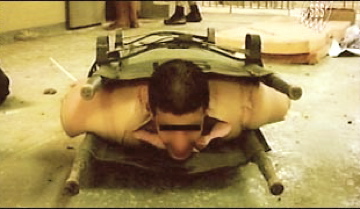
Would he also insist that what was done to the prisoner, however awful, could not be called torture under American law and the Geneva Conventions? Now imagine that the International Red Cross eventually got access to the prisoner and judged his treatment unequivocally torture; and that the Iranians claimed that since they merely applied "an alternative set of procedures" in order to gain critical intelligence that might have prevented a nuclear accident or sabotage, and remain in compliance with international treaties.

Can you imagine Krauthammer agreeing with Iran? And siding against the Red Cross? These are, of course, rhetorical questions. On every point, Krauthammer's moral and ethical standards are entirely dependent on who is torturing whom. If we do it, it's moral and it works. If they do it, it's evil and misleading.

It is important to note that this is underlying moral position of the leading conservative intellectual in Washington. And they say power doesn't corrupt.

Yglesias Award Nominee

"If Bybee had rejected the notion that a subject felt the fear of imminent death in waterboarding, then his approval of it might be defensible.  However, that’s not the case.  Bybee specifically states that it does meet that definition.  But because it only last a few moments or minutes, depending on the number of times the procedure is applied during a single session, the “imminent death” clause is supposedly immaterial.

This makes no sense at all. 

Using Bybee’s reasoning, the “threat of imminent death” part of the statute would have to last for months or years in order to qualify as torture.  What could possibly qualify in section 2 (C)?  We’d have to make a subject smoke for several years and threaten him with cancer.

Imminent threats, by definition, are short-term situations.  If one ignores that, all sorts of actions commonly considered psychological torture would be approved.  False hangings, for example, could be permissible as long as they didn’t cause serious physical injury.  Faked firing squads would also be permissible.  Gas chambers, injections, one could go on and on, and all of it would be legal because it doesn’t last for “months or years”.  The more obvious conclusion from the statute is that procedures creating an “imminent threat of death” in and of themselves create lasting severe mental pain, which is what makes them torture.

I’d like to defend Bybee, but in this case, with this memo, I have to agree with the critics.  Bybee turned 2 (C) on its head in order to justify the waterboarding request.  Given the deep fears of further attacks, one can understand why Bybee wanted to give interrogators the greatest latitude possible, but this reasoning is insupportable," – Ed Morrissey, Hot Air.

In The Wake Of War Crimes II

Agabuse

A second round up (first one here). After noting his disappointment with Obama for advocating against prosecutions, Greenwald offers this praise:

In the United States, what Obama did yesterday is simply not done.  American Presidents do not disseminate to the world documents which narrate in vivid, elaborate detail the dirty, illegal deeds done by the CIA, especially not when the actions are very recent, were approved and ordered by the President of the United States, and the CIA is aggressively demanding that the documents remain concealed and claiming that their release will harm national security.  When is the last time a President did that?

John Cole:

Sullivan yesterday noted an odd silence over the torture memos, and I predict that will end now that the new talking points have been released in the WSJ op-ed pages. For fun, look for instances of the phrase “tied his own hands” in the right-wing blogosphere when they discuss the subject.

Jonathan Zasloff:

Amidst the uproar over the torture memos, it’s important not to lose sight of a crucial fact: its responsible author, Jay S. Bybee, is now a federal appeals court judge. Thus, apart from any issue of criminal prosecution, he can be impeached by the House and removed by the Senate.

This would be appropriate. Having judges declare that torture is legal does not serve as a good precedent. Perhaps more significantly, the memo’s legal analysis was so shockingly incompetent that Bybee’s successor, Jack Goldsmith, withdrew it, noting subsequently that he was appalled by its incompetence.

Joe Klein talks to some intelligence community insiders:

Not many Presidents have had good relationships with the CIA. George W. Bush’s was particularly dreadful, with Dick Cheney constantly pushing for intel that reflected his ideological predilections rather than reality. (You may remember that a series of damaging anti-Bush leaks seemed to seep out of the Langley environs during the 2004 campaign.) The release of these memos may cripple Obama’s relations with the clandestine service–or not, especially if the President and Leon Panetta continue to make clear that they appreciate and stand behind the clandestine service, so long as the operators act within the new ground rules.

And Abe Greenwald continues to excuse torture:

As these memos are pored over in the hours and days ahead, we must be prepared to hear details about Operation Harmless Squishy Thing that may rock the very moral foundations of our country. The caterpillar is likely just the beginning. Slugs, inchworms, centipedes, millipedes — a whole backyard of horror could be exposed.

This is the primary technique of those who endorse Bush’s torture regime – focus on the particular and ignore the whole. Any act – slapping, running prisoners headfirst into walls, stress positions, sleep deprivation, waterboarding, use of insects in confined spaces – is bad enough on its own, but can be made to seem minor annoyances in isolation. But when these techniques are combined they become deadly. We have the bodies to prove it.

Mike Allen: Bush Mouthpiece, Ctd.

Greg Sargent gets a response from Mike Allen:

Sometimes ya have to read beyond a blog snippet. When people read our actual article, they’ll see that the headline and top two-thirds are an exclusive on David Axelrod’s behind-the-scenes description of the President’s decision-making process, followed by a shorter Bush view from a very high-level official whose opinion was available only on background — not ideal, but better than making readers wonder what the official Bush view is.

Anonymity is a problem in this case because it is allowing the Bush official to make unsubstantiated or opaque claims. Kori Schake, a former national security adviser on defense issues to President George W. Bush, went on the record against the memos. I'm sure others would have as well. I stand by my post. And Allen broke one of the most basic rules in fair journalism and should apologize, not dig in.

The Bigger Picture

BUSHjimwatsonAFPGetty

It will take some time to absorb the full implications of the ICRC report and the OLC memos. Right now, many are understandably focused on the legal details, the grotesque specifics of the techniques ("insects", "walling"?), the inconsistencies of the memos, the weakness of the legal arguments, the human context in which some of these decisions were made. I certainly think we have to remember the climate of terror and fear of the unknown that followed the 9/11 attacks, a climate that dragged all of us, including this blogger, to places we now wish we hadn't gone. And it's equally important to remember the sense of responsibility Bush and Cheney must have felt for already presiding over the worst attack on the mainland US in history. This helps explain, even if it does not excuse, the extremism of a Yoo or Cheney, whose eagerness to prove the absolute power of an untrammeled executive branch led us into the legal and moral and strategic darkness.

No: what is far more important and far graver is the decision after the 2004 re-election, after the original period of panic, to set up a torture program, replete with every professional and bureaucratic nicety. This is why the Bradbury memo of 2005 is so much more chilling in its way. This was long after Abu Ghraib, long after the initial panic, and a pre-meditated attempt to turn the US into a secret torture state. These legal memos construct a form of torture, through various classic torture techniques, used separately and in combination, that were to be used systematically, by a professional torture team along the lines proposed by Charles Krauthammer, and buttressed by a small army of lawyers, psychologists and doctors – especially doctors – to turn the US into a torture state. The legal limits were designed to maximize the torture while minimizing excessive physical damage, to take prisoners to the edge while making sure, by the use of medical professionals, that they did not die and would not have permanent injuries.

The core point of this, one infers from the memos, is to create a sense among the prisoners that their assumptions about the West, the US, and countries constructed on the rule of law are without any basis whatever.

The torture techniques were all the more brutal in order to push back against the reputation of the US even in the minds of Qaeda or alleged Qaeda members. What Mukasey and Hayden are arguing for today is a scheme whereby, in secret, the US government credibly allows captives to believe they are in an endless, bottomless pit of extra-legal terror. This is the state of mind they are trying to construct by torture. That's the point of the sensory deprivation, the disappearances, the sequestering from the Red Cross, the endless solitary confinement, the IRFing, the hoods, the nudity, and all the other sadism. It is precisely to persuade the barbarians that we are as bad as they are and have no limits and no qualms in doing to them whatever we want.

Looked at from a distance, the Bush administration wanted to do two things at once: to declare to the world that freedom is on the march, and human rights are coming to the world with American help, while simultaneously declaring to captives that the US has no interest in the law, human rights, accountability, transparency or humanity. They wanted to give hope to all the oppressed of the planet, while surgically banishing all hope from the prisoners they captured and tortured. And the only way they could pull this off is by the total secrecy they constructed and defended. So we had a public government respectful of the rule of law, and a secret government whose main goal was persuading terror suspects that there was no rule of law at all. It is hard to convey just how dangerous this was and is.

Moreover, this was done by the professional classes in this society. It was not done by Lynndie England or some night-shift sadists at Abu Ghraib. According to these documents, almost nothing that was done at Abu Ghraib was outside the limits agreed to by Bush – and much of what was done at Abu Ghraib was mild in comparison. So when the president acted "shocked" at what we all saw, and said it was not America, he was also authorizing far worse in secret – and systematizing it long after Abu Ghraib was over. He was either therefore a fantastic liar on one of the gravest matters imaginable or so psychologically compartmentalized and prone to rigid denial of reality and so unversed in history, law and morality that he had no reason being president.

If you want to know how democracies die, read these memos. Read how gifted professionals in the CIA were able to convince experienced doctors that what they were doing was ethical and legal. Read how American psychologists were able to find justifications for the imposition of psychological torture, and were able to analyze its effects without ever stopping and asking: what on earth are we doing?

Read how no one is even close to debating "ticking time bomb" scenarios as they strap people to boards and drown them until they break. Then read how they adjusted the waterboarding, for fear it was too much, for fear that they were actually in danger of suffocating their captives, and then read how they found self-described loopholes in the law to tell themselves that what the US had once prosecuted as torture could not possibly be torture because we're doing it, and we're different from the Viet Cong. We're doing torture right and for the right reasons and with the right motive. Many of the people who did this are mild, kind, courteous, family men and women, who somehow were able to defend slamming human beings against walls in the daytime while watching the Charlie Rose show over a glass of wine at night. We've seen this syndrome before, in other places and at other times. Yes: it can happen here. And imagine how this already functioning torture machine would have operated in the wake of another attack under a president Romney or Giuliani.

It is this professionalism and bureaucratic mastery that chills in the end. Not the brutality of "the program," but the modernity and banality of the apparatus around it. As Orwell predicted, the English language had to disappear first. The president referred to waterboarding prisoners as "asking them questions." Bringing prisoners' temperatures down to hypothermia levels was simply an "alternative set of procedures." The entire process is "enhanced interrogation." Even the press has to find a way to call it merely "harsh", a term now changed to "brutal" in the NYT, even though nothing we found out yesterday was more brutal than anything we knew about before.

Mukasey and Hayden complain that the president has tied the hands of future presidents in this. Yes, he has. What Obama understands is that what is truly vital is that this dark and shameful period not become a workable precedent. It must be repudiated at the very heart of the American political system, and removed like the cancer it is.

The question of prosecution remains. It's a painful decision. My view is that those who pay the legal price should be, first and foremost, those who authorized this at the highest levels. My view is also that it is a travesty that the Abu Ghraib reservists were prosecuted, and yet far, far more culpable people are claiming it would be too divisive to prosecute them. My view is that no one is above the law, and that when a society based on law prosecutes the powerless and excuses the powerful, it is corroding its own soul.

But my view is also that the president has acted wisely in this. As president in wartime, he knows how wounding it would be to engage in this kind of activity right now. But he has also ensured that a process of transparency continue. A full accounting of all of this – by people from both parties with real power to investigate and report (a 9/11 style commission, in other words) would be a natural next step. There is still much we don't know. It should take its time to get everything right. Justice can be slow as long as it is guaranteed. From the president, some well-chosen words he clearly wrote himself:

At a time of great challenges and disturbing disunity, nothing will be gained by spending our time and energy laying blame for the past. Our national greatness is embedded in America's ability to right its course in concert with our core values, and to move forward with confidence. That is why we must resist the forces that divide us, and instead come together on behalf of our common future. The United States is a nation of laws. My Administration will always act in accordance with those laws, and with an unshakeable commitment to our ideals. That is why we have released these memos, and that is why we have taken steps to ensure that the actions described within them never take place again.

Let me repeat the critical two words in that paragraph: Never. Again.

OBAMAMISSISSIPPI:EmmanuelDunand:Getty

Malkin Award Nominee

"Slapping is a nasty business, but if you tell me it’s torture I’ll slap myself to make sure I’m awake. Though chances are I am, seeing as I’m regularly sleep-deprived. And confession by bee sting simply must be used in the next Austin Powers movie," – Abe Greenwald, Contentions, who claims that the OLC memos "completely vindicate CIA interrogators and expose the hysteria of anti-Bush fanatics."

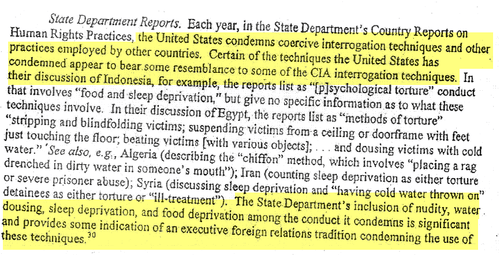
We Are Now Indonesia

Indonesia

Greenwald points to this nugget:

They explicitly recognized that the techniques they were authorizing were ones that we condemned other countries for using — including as "torture" — but nonetheless approved them, explicitly saying that the standards we impose on others do not bind us in any way.

And this is, in fact, the Bush-Cheney position. Because America did these things, they are not torture. This is also, by the way, the position of the news reporters and editors at the New York Times and the Washington Post. Does anyone believe that if Iran, say, captured an American soldier, kept him awake for eleven days straight, bashed his head and body against plywood walls with a towel around his neck, forced him to stand and sit in stress positions finessed by the Communist Chinese, stuck him in a dark coffin for hours, and then waterboarded him, that the NYT would describe him as a victim of "harsh interrogation techniques"? Do you think Mike Allen would give anonymity to a top Iranian official who defended these techniques as vital to Iran's national security?

The last seven years have revealed that almost the entire American establishment views itself as immune to the moral and ethical rules it applies to every other country in the world. Now we know, at least. And you can be sure they will protecting each other to the bitter end.

Who Is Being Hit The Hardest?, Ctd.

After looking at the correlation between education and unemployment in the current recession, I remarked yesterday: “Charles Murray was onto something, wasn’t he?” Doug at Balloon Juice asks:

…do people like Sully and Murray actually believe that they and their friends are members of a genetic “cognitive elite” and that some portion of the rest of the population belongs in a “more lavish version of the Indian reservation”? Or am I simplifying things[?]

In a related noted, Nick Kristof has a good piece on ways to increase educational/intellectual attainment among Americans living in poverty. Which brings me to my last question: is the Sully/Murray stuff at some level an argument against taking government action towards rectifying the country’s educational inequality problem?

After going through the new research on genetics and intelligence Kristof concludes:

The implication of this new research on intelligence is that the economic-stimulus package should also be an intellectual-stimulus program. By my calculation, if we were to push early childhood education and bolster schools in poor neighborhoods, we just might be able to raise the United States collective I.Q. by as much as one billion points.

That should be a no-brainer.

If anything, the evidence that cognitive skills have much more influence on income and success in this advanced global economy than in previous times when other skills were more valuable suggests that we need to focus on education more, not less. But intelligence is not infinitely alterable. My point was that growing inequality will be very, very hard to prevent or restrain in the face of these factors.