In The Wake Of War Crimes

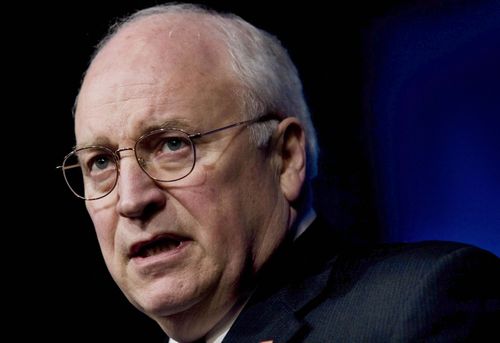
CHENEYmandelnganAFPGetty

The blogosphere reacts. Glenn Greenwald:

Obama did the right thing by releasing these memos, providing all the information and impetus the citizenry should need to demand investigations and prosecutions.  But it is up to citizens to demand that the rule of law be applied.

Digby:

I would have hoped the president would use some of his political capital to prove that the United States is a country of laws not men.However, I have to wonder if by releasing the memos they aren't at least obliquely asking for the public to "make" them do it. They could have kept them secret, after all. If there were significant public pressure as well as pressure from congress, they would have enough cover to launch an investigation with the assurance they aren't going to go the Bad Apple route.

Reynolds uses the release to attack Pelosi while Hugh Hewitt manages to blame Congress, and only Congress:

As the commentators show their feathers to each other, see if any of them cite a single vote by the Senate or the House to define waterboarding as torture throughout the years when the Congress was fully aware of the practice.  The DOJ legal analysis was the best effort of front-line lawyers in the aftermath of a massive attack on the United States.  Their Congressional critics of today who did not demand a defining vote on what constituted torture are the worst sort of hypocrites.  They are the lawmakers, and chose –even when House and Senate were controlled by Democrats from January 2007 to the present– to avoid passing a law bringing clarity to the very gray areas of the law of interrogation.

Spencer Ackerman:

Most of this story — the torture techniques (except for the insects); the OLC blessings and reblessings — has been thoroughly reported already. What the memos leave unclear is how much the CIA jumped into the torture game and how much the Bush administration pushed it. The memos are written to be responsive to the CIA lawyer — the malefactor going to the priest to give his work absolution. They're written to guide the interrogators. But they leave unclear — as does most of the narrative so far — who's compelling Rizzo in the CIA counsel's office to keep pushing for more.

Kori Schake, a former national security adviser on defense issues to President George W. Bush:

What struck me most about the memos was that as late as August 2002, C.I.A. officials believed they were hearing “chatter” of the level and kind that proceeded the September 11th attacks. At that time, the country was still reeling from those attacks. The agency believed it had in custody enemies planning catastrophic terrorist attacks against our country and were urgently seeking information. The C.I.A. sought legal counsel and complied with the advice. Subjecting people to prosecution under those circumstances would be a dangerous politicization of difficult choices made by those serving our country.

Drum:

Reading the OLC torture memos is enough to make you ill.  The techniques in question are plainly and instinctively abhorrent by any common sense definition, and the authors of the memos obviously know it.  But somehow they have to conclude otherwise, so they write page after mind-numbing page of sterile legal language designed to justify authorizing it anyway.  It's not torture if the victim survives it intact.  It's not against the law if it takes place outside the United States.  Waterboarding is OK as long as it isn't performed more than twice in a 24-hour period.  Sleep deprivation of shackled prisoners for seven days at a time is permissible as long as the victim's diaper is changed frequently.  And on and on and on.

Do they know this is torture?  Of course they do.

Mike Dunford:

Reading these memos, it's very clear that there are quite a few CIA employees who are allegedly medical professionals. Those people need to find new professions. I would strongly suggest that you take a few minutes – particularly if you're a doctor or a psychologist – to suggest to your colleagues at the American Medical Association and the American Psychological Association that it might be good to take some formal steps along those lines.

Alex Koppelman:

As it stands now, the words "good faith" might be the most important factors not just for CIA officers involved in torture but for the coming decisions about memo authors such as Jay Bybee and John Yoo. Justice Department officials declined to comment to Salon, but it's likely the administration will make those decisions after an ongoing review by the DOJ's Office of Professional Responsibility into the attorney's actions is complete. According to a letter Sens. Dick Durbin, D-Ill., and Sheldon Whitehouse, D-R.I., sent to the OPR head in February of this year, the review hinges on whether the legal advice people like Bybee and Yoo provided "was consistent with the professional standards that apply to Department of Justice Attorneys."

Larry Johnson:

Unfortunately, Barack “Mr. Constitutional Scholar” Obama left the door for future abuses? Why? No one who worked for the CIA will be punished for carrying out these actions.

Ironically the U.S. Department of Justice this week was allowing a former Nazi death camp guard to be deported back to Poland to face possible charges for abuses he committed while carrying out the orders of superiors. Hell, while we are giving everyone a pass for illegal, immoral activity carried out for what the leaders considered to be a good purpose, let’s let Demanjuk go. At least we would be consistent.

Rule of law my ass.

Andy McCarthy:

A terrible decision, pushed for aggressively by AG Eric Holder.

Jeff Emmanuel at Redstate:

Co-opting the word “torture” to include methods far less offensive than the majority of interrogation techniques I underwent in military SERE training isn’t a victory for moralists and humanitarians in any form; rather, it’s an Orwellian perversion of a word that once had meaning by those who have spent the last eight years on constant lookout for some greviance to hold against a president whose mere existence they resented.

The sad fact is, by co-opting the word “torture” and using it to describe activities going on at Gitmo, Bagram, and elsewhere, these faux-humanitarians have left us with no word to use to describe those activities which used to be classified as torture, like beheading captives on video, hanging people from meat hooks, drilling out eyeballs, using electric current to cause severe pain and physical damage, and cutting off limbs.

E.D. Kain responds to Jeff:

Damn co-opters!  First you co-opt the word “marriage” and now the word “torture!”  By the way, is “beheading captives on video” really considered torture?  I thought that was murder…

It’s interesting that Jeff thinks the only forms of torture that ought to be called that are the sort that essentially just almost instantly kill the victims.  Been watching too many Saw movies there Jeff?

Kevin Jon Heller:

…the OLC acknowledges that it cannot be confident that the enhanced interrogation techniques are legal, but expresses its opinion that the judiciary is unlikely to address the issue.  Is that the kind of advice that justifies not prosecuting CIA interrogators for engaging in conduct that even one of the highest-ranking members of the OLD admits is “patently illegal”?

I think the question answers itself.

Anonymous Liberal:

…the entire Bybee memo (which was likely written by John Yoo) is shockingly conclusory in its reasoning. One obvious torture technique after the next is quickly dismissed as not generating a sufficient level of suffering to constitute torture. But there's no attempt to back these conclusions up or explain away possible objections to them. No attempt to address the wide array of contrary precedent. And there's virtually no evidence that the author of the memo even spent much time imagining what it might actually be like to be subjected to some of these techniques.

As I've said many times here before, the most culpable parties in this whole disgusting affair are the lawyers. Their job was to stand up for the rule of law, to tell the Dick Cheneys of the world that what they wanted to do was clearly illegal. They didn't do that. Indeed, they went to elaborate lengths to give their legal blessing to conduct they had to have known was illegal.

John Schwenkler:

Let the record show that I was secretly rooting, at least some of the time, that Obama would keep the memos secret or at least heavily redact them, so that then I’d be able to call him a bastard. And let it also show that I’m really much happier to have the truth out there than to be able to score some cheap points, and that on the whole I’m pretty damn impressed. This I can believe in, Mr. President.
The Daily Wrap

Spain's AG punted torture prosecution to the US, the partisan right continued to flail over domestic surveillance, Taibbi completely jumped the shark on teabagging, John Cole found the dumbest thing ever written about the recession, I reflected on the meaning of conservatism and liberalism through Oakeshott, Palin made Cheney proud, readers went back and forth over Mickey's healthcare post, and the true darkness of the Bush administration came to light.

Mike Allen: Bush Mouthpiece

Under what reasoning does Politico's Mike Allen give the following piece of spin anonymity?:

A former top official in the administration of President George W. Bush called the publication of the memos “unbelievable.”

“It's damaging because these are techniques that work, and by Obama's action today, we are telling the terrorists what they are,” the official said. “We have laid it all out for our enemies. This is totally unnecessary. … Publicizing the techniques does grave damage to our national security by ensuring they can never be used again — even in a ticking-time- bomb scenario where thousands or even millions of American lives are at stake."

“I don't believe Obama would intentionally endanger the nation, so it must be that he thinks either 1. the previous administration, including the CIA professionals who have defended this program, is lying about its importance and effectiveness, or 2. he believes we are no longer really at war and no longer face the kind of grave threat to our national security this program has protected against.”

Allen is allowing a member of the administration that broke the Geneva Conventions and commited war crimes to attack the current president and claim, without any substantiation, that the torture worked. He then allows that "top official" to proclaim things that are at the very least highly questionable. What journalistic standard is Allen following in allowing such a person to speak anonymously?

And how much lower can he sink in craving buzz and traffic?

The Reason For Gitmo And The Black Sites

It’s right there in Steven Bradbury’s memo of May 30, 2005:

By its terms, Article 16 [of the United Nations Convention Against Torture and Other Cruel, Inhuman or Degrading Treatment of Punishment] is limited to conduct within “territory under [United States] jurisdiction. We conclude that territory under United States jurisdiction includes, at most, areas over which the United States exercises at least de facto authority as the government. Based on CIA assurances, we understand that the interrogations do not take place in any such areas.

So no torture happened and the US broke no treaties.

Bybee At Nuremberg

A reader writes:

I also just finished reading the 2002 Bybee memo. As a lawyer, one of the things that surprised me the most was Bybee arguing that “suffering” did not have a meaning independent of “pain” in the phrase “severe physical or mental pain or suffering” – in fact, he goes out of his way to change the phrase to “pain AND suffering” (page 11).

Under the canon against surplusage, courts interpret statutes so as to avoid creating surplus, redundant, or unnecessary language. Bybee clearly violates this long-established common law canon by defining “suffering” to mean the same thing as “pain.” This is especially egregious because the language here is not “pain and suffering” (which could arguably be a phrase of art), but “pain or suffering,” which inherently suggests that the two are different things and that the presence of either justifies a finding of torture. Instead, Bybee defines away the “suffering” element, since it is by far the more problematic. Just to be clear – this is a fundamental issue of statutory interpretation that would be clear to any first year law student.

While the canon against surplusage is by no means an absolute rule (the canons of construction are rather general guidelines to be used when interpreting statutes and they sometimes conflict with each other), these sorts of issues would definitely be considered by a lawyer in considering whether a statute covered specific conduct. That said, there is also a canon called the “rule of lenity” that strictly construes criminal statutes so that potential defendants are not unfairly punished for conduct that does not fairly fall within the law. But, there is also a canon that requires statutes to be interpreted in line with international law, if possible, which would throw open a whole litany of applicable international cases/issues/obligations, since the statute here implements the UN Convention Against Torture. I would expect an honest assessment of the torture statute to address all of these issues, especially since American courts have not ruled on the statute. By ignoring standard issues of statutory construction such as these, Bybee makes clear that he is arguing a position rather than trying to reach the correct result.

Saul Becomes Paul

Agcorpse2

A reader writes:

This is an eye opening event for me.  It’s easier for a liberal like me, who voted against Bush twice, to feel I’m off the hook.  But, clearly, I kept my eyes closed and my mouth shut.  When I let talk of torture filter in, early on, such as keeping people awake and some of the accounts of Abu Ghraib, I kept drawing lines to things I wanted to believe.  They’re keeping them awake?  Oh, that must be like playing loud music.  Like… they used on Noriega.  Today, I have to ask myself why I didn’t take to the streets. 

I guess I’m “lucky” again in that I have a President who believes in the rule of law.  But where was I, a Jew, taught to say Never Again when I was growing up? My guess is that somewhere this evil satisfied a dark place in me. A generalized anger or rage that we can all walk around with at times. Why else was I content not to stare this evil in the face?

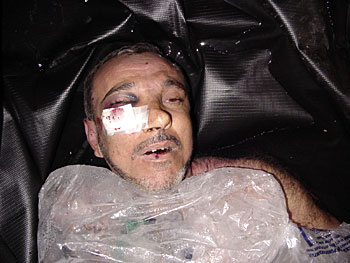
(Photo: a torture victim murdered while being beaten in a stress position by a masked US agent at Abu Ghraib.)

For The Record

No mention of the torture memos appears right now on the Drudge Report (which provides news of a prank at Dominos pizza), Instapundit (which mentions the new DVD for the Lord of The Rings trilogy), Pajamas Media, or Michelle Malkin. They are reacting to the evidence of war crimes committed by the president of the United States the way they did at the time the crimes were committed.

The Nuremberg Principle

"The fact that a person acted pursuant to order of his Government or of a superior does not relieve him from responsibility under international law, provided a moral choice was in fact possible to him."

This much we know: under Bush, the United States insisted that these principles did not apply to its own government. Our standards are now lower for the US than they were once for Nazi Germany.

“A Controlled Acute Episode”

Waterboard3-small

From the Bybee memo:

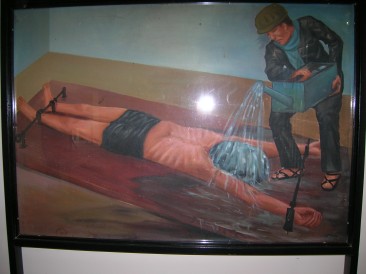
As we explained in the Section 2340A Memorandum, "pain and suffering" as used in Section 2340 is best understood as a single concept, not distinct concepts of "pain" as distinguished from "suffering"… The waterboard, which inflicts no pain or actual harm whatsoever, does not, in our view inflict "severe pain or suffering". Even if one were to parse the statute more finely to treat "suffering" as a distinct concept, the waterboard could not be said to inflict severe sufering. The waterboard is simply a controlled acute episode, lacking the connotation of a protracted period of time generally given to suffering.

The image above is from the Cambodian museum recording the torture committed by the Khmer Rouge. According to the Bush administration, the Cambodians should not have included the waterboard in a torture museum. It inflicts neither pain nor suffering.

Jay Bybee

Jeffrey Toobin doesn't want him to get off easy:

Bybee is generally the forgotten man in torture studies of the Bush era. The best known of the legal architects of the torture regime is John Yoo, who was a deputy to Bybee. For better or worse, Yoo has been a vocal defender of the various torture policies, and he remains outspoken on these issues. But whatever happened to his boss?

Today, Bybee is a judge of the United States Court of Appeals for the Ninth Circuit. He was confirmed by the Senate on March 13, 2003—some time before any of the “torture memos” became public. He has never answered questions about them, has never had to defend his conduct, has never endured anywhere near the amount of public scrutiny (and abuse) as Yoo. It is an understatement to say that he has kept a low profile since becoming a judge.

It’s a lesson in the vagaries of politics, and timing, that Bybee could slip through the cracks of this story so easily.