Quotes For The Day

"You would like to place Zubaydah in a cramped confinement box with an insect. You have informed us that he appears to have a fear of insects. In particular, you would like to tell Zubaydah that you intend to place a stinging insect into the box with him," – Jay Bybee, judge of the United States Court of Appeals for the Ninth Circuit.

"‘The worst thing in the world,’ said O’Brien, ‘varies from individual to individual. It may be burial alive, or death by fire, or by drowning, or by impalement, or fifty other deaths. There are cases where it is some quite trivial thing, not even fatal,’" – George Orwell, Nineteen Eighty Four.

The Doctors

One thing is also increasingly clear from the torture memos: medical professionals were indeed present throughout the torture sessions, carefully monitoring and measuring the health and suffering of the torture victims. There is no conceivable way in which this is compatible with the Hippocratic oath, or with minimal standards of medical ethics. They were there to ensure that pain was maximized short of death or permanent visible injury. They failed in the score of cases where torture victims died by the Pentagon's own admission – and in the over a hundred deaths-by-torture recorded by human rights organizations. These doctors need to be identified and prevented from ever practising medicine again.

The Question Of Immunity

My sense is that Ambers is right. The president's statement that he does not seek to prosecute CIA staffers who tortured suspects believing in good faith that they had legal authority to do what they did is not quite as blanket as it sounds. If evidence emerges of bad faith in torture sessions, then those staffers may well face legal consequences. Ditto if the legal advice was given in bad faith, along Nuremberg lines, Yoo and Bybee should start sweating. That's why the internal OPR report on the legal professionalism of the torture lawyers is so crucial and why it is being fought over so fiercely. If Yoo and Bybee's memos were so below legal standards that they can be objectively shown to be a means to get away with torture rather than good faith effort to apply the law to proposed torture techniques, then they too acted in bad faith. And they too are war criminals.

I do not believe that the focus should be on CIA staffers. I never have. These war crimes should be traced directly to those responsible: the men who made the decision to deploy torture as a routine part of American government, and to turn America into an international symbol that democracies, as well as autocracies and dictatorships, can allow torture to be integrated into their identity and legal system. This Bush and Cheney did. It affected America, but one suspects that the period in which America told the world that torture was fine, and even moral, will have consequences far and wide for a long time to come.

And if we do nothing in response, if we refuse to subject the powerful to the rule of law, then the consequences for the West and the broader world will be graver yet.

The Banality Of Evil

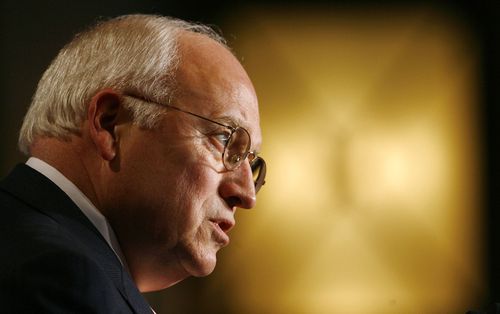
CHENEYWinMcNamee:Getty

Perhaps you are reading these documents alongside me. I've only read the Bybee memo, as chilling an artefact as you are ever likely to read in a democratic society, the work clearly not of a lawyer assessing torture techniques in good faith, but of an administration official tasked with finding how torture techniques already decided upon can be parsed in exquisitely disingenuous ways to fit the law, even when they clearly do not. This is what Hannah Arendt wrote of when she talked of the banality of evil. To read a bureaucrat finding ways to describe and parse away the clear infliction of torture on a terror suspect well outside any "ticking time bomb" scenario is to realize what so many of us feared and sensed from the shards of information we have been piecing together for years. It is all true. These memos form a coda to the Red Cross report, confirming its evidentiary conclusions, while finding exquisite, legalistic and preposterous ways to deny the obvious.

I do not believe that any American president has ever orchestrated, constructed or so closely monitored the torture of other human beings the way George W. Bush did. It is clear that it is pre-meditated; and it is clear that the parsing of torture techniques that you read in the report is a simply disgusting and repellent piece of dishonesty and bad faith. When you place it alongside the Red Cross' debriefing of the torture victims, the fit is almost perfect. I say "almost" because even Jay Bybee, in this unprofessional travesty of lawyering, stipulates that these techniques might be combined successively in any ways that could cumulatively become torture even in his absurd redefinition of the term. And yet the ICRC report shows, as one might imagine, that outside these specious legalisms, such distinctions never hold in practice. And they didn't. Human beings were contorted into classic stress positions used by the Gestapo; they had towels tied around their necks in order to smash their bodies against walls; they were denied of all sleep for up to eleven days and nights at a time; they were stuck in tiny suffocating boxes; they were waterboarded just as the victims of the Khmer Rouge were waterboarded. And through all this, Bush and Cheney had lawyers prepared to write elaborate memos saying that all of this was legal, constitutional, moral and not severe pain and suffering.

Bybee is not representing justice in this memo. He is representing the president. And the president is seeking to commit war crimes. And he succeeded. This much we now know beyond any reasonable doubt. It is a very dark day for this country, but less dark than every day since Cheney decided to turn the US into a torturing country until now.

Stay tuned as I try to unpack and make sense of these documents. There is some feeling of relief that we now have the incontrovertible evidence in front of us. But there is also a feeling of great nausea as well. Look what they did to these suspects. And look what they did to America.

OLC Memos Incoming

The ACLU has just posted them; you can download them here. Here's the president's full statement:

The Department of Justice will today release certain memos issued by the Office of Legal Counsel between 2002 and 2005 as part of an ongoing court case. These memos speak to techniques that were used in the interrogation of terrorism suspects during that period, and their release is required by the rule of law. My judgment on the content of these memos is a matter of record. In one of my very first acts as President, I prohibited the use of these interrogation techniques by the United States because they undermine our moral authority and do not make us safer. Enlisting our values in the protection of our people makes us stronger and more secure. A democracy as resilient as ours must reject the false choice between our security and our ideals, and that is why these methods of interrogation are already a thing of the past. But that is not what compelled the release of these legal documents today.

While I believe strongly in transparency and accountability, I also believe that in a dangerous world, the United States must sometimes carry out intelligence operations and protect information that is classified for purposes of national security. I have already fought for that principle in court and will do so again in the future.

However, after consulting with the Attorney General, the Director of National Intelligence, and others, I believe that exceptional circumstances surround these memos and require their release. First, the interrogation techniques described in these memos have already been widely reported. Second, the previous Administration publicly acknowledged portions of the program – and some of the practices – associated with these memos. Third, I have already ended the techniques described in the memos through an Executive Order.

Therefore, withholding these memos would only serve to deny facts that have been in the public domain for some time. This could contribute to an inaccurate accounting of the past, and fuel erroneous and inflammatory assumptions about actions taken by the United States. In releasing these memos, it is our intention to assure those who carried out their duties relying in good faith upon legal advice from the Department of Justice that they will not be subject to prosecution.

The men and women of our intelligence community serve courageously on the front lines of a dangerous world. Their accomplishments are unsung and their names unknown, but because of their sacrifices, every single American is safer. We must protect their identities as vigilantly as they protect our security, and we must provide them with the confidence that they can do their jobs. Going forward, it is my strong belief that the United States has a solemn duty to vigorously maintain the classified nature of certain activities and information related to national security.

This is an extraordinarily important responsibility of the presidency, and it is one that I will carry out assertively irrespective of any political concern. Consequently, the exceptional circumstances surrounding these memos should not be viewed as an erosion of the strong legal basis for maintaining the classified nature of secret activities. I will always do whatever is necessary to protect the national security of the United States. This is a time for reflection, not retribution. I respect the strong views and emotions that these issues evoke. We have been through a dark and painful chapter in our history.

But at a time of great challenges and disturbing disunity, nothing will be gained by spending our time and energy laying blame for the past. Our national greatness is embedded in America's ability to right its course in concert with our core values, and to move forward with confidence. That is why we must resist the forces that divide us, and instead come together on behalf of our common future. The United States is a nation of laws. My Administration will always act in accordance with those laws, and with an unshakeable commitment to our ideals. That is why we have released these memos, and that is why we have taken steps to ensure that the actions described within them never take place again.

The Fissures Widen

Larison explains:

 I think the reason there is so little “respectful engagement” between mainstream and dissident conservatives is that there isn’t much mutual respect that would serve as the basis for such engagement. Instead of dissolving during the early years of renewed Democratic rule and liberal ascendancy, the lines have hardened. For my part, this is why I am much more interesed in talking to and engaging with heterodox, meliorist conservatives who tend to break with the movement in other ways, because at least they are interested in ideas and policy discussions, which seem to be incidental at best in mainstream conservative discourse nowadays. If that changes, there might be more engagement in the future, but I doubt that this will happen.