Path To Prosperity Reax

Tyler Cowen:

Let’s say it’s 2027 and I’ve just turned 65.  I fill out a Medicare application on-line and opt for a plan with superior heart coverage (my father died of a heart attack), not too much knee coverage and physical therapy (my job doesn’t require heavy lifting), no cancer heroics (my mother turned them down and I wish to follow her example), and lots of long-term disability. Is that so terrible an approach?  Is it obviously worse than having the Medicare Advisory Board make all of those choices for me?

Rationing yourself is much more tolerable than having government rationing it for you. Matt Yglesias:

[I]n terms of the “welfare” aspect of Medicaid by far the largest set of poor people it covers are poor children …. Poor kids tend to struggle with a lot of problems and are in many ways disadvantaged in the competitive economy by the time they’re out of diapers. It seems to me that investing in their basic health care is a no brainer way of leveling the playing field somewhat and ensuring that the country is making the most of our human resources.

Matt fails to say what he would do instead. It seems to me that any criticism of Ryan should explain a realistic alternative to what he has proposed. Just hammering him on cuts is not enough, given the debt that hangs over the future generations. If Matt, like Chait, wants simply to raise taxes, he should say so. J.D. Hamel:

Of all the things I can’t stand about politics, the tendency to emotionalize a difficult topic is probably the worst.  Budget cuts hurt—just ask our friends in the United Kingdom.  But budget cuts are coming, because our entire welfare system depends on a false premise: a rapidly growing population.  It’s a pretty simple concept: the taxes from young workers support the benefits of elderly dependents, so the system works fine so long as the young significantly outnumber the old.  Our system is stressed because the number of retirees is growing at a faster pace than the number of workers. 

Ezra Klein:

Paul Ryan is unveiling the Republican’s 2012 budget proposal. Credit where it’s due: He didn’t dodge. His budget privatizes and voucherizes Medicare, dismantles Medicaid and turns it into a system of block grants, reforms the tax code, sets caps on federal spending, and much more. Like many such plans, it says more about how much government can spend than about how it will get spending down to that level while still providing the promised services, but it is, nevertheless, a dramatic proposal that will define the budget debate for the rest of the year. It’s also completely, almost gleefully, unacceptable to Democrats

Further analysis from Klein hereDouglas Holtz-Eakin:

 Critics from the left will quickly attack “premium support” for Medicare and “block grants” for Medicaid as cheap attempts to shift costs to seniors and the poor who are ill-equipped to handle the burden. In fact, premium support will likely be means-tested to reflect economic circumstances, risk-adjusted to give those who are ill more support, and indexed to reflect rising prices. The reform will protect those in or near retirement and then shift to a system that essentially mirrors what Congress has right now. Seems hard to object.

Kevin Drum:

A plan dedicated almost entirely to slashing social spending in a country that’s already the stingiest spender in the developed world, while simultaneously cutting taxes on the rich in a country with the lowest tax rates in the developed world — well, what could be more serious than that?

Ed Morrissey:

Paul Ryan may be Barack Obama’s worst nightmare. On the day after Obama launched his re-election bid with a soft, ambiguous, and oddly passive ad imploring people to come to his rescue, Ryan and his team have released a sharp, focused three-minute video on his plan to rescue America from its looming debt and entitlement crises. Obama and his fellow Democrats have chosen not to lead for short-term political gain. Ryan fills the leadership vacuum in three minutes, explaining the nature of the crisis in easily-understood terms, and the solution to it — cutting spending.

Greg Sargent:

 There’s a lot to say about Ryan’s rollout, but the immediate point to be made is that the optics of it have been carefully thought through and are very slickly done. Ryan’s sales pitch will rely on repetition of the phrase “path to prosperity,” on persuading the public that these proposals spread the pain around to everyone, and on creating a profound sense of crisis as a means to selling the public on ideas that are deeply unpopular and ideologically far out of the mainstream. 

David Brooks:

The Ryan budget will not be enacted this year, but it will immediately reframe the domestic policy debate. His proposal will set the standard of seriousness for anybody who wants to play in this discussion. It will become the 2012 Republican platform, no matter who is the nominee.

Where Obama Feared To Tread

GT_PAULRYAN_04042011 The president’s walking away from the deficit commission he set up was, to my mind, one of those moments when his caution was not about the substance of the issue but the politics. He knows we need to cut entitlements and defense or face fiscal collapse. And yet he has allowed Paul Ryan to move into the vacuum Obama created on the most important domestic issue of the day. Ryan’s proposal, whatever you think of it, is serious. His proposal for Medicare looks to me like an extension of the Romney/Obama healthcare exchanges. His proposal for Medicaid – block grants to the states – will inevitably cut down on sky-rocketing healthcare spending. His tax reform is straight out of Bowles-Simpson. Alas, his op-ed is needlessly partisan in its initial lashing out at Obama. That’s not the way to start a real dialogue, which is what we desperately need. But the good news is that we finally have a political party being honest about what it takes to avoid falling off a fiscal cliff. It means sacrifice. And my objection to the Ryan plan really comes down to the injustice of imposing major sacrifices for the poor and elderly, while exempting the wealthy from any sacrifice at all. This is because of Ryan’s and the GOP’s intransigent, doctrinaire refusal to bring taxes back to their Clinton-era or Reagan-era levels, even as they have given themselves a great opportunity to raise revenues as painlessly as possible.
All the GOP has to do is make tax reform revenue-positive rather than revenue-neutral. Income tax rates would come down – but not quite as low as they might have. The money left over could reduce the burden on the poor. If he advocated serious cuts in defense, rather than the minor measures backed by Gates, he’d be on much firmer ground as well.

But this is clearly an opening bid – and a powerful rebranding of the GOP, after the Bush years, as fiscally serious. As David Brooks wrote this morning, we shall soon see what Obama is made of by how he responds. We were told that Obama did not embrace long-term fiscal reform in his State of the Union this year because he needed political cover from the right. Well, he’s got it now. Will he react by demagoguing the issue as the liberal blogosphere is doing – or by seeking a way to build on it, to trade cuts in Medicare and Medicaid for a revenue-positive tax reform and deeper defense cuts?

I don’t accept the logic that this cannot be done in the year before a general election. The massive debt and deficits can be ducked no longer. While I’m sure there are many legitimate complaints about Ryan, in this proposal at least, he gets real points for seizing the initiative on honest debt-reduction, and pushing it forward as a principal issue for the elections in 2012. For the first time, the Tea Party seems genuine and serious in its fiscal goals.

And the Democrats and Obama now have to offer a response. The question I’ll be asking is quite simply: how would they save $5.8 trillion from the federal budget over the next decade? Tell us, please.

(Photo: Getty Images).

The Beast Switch: Your Take, Ctd

Earlier feedback here. A reader writes:

I am a longtime reader, and you have probably heard this from others as well … the new site is slow.  Painfully slow. Can you get them to speed things up?

We spent yesterday compiling a list of tweaks based on your emails and our use of the live-site. Please be patient; we're working on it. Another writes:

My question is when you will show up on the Beast App on my iPod? I already found and downloaded it, so now you need to get your outlet there as you did in the Atlantic app.

Another:

I miss the Orwell quote beneath the title; it seems lost hanging above the masthead. And what ever happened to “Of No Party Or Clique”? Are you going to replace it with something else?

Not right now – but we may hold a reader contest to come up with a new one. The Atlantic trademarked the phrase "of no party or clique" since it's in the founding mission statement of the magazine, which is fair enough, it seems to me. Another:

Thank you for continuing to not accept comments on posts. That is the worst thing about the Internet.

Is Love A Choice? Ctd

A reader writes:

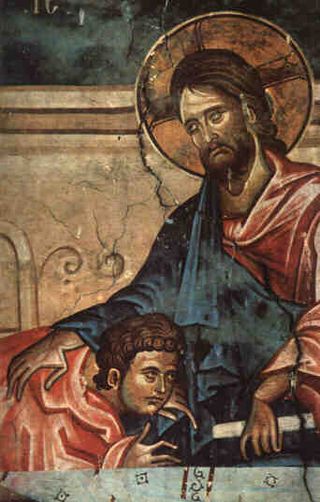
Ever since I read Damiane._Jesus_Christ_and_St._John_the_Apostle. context of heterosexuality, the relationship between romantic love and the peopling of the earth allows us to see how friendship is less useful or necessary, in the narrow sense of those terms.

I get that comparison, and understand how the superfluousness of friendship, from a kind of biological perspective, could redound to connecting it to "choice" or "freedom." Friendship does not directly participate in perpetuation of the species in the way romantic love does.

But I really can't say I've chosen my friends.

There is a way in which I am mysteriously drawn to my closest friends. I don't think this is sublimated eros, either. It is true that I could list reasons why I am friends with certain people: shared intellectual preoccupations, a love for certain activities, similar religious devotion, or compatible tastes in music, literature, or art. But friends are always more than the sum of their parts, more than a checklist of similarities, interests, and activities. And isn't that "more" what ultimately draws us to them? Something about their being is intriguing or comforting or seems to elicit some kind of response from us. I could imagine stumbling upon someone who liked the same food, books, and films as I do, while also leaving me cold. I could even imagine wanting to be friends with someone, but having it never really materialize.

Why does being friends with a particular person make the world seem less lonely? I'm not sure, at the level of conscious choice, the answer to that is entirely different from the question, Why am I so attracted to this person, why do they make my heart leap, why can't I get them off of my mind? Both involve, I think, something instinctive or pre-reflective. Both can't be entirely described with words. I'm not saying they partake of the same phenomenon, as if they are just different points on one spectrum. But their form, if not their content, seem to be recognizably similar. In other words, both modes of love seem to originate in something deeper than choice, or will, or freedom.

I grasp, too, that there is something moderate, solid, less capricious, and more steady about friendship than romance, which perhaps gives it the illusion of being something we control. And maybe in some ways, comparatively, we are more in control of our friendships. Certainly, again, when compared to eros they are less connected to desire and passion. But for me, when I really think about it, my love for my friends escapes calculation and rationalization. I find myself drawn to them — there is something passive about it.

Your examples make me wonder about this even more. Think of Montaigne — "because it was he; because it was I." If, for Montaigne, and Oakeshott, friendship is connected to delight and enjoyment, who can say why someone delights us?

Yes, there is a mystery to friendship. It is indeed more than the sum of its parts. But it remains a choice, it seems to me, to build on this mysterious form of connection, to nurture it, and to obey its unspoken rules. Romantic love is much less rational; it blinds when friendship always has open eyes. It takes no work to fall in love. It takes real work to rise to a real and lasting friendship.

A durable marriage, it seems to me, begins in romance and evolves, if you are lucky, into real friendship. It is a process of self-liberation into another.

(Painting: "Jesus Christ and St. John the Apostle". A detail of the Last Supper fresco from Ubisi, Georgia.)

Earlier thoughts on the topic here and here.

Cool Ad Watch

HotwheelsColombia

Copyranter registers a rare "like":

Being a man of a certain age (fucking old), one of my favorite childhood memories is sending my Hot Wheels hot rods down that orange track ramp into the loopty loop and watching them crash. That wonderful memory came crashing back when I found the above installation, via Bogota, Colombia. Cool.

Our Welfare King In Afghanistan

Hitchens slams President Hamid Karzai for fanning the flames:

Unlike some provincial mullahs, Karzai also knows perfectly well that the U.S. government is constitutionally prohibited from policing religious speech among its citizens. Yet, when faced with the doings of the aforementioned moronic cleric from Gainesville, he went out of his way to intensify mob feeling. This caps a long period where his behavior has come to seem like a conscious collusion with warlordism, organized crime, and even with elements of the Taliban. Already under constant pressure to make consistent comments about Syria and Libya, the Obama administration might want to express itself more directly about a man for whose fast-decomposing regime we are shedding our best blood. 

And that is why, of course, the counter-insurgency will fail. The government we are defending is unworthy of the Afghan people, and any force attached to it will eventually be discredited. We may decimate the mid-level ranks of the Taliban, but as long as they have a refuge in Pakistan, they can wait us out. That's why I feel it's close to Vietnam to send soldiers to fight for a foreign regime that stinks to high heaven, and stirs up passions that ultimately leads to more casualties.

At some point this has got to end and we will have to withdraw. But the deeper we get, and the longer we stay, the harder it is to leave. As I said before warfare can become welfare. And Karzai is the biggest welfare king of them all.

Gbagbo On The Ropes

Adam Martin provides a good round-up of the rapidly evolving situation in the Ivory Coast:

With rebel forces surrounding his building and French and U.N. helicopter strikes destroying his remaining army [yesterday], Ivory Coast's strongman leader Laurent Gbagbo, currently sheltering in a basement bunker, is reportedly in talks with the French ambassador to negotiate a surrender and a transfer of power that may happen as soon as today.

The BBC is reporting a ceasefire. Track more breaking news at their live-blog.

Truth In Cartooning

Bear

A reader rubs it in:

For the most part I will wait a few weeks to comment on the look and feel of the site, as others have begun addressing issues that I noticed. Shame on you, though, for not offering a more accurate cartoon; what's with the beard and hair on your illustration? Is he locked in a time capsule?

I saved you the trouble and updated the image.

So where's the white splash in my beard?