Cool Ad Watch

Copyranter isn't as sure as we are:

Well, it certainly is dripping with melodrama. But, I think that may be the best way to go with an organ donor commercial. I know some of you will disagree, which is fine. I was on the fence between praise and derision myself.

The track is "I Could Use Somebody," the Kings of Leon.

Sugar Doesn’t Make Kids Hyper, Ctd

A reader writes:

"Another myth bites the dust." Not quite.  As I argued in the comments of the linked article, the studies listed there only show that the idea of sugar sensitivity is overblown in the population, and that sugar sensitivity is not observed in the majority of the population.  Majority being the key word.  In fact, one of the studies' authors says in a related paper: "However, a small effect of sugar or effects on subsets of children cannot be ruled out."

It may very well be a real effect in a sizable number of children. How many kids in the US?  60 million?  If only 1% of kids have a sensitivity, the effect would not appear in these studies.  But it sure would be wrong to tell those 600,000 parents that they are imagining things, that it's all in their head, no?

A parent writes:

"Sugar doesn't make kids hyper"? Like hell it doesn't.

When my son was about eighteen months old, we let him have some sherbet for dessert. Two hours later, he still was running around in circles, screeching "Eeeeeeeeeeeeeeeeeeeeeeeeeee!!!!!!!!!!!!!!!!!!!!!!!!!!!!!!!!!!!!!!!" like a little air-raid siren. There was no birthday party, no circus, no clowns, no television – just a little high-pitched blur lapping our living room every five seconds.

Now, in contrast we have found that *large* quantities of sugar have a sedative effect. The same child at about age nine ate what seemed like his weight in pasta, two rolls, a pint of orange juice, all followed by a huge freaking slice of chocolate ganache cake. He had engaged most of the adults at the table in conversation, and was monologuing at high speed when he crashed and did a face plant in his now-empty plate. My husband and father-in-law took him outside and walked him around to try to rouse him. (He promptly locked himself in a closed revolving door, but that's a story for another day.)

Another:

I once let my three-year-old daughter have her way with her small Easter basket. What a mistake. That night she was in her twin bed crying out for me to keep the flies away from her. Like she was tripping on some kind of drug. I spent that night lying next to her (as best I could being eight months pregnant) and trying to convince her that she was dreaming about flies and that they were not real. She may or may not have been hyper during the day (don't remember) but she was certainly hyper at night. From then on I had tighter control over her exposure to sugary things and this horrible night was never repeated. Moderation in everything, please.

Another flags a compelling link:

This is the reason people think sugar makes kids hyper. Food dyes. Birthday cake frosting is loaded with it. Kids get hyper at birthday parties. You know what else has it? Infant Tylenol. It made my kids act like they were on cocaine. It's mostly banned in Europe. (For example, European M&M’s don’t have red dye in it.)

Israel’s Activist Military

Beinart applauds what he reads as the Israeli military's attempt to push back against Netanyahu's desire for war with Iran:

The military and intelligence agencies in the United States certainly leak to the press, and use bureaucratic tactics to box in their civilian overlords. At the end of the day, however, soldiers and intelligence analysts are trained to give their professional advice and then get out of the way. In Israel, the lines are more blurred, and bureaucrats are more freewheeling in speaking to the press. This has its disadvantages, but in a case like this, it gives the antiwar generals and spies greater leverage to fight back.

Exum angrily counters:

[E]ndorsing a system of government in which military officers pick and choose which policy preferences of their elected leaders to carry out is not a prescription for better policy-making. That's a prescription for turning yourself into Pakistan.

What The Hell Just Happened In Oakland?

Caitlin-esch

A reader writes:

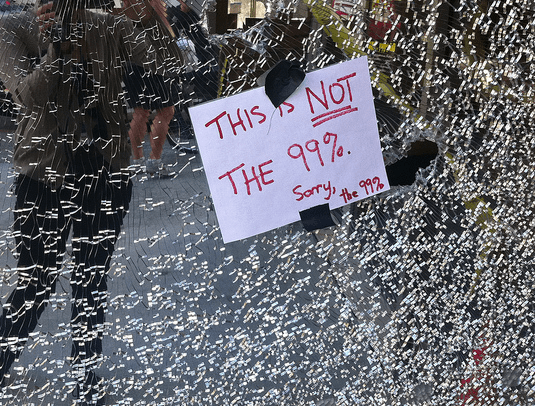
Yesterday, thousands of protestors converged on Oakland for the first general strike on the city since 1946 and successfully brought the port to a standstill. Aside from the unfortunate actions of a few anarchists that resulted in the vandalism of several businesses, the strike was a peaceful and genuinely moving affair. I was present, and marveled at the cross-section of people who had taken the time out of their day to express their dissent: folks of all ages, races, occupations, political affiliations (one man carried a sign that said "Conservatives for the 99%") were there. How can you ignore images such as this? Those aren't all dirty hippies, you know.

Live-blog coverage of the protests here. A Flickr gallery here. More photos and videos here. And here is a helpful history of general strikes in the US – "rare events." Update from a reader:

Let me get this straight: shutting down a major engine of the local economy and imperiling the livelihoods of people (think about truckers who get paid by the payload, not by the hour) is a "success" and "genuinely moving"? If that's a success, I am rooting for the failure of these people all day long. These are the real nihilists in our politics today, with no clear aim other than spreading economic harm for its own sake. How utterly petulent and self-indulgent.

Another pushes back:

Your reader provides a shallow critique calling the Oakland protesters petulant and self-indulgent.  Of course the protesters know the stakes of shutting down the port.  That's what give these rare events their potency.  When the system of democratic capitalism appears to be rigged by the major players, both government and private enterprise, how can the citizenry be heard?  Perhaps your reader thinks people should write to Congress, contact customer-service lines, and simply keep playing the rigged game.  That would be unfortunate,  and about as workable as trickle-down economic theory.

(Photo by Caitlin Esch/KQED)

“Too Disturbing, Too Ugly, Too Familiar”

Many readers are sharing their stories of abuse:

From the perspective of someone who as a kid was in a somewhat similar position to the beating victim in the "Texas Domestic Justice" video, perhaps the worst part was the relentless yelling and swearing that accompanies the attack.  I'm doing OK and am generally happy thanks to great friends and relatives and a lucky wealth of internal resilience.  But more than 30 years after the last parental attack, the screaming, swearing and verbal assaults still echo. I've long since forgotten the relatively minor physical pain I felt from being hit, but in my low moments, I still hear those words and feel completely substandard.

I'm sure I drive my kind, gentle and loving partner nuts because the legacy of hearing those "you are worthless" words has me blaming myself for everything that goes wrong.  I don't mean to play the victim card here, because I've truly come a long way and have become a relatively successful and competent adult.  But let's hope the counseling the young woman and others receive addresses the terrible words she heard from her father. The cliche, "Sticks and stones may break my bones but words will never hurt me" is a lie.

Another writes:

I watched that video in mouth-covered horror. At the end, my first calm thought was: damn I wish I had had a video camera when I was young. And that's what's so striking about the video to someone who lived through that sort of violence. It's SO commonplace. A scene like that could have been recorded any day – though not every day – of my childhood. The swirling feeling of incipient violence and helplessness. The awareness that your life is under the control of a man who can turn into a beast.

Yeah, my specifics are different. My mom didn't play that weird game of semi-protective, semi-enforcer participation. She played a game of "get as far away from it as possible and try to pretend it wasn't so bad." Dad's favorite weapon wasn't a belt; it was a hammer handle or a length of PVC pipe. By the time we were 16, the physical violence had more or less stopped.

So many of the fragments are so heart-rendingly familiar. The unpredictability of the man's rage-fueled violence, spiking and subsiding as he channels it. The first time I watched that video, it was terrifying because you just don't know how far it's going to go. You think it's over, then it's not. You keep wondering if it could get worse. The fact that the girl knew to tape it tells you how regular this was. The way she recovered from sobbing so quickly tells you how used to it she was. I know, because I recovered that fast too. There's no doubt in my mind that this was not the most severe beating she ever took from him.

If you see his statements yesterday, he's still blaming her. When I was 23, Dad was still blaming me for why he hit me so much. (It was always my fault that he hit me. Everyone in the family told me so – if I hadn't made him so angry, none of it would have happened.) Her mother left after 22 years of marriage, as my mother did, and sacrifices the "family secret"of his "addiction" being the source and cause of this rage.

The daughter expresses some regret for exposing him. She wants people NOT to blame her mother. She says she didn't show this video for 7 years because he still controlled her life, and she was afraid of being hurt in his inevitable backlash. All of those statements could have been made by me at the age of 23. Because my father was a fine upstanding community pillar who clearly loved his children, no one would believe the "spankings" I reported were abuse. Because no one saw it, no one heard his raging or our screaming. Any teacher or coach I tried to tell thought I was exaggerating and told me that my father loved me. If anything, I didn't have the bravery or language or distance to express anything close to what it was. And it occurred before the laws that require reporting.

So yeah, I wish I had had a video camera. And the fact that this girl did have one, and published this, is so empowering to all of us abused kids who had no voice, no proof that the Dr. Jekyl they called Dad was a Mr. Hyde when the doors were shut.

Another:

I can't finish watching that video. I made it to the 1:58 mark before hitting "pause." The summoning of the belt, the quiet wait before the beating, the first blow, the swearing and yelling, the urging for a fallen victim to "stand up" and take some more – the content is too disturbing, too ugly, too familiar. Growing up, I was routinely belted by my own father for infractions that ranged from quarreling with my siblings to doing poorly in school. My mother, too, also employed corporal punishment.

My parents stopped beating me when I was a teenager. One evening, after my father readied to unleash another belting, I also went for a belt to fend him off. Months later, after my mother swatted me, I turned around and slugged her in the stomach.

Violence imposes physical domination. Watching and hearing this girl be thrashed, it is clear her attacker enjoyed physically dominating her. It can be a thrill to dominate someone like this. The thrill is a rush, and the violence is repeated. After receiving years of beating from my parents, I, too, wanted some of that thrill. I, too, wanted to dominate others. So I, too, started beating up fellow classmates in my elementary school. They were always smaller and weaker in stature. Bullies don't want fair fights. The point is to dominate someone, not risk a bloody nose or humiliation.

I hope to never unleash that wrath on a child. I know that thrill of domination. I know that hate lurks within me. I know what the penalty for swearing, losing popcorn money, or breaking a window can lead to. I know that I am just as capable of assaulting a minor as I am to watch the evening news. Knowing what I know about myself, I hope to never father a child. I wish others knew themselves, too.

The Death Penalty’s Hidden Costs

Pamela Karlan shines a light on how it disrupts the rest of the legal system:

[Douglas Berman of Ohio State] has calculated that about one in ten thousand state felony sentences is a death sentence, yet the Court devotes more resources to reviewing death sentences than to reviewing claims in all other criminal cases combined. And while the Court has repeatedly considered whether a death sentence is proportionate to a particular class of crimes—for example, barring death sentences for non-homicide offenses or for juvenile or mentally retarded defendants—it has set virtually no limits on the severity of prison sentences. In the 40 years that the Court has been actively policing capital punishment, prison sentences have lengthened and the U.S. prison population has skyrocketed. With execution at the top end of the scale of punishment, a life sentence begins to look something like leniency, and other sentences are inflated in turn.

What Was Cain Accused Of?

Pajamas Media has new details:

[T]wo sources have now confirmed to PJ Media that a female employee of the National Restaurant Association told associates she had been brought by Mr. Cain to his Crystal City, Virginia residence where she alleged "he had taken advantage of me." Both sources claim to be politically conservative.

Herman Cain’t

Pejman Yousefzadeh tries to talk some sense into Cain supporters:

I don’t even care at this point whether the [sexual harassment] charges are accurate; even if we assume that they are not, Cain’s habit of shifting his story in addressing the accusations, his campaign’s treatment of reporters asking questions about the charges, and now, the wild claims that other campaigns are behind the attacks, offered with little supporting evidence, show the Cain campaign in a very bad light, and show that the candidate himself is confused, desperate, and entirely on the defensive. No one should have any confidence whatsoever in Cain’s ability to survive a fall election campaign against a battle-hardened Obama team …

(Video, via Doug Mataconis, of Cain's campaign walking back the accusations against Perry.)