Well, the hard right has to find some reason why Herman Cain seems to believe that China has yet to develop a nuclear capacity.
Month: November 2011
Texas Domestic Justice, Ctd
A reader writes:
You didn't point out the worst part of this video: the judge was beating his disabled daughter. She has cerebral palsy. Not someone who could run or hit back.
Max Read headlines a local news segment, "Abusive Judge Even Less Sympathetic After Interview". Another writes:
Oh wow. Thanks for posting that. That is the kind of abuse I was subjected to since I was a toddler. The lasting anxiety that frequent attacks like that caused me have been difficult to deal with and sometimes debilitating.
I feel like I can never ever make a mistake, because if I do, the repercussions would be devastating (as aptly shown). This video helped me to explain better to my husband the origin of my anxiety. I honestly don’t think he believes that people abuse their children in such a manner because he did not experience it. I hope that girl gets help – sadly, she is going to need it.
Another:
I should have been more careful before clicking. I was finishing an essay proposal in the library when I saw the video and started crying immediately. Gosh, just the sound of the belt hitting made me sick. Just like that, I relived my childhood. I was beaten for peeing in bed, but most of the time because he felt like it.
Who Caused The Euro Mess?
Frum points his finger at Germany.
Scientists’ Toughest Nut To Crack
David Barash thinks it's the question of how the brain creates subjective experience:
[T]here are lots of other hard problems, such as the perennial one of reconciling quantum theory with relativity, whether life exists on other planets, how action can occur at a distance (gravity, the attraction of opposite charges), how cells differentiate, and so forth. But in these and other cases, I can at least envisage possible solutions, even though none of mine actually work. But the hard problem of consciousness is so hard that I can’t even imagine what kind of empirical findings would satisfactorily solve it. In fact, I don’t even know what kind of discovery would get us to first base, not to mention a home run.
Sugar Doesn’t Make Kids Hyper
Another myth bites the dust:
Even when science shows time and again that it’s not so, we continue to persist in believing that sugar causes our kids to be hyperactive. That’s likely because there’s an association. Times when kids get a lot of sugar are often times when they are predisposed to be a little excited. Halloween. Birthday parties. Holidays. We may even be causing the problem ourselves. Some parents are so restrictive about sugar and candy that when their kids finally get it they’re quite excited. Even hyper.
Sugar's impact on Rick Perry is less clear.
Correction Of The Day
From Wednesday’s press briefing at the White House:
MR. CARNEY: Well, I believe the phrase from the Bible* is, "The Lord helps those who help themselves." And I think the point the President is making is that we should — we have it within our capacity to do the things to help the American people.
Amended in the official transcript:
* This common phrase does not appear in the Bible.
(Hat tip: Matt Negrin)
A Century Of War From Above

Micah Zenko marks the occasion:
This week marks the 100th anniversary of the first use of an aircraft as an instrument of warfare. In a morbid symmetry with this year’s NATO-led intervention into the Libyan conflict, back in 1911, the pilots were Italian and the targets were Libyan. …
Over the last century, airpower has witnessed two parallel developments. The first, accurately predicted by [H.G.] Wells, relates to the farreaching capabilities of airpower in terms of the scope of combat operations, real-time target acquisition, destructive capabilities, and remarkable precision. The second development is mental, namely an increasing faith in the ability of airpower to achieve a set of discrete military and political missions, which once also required boots on the ground.
(Photo: A French Dauphin helicopter flies over the French aircraft carrier Charles De Gaulle, on March 24, 2011, on her way for a mission to Libya. By Eric Fefeberg/AFP/Getty Images.)
The Midwestern Madoff
Mariah Blake digs deep into the mega-crimes of Tom Petters and his political connections:
At the time, the Petters Ponzi scheme—which, all told, brought in more than $36 billion—was vastly larger than any known Ponzi scheme in U.S. history (although it was soon eclipsed by Bernie Madoff’s). … The fallout from the scam moved through the Twin Cities like a slow-motion tsunami.
Businesses went bankrupt. Charities slashed staff and walked away from half-built offices. Among them was Minnesota Teen Challenge, which lost $5.7 million and had to lay off 22 employees. Countless people also lost their homes or watched their retirement savings dry up. The tight-knit evangelical circles in which Vennes moved were among the most devastated. "If only a few had gotten hit, the faith community could have stepped in to help them," explains Carolyn Anderson, the attorney representing evangelical investors. "But everybody got hit. The safety net was ripped out."
One of the top fundraisers for the Ponzi scheme, Frank Vennes, a convicted money launderer and cocaine dealer turned evangelical Christian, was a major donor to Michele Bachmann. Minnesota blogger Karl Bremer has more on the Bachmann connection. Scott Lemieux zooms out:
Among many other things, the Petters tale is an object lesson of the value inherent in being a responsible looking white guy in a suit. While Maddoff’s Ponzi scheme at least grew out of a legitimate operation, Petters was never anything but a con artist. And in the beginning, not a very sophisticated one — his basic strategy was to sell things he didn’t own and keep the money. And, yet he was able to get away with a more elaborate and lucrative fraud for more than two decades, while accruing many of the markers of social respectability up to and including many powerful friends. There are too many examples of our fundamental regulatory failures to count, but this one is a doozy.
What Are We Doing About Somalia?
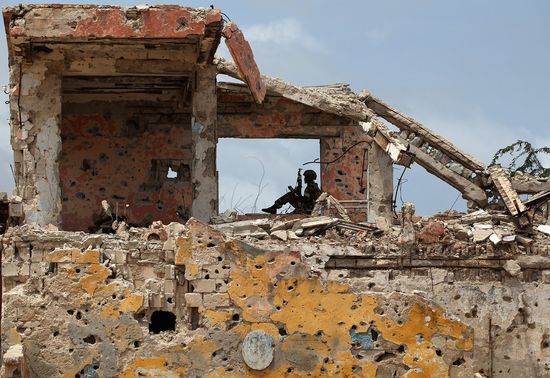
Daveed Gartenstein-Ross and Daniel Trombly parse the US government's strategy in light of Kenya's recent invasion:
The U.S. appears to be attempting to use the Kenyan invasion, whatever its faults, to advance the strategy it has developed for Somalia, allowing Kenya to push al-Shabaab [an al-Qaeda affiliated group] back in areas other than Mogadishu (where [the African Union peacekeeping force] already has a strong presence). But there are real dangers to having the Kenyans, who will be portrayed as a "crusader" force by al-Shabaab and others, inside Somalia.
There were possible problems with the U.S. strategy in Somalia even before Kenya's invasion. Its most glaring omission has been governance, which remains non-functional. The transitional government is still not able to govern within Somalia. As long as the country lacks long-term stability, it will be difficult to prevent the reemergence of another potent insurgency — if the current one can even be quelled in the first place. Still, at least the U.S. has a strategy now, a fact that is in itself significant.
Adam Serwer reports on al-Shabaab's worrying ability to recruit Americans to fight on their side in the recent conflict.
(Photo: An African Union [AMISOM] soldier looks out from war rubble on August 19, 2011 in Mogadishu, Somalia. By John Moore/Getty Images.)
App Of The Day
Farhad Manjoo is excited about Card Case, an app that lets you pay with your name without even taking out your smartphone:
I used it at a couple of small stores in San Francisco. In one case, I walked into Pinkie’s Bakery and asked for a cupcake. The cashier told me my total, and I said, "Put it on Farhad’s tab." She saw my name and photo on her iPad, tapped it, and I was done. A receipt was sent to my phone. The experience was magical—almost creepily so.
 The Dish