Must The National Anthem Be Triumphant? Ctd

A reader writes:

If you're going to talk about "America the Beautiful", it's probably time to bring up "This Land is Your Land", Woody Guthrie's 1940s folk-ode to the country. It's far superior to "The Star Spangled Banner", in my opinion. But the story behind Woody writing the song is not well known (it was a sarcastic response to Irving Berlin's (still) terrible "God Bless America"), nor have most people ever read the additional/alternate lyrics to the song. Read this 2004 New Yorker piece for a pretty good rundown on Woody, and also the Wikipedia page for the song.

Right now is also a wonderful time to examine Woody's work, even his more controversial political views, in relation to the #OWS movement and our present-day troubles:

There was a big high wall there that tried to stop me;
Sign was painted, it said private property;
But on the back side it didn't say nothing;
This land was made for you and me.

WoodyGuthrie.org has a variant:

As I went walking I saw a sign there
And on the sign it said "No Trespassing."
But on the other side it didn't say nothing,
That side was made for you and me.

It also has this verse:

Nobody living can ever stop me,
As I go walking that freedom highway;
Nobody living can ever make me turn back
This land was made for you and me.

In the squares of the city, In the shadow of a steeple;
By the relief office, I'd seen my people.
As they stood there hungry, I stood there asking,
Is this land made for you and me?
The Daily Wrap

GT_CAIN_111103
Today on the Dish, Herman Cain owned South Carolina, he reminded us of his foreign policy ignorance, and we got to know his wife Gloria. Derbyshire ridiculed sexual harassment as Cain faced more accusations, the Hermanator played an uncertain race card, and Dreher saw Cain candidacy's as a sign of decadence. The Republican base flat-out rejected an intelligent and capable two-term governor with deep domestic and foreign policy experience, T-Paw nostalgia took hold, and the Obamacons dispersed. Obama's allies offered up a vision of "Mitt Romney's America," Mitt ducked the press, we graphed Rick Perry's baffling tax plan, and the Texas governor was somehow sober during this speech

A former American Foreign Service worker collected Qaddafi's stamps, Stuart Schoffmann unpacked Israel's particular "theocratic tendencies," and Mollie Ziegler investigated the relationship between mental illness and religious fundamentalism. Iran isn't prepared to absorb popular resentment in the Middle East, Libya's military has trust issues, and China's Global Times rebranded Chinese nationalism. 

Andrew introduced "Dish-Check," and invited readers to correct or refine his post about the sources of the financial collapse. Glenn Greenwald captured the accountability deficit, memories may determine the election, and readers reflected on nature and grace in The Tree of Life. BofA retreated, Josh Barro found the Washington establishment reassuring, and the supercommittee underwhelmed. The Christianist's faith isn't strong enough to withstand another human being's happiness, a gay Christian was shunned, and HuffPo uncovered some gruesome homosexuality "cures." Amicable divorce is on the rise, technology can see what you're thinking, and Fairfield County is probably the most unequal county in America. Houston police unleashed unmanned drones, a Texas judge attacked his daughter, and the screeching sound of fingernails on a chalkboard is amplified inside our ears. We weighed the Internet, parsed Steve Jobs' last words, and cursed the new Google Reader. A humanoid military robot sweats, and "Scott Tenorman Must Die."

FOTD here, VFYW here, MHB here, and the new "Ask Andrew Anything" video archive is here

M.A.

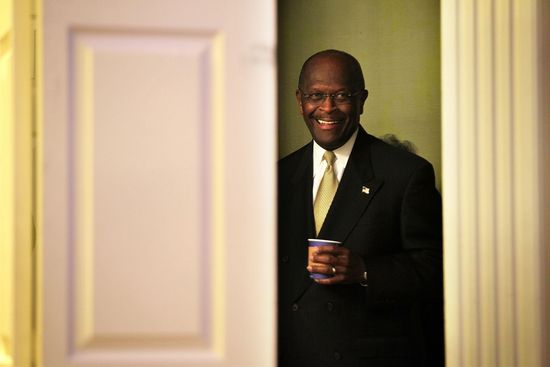
(Photo: Republican presidential candidate Herman Cain waits to be introduced prior to his address to the Northern Virginia Technology Council and the Consumer Electronic Association on jobs, the economy and American competitiveness November 2, 2011 at the Ritz-Carlton Hotel in McLean, Virginia. Cain has denied the sexual harassment accusations that have surfaced from the time when he was the head of the National Restaurant Association. Photo by Alex Wong/Getty Images.)

Drip, Drip, Drip

Cain is now facing five harassment accusations – three from women he worked with, one from a GOP pollster, and one from an Iowa radio host. Cain's campaign is accusing Perry of leaking the story and demanding an apology. Jennifer Rubin sighs:

There are some who will say that where there is this much smoke there’s a roaring fire. Others will say these are just opportunists jumping on the get-Cain bandwagon. But come on: Cain seems intent on making the controversy worse, and accusing another campaign of mischief with zero proof is, if nothing else, very foolish.

Allahpundit sorts through today's developments. Chauncey DeVega, writing earlier this afternoon, wondered how many more will come forward:

By the time this winds down how many accusers will there be in total? I say no less than five and no more than 7.

Good And Evil; Nature And Grace, Ctd

TOL_dinosaur

A reader writes:

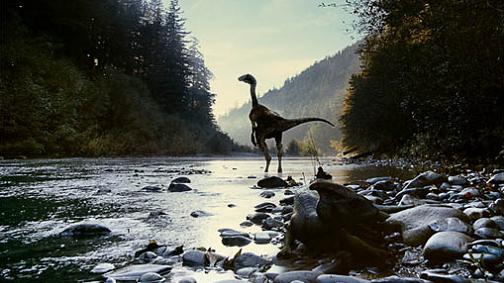
Thank you for continuing to engage Terrence Malicks's criminally under-attended The Tree of Life. Even as an athiest, I believe the film to be a masterpiece and an extraordinary source of beauty. I'd like to correct, however, Fr. Barron's otherwise lovely meditation on the film. He characterizes the encounter of the two dinosaurs as an example of "nature," and describes one dinosaur as "dominating" the other. In fact, the scene depicts both "nature" and "grace" – or, rather, the development of one following the other. The dominant dinosaur is shown pushing the injured dinosaur's face into the ground. This is "nature," as Fr. Barron describes. But the scene does not stop there. The dominant dinosaur then appears to effect something akin to mercy and backs away from the injured dinosaur, leaving him in peace. It would apear that Malick has shown us the birth of "grace."

Another writes:

While I'm personally a Christian – and I was knocked out by Malick's film every bit as much as you were – I left the theater feeling it was a devastating, almost unanswerable challenge to the Christian message. If the film is asking whether the universe tilts toward nature or grace, I would say Malick puts his thumb on the scales every-so-slightly in favor of grace. But I had a powerful feeling in my gut that it's all just nature.

In one cut-away in the film, you see a wounded dinosaur approached by another hunter-dinosaur. When it looks like the hunter is about to finish off the wounded prey, it inexplicably walks away. Grace? Maybe. But I had the sinking feeling that the human experience of grace isn't any different in kind or meaning than a dinosaur deciding for some unknowable reason to walk away from its wounded prey.

Measured against the staggering scope of cosmic time, even the most meaningful personal events – or traumas – really are insignificant, even meaningless. That's the overall impression I carried from the film.

I believe that is one core mystery that Christianity asserts: that despite all the power of nature, grace triumphs. It's as unlikely as a Resurrection. Another:

The two biblical stories Barron references have long bothered me. They both contain some thorny issues that most clergy, including Fr. Barron, sidestep. Why does God put the forbidden tree in the garden to begin with? The snake and the woman get the blame, but it seems like God is just taunting humans, daring them to break the rules. Before eating from this tree of knowledge, do Adam and Eve have no understanding of good and evil? Don't they actually gain from eating the fruit?

The Job story actually gives us an answer for God's perplexing actions, because we know more than Job does. He has gone through all of this crap because God and Satan have made a bet. How fair is that? When Job, justifiably, wants to know why such bad stuff has happened to such a good person, God just blows him off. "I'm God, and you're not. Mind your own business."

Both of these stories, it seems to me, tell us to remain ignorant. Don't ask questions, don't ponder too deeply. Life is hard, but even though God's reasons may be unjust, he's God, and you just have to suck it up.

I think Malick's film actually puts God in a much more favorable light than either of these Bible stories do. Jack accuses God just like Job: you let anything happen; you don't seem to care. But at least in Malick's version it's fair. Everybody suffers, everybody dies, and that's just the way of nature. That dinosaur gets a momentary reprieve, but the meteor is on its way. This is everyone's fate. At least there is a comfort in knowing that I have been a part of it, that all of life shares my personal grief, and that it's all so beautiful.

"Oh wow. Oh wow. Oh wow." I can't know what Jobs meant by that, but the ambiguity is fitting here.

What Does Herman Cain Say About Us?

Nothing good, according to Dreher:

Expertise does not guarantee wisdom. But that doesn’t mean the amateurism puts us on the side of the angels, either. You wouldn’t trust an amateur to spay your cat or to give you sound investment advice for your 401(K) — yet there are millions of Republians who think an avuncular amateur like Herman Cain would do a great job as president of the United States, or at least a better job than Jon Huntsman, Mitt Romney, Ron Paul, or anybody else on offer who has actually worked in politics. I’m not thrilled with these choices either, but come on, what is wrong with us?

James Poulos thinks we've hit a new low. Nate Silver says the harassment scandal could damage Cain's brand. David Frum differs:

Unless the accusations against Cain prove both true and objectively heinous, today’s breakthrough fundraising day for Cain may augur many more – and a man unqualified for the presidency may prove brilliantly suited to a new career as ideological martyr.

Debating Pinker

The Boston Review hosts a back-and-forth on one of the Dish's current obsessions. Morgan Meis has issues with the book:

Halfway through reading Pinker’s book, I felt as though I was being beaten up: either I accept modernity in its entirety or I am, in essence, nostalgic for a world of immense cruelty and violence. For all his talk of scientific objectivity in his analysis, Pinker is guilty of irrational whimsy. The story of declining violence could just as easily be told, after all, without the additional claims about progress in all things. But that isn’t enough for Pinker—he wants to see an historical trajectory here, leading from worse to better.

 S. Abbas Raza counters:

[Meis assigns] Pinker a role as an unquestioning cheerleader for capitalism, and again, this is a misleading description made possible by stripping away the context of what he actually says. After presenting the evidence for the centuries-long decline of homicide rates in Europe, for instance, Pinker presents two main explanations to account for it. The first cites the consolidation of many small political units into larger entities ruled by powerful monarchs. This prevented the constant battles and feuds between knights and warlords in which peasants were mercilessly exterminated as a way of weakening one’s rivals. 

Face Of The Day

131174049

Kenji Hino, a Japanese-American veteran of the 100th Infantry Battalion, 442 Regimental Combat Team, along with veterans from the Military Intelligence Service, U.S. Army, await a ceremony in which they received the Congressional Gold Medal in recognition of dedicated service during World War II on November 2, 2011 in Washington, DC. About 19,000 veterans were awarded the honor, which is Congress' highest civilian medal. By Brendan Hoffman/Getty Images.

How Long Are Voters’ Memories?

The answer to that question may determine the election:

If President Obama is judged primarily on the state of the economy in 2012, the verdict of the electorate is very likely to be a negative one. But if voters, for whatever reason, take into account the disastrous economic conditions Obama inherited from his predecessor, then he is likely to prevail. And if past election outcomes are a reliable guide, voters may indeed temper their unhappiness with economic conditions in 2012 by recalling how much worse things were in 2009.

A Robot That Sweats

PETMAN is a humanoid military robot designed by the company that created Big Dog. The robot, according to the YouTube caption, is intended "for testing special clothing used by the US Army." Spencer Ackerman has more:

Boston Dynamics sells it as a way to "simulate how a soldier stresses protective clothing under realistic conditions," including wearing heavy chemical weapons gear. Lest anyone think the Terminator comparison is far-fetched, the company assures that PETMAN’s ersatz "human physiology" means it will be "sweating when necessary." A headless robot that sweats.