Must The National Anthem Be Triumphant? Ctd

A reader quotes me:

This experiment has never been easy, or its success foretold, as the questions of the anthem seem to illustrate. We have faltered, nearly given up, torn ourselves apart, segregated and murdered, boomed and busted more than a few times.

I think this best represents why my favorite American anthem is actually "America, the Beautiful". I wish it had been made the offical anthem instead of "The Star-Spangled Banner" because it acknowledges the problems of this country. "America, America, God mend thine every flaw!" is not the kind of writing that encourages mindless jingoism or the idea that our every deed is right because we're God's chosen country. Follow that up with "America, America, may God thy gold refine, 'til all success be nobleness and every gain divine!" and you have a song that, while acknowledging the flaws, encourages an endless striving towards perfection, towards the betterment of ourselves and our country.

P.S. Nobody does it better than Ray. I listened to it the night Obama was elected (after a few too many beers) and it brought tears to my eyes.

The rest of the popular thread here.

Romney’s Flip-Flopping

Like Frum, Michael Gerson attempts to defend it:

Precisely because [Romney] has a history of ideological heresy, it would be difficult for him to abandon his current, more conservative iteration. He has committed himself on key conservative issues. Having flipped, he could not flop without risking a conservative revolt. As a result, conservatives would have considerable leverage over a Romney administration.

Ed Morrissey pounces

The most laughable assertion here … is that Romney’s record of inconsistency works as a guarantee of future consistency.  That’s not an argument; it’s a rationalization.  Since when has a history of political expediency been a good indicator of future principled stands?

The Egyptian Whale

Safety_Egypt

Michele Dunne offers an analogy for thinking about the Tunisian and Egyptian transitions:

[W]e have to remember the relative importance of these countries. Tunisia to me is a dolphin, sort of jumping nimbly through the waves of this transition and getting everyone's admiration. But Egypt is a whale, and although the Egyptian transition is a difficult one, we have to remember how important Egypt is. 

As the above chart shows, Egyptians are less likely to report assaults or robberies since the revolution. But, paradoxically, Egyptians also report feeling less safe. Media explain part of the puzzle: 

There appears to be a relationship between people's feelings of safety and the type of media they used for reports on protests, according to Gallup's surveys in late March and early April. … Egyptian policymakers should work on tackling "perceived fear" rather than just security problems, understanding that perceptions can affect the Egyptian economy and political sphere as much as actual crime rates.

Should 17-Year-Olds Vote?

Students in Lowell, Massachusetts are making their case:

“When you’re 17, that’s when most of us are seniors,” said Carline Kirksey, one of the youth leaders of the campaign. “You have more adult responsibilities. You can join the military. You can be tried as an adult in court.” Another organizer Corinne Plaisir chimes in, saying that at 18 many young people are off at college. Figuring out the process all alone and voting unceremoniously by absentee ballot aren’t exactly enticements to civic participation. Instead, argues Plaisir, if young people can start voting in high school as part of their civics education, “It’s a prime time to engage in our civic rights.” Plus research has shown that when teens engage in even mock elections, their voter turnout as adults increases by almost 10 percent.

Jonathan Bernstein's is on board: "[V]oting is just the entry-level political act, and since we allow and even encourage teenagers to do far more important forms of political action, I can't imagine a good case for them to not share in voting."

Face Of The Day

131099712

An Afghan National Army (ANA) soldier looks on while he is airlifted by a medevac helicopter from the U.S. Army's Task Force Lift 'Dust Off', Charlie Company 1-171 Aviation Regiment in Helmand province on November 1, 2011. Three ANA soldiers were shot in their legs by insurgents. There are currently 98,000 US troops out of a total NATO-led force of 130,000 deployed to Afghanistan, fighting an insurgency that remains virulent across the country, with the war now focused on the eastern border with Pakistan. By Behrouz Mehri/AFP/Getty Images.

How The World Changes

Mostly, new people:

One potentially very important mechanism of institutional change is cohort replacement. By that I mean the replacement of old guards of organizational members and leaders with newer cohorts who have different beliefs, opinions, and values.

It’s strange, when you think about it, that institutional theorists haven’t considered in any serious way how cohort replacement affects organizational practices and policies, even though opinion research indicates that cohort differences explain significant variation in beliefs and attitudes. Cohort differences may often matter more than life stage differences in explaining political opinions and attitudes. Take the case of liberalizing beliefs about same sex marriage. One study indicates that about half of the growth in support for same sex marriage is the result of cohort replacement. Younger generations are simply more open to this practice than preceding generations. We can expect that in a couple of generations, same sex marriage will be legal everywhere due to cohort replacement.

What The Hell Just Happened In Greece?

Greek_Bond

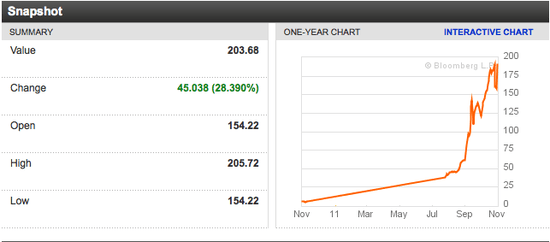
Greece's Prime Minister, George Papandreou, announced today a referendum on the bailout/austerity measures the EU is offering. Greek bonds have skyrocketed (above is a screenshot of the one-year Greek bond increase). Kevin Featherstone hits the panic button:

At the moment, we could be hours from the collapse of the Greek government. It’s never boring. Or if not hours, next days, couple of weeks. .?.?. At this moment, I’d say the odds that the Greek government survives are 50-50.

Paul Mason sounds equally dire:

[I]f Greece votes no – and goes for euro-exit – there are several plans in the process of being published that explain what you have to do. Close the banks for days, ration food and energy, institute strict capital controls – with most probably a few fast patrol boats at Glyfada harbour to check every departing yacht for cash and bonds.

Tyler Cowen thinks this is an attempt to kill the deal with the EU:

Make no mistake about it, the decision to hold a "referendum" is a decision to turn down the deal altogether. The referendum will never be held.  

Niamh Hardiman comes to the opposite conclusion:

Presumably Papandreou hopes to use the referendum as an educational device to show that only one answer, what we might think of as the technocratic one, is in fact possible – why else would he do it? But it’s a pretty high-risk strategy.

 Yglesias:

[A]ny realistic path to a solution will involve multiple rounds of decision-making, as one crisis after the other is staved off. Which is fine. At any given moment "consensus emerges at the last minute to alleviate the crisis" is more likely than the alternative. But there are so many iterations this whole thing will go through and so many different steps at which it could go wrong that the overall odds for success don’t seem really great to me.

John Cassidy:

Outside the euro zone, Greece could relaunch its old currency, the drachma, which would trade at a much lower rate than the euro, meaning its exports would be cheaper abroad. The country’s banking system would probably collapse—it’s pretty much a basket case already—inflation would rise, and there would be a period of chaos. But, relieved of its debts, the economy would eventually start growing again. At least that’s what happened to Argentina, which, back in 2002, defaulted on its debts and abandoned a one-to-one peg between the peso and the dollar.

 Kevin Drum summarizes the stakes:

If the Greek government falls, and a new government demands a better deal, it's unclear what will happen next. It could be a prelude to Greece exiting the euro in a decidedly non-orderly way, and if that happens there's no telling if the euro will survive. Stay tuned.

Henry Farrell ponders the broader European project. Kostas Kallergis goes in-depth on the insane domestic politics surrounding the referendum. Update from a reader in the financial sector:

Greek bonds have not skyrocketed – it’s Greek yields that are rising so rapidly (and the spreads on their credit default swaps). Greek bonds have been plummeting in price due to the turmoil over the government announcement today.

Where Marriage Is A Must

Anna Fields counters Kate Bolick's latest article on marriage and dating:

Because men are falling behind in their pay while women are powering ahead, [Bolick] concludes, many women are opting out of the whole marriage thing altogether. Well, I’m here to tell you, this may very well be the case in New York and Los Angeles, the land of the alpha woman. But here’s a dispatch from America—the real world, the red states—where marriage is not so much an option as a goal that’s hammered into women’s heads since birth. It doesn’t matter how successful you are in your career—or how unsuccessful your man is. If you’re not married, you’re a loser.

J. Bryan Lowder nods.

You Are Not The Lorax

Dave Roberts calls the above trailer "a rainbow-barf monstrosity":

What makes [The Lorax] unique is its overwhelmingly mournful tone. It is unusually long for a Dr. Seuss story, almost 60 pages, and only on the last two pages, in the last two short verses, is there a glimmer of light.

But it's not like the end of The Sneetches or The Grinch, where societies in conflict are healed. The mini-society the Once-ler started — a stand-in for industrial society? — ends in abject ruin, drained of all color and life. There is no redemption, only the faint promise that something might be learned, that the mistakes might be avoided next time. The Once-ler's story is an elegy…[the trailer] is just sappy, generic uplift, all about chasing your dreams and actualizing your inner self, the usual crap that's fed to suburban kids to keep their minds off outer-directed goals, social and political goals, goals like, oh, preventing corporations from cutting down all the trees. 

Who Started The Cain Story?

It could have been almost anyone:

In the case of Cain, there was probably an incentive for any of his rivals to have leaked the sexual harassment story. But as Kennedy notes, that’s also true for just about anyone in the Republican establishment, even those who aren’t aligned with a particular campaign, who have plenty of reason to believe that Cain would be a disaster for their party as its nominee. So there’s no shortage of suspects. And, of course, it’s always possible the story came from somewhere else entirely.