Pot Populism

Nick Gillespie and Matt Welch report from Seattle's Hempfest:

The government estimates about 23 million people use [marijuana] monthly, willing to live illegally rather than obey unjust laws. By becoming increasingly visible and outspoken, marijuana activists have pushed repeal much further than the most baked reformer would have thought possible in 1991. And they’ve done so largely by avoiding politicians and the two-party system, taking their message directly to voters. Along the way, they have provided a blueprint for any bloc of citizens who understand, at some deep and personal level, that the two major parties in this country are worse than useless when it comes to many essential questions of freedom.

Neuroscience And The Novel

Austin Allen believes that knowing more about our brains won't interfere with great characters:

Explaining a subjective state isn’t the same thing as expressing it. A neurologist may be able to tell you exactly what’s happening in his brain when he stares at autumn leaves, but he’s unlikely to describe them as “yellow, and black, and pale, and hectic red,” as Percy Shelley did. … A glut of the literal only sharpens our appetite for the metaphorical: “human kind / Cannot bear very much reality,” as T. S. Eliot put it. The day the brain is fully mapped, writers will find a way to turn it into a foreign country.

“This Is Not A Small Incident”

The killing of an alleged 28 Pakistani soldiers by NATO forces will surely take the alliance with Pakistan to an entirely new low. Details are currently murky, but the scale of the mistake is pretty clear:

“Even if the U.S. thinks Pakistan is an unreliable and undependable ally, how does it think such an incident will go down with public opinion in Pakistan?” asked Omar R. Quraishi, the opinion editor at The Express Tribune, an English-language daily in Karachi.“U.S. is funding civil society initiatives to the tune of millions of dollars, but attacks like this won’t help,” he said in an interview. “The U.S. should take more care.”

Imran Khan, an opposition politician who has recently experienced a surge in his public support, urged the Pakistani government to break its military alliance with the United States. “The time has come to leave America’s war,” Mr. Khan thundered while speaking at a political rally in Shujaabad in Punjab Province Saturday evening. “The attack was carried out by those for whom we have destroyed our own country,” he added, alluding to a popular perception here that Pakistan has suffered economically and in terms of human lives because of its partnership with the United States.

The Era Of Corporate Profit

1126-biz-CHARTSweb2

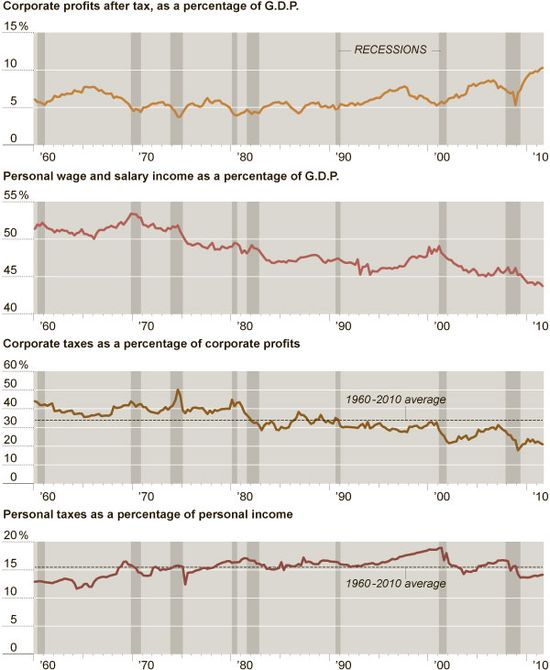
The graphs above need no more elaboration. What they show is that, at a time of soaring public debt, corporate and personal taxes are at historic lows, while wages are in the toilet but corporate profits, after tax, have never been as healthy as they currently are, as a share of the economy. Money quote from Floyd Norris:

Corporate profits after taxes were estimated to be $1.56 trillion, at an annual rate, during the quarter, or 10.3 percent of the size of the economy, up from 10.1 percent in the second quarter. Until 2010, the government had never reported even a single quarter in which the corporate share was as high as 9 percent, as can be seen in the accompanying charts.

The government began calculating the quarterly figures on corporate profits in 1947, but it has annual figures back to 1929. Until last year, the record annual share was 8.98 percent, set in 1929. For all of 2010, the figure was 9.56 percent.

Does this seem to you to be an era in which the president knows nothing about business and needs to get out of the way of the great American job-making machine by, er, cutting taxes even further? Or does it seem an era in which global corporations can make serious global money even when domestic workers are suffering, and where the obvious primary worry for any government would be the collapse of demand and risk of deflation at home?

I don't particularly like this set of facts; but what my ideology tells me should be put aside at all times by an engagement with reality. That reality suggests a country veering fast into two countries, and one party, the GOP, proposing to accelerate the shift. I'd lean on the rudder right now somewhat toward getting revenues from those currently enjoying a boom, while the rest try slowly to recover from excessive debt. Not because I hate the successful, or despise the wealthy. But because that's the obvious way to stabilize the polity and economy. 

And, you know, I'm a conservative in part because I like political stability. Pity today's Republicans have never seen a stable politics they didn't want to smash up.

Reading As Religion

Julia Jackson cherishes her communion with books:

Religion or spirituality (or whatever word you prefer) gives us another way to inhabit a person’s perspective. As much as religion is about connection to God (or whatever word you prefer), it is also about forging a connection to other human beings—how to act in a socially responsible way, how to discuss things that are Real or True, how to feel we are not doomed to die alone—which is why [author Gary Shteyngart] likened reading to a "quasi-spiritual experience." … When I read a real book, I am forcing myself to follow one stream of thought—that which the author committed to paper. In today’s world, this simple act is meditative, even transcendent.

When An Academic Body-Builds

Screen shot 2011-11-21 at 7.06.29 PM

What Lianne McTavish learned from the experience:

I was and remain more comfortable at the gym than at the university, likely because I refuse to disguise or reject my working-class background. Unlike the teaching, publishing, and administrative work that my career requires, bodybuilding is rooted in physical labor that is visible for all to see. According to the sociologist Pierre Bourdieu, bodybuilding is thus a working-class sport that privileges strength, endurance, and the spirit of sacrifice, whereas such bourgeois activities as golf and horse riding typically require early training and emphasize grace rather than muscularity. Whereas those arguably more upper-class sports ideally appear to be natural or effortless, I contend that bodybuilding is entirely unnatural and thrives on the display of effort.

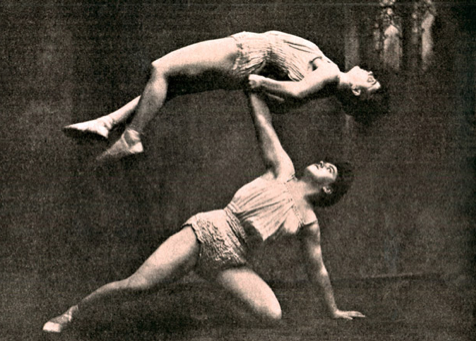
(Image from Venus With Biceps, a history of strongwomen reviewed by Maria Popova)