A supercut to be thankful for:
(Hat tip: Eliot Glazer)
A supercut to be thankful for:
(Hat tip: Eliot Glazer)
In a flowchart.
Shalom Auslander shares a meditation on spending the holidays with friends:
My wife and I are estranged from our families and have been for some time. I dislike the word "estrange"; we have not (as the Dictionary of Etymology explains of the word) been made strange, or foreign. We checked out. We ran. Furthermore, I don’t mind strangers, or foreigners; I could share a meal with either and not feel like I want to kill them. Or myself.
We did not, from the Latin extraneus, become external. We bailed. We jumped. We split.
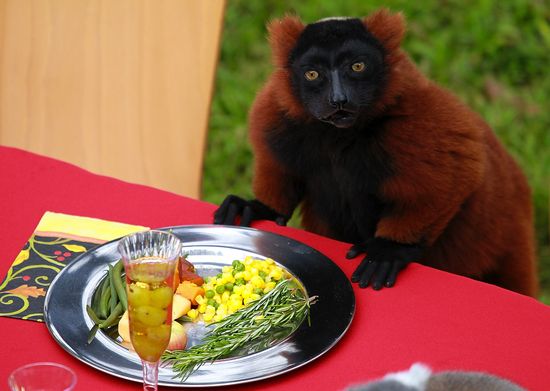
A Red Ruff Lemur enjoys a Thanksgiving meal at the San Francisco Zoo on November 23, 2011. Fifteen lemurs at the zoo were treated to a Thanksgiving feast of green beans, a fruit salad made up of apples, bananas, grapes sweet potatoes and a turkey made out of monkey chow. By Justin Sullivan/Getty Images.
According to an informal supermarket survey conducted by the American Farm Bureau Federation, your Thanksgiving meal now costs 13% more than last year's meal, averaging $49.20 for a family of ten:
This summer, poor weather shrank the crop yield as exports for beef and pork increased. Even so, many supermarkets are wary of passing along those costs to consumers. That mindset kept the food inflation rate at 0.8% last year, the slowest since 1962. But those days appear to be over. That rate has started to escalate as retail grocery prices rose 6.3% for the 12 months ending in September. Still, the Thanksgiving dinner averages out to $5 per person — plus leftovers! — an absolute bargain even in a time of rising food prices.
Along the same lines, Yglesias reports that the "retail price of a turkey is generally about 10 percent lower each November than it was the month before":
The fact that prices for certain goods fall during peak demand periods is actually well-known among economists who care about such things, and it applies beyond Thanksgiving. Harvey’s explanation for the price drop is the most orthodox: Retailers heavily discount key seasonal goods in order to get customers in the door, then make their profits selling sweet potatoes and cream of mushroom soup.
"The Gift Outright" by Robert Frost:
The land was ours before we were the land’s.She was our land more than a hundred yearsBefore we were her people. She was oursIn Massachusetts, in Virginia,But we were England’s, still colonials,Possessing what we still were unpossessed by,Possessed by what we now no more possessed.Something we were withholding made us weakUntil we found out that it was ourselvesWe were withholding from our land of living,And forthwith found salvation in surrender.Such as we were we gave ourselves outright(The deed of gift was many deeds of war)To the land vaguely realizing westward,But still unstoried, artless, unenhanced,Such as she was, such as she would become.
Adam Gopnik honors the turkey:
[T]he turkey has, like its country, known more glorious moments. Benjamin Franklin disliked the choice of the bald eagle as the national bird, and it was in a letter to his daughter, in 1784, that he proposed putting the turkey in its place. The eagle, Franklin points out, is "a bird of bad moral character. He does not get his living honestly. . . . He watches the labor of the fishing hawk; and when that diligent bird has at length taken a fish, and is bearing it to his nest for the support of his mate and young ones, the bald eagle pursues him, and takes it from him." Truly, a one-per-cent kind of bird. The turkey, however, represented to Franklin the best of bourgeois Philadelphia values. The turkey is not only a native; "He is besides, though a little vain and silly, a bird of courage, and would not hesitate to attack a grenadier of the British guards who should presume to invade his farm yard with a red coat on."
And then there's Gobbles.

To my amazing team of underbloggers: Patrick, Chris and Zoe and their underbloggers, Zack and Maisie. To be perfectly frank, the Dish would not exist without them. I would have been carted off on a stretcher by now. The last year – of transition to the Beast, while I grappled with intense health and immigration stress – was one in which they insisted on the importance of Dishness and interpreted and played with it on a daily basis. That the changes and shifts may seem seamless to many readers is a testament to how talented and dedicated and sometimes inspired the Dish team is.
Thanks too to the Beast, and their total support of our endeavor, their video team, their homepage team and the great fun of working with and for Barry Diller and Tina Brown and Stephen Colvin. It's been much more of a blast than I expected.
I'd also like to thank you for hanging in. Not every transition from one site to another goes as smoothly as ours did, and it's because you followed us. Indeed we saw our readership grow another steady 20 percent this year over last. But as you know, you do much more than add numbers to the traffic data. Your contributions, emails, corrections, testimonies, arguments, photographs, questions – all contributed anonymously and freely to the general world of ideas – are what makes this site unique. They bring it to life.
So thank you. On my first Thanksgiving as a permanent resident of the United States, thank you.
Courtesy of Mr Kimmel and Charlie Brown.
A reminder:
Jeffrey Froh, a professor of psychology at Hofstra University, did a study in which he asked a group of middle-schoolers to keep “gratitude journals” for two weeks. The kids wrote down a few things they were grateful for every day. A second group of kids wrote down the day’s petty annoyances, and a third group did neither. The students who were made to think about what they had to be grateful for experienced a surge in optimism and a decrease in negative feelings.
 The Dish