Raiding The Medical Marijuana Piggybank

Morgan Fox bemoans asset forfeiture laws:

Far too often in recent years, state-legal medical marijuana dispensaries have seen their locations raided by heavily armed agents who take anything of value (cash, computers, marijuana, confidential patient information), harass patients, and destroy anything they cannot take with them, yet do not file charges or find any evidence of state law violations.

Such smash-and-grab tactics are a direct threat to property rights and due process and have done much to erode respect for the rule of law. In addition, the proceeds of asset forfeiture provide incentives for law enforcement to actively work against marijuana policy reform, as, in their perception, it directly threatens their budgets.

Should Your Baby Share Your Bed?

A reader writes:

This likely will not be the only email you get on this subject,  but I thought a bit of background on that MilwaukeeHealth2majority areas of Milwaukee have been hit by something of an epidemic in the last few years of babies dying from unsafe sleeping.  There have already been ten deaths just in 2011.  Most of the time, the deaths are the result of babies being put to sleep on couches or in big beds surrounded by pillows.  Occasionally there is a crushing death due to an adult co-sleeping.  All of these deaths are completely preventable, and yet they seem to continue. 
Is that ad creepy and shocking?  Yes, but it is by design.  The public health community in Milwaukee is desperate to stem the tide (including my wife who is a pediatrician serving the affected population).  If this ad gets these young moms to think twice, it's worth a bit of creepiness.

A Milwaukee resident writes:

The mortality rate of black babies is at 14.1 for every 1,000 (compared to 5.4 for white babies) in Milwaukee. Co-sleeping deaths are a part of that statistic, so yeah, people need to be scared into not sleeping with their babies. Yes, the execution could have been better, but the people behind the campaign had their hearts in the right place. Infant mortality is at a crisis point in our city, and it's an issue that shouldn't be glibly dismissed as Copyranter did with their line of "…they die doing almost anything at that age!"

Barbara J King recently researched the arguments for and against co-sleeping:

The American Academy of Pediatricians (AAP) … advises that infants should always sleep on their backs and on a firm surface, and on the issue of co-sleeping, recommends that "the baby should sleep in the same room as the parents, but not in the same bed (room-sharing without bed-sharing)." The idea is that room-sharing embraces the benefit of close monitoring of the baby but avoids any risk of a parent inadvertently rolling over on the child. …

In a peer-reviewed article co-authored with Thomas McDade, McKenna describes research that includes videotape analysis of mother-infant pairs in his sleep lab. Because babies' brains at birth are neurologically immature, episodes of mutual arousal between mom and baby through the night can help regularize the infant's respiration. Some studies suggest that the risk of SIDS (Sudden Infant Death Syndrome) may be reduced by bed-sharing, though the debate on that point is ongoing.

Teen Mom Nation

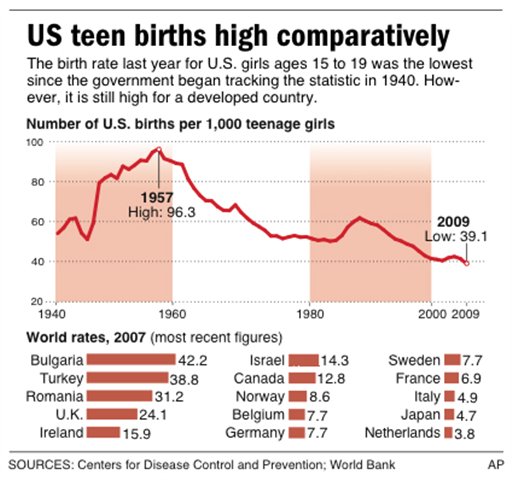
TEEN-BIRTHS-JPEG-1

Dana Goldstein puts the teen birth rate, which hit a record low last year, in context: 

The good news is that the American teen birth rate has steadily decreased over the past seventy years, despite year-to-year ups and downs. The bottom line, though, is that the United States remains an outlier not only on the teen birth rate but on teen pregnancy and abortion, too, which occur far more often here than in European nations. Clearly, our hot-potato reproductive rights debate isn’t solving these problems, which is just one of many good reasons why we should ratchet down the politicization of this public health issue and take a common sense prevention approach, one that accepts that over 95 percent of Americans have premarital sex.

Will The Defense Cuts Survive?

Spencer Ackerman is betting that the defense cuts triggered by Super Committee's failure will never be implemented:

Stopping sequestration probably won’t have to wait until the next election. Already, Republican legislators are preparing bills that will spare the Pentagon — now slated to spend $5 trillion over the next ten years, excluding war costs — the budget axe. “[M]ost of us will move heaven and earth to find an alternative that prevents a sequester from happening,” Rep. Michael Conoway, an Armed Services Committee member, told the New York Times. And it’s probably going to be one of the few bipartisan affairs left in Washington. 

Except Obama has promised to veto any attempts to defuse the trigger.

The Daily Wrap

Obama still matters
Today on the Dish, Andrew remained unrepentant in his support for the president, and he disproved the analysis of the Fox News Democrats. We unpacked the implications of the supercommittee's collapse, Derbyshire chastened Newt, and Andrew debunked the "Gingrich proposition." We thought through the Gingrich scenario, Newt condescended to OWS, and Americans foolishly invested in second and third chances. In our AAA video, Andrew explained why he's against military humanitarian interventionism.

Egypt was rocked by a second wave, Syrians stuck to the streets, and we looked to Jordan's growing protests. The task in Iran is containment, Iraq is not in terrible shape, and India's newspapers are flourishing

UC-Davis protesters shamed their Chancellor, Alexis faulted bad institutions, and we tackled homosexuality and Penn State. Victim Number One was punished, Scott Lemieux rewrote the history of Roe, and our justice system retained mind-boggling notions of fraud. State borders faded, freeways can get in the way, and recessions breed risk-averse management. We want people to leave, we were drawn to an approachable porn star, and a hearing on the Arctic National Wildlife Refuge got testy. A couple of law professors proposed a first-year rebate option, the study of intelligence was suppressed, and we reimagined sex ed. A reader argued that atheism is not a choice, we wondered if animals were capable of committing suicide, and hummingbirds did the wet-shake. 

Chart of the day here, quote for the day here, creepy ad watch here, eurozone "debt web" here, FOTD here, MHB here, VFYW here, and why we shouldn't forgive student loan debt here

M.A.  

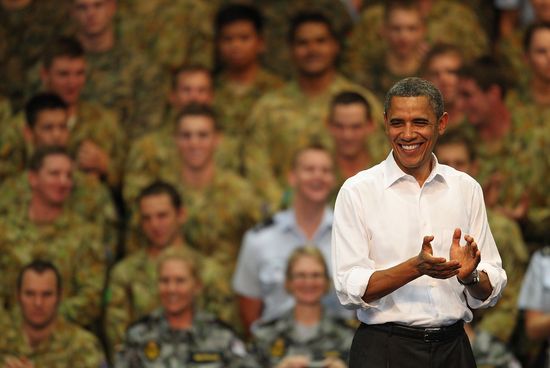
(Photo: Scott Barbour – Pool/Getty Images.)

Egypt Smolders

After this weekend's events, Marc Lynch re-emphasizes the need for "a speedy political transition to civilian rule":

I don't expect that the Tahrir fighting is going to spark a second popular revolution, but  I could easily be wrong.  The situtation is extremely turbulent, and things could change quickly, especially if the Muslim Brotherhood decides to join in. I will be looking for signs of a cascade of ordinary people joining the protests, which I'm not yet seeing in the reporting. But neither the SCAF nor the international community should take that as a sign that the crisis has passed.  As long as the SCAF continues along its current path, such chaos will be ready to ignite at any random spark.

Video from Issandr El Amrani.

End College Sports? Ctd

A reader writes:

With all due respect, claiming that Penn State should mark the end of college sports is borderline comical.  Katha Pollitt and George Will completely miss the boat on what college athletics means to the 98.5% who don't make it to the pros, from D-1 down to D-3.  The work on my jump shot got me into a better college than I could have without it.  Athletics, particularly in poorer communities, gives students an incentive to maintain and work in the classroom to maintain their eligibility.  Yes, there will always be outliers, but athletics gives people in the worst communities an out.

A student-athlete writes:

Collegiate athletics is as much a part of American heritage as any institution or religion. In essence, Pollit is arguing for the sterilization of American culture.  Something tells me Burke would not approve, even in the face of a horrific scandal.

Another reader:

If a high-school teacher is found to have been involved in child molestation and it turns out the principal may have had some knowledge of it and did nothing, should we disband secondary education in America? 

Pollitt's attack on college sports as a monolithic venture, with little distinction made between football and smaller, non-revenue sports such as tennis, field hockey or wrestling, raises serious questions about the article's seriousness and objectivity.  The corruption that she complains about may well infect football, basketball and perhaps baseball and hockey, but to tar these other athletes and coaches, who labor intensely for little recognition (or in the case of the coaches, pay) is insulting.

Pollitt notes that in no other country do people connect sports and education as we do.  This is true (I teach at a university in Belfast, Northern Ireland), but with very few exceptions they also feel nothing like the sort of affection for their various alma maters that Americans do, an affection that in many cases leads toward significant financial donations – not just to athletic departments, but to the university in general, allowing a financial stability that is making the American university system far more secure than many European universities during the current crisis.  There is little doubt that, like it or not, the obsession with college sports plays some role in this.

Another also looks abroad:

Pollitt says "sports is sports and education is education," and claims that "[i]f there was no scholarship incentive for those skills, the kids might not blow off their classes in favor of endless hours in the gym." Frankly, that's spoken like someone who has never loved playing a sport and aspired to greatness at it, and like someone who didn't do all that much research into the international examples she cites.

Pollitt points out that no other country has such a robust university-based sports system. She's right. What she ignores is that other sports-crazy nations have robust junior leagues for star athletes that enable them to blow off university altogether. As you're surely aware, the professional structure of English football goes WAY beyond the Premier League; the next seven tiers of the football pyramid (going down to the regional divisions) have a whopping 338 teams combined – dozens more professional or semi-pro minor league teams than baseball in the US (even counting all the independent semipro leagues), in a country one sixth the size of the US. (I know, I know, football dominates the sporting scene in England while baseball competes with several other major sports, but the point holds.)

The absence of athletic scholarships did not lead to more studious young athletes; it led to those athletes blowing off classes for endless hours in the gym actually playing professional sports, bypassing college altogether. If Pollitt is serious about eliminating college sports altogether, that's fine – but she's loony if she thinks that, magically, kids will choose books over balls.

So let's assume that's not actually what she meant, and she really means "let's eliminate scholarships for athletics." But that justification is weak both in theory and practice. In the American ideal, universities are about more than just what happens in the classroom; they are about a campus culture that provides a full day of educational and life experiences for students. On that score, an athlete is no less deserving of a scholarship than someone who brings academic honors to the institution, or a dancer or actor who contributes to its art scene, or any of the other myriad skills for which institutions may choose to award scholarships.

There is a different way, though. For decades, the Patriot League – a Division I league that includes the Naval Academy and West Point in all sports but football, and includes other notable institutions such as Lehigh, Lafayette, Holy Cross, and (in football) Georgetown – prohibited schools from offering athletic-only scholarships in its bylaws. Schools could still offer grants-in-aid packages that would cover the student/family portion of the financial aid package, but would still leave the student responsible for things like completing work-study programs. That policy has since been lifted, but that model would present a more graduated approach to mollifying Pollitt's concerns.