Face Of The Day

133864233

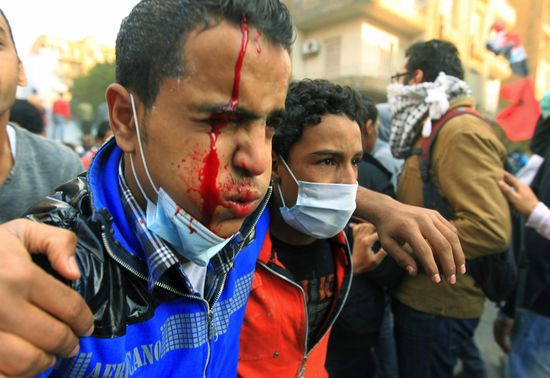
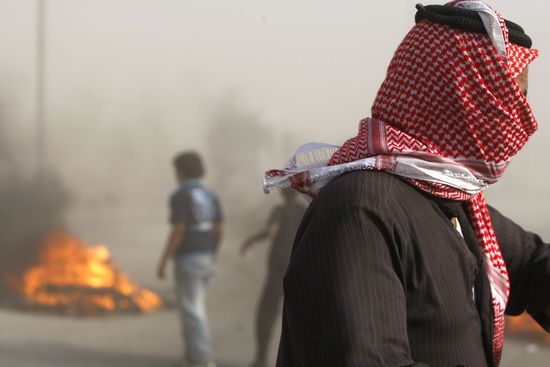
An injured Egyptian protester is helped away during clashes with security forces on the third day at Tahrir Square in Cairo on November 21, 2011. Fresh clashes erupted in Cairo's Tahrir Square between police and protesters demanding the end of army rule, as the ruling military council faced its worst crisis since Hosni Mubarak was toppled. By Khaled Desouki/AFP/Getty Images.

Should We Have Stayed Hunter-Gatherers? Ctd

A reader responds to the question:

No. "Is civilization good — in the long term — for planets and their capacity to support life?" Yes.  So far as we know, technological civilizations are the only way that our planet will be able to spread life outward to other planets that don't have any yet. We may not actually pull this miracle off, but hunter-gatherers don't have a chance.

Another reader:

Very provocative question indeed. From the point of view of a single intelligent species, civilization must, over the long term, be the best choice. Natural disasters, severe environmental changes, or (most likely) meteor strikes would, with eventual certainty, wipe out any species of hunter-gatherers. Only civilization offers the chance of avoiding or mitigating this type of disaster. If you wanted to take an even longer view – Adam Frank says "billions" of years, so let's go ahead with that – any hunter-gatherer species will last no longer than its parent star. Civilization offers the chance to deflect asteroids and, eventually, move to a younger star system. The tradeoff is the downside risk of fundamental unsustainability that was the point of the article.

Another:

We showed up late and we are nearly dead already. Life has been around for about 4 billion years – and it has about 1 billions years left. All living organisms, a collective "us", are 80% towards fulfilling, as Steve Jobs put it, life's greatest invention: death. The sun has a life cycle, and current estimates suggest as the sun's luminosity increases over time it will cook the earth, evaporating away all the water in about 1 billion years from now (see here). That will end all terrestrial life.

We want to be there to be cooked by the sun, rather than doing something collectively stupid and eliminating ourselves prematurely. Civilization allows us to do things that are collectively great, but also collectively stupid (vaccinations – great!; nuclear bombs – maybe not so smart). The opposite is true for living tribally as hunter-gatherers (no nuclear bombs – great!; no vaccines … hello small pox, maybe not so smart). Does one style of living really give us a better shot at being there to be roasted by the sun in 1 billion years?

Another looks backward:

The answer is: Who can say? But in all likelihood, it probably doesn't matter one way or the other. Billions of years ago there was an event called the Great Oxygenation Event or the Oxygen Catastrophe. Life had discovered how to produce energy at the cost of releasing oxygen into the environment. Unfortunately oxygen turned out to be toxic to nearly every other life form on the planet, causing vast swaths of death and extinction. It also changed the global climate, and the whole world irrevocably.

If you'll allow me to anthropomorphize for a second, we could imagine for a second our very, very distant single celled ancestors holding a debate about whether they had done the right thing by adopting photosynthesis as a way of life. What they might see around themselves is nothing but destruction of what was. On the other hand, if this event had not come to pass, the current environment that people are regretting the destruction of would never have existed, along with the people doing that regretting.

Regardless of our own actions, a billion years from now, every individual life form currently alive will be dead, and every species we care about will be extinct. The time between us and dinosaurs after all is measured in millions, not billions of years, to give one a perspective on the sort of changes that we might expect in that coming time period. We will have shaped what comes after, but will it have been the better or worse of the planet and its capacity to support life? Maybe not for the life we know and love now, but it's impossible to speak for the life that will exist then, any more than our oxygen-producing ancestors could have spoken to the quality of our environment.
Is Jordan Next?

GT_JORDAN_111117

Nicholas Pelham suggests so:

By regional standards the turnout of protesters has been puny. Few rallies attract more than five thousand demonstrators; many are attended by only a few score. It is possible to visit the capital and not hear their cries. East as well as West Bankers appear reluctant to join a movement whose slogans are openly seditious. But what the protests lack in numbers, they compensate for in tenacity and depth.

Taylor Luck examines the Kingdom's role in Syria's uprising.

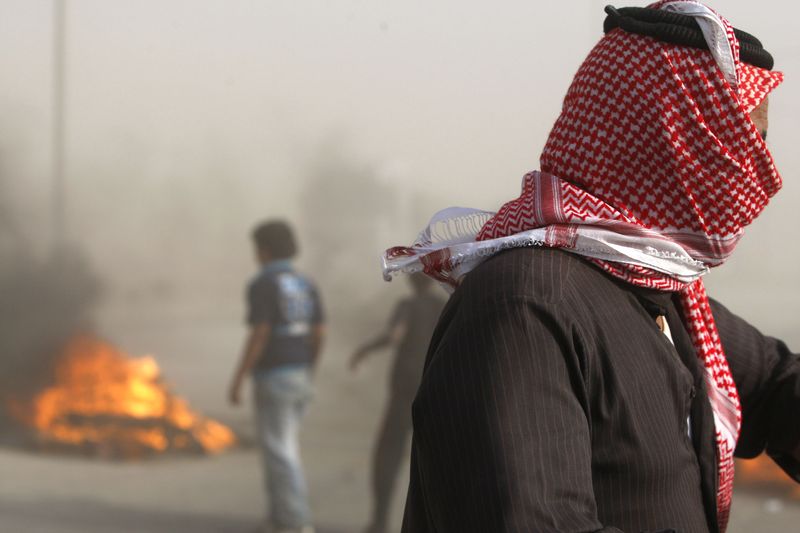
(Photo: Angry Jordanian protesters blockade Jordan's main highway a few kilometers south of Queen Alia Airport that links Amman and the north with all southern cities on October 12, 2011 in West Erainbeh, Jordan. By Salah Malkawi/Getty Images.)

Pay Some Students To Drop Out?

A couple of Yale Law professors make the case for a first-year rebate option:

Consider the innovative employment policy of the Internet shoe seller Zappos. At the end of a four-week training course, Zappos offers new employees a one-time offer of $3,000 to quit. In part, the company uses the offer as a screening device. If you’re the type who prefers a quick three grand to the opportunity to work at a great company, then Zappos isn’t the place for you. 

Law schools might analogously offer to rebate half of a student’s first-year tuition if the student opts to quit school at the end of the first year. (If the student has taken out government loans, this rebate would first go to repay this debt.)  A half-tuition rebate splits the loss of an aborted legal career between the school and the student. Each has skin in the game, so students will not go to law school lightly, and law schools will have better incentives not to admit students likely to fail.

Today In Syria

Warning: some extremely graphic footage:

As Assad's soldiers killed at least 14 today, tensions continue to rise with Turkey. A bus of Turkish citizens returning from the hajj were attacked by "unidentified gunman," [NYT] and Turkish President Abdullah Gul told the BBC that Syria required "fundamental reforms." The Arab League deadline for Assad to back down passed on Saturday, meaning that sanctions may be on their way, and the Syrian National Council previewed its own plan for a post-Assad Syria. Regime victim Abu Abdu explains what life in Syria is like in the meantime:

They are taking and raping girls and women. More than twenty people I know have been killed. I was trying to transport a friend who was wounded and they shot six bullets into our car. They like children, the snipers. Most of my friends who have been caught they disappeared or they come out tortured. If they see you carrying any medication or food you get shot or arrested. If they catch anybody, they torture you and give you a paper to memorize and then put them on television to confess.

But the threat of torture and sexual violence doesn't appear to be keeping these women off the streets of Homs today:

Homs was also home today to a funeral/protest:

And here's a video of a student gathering in the Damascus suburbs:

Can Animals Commit Suicide?

The jury is still out:

There is plenty of evidence that animals engage in self-destructive behavior. In addition to the beached whales, ducks and dogs have been observed drowning themselves, cows have walked off cliffs, and naked mole rats (like some insects) leave the colony to die when infected with a communicable disease. It’s not clear that any of these behaviors are comparable to human suicide, though, because suicide involves a set of higher-order cognitive abilities.

Is Atheism A Choice?

A reader writes:

In your post "Why Don't People Trust Atheists?", you quote Tom Rees: "I think there is a special feature of atheism that separates it from many other kinds of prejudice – and that's the fact that atheism is a choice." Most atheists, myself included, would argue that our atheism is not a choice. Many of us lost our belief in God not because we just decided, "Hey, I think I'll choose not to believe in God any longer."  Rather, the weight of the evidence against the existence of a deity as well as our life experiences led us, inevitably, to a point where we could no longer believe in God.  We did not choose to relinquish our faith any more than Christians choose not to believe in Zeus or Kali or any number of other non-Christian deities.  To borrow a phrase from William James, belief in God ceased to be a live option for us.

I have many atheist friends who deeply regret that they can no longer believe in God.  If belief in God were a choice, they would choose to believe in him.

Earlier thoughts on whether faith is choice here and here.

A Rotten System

Alexis Madrigal sympathizes with Lt. John Pike, who infamously pepper-sprayed UC-Davis students last Friday:

I see John Pike as a casualty of the system, too. Our police forces have enshrined a paradigm of protest policing that turns local cops into paramilitary forces. Let's not pretend that Pike is an independent bad actor. Too many incidents around the country attest to the widespread deployment of these tactics. If we vilify Pike, we let the institutions off way too easy. 

Gingrich’s Path To The Nomination

Gingrich

Ambinder ponders it:

[E]verything turns to South Carolina.  If the person who wins Iowa…say…Newt…wins South Carolina, then the party's conservative forces will seek to winnow the field quickly.  There's no question that everyone knows Newt's vulnerabilities.  But conservatives remember more indelibly, I think, the old Newt — the guy who invented the language that they use to run against Democrats…the guy who took on the Clintons in the 90s..  and this impression engenders considerable loyalty. 

Suddenly, he gets money. Suddenly, Florida becomes a race again. And the conservative movement gets to see whether they can beat the establishment forces…losing the race in 2008 but vowing to fight another year. With the right conservative candidate, the Mitt Romney coronation is not inevitable. Still likely? Yes. Inevitable? No. 

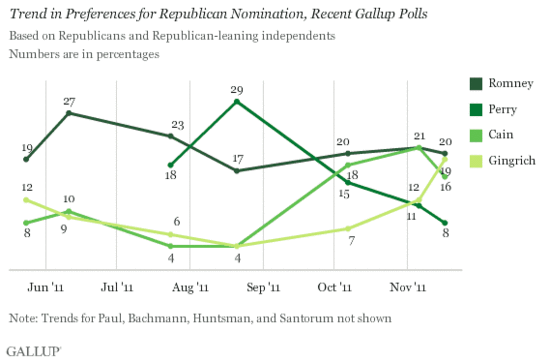
Chart from Gallup's latest poll. They note the volatility of the Republican race:

[T]he current contest stands to be the most competitive and perhaps most unpredictable for the Republican nomination since 1972, when the parties shifted the power to choose their presidential nominees away from party leaders at the national convention to the rank-and-file voters in state primaries and caucuses.

Jonathan Bernstein, on the other hand, claims that "Romney has an excellent chance of wrapping this thing up by New Year’s Day" because he's winning the endorsement race. Weigel expects Gingrich to go down in flames:

[T]here's strong evidence that we're catching Gingrich at the height of his late career popularity. Nobody's taken a swing at him in any real way for six months. (Mitt Romney delivered a slap on the health care mandate in the Vegas debate; that's about it.) Swing voters haven't paid attention to him, either. But Gingrich is the same guy that got demonized and hoisted by his petard 13 years ago.