The core appeal of an increasingly in-demand straight male porn star. There's also an interview with the scrawny dude with a big one here. Previous Dish coverage of the dude here.
Month: November 2011
Medical Marijuana’s Overwhelming Public Support
Full legalization still divides the country – largely by generations and gender (older folks and women are the most resistant). But support for the medical marijuana policy that the DEA is now targeting in Californa and elsewhere is massive:
[M]ore than three in four Americans think that doctors should be allowed to prescribe small amounts of marijuana for patients suffering from serious illnesses – the conditions for use that are set up in all of the states that have legalized medical marijuana programs. Support for this cuts across age, gender, region, and political affiliation.
And they do this despite believing that the strict criteria are routinely ignored. And so we have a basic and classically American position: legalize but prohibit it. Grant it medical but not sanction. Keep the fig leaf on, and let minorities pay the price.
Police Abuse On Parade, Ctd
A reader comments on the above video:
Here's a powerful example of how UC-Davis students harnessed the power of silence to shame their school Chancellor on Saturday night. Powerful stuff.
Xeni Jardin provides more details on the incident, including this report:
A pretty remarkable thing just happened. A press conference, scheduled for 2:00pm between the UC Davis Chancellor and police on campus, did not end at 2:30. Instead, a mass of Occupy Davis students and sympathizers mobilized outside, demanding to have their voice heard. After some initial confusion, UC Chancellor Linda Katehi refused to leave the building, attempting to give the media the impression that the students were somehow holding her hostage. A group of highly organized students formed a large gap for the chancellor to leave. They chanted "we are peaceful" and "just walk home," but nothing changed for several hours. Eventually student representatives convinced the chancellor to leave after telling their fellow students to sit down and lock arms.
Another reader:
I graduated from UC Davis in 2006. Over four years, my average tuition was $5,200. The students who were pepper sprayed pay $13,200 – $150 less than the best private university in the state, Stanford.* They deserve a fucking medal.
Another:
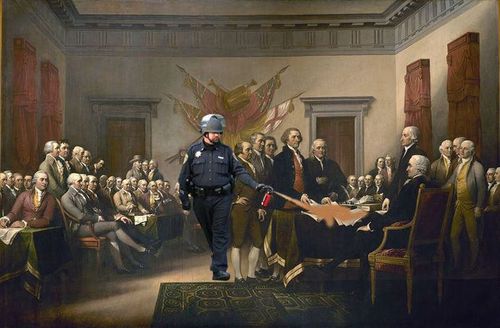
The thing that strikes me in the UC Davis video is the posture of Lieutenant John Pike, the man who directs pepper spray into the faces of those students at point blank range. Pike's visor is up and his manner is completely relaxed – this is not a man who is concerned about a threat of imminent violence against him. He looks like someone spraying a weed with Roundup.
Let's call the pepper spraying incident what it was: punishment. There was no threat of danger to the police. No, those students were punished by the police for refusing to obey. When they tried to protect themselves, the police ensured that they received the full dose of punishment, literally down their throats.
The thing is, punishment is a government act that is controlled by the Constitution. Three separate amendments in the Bill of Rights apply. Under the Fifth Amendment, government punishment cannot be meted out without "due process of law." The Sixth Amendment requires a fair trial before punishment. Under the Eighth Amendment, "cruel and unusual punishments" cannot be employed no matter what kind of "due process" is given. All of these Amendments apply to the Davis police force and Lieutenant John Pike through the Fourteenth Amendment, which applied these duties (and the First Amendment) to the states. This act was not just evil, but a violation of our most sacred Constitutional precepts.
The Davis police website even indicates that the force has a "Professional Standards Unit" that is required to "ensure the department complies with current law, community needs and industry standards." Of course, I don't think I'd get very far with that approach. The name directly above the description of the "Professional Standards Unit" is Lieutenant John Pike.
Another adds:
Apparently they had a "Civility Project" at UC Davis. Chancellor Katehi touted it on her blog last month. (Money quote: "We are a campus known for its civility and our commitment to respect, equality and freedom of expression runs deep.") I couldn't help noticing that she has a contact form on her website. I have made use of it.
*Update from a reader:
ANNUAL tuition at UC Davis: roughly $13,000. Tuition PER QUARTER (students take three per year) at Stanford: $13,000. Public college tuition has risen exponentially in recent years, but your reader's statement is off by a factor of three. If only Stanford were $13,000 a year…
(Illustration from Occupy Lulz via Xeni Jardin)
Quote For The Day
"The sad thing about the United States is that we get the government we deserve. And then, via deficit spending, we make our kids and grandkids pay for it," – Nick Gillespie on the super-committee's collapse. Yes, the sequestration cuts are nowhere near what's needed. And the fact that even they might not survive, given the GOP's dedication to a Cold War Offense budget rather than a post-Cold War Defense budget, is telling.
What Does The Super Committee’s Failure Mean?
Atrios doesn't understand why the $1.2 trillion dollar spending-cut trigger is worse than whatever the Super Committee might have dreamed up. It's worse because it's only a fraction of what needs to be done – and may not happen at all. Kevin Drum's spin:
Republicans got domestic spending cuts that were about as big as they really wanted. They know they'll never have to implement most of the defense cuts. And there are no tax increases. Given all that, why is anyone surprised that they were unwilling to seriously consider any alternative? Why should they when they already had what they wanted?
Ezra Klein worries about more than the debt:
The supercommittee was widely expected to extend the payroll tax cut and the expanded unemployment benefits. Those policies alone are expected to add 1-2 percentage points to growth next year. Some of the proposed deals included further stimulus measures like increased infrastructure spending, which would have given the economy a further boost. There was also talk of patching Medicare's payments to doctors and the Alternative Minimum Tax, neither of which is specifically a stimulus measure, but both of which would hurt the economy if allowed to expire now. The supercommittee's failure throws those deals into doubt.
Given the GOP's total opposition to any serious net revenue increases, this failure was predictable. It's also a wretched sign of the Republican willingness – indeed eagerness – to torpedo the entire economy to defeat Barack Obama. For me, the key test will be the effectiveness of the trigger, especially on defense. If the Congress rescinds its own promise to cut defense and entitlements through sequestration after this failure, they're telling the world we're the same as Greece: incapable of putting our fiscal house in order. The needless tragedy of this country's right-wing intransigence would become a dangerous farce.
Newt And The Base
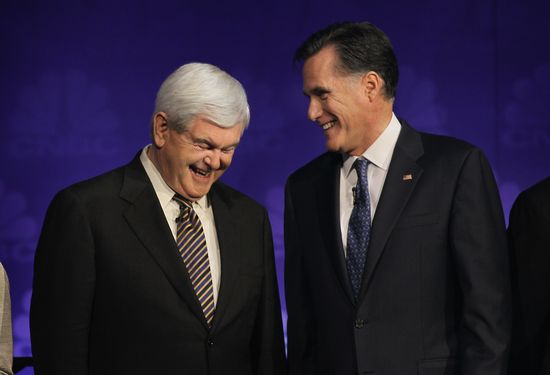
Bill Kristol is open to him:
Gingrich may not follow the Bachmann-Perry-Cain trajectory of rapid rise and rapid fall. He is a far more experienced national politician than they. He’s a familiar figure. It’s not as if, like Bachmann, he’s making a favorable first impression that will then be qualified, or, like Perry, that the idea of the candidate will be very different from the reality, or that, like Herman Cain, he seems a breath of fresh air. Voters who have warmed to Gingrich in the last few months could of course still have second thoughts, and his rise may stall and reverse. It would indeed be surprising if he doesn’t now hit some bumps in the road. But he could be formidable.
I can see the point against Romney. But formidable against Obama? Seriously? Obama’s current lead over Gingrich is 8.5 points, landslide territory. Newt must be one of the least likable human beings ever to run for public office. Katrina Trinko looks at his standing among social conservatives. The evangelical problem could be severe:
Land has been doing informal focus groups among Southern Baptists for the past two years on Gingrich’s candidacy, as he expected Gingrich to run and be a serious contender. He found that women are especially wary of Gingrich.
“He’s got a gender problem,” Land says. “His toughest audience is going to be evangelical women. Evangelical men, depending on what Newt does and says, are more likely to give him the benefit of the doubt.” Women, on the other hand, have told Land that they would vote for Gingrich “under no circumstances.” If the general election comes down to Gingrich and Obama, they say, they may just not vote.
(Photo: Scott Olson/Getty.)
Yglesias Award Nominee
"Newt’s chutzpah knows no bounds, though. Back during the 2008 presidential campaign, he told a Fox News interviewer that then-Senator Obama ought to return contributions he had received from Freddie Mac and its sister racket, Fannie Mae. Just last year Newt brought out a campaign book in which he argued for getting rid of Freddie Mac and Fannie Mae. Now here he is in Iowa this week defending Freddie Mac. Quote: “Every American should be interested in expanding housing opportunities" …
As a conservative Republican, I’d reply that every American should be interested in getting government out of activities where it has no legitimate function, and that would include mortgage lending to home buyers. The phrase “expanding housing opportunities” is pure Democrat-speak, the kind of phrase that drops naturally from the lips of a Pelosi or a Barney Frank. It has no place in the vocabulary of a Republican," – John Derbyshire.
Ask Me Anything: Should US Soldiers Ever Be Humanitarians?
Iran Isn’t Building A Bomb?
Seymour Hersh has doubts about the existence of Iran’s nuclear program:
A nuanced assessment of the I.A.E.A. report was published by the Arms Control Association (A.C.A.), a nonprofit whose mission is to encourage public support for effective arms control. The A.C.A. noted that the I.A.E.A. did “reinforce what the nonproliferation community has recognized for some times: that Iran engaged in various nuclear weapons development activities until 2003, then stopped many of them, but continued others.” (The American intelligence community reached the same conclusion in a still classified 2007 estimate.) The I.A.E.A.’s report “suggests,” the A.C.A. paper said, that Iran “is working to shorten the timeframe to build the bomb once and if it makes that decision. But it remains apparent that a nuclear-armed Iran is still not imminent nor is it inevitable.” Greg Thielmann, a former State Department and Senate Intelligence Committee analyst who was one of the authors of the A.C.A. assessment, told me, “There is troubling evidence suggesting that studies are still going on, but there is nothing that indicates that Iran is really building a bomb.” He added, “Those who want to drum up support for a bombing attack on Iran sort of aggressively misrepresented the report.”
Why not the Japan option … of having the technology to quickly make a nuke but not actually taking that step? It always seemed to me the obvious best choice for the Iranian regime. My own view is that we should assume that at some point in the future, Iran will have a de facto nuclear bomb capacity, even if they are smart enough to pull a Japan. The task is then an obvious one, not the radical and recently disastrous policy of pre-emptive war, but that classic and successful American policy: containment. From my paywalled column yesterday:
It seems to me inevitable that at some point, a country as advanced as Iran that wants to get a nuclear capacity will get one. That capacity, to borrow George Kennan’s words, will not be “charmed or talked out of existence”. It is not a matter of if but when. And history suggests it would not be catastrophic. In fact, a region with two nuclear powers facing off against each other is more stable than one country with a monopoly of nuclear force. The only time a nuclear bomb has ever been used was when only one country had it. The task, therefore, should not be the truly dangerous bid to prevent a nuclear weapon from ever being developed by Iran, but a containment strategy to prevent its ever being used.
Reuel Marc Gerecht and Mark Dubowitz see a new way to enforce more damaging sanctions without harming ourselves or the Iranian people:
Effective energy sanctions don’t have to raise oil prices; they can actually do the opposite. Washington just has to learn how to leverage greed.
We should bar from operating in the United States any European and most Asian energy companies that deal in Iranian oil and work with the Iranian central bank, Revolutionary Guards or National Oil Company. At the same time, however, we should allow companies from countries that have little interest in Iran’s nuclear program, or its pro-democracy Green Movement, and that are willing to risk their access to American markets — mainly Chinese companies — to continue buying Iranian crude in whatever quantity they desire. This would reduce the number of buyers of Iranian petroleum, without reducing the quantity of oil on the market. With fewer buyers to compete with, the Chinese companies would have significant negotiating leverage with which to extract discounts from Tehran. The government could lose out on tens of billions of dollars in oil revenue, loosening its hold on power.
But where I differ from Gerecht, Dubowitz and Obama is the intolerability of an Iranian nuclear weapon. It’s a horrible option, but not a doomsday scenario. If Israel were to initiate such a pre-emptive global war, I think its long-term survival would be highly unlikely.
Apologies
The Dish was down for quite a while this morning, and we are still struggling to get posts up. Our blogging platform, Typepad, went belly-up and we couldn't do anything about it. Things look better now.
 The Dish