"They take over a public park they didn’t pay for, to go nearby to use bathrooms they didn’t pay for, to beg for food from places they they don’t want to pay for, to obstruct those who are going to work to pay the taxes to sustain the bathrooms and to sustain the park so that they can self-righteously explain that they are the paragons of virtue to which we owe everything… Go get a job. Right after you take a bath,” – Newt Gingrich.
Month: November 2011
The Schoen-Caddell Two-Step
Doug Schoen and Pat Caddell are the Fox News Democrats and are about as representative of Democrats as a whole as Mickey Kaus. But note one thing about their analysis: it puts the entire blame on Obama for the current fiscal and political impasse and none on the GOP; and its logic would merely reward Republicans for total obstructionism. Money quote:
One year ago in these pages, we warned that if President Obama continued down his overly partisan road, the nation would be "guaranteed two years of political gridlock at a time when we can ill afford it." The result has been exactly as we predicted: stalemate in Washington, fights over the debt ceiling, an inability to tackle the debt and deficit, and paralysis exacerbating market turmoil and economic decline.
Now ask yourself for a minute: who, outside Fox News contributors, genuinely believe that the polarization we are now experiencing is a direct result of president Obama rather than the Republicans? The polling shows the public believes Obama has been readier to compromise. To put the entire blame for polarization on Obama – at a time when the GOP has refused any net revenue increases at all – is insane. Note also this misleading claim:
President Obama is now neck and neck with a generic Republican challenger in the latest Real Clear Politics 2012 General Election Average (43.8%-43.%).
And at 9 percent unemployment and the worst recession since the 1930s, this is bad? Even Rasmussen shows him besting a generic Republican. And he's showing new life: In this month alone, Obama has gone from 3 points behind to one point ahead in the RCP poll of polls. But even '90s neo-libs like Scoen and Caddell know that with structural unemployment, a draw like this shows remarkable candidate strength, not weakness. And when you look at the more specific polling, you find that Obama beats every single GOP nominee right now. His lead is 1.4 percent over Romney, 8.5 percent over Gingrich and 9 percent against Cain and Perry. A president with 9 percent unemployment leading most GOP rivals by 8 points or more is not a lame duck by any means.
Schoen and Caddell suffer from the post-traumatic stress disorder of the 1990s Democrats.
Convinced they can never win on what they believe in, they always stress capitulation either to Republican orthodoxy, or to Republican will-power. And they actually seem to believe that the hard right – from Limbaugh to Levin, from Krauthammer to Kristol – would not return to the Clinton demonization of the 1990s. Do either of them remember what was said and done about her last time around?
The answer is not to cave to GOP demands that the only group not to sacrifice in the coming austerity should be the very wealthy and successful; it is to make the case for balanced sacrifice, including serious entitlement and defense cuts and an overhaul of the tax code to remove almost all deductions. Obama can and should run on this blend. And polls suggest it is overwhelmigly more popular than a debt-reduction that would represent another gift from young to old and from poor to super-rich.
Where Print Is Still King
The Economist surveys India's anachronistic media landscape, "the world's fastest-growing newspaper market":
Indian papers, which cost as little as 7 cents, make money while their western counterparts struggle to survive. … The primary reason is that in India, print commands a whopping 47% share of advertising spend (as compared to under 15% in America), a perennial revenue source which covers all cost.
Why Mobility Matters
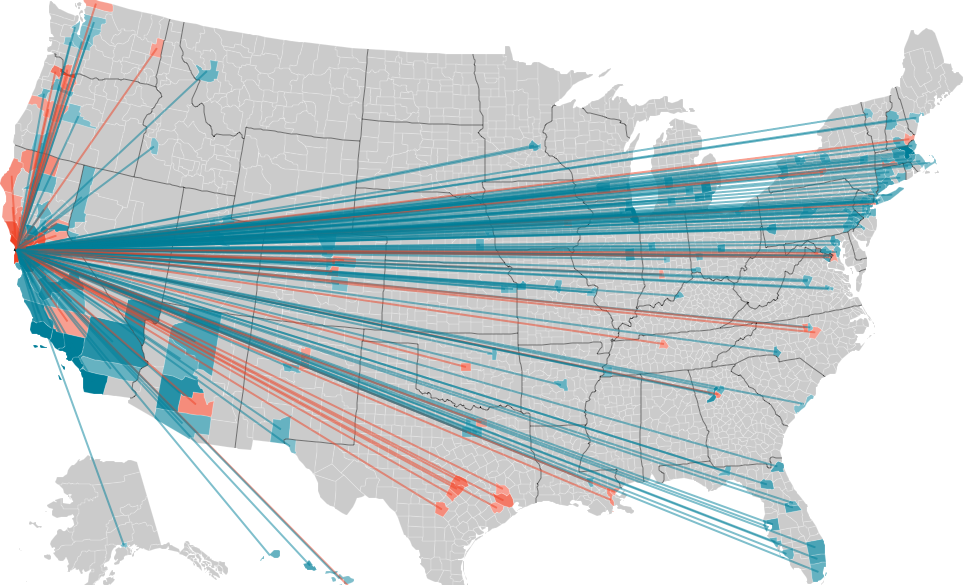
Paul Kedrosky champions it:
We want people to leave. We want cities and counties to constantly re-sort, to react adaptively, almost biologically, to changing economic conditions. The best way for that to happen is for there to be large population flux—inbound and outbound—and generally more people leaving than staying.
Mobility creates flux, and that drives energy and human collisions. The result is vibrancy, entrepreneurship and economic energy, or the lack thereof. Mobility is the economic social network that matters.
(Map of San Francisco county where blue lines represent inbound migration and red lines, outbound migration. You can adjust Forbes' interactive map here.)
An Uneven Justice
Anita McLemore lied about past drug convictions in order to get food stamps for her two children. She paid back the $4,367 she received but is still being sentenced to three years in jail. Matt Taibbi fumes:
You get busted for drugs in this country, and it turns out you can make yourself ineligible to receive food stamps. But you can be a serial fraud offender like Citigroup, which has repeatedly been dragged into court for the same offenses and has repeatedly ignored court injunctions to abstain from fraud, and this does not make you ineligible to receive $45 billion in bailouts and other forms of federal assistance.
What Hummingbirds Share With Dogs
The wet-shake:
Krulwich is awed by a new paper's findings:
The Anna's hummingbird whips its head back and forth 202 degrees — which is more than half way around — at the amazing rate of 132 times every second, and not while standing in place, legs on the ground like a dog or a deer. No, it does this while flying through the air! So it's shaking, navigating AND flapping at the same time.
Why it's important:
A little drop of rainwater is a heavy burden when you only weigh an eighth of an ounce. If you can't flick it off, you'll either need a lot of extra calories or you'd better hide on rainy days (and starve, because Anna hummingbirds live in cloud forests.)
Are Borders Obsolete?
Tim De Chant considers state lines:
Obvious examples of their obsolescence abound: The New York metropolitan area has grown to encompass counties in four states. Kansas City is really two different municipalities divided by the Missouri-Kansas border. Chicago's Metra commuter rail stretches into neighboring Wisconsin, just as Washington, D.C.'s Metro trains and buses collect riders from Maryland and Virginia.
He cites a recent study examining which borders actually matter. Researchers used bill tracking data from the website Where's George:
Though there are 48 states, the researchers found evidence of only about 12 distinct regions. The Midwest remained largely in tact, as does New England. But Pennsylvania was split in two by the Appalachian Mountains, while the southern half of Georgia was given over to Florida (which in turn lost part of its panhandle to a new Gulf shores region). And as far as Where’s George data is concerned, most of the western United States is indistinguishable.
Creepy Ad Watch

Copyranter gets the willies:
Nothing like scaring the absolute poop out of people about SIDS. Prints ads via the city of Milwaukee targeting—judging by the copy—poor parents about the danger of sleeping with their babies. Well, I know next to nothing about caring for a baby (as I hate kids), but I DO know that babies die sleeping in cribs, too. In fact, they die doing almost anything at that age! Another thing I do know is that that headline is very awkward. The ad agency here is Serve Marketing, a "cause" agency that has a track record of doing awards-bait "shocking" ads like these very creepy statutory rape ads.
Recession-Era CEOs
A new study finds that managers who start working during down times rise through the ranks faster but tend to be more risk-averse:
Managers with a more conservative style are perhaps more likely to be promoted, and less likely to switch business and industries, which explains their faster rise to the top. This risk-aversion, however, could also keep them from bigger companies, and bigger salaries. The authors point out that companies should strive to have a mix of both recession and boom-beginning managers: "If the majority of existing managers are brought up in a boom time there might be a net shortage of managers who know how to manage in a recession once the economic outlook changes."
Do Freeways Deter Development?
Diana Lind wants to demolish aging freeways. Andrew Nusca summarizes her argument with an illustrative example:
After the 1989 Loma Prieta earthquake, the city of San Francisco faced the tremendous task of rebuilding the structurally-damaged Embarcadero Freeway. Instead, they tore it down, replaced it with a people-friendly boulevard that encouraged development. The surrounding area has since rebounded, Lind said, with higher property values, more tourism and more housing for city residents.
Timothy B Lee wants freeways judged on a case-by-case basis. He looks to Philly:
The really disruptive freeways are the ones that divide urban neighborhoods from one another. Philadelphia’s Vine Street Expressway, a below-grade freeway which provides East-West traffic through the heart of downtown Philadelphia, is a good example. Not only does it damage the fabric of urban life north of downtown, but its chronic congestion means that it’s often not much faster than driving on ordinary city streets.
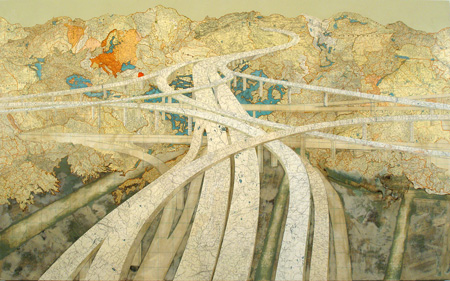
(Image: "Course of Empire" by Matthew Cusick via Web Urbanist)
 The Dish