Why Don’t We Have Apprentices?

Steven Brint compares the US to Germany:

Students in Germany are trained for a particular occupation, and they cannot easily move to a new one. Our approach has been to say "it's never too late" to move up the ladder with a higher-level credential. We are long on second and third chances, and anxious about "forcing" students to commit to a particular line of work. Our system is one that provides opportunity to obtain credentials, but lacks responsibility for employment. This is expensive and wasteful, but it is also optimistic in a cockeyed way.

Is The Internet Awake?

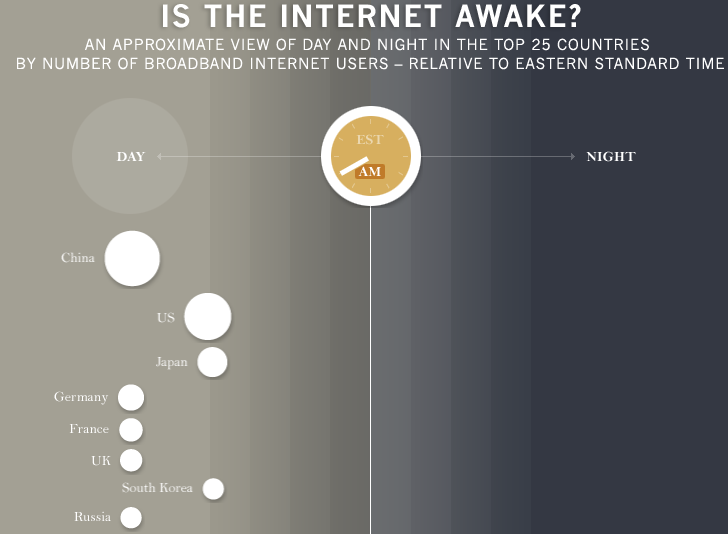
Screen shot 2011-11-17 at 3.14.13 PM

Creator Bård Edlund explains:

The further a circle is to the left, the more certain it is that most citizens in the country it represents are awake. The opposite is true for the right/night side. If you're wondering when to tweet your most brilliant thoughts in order to maximize International exposure, it looks like 9am EST or thereabouts is a pretty good bet!

The above graphic is only a screenshot. Click here to see the circles in motion.

Motherese

In a review of Sarah Blaffer Hrdy's Mothers and Others: The Evolutionary Origins of Mutual Understanding, Melvin Konner stumbles upon this gem:

Of all the calls, hoots, and screeches issued by our chimpanzee relatives, the only ones that sound a little like human speech are the coos exchanged in quiet moods by mothers with their young; the first language may have been “motherese.”

Faces Of The Day

451370009

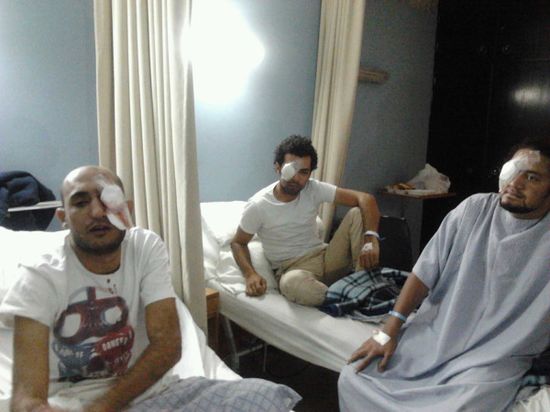
An Egyptian reader writes:

I thought I should share this photo with you. From right to left: @Malek activist and blogger (injured yesterday), @AhmedFatah photo-journalist for Al-Masry Al-Youm daily newspaper (injured yesterday), and Ahmed ElBardesi, a dentist who lost his right eye on Jan 28 and lost his left eye yesterday in Tahrir Sq. The number of eye injuries have alarmingly high and unusual.

Security forces has been accused of targeting activists and journalists. On Twitter, people have been advising each other to turn off the location feature in fear that they're being tracked by security forces. Here's a tweet yesterday from Yosri Fouda, a well-respected journalist (BBC, AlJazeera, now ONTV) who suspended his TV show protesting pressures from SCAF to silence criticism: "Injury of 10 media people, the arrest of 2, and the Press Syndicate confirm that they're being targeted on purpose. No honorable person is afraid from a Pen or a Camera"

Inside A Death House

Werner Herzog explains what it's like to be with those on death row, the subject of his new documentary, Into The Abyss:  

What distinguishes death-row inmates, and what makes their perspective unique, is that they know exactly how they will die and exactly when they will die, and we do not. That makes the conversation so intense, but it’s very much about us as well. Secretly, it’s about us.

He elaborates in another interview:

The inmates are housed at Polunsky Unit in Livingston, Texas, but Polunsky Unit doesn’t have a death house. So they transport them forty-three miles to Huntsville, to Walls Unit. And many of them for a decade or more have never seen the world out there any more. … [One inmate who got a stay on his execution] tells me about his last trip, seeing the world there, all of a sudden everything is magnificent. It’s a glorious world out there. And when you do this trip, which I did, actually with a camera, these forty-three miles, it’s very bleak, it’s very forlorn part of Texas. And yet all of a sudden an abandoned gas station is magnificent. What he says, it resonates in me wherever I am looking around. For him this was Israel, it was like the Holy Land.

Intragalactic Ethics

Ronald Bailey ponders our responsibility in exploring other planets:

[O]ne chief reason [to avoid human contamination of new planets] is to prevent inadvertent contamination by Earth microbes from being mistaken as evidence for the existence of extraterrestrial life. But do we have an ethical obligation to prevent harm that might be caused by Terran life to extraterrestrial life? Even more broadly, do we have the right to change the environments of other worlds even if they do not contain any living organisms?

Josh Rothman weighs the arguments:

About these questions, moral philosophers disagree. There's a long pro-terraforming tradition (especially among philosophically inclined science-fiction readers): Turning a lifeless place into an inhabitable one seems like a noble goal. Meanwhile, others argue that we have a moral, and possibly even an aesthetic, obligation to leave extraterrestrial life untouched. 

A Chaplain For Atheist Soldiers?

GT_SOLDIERPRAYER_111116

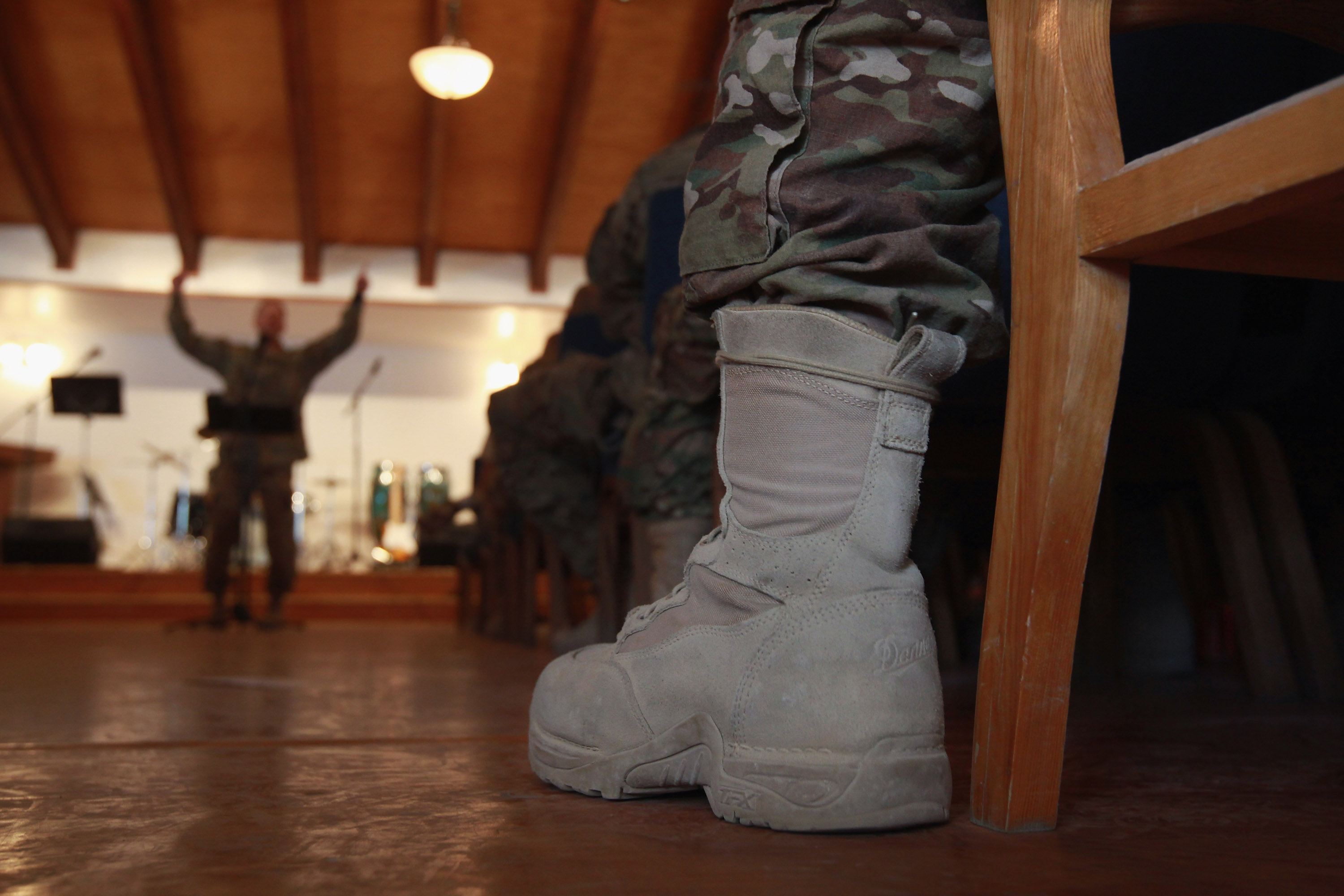
Capt. Ryan Jean is one of a dozen seeking Army recognition as a humanist lay leader, similar to (but more unofficial than) a military chaplain. Jean explains why recognition is important:

It shows that we are a community with real needs. It shows that the chaplaincy by its very nature is not meeting those needs — and, I would argue, is inherently incapable of properly meeting those needs without some sort of liaison.

Craig James is up in arms about a Fox News segment featuring Father Jonathan Morris, an Army Chaplain who ridiculed the idea:

The Chaplains in our military are the first and best resource that these young soldiers turn to for help when faced with the awful reality of war. Yet Father Jonathan Morris seems to think that atheist and agnostic soldiers don’t deserve the critical services of a chaplain.

On a related note, Jennifer Rizzo  tells the story of a recent soldier almost pulled from graduation for refusing to bow his head in prayer.

(Photo: Protestant U.S. Army chaplain Brian Chepey leads prayers on September 11, 2011 at Bagram Air Field, Afghanistan. By John Moore/Getty Images.)         
How Quickly Can Nations Advance?

 Very, if South Korea is any indication: 

Life has gotten much better for Koreans as the country has gone from 28 percent urban in 1961 to 83 percent today. Life expectancy has increased from 51 years to 79—a year longer than for Americans. Korean boys now grow six inches taller than they used to. South Korea's experience can't be easily copied, but it does prove that a poor country can urbanize successfully and incredibly fast. 

Mental Health Break

A stunning year-long timelapse:

The YouTube caption:

This is a year-long time-lapse study of the sky. A camera installed on the roof of the Exploratorium museum in San Francisco captured an image of the sky every 10 secobnds. From these images, I created a mosaic of time-lapse movies, each showing a single day. The days are arranged in chronological order. My intent was to reveal the patterns of light and weather over the course of a year.

(Hat tip: Kottke)

Questions Neuroscience Can’t Answer

Another promising antidepressant bit the dust this week. Jonah Lehrer reports on why we still haven't figured out a cure:

Pharmaceutical failures like this are a sobering reminder that the brain and its afflictions remain deeply mysterious. Despite the billions of dollars poured into depression research, we still don’t understand the causal mechanisms of the illness, which means we don’t even know which drug actions to screen for. We can’t even imitate our past successes. … So how does Prozac work? The sad answer is that we’re still not sure. And that means we don’t know how to come up with something better.