Von Hoffmann Award Nominee

"America is beginning the process of electing another Texan to be president.  … Perry's coyote-killer good looks, $2,000 hand-tooled cowboy boots, supernova smile and Armani suits, combined with podium skills to embellish the mythology of Texas, all will create a product Americans will want to believe and buy," – James C. Moore, August 11th, 2011.

Dish award definitions here.

(Hat tip: PM Carpenter)

What’s Next For Europe?

McArdle panics:

I am very much afraid that the euro zone is about to plunge us into phase two of the global financial crisis–and that as with the Great Depression, phase two may be even worse than the dismal years we've just endured.    

Krugman explains how Italy committed an economic mistake usually reserved for developing nations. And Tyler Cowen says austerity can't save Italy:

The only answer, if that is the right word, is a central bank.  Right now central banks need to be doing everything they can to avoid a second Great Depression.  I talk to many smart people, and I am continually surprised how many of them do not realize the urgency of the current situation.

But the European Central Bank doesn't sound very eager to act. J.O. at Free Exchange imagines what would happen if Italy exited the Euro:

It would be a gigantic financial shockwave. Once departure by Italy were a serious prospect, there would be runs on its banks as depositors scrambled to move savings to Germany, Luxembourg or Britain, in order to avoid a forced conversion into the new weaker currency. The anticipated write-down of private and public debts, much of which is held outside Italy, would threaten bankruptcy of Europe's integrated banking system.

Zachary Karabell tells everyone to chill:

We are now in a period of adjusting the reality of ever-present risk that the financial world, connected globally and electronically without circuit breakers, might fail. One day it is Greece, today it is Italy, and tomorrow it may be France or the United States—or Iran. We will over time learn to treat those risks with greater equanimity. For now, we at least need to stop and realize that Italy is a rich and vibrant society; a land of immense beauty and culture, with a fair number of viable and supremely successful industries. But is not the hinge of global prosperity; it matters, but not that much.

Does Our Tax Code Push Jobs Overseas?

A reader quotes me:

But the notion that under any tax code, American workers can compete with Indians and Chinese earning one tenth of the salaries is bizarre. Cain jumped his own shark here a bit.

Cain knows more about this than you do.  The US has a tax of 35% of a corporation's net income, which is about the highest in the developed world.  American workers not only can but do compete with Indians and Chinese every day, because productivity per workers isn't the same in all countries.  In some cases American workers win, in other cases they don't.  The 35% tax incentivizes multinational companies to operate from low tax countries.  Do some research as to why Microsoft has such a large presence in Ireland.  It isn't because labor is 1/10 as costly in Ireland than in Seattle.

One fact that should be noted: many companies do not pay anywhere near 35 percent. Another reader:

I wouldn't be so sure to discount Cain on this. I identify as a progressive and so would be generally inclined to agree with your statement, but I also work for a tech firm that outsourced most of its employees about a decade ago (currently 90% of employees are in Asia).

I wasn't with them at the time, and this is anecdotal, but I've had a number of frank discussions with one of my managers, who was instrumental in moving manufacturing overseas at that time. He said that taxes were the primary reason. Paraphrasing: sure, they could hire employees over there for maybe 1/3 the cost, but they were also hiring a bunch of people who didn't know how to do anything, and would often end up hiring three times as many people to do the same thing. It was by negotiating a tax free/tax minimal status with the Southeast Asian country that made the move highly profitable. Eliminating these taxes resulted in an additional 20% to 30% profit, which is Huge.

I myself am personally opposed to this sort of outsourcing, and don't think eliminating corporate taxes is a solution, but I think it's important to try and understand the financial pressures involved.

The Epistemic Closure Candidate

GT_CAIN_111110

T.A. Frank profiles Cain in this weekend's NYT Magazine:

"I can honestly say that if I hadn’t been on the radio, I wouldn’t have been as familiar with the issues as I am now," Cain has written. "I believe that having that program was God’s way of forcing me to understand the critical issues confronting our nation." In short, Cain’s briefings on politics came from heated right-wing callers on talk radio. "Epistemic closure" is probably too mild a term for such conditions.

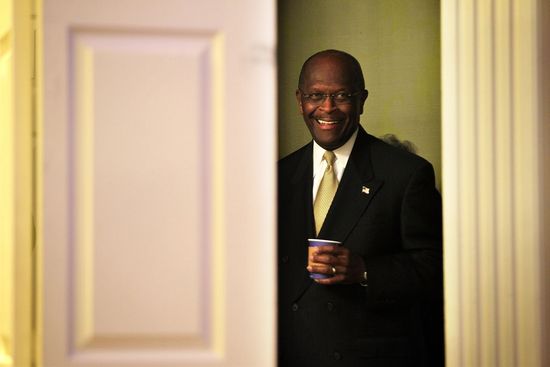
(Photo: Republican presidential candidate Herman Cain waits to be introduced prior to his address to the Northern Virginia Technology Council and the Consumer Electronic Association on jobs, the economy and American competitiveness on November 2, 2011 in McLean, Virginia. By Alex Wong/Getty Images)

In Defense Of “Classical Studies” Ctd

A reader writes:

I have to respectfully disagree with your assertion that "the main reason for a classical education is precisely its uselessness". I majored in history, with a heavy focus in ancient and Medieval Europe, and I wish I could cop to even the content being useless, but I just can't. I draw on the lessons of history every day when interpreting current events. I roll my eyes at people comparing America's "empire" to that of Rome (we're really a lot closer to the Delian League – Athens' economic empire that thrived in the 5th century). I look at today's rising inequality and I see traces of the Roman inequality that destroyed a Republic in the span of a century.

But the most useful part of majoring in history wasn't learning history; it was learning how to learn and how to understand things.

It was learning how to take a complete jumble of names, dates, places, facts, ideas, conjecture, and so on and build from it a stable, mostly-consistent picture of what really happened. It's a skill that, quite frankly, has formed the backbone of my career. Useless? Hardly. But it's the kind of learning that defies easy quantification.

Another writes:

You are missing the point. The question isn't whether classical studies are valuable. The question is whether they justify their cost. We've been programmed to believe that a college education is a ticket to the middle class regardless of the cost. But that's wrong. Would you pay $50k for a philosophy degree? $100k? $500k? At some point, that answer becomes "no".

The problem isn't that classical studies aren't valuable – quite the contrary. But the real issue is that no one knows how valuable. It would be a great boon for society if we could place a dollar value (perhaps tied to future earnings) on various college degrees. That way people could make informed decisions on whether or not the tuition was worth it. People should be able to decide for themselves whether a classics degree is a good fit for them, financially speaking.

Another:

I've had several positions during my working life where I have had the opportunity, or burden, of wading through resumes at either the first or second stage of the hiring process for a new position.  Some of the positions have required no more than a high-school education, some a two-year degree, others a four-year degree.  

No one should be fooled by those who dismiss higher education, especially in the liberal arts.  Those students with a strong liberal arts background are far more likely to write a coherent sentence or paragraph.  Written communications skills are more necessary than ever, not less.  Rising travel costs for business and government have required more web-based communication and meetings.  The ability to string together a group of ideas into a logical sequence, or to know the difference between a hypothesis and a theory (or a hypothesis and an ellipsis, for that matter), makes someone far more appealing as an employee.  

A technical degree will help you get a job in an IT section, but if you can't express yourself and communicate abstract ideas to your co-workers or subordinates, you will be imposing a cost of low productivity that cannot be measured and could have been mitigated.

One Orgasm Straight Guys Don’t Want: TMI Edition

The thread suddenly gets very popular:

As a women, I can attest that when you become the penetrator rather than the penetratee, EVERYTHING changes. I had no idea how much of my sexual experience was defined and limited by my "catcher" position until I played "pitcher" for the first time. A turn off? Try major, major turn on. The power, the control, the mind-blowing amazement that you are actually inside another person's body – no wonder men love it so much! (And, no wonder they don't want to consider playing the other position.)

Another writes:

To the reader who claims that ass-play is a turn-off to women: I respectfully disagree. My girlfriend may be an outlier, but boy, what an outlier!

I interrupt this email to warn readers that things get pretty graphic from here on out, so if you don't want to read further, do not click "Read On".

She broached the subject shyly at first, but when I didn't object, we entered in a full out RJ (rim job) love fest. Post-shower, she is liable to pin me down and go to town. And I quite like it. Never thought I would, never dreamed of RJs, but I do.

Another not so much:

Speaking as a straight, married guy who is into anal play, I've only had three serious relationships, and in one of them, my girlfriend was not only turned on but willing and happy to involve anal play in our relationship and moments in which we did remain some of my fondest sexual memories.  That girlfriend and I split up ten years ago, and since that time I've married my wonderful wife.  She isn't willing, at this time, to use anal play in our relationship, however.  I keep hoping that one day things will change, but until then, we humans have invented a number of ways to self-pleasure …

Aaand another:

Not to be too blunt about it, but if there's one good way to examine the sexual id of the average American straight male, it's by what's currently popular in porn. And that's where things get really weird, really fast. There are more and more scenes nowadays featuring what's referred to as "DPP" or "DAP"; i.e., two penises at the same time in the same woman's vagina or – for the real circus-act fans – anus. But let a porn director throw in some footage of a guy getting his butt fingered by a woman, and he'll get a huge backlash from fans about how "gay" that is.

So, just to sum up:

Rubbing your penis against another man's penis until you both ejaculate = totally straight

Having a beautiful woman finger your butt = totally gay

Don't forget DVDA. One more reader:

Oh, jeez, I guess I'm going to respond to this even though I'm not anonymous to you, Andrew. I am counting on the fact that you probably have other semi- or truly-famous devotees who have – in a moment of Dish-inspired candor – told you intimate details of their personal lives.

I'm sure it's true that many men don't want to admit to themselves they enjoy anal stimulation/penetration. Remember the Sex in the City episode where Miranda got into talking dirty with her boyfriend and learned that the one thing she couldn't say was "you like a finger in your ass when you come?" And I guess it's probably true that some guys who do engage in it are into submission. But I doubt that what's going on for most of them. It just feels good, you know? Incidentally, biology pretty much makes bottoms of women … does this make us all into submission? I would say no.

But there's hope for your reader – and I bet Dan Savage would confirm this. (Tell your readers to check out this old installment of Savage Love.) There are plenty of nice girls like me who are willing to peg their guys, and plenty of guys like my husband who have no hangup about being on the receiving end.

Besides, your reader is misinformed. Women don't have to "get all up in there" – there are perfectly washable dildos for that. And any mild aversion to the butt is more than superseded by what a turn on is to watch your straight mate learn what gays have known all along – how mind-blowing pegging feels (especially when she gives you a BJ at the same time). My husband is very grateful and eager to reciprocate in any way he can.
What Cain Says About Race

Douthat meditates on the subject:

We should remember this moment, because it’s a perfect encapsulation of how race’s role in American politics has changed over the last 75 years. We are nowhere near the post-racial moment that Barack Obama’s election was supposed to usher in; instead, we seem more obsessed with race than ever, and more attuned to identity politics in all its permutations. But Herman Cain’s candidacy has confirmed what the experience of the Obama era has already suggested: In national politics, race matters, but ideology matters much, much more.

Earlier thoughts here.

As The GOP Implodes

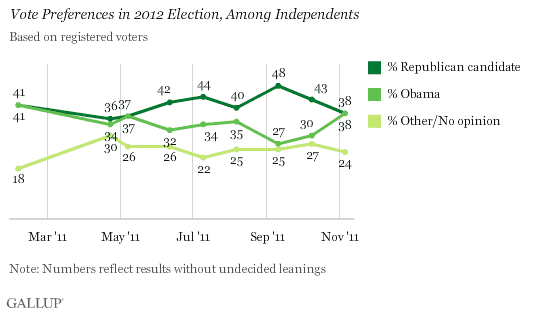
Obama inches back. Here's the latest Gallup graph on independents' preferences between Obama and a generic Republican:

R5n0uk4bwk-1tkxsle5vha

That's a hell of a swing – from minus 21 to even in two months. And, remember, Obama does better against the actual Republican candidates.

It's not, in my view, because Obama is performing well as a communicator. It's because the GOP is revealing itself as unfit for governing responsibility. Once again, Obama's opponents self-destruct. Of course there's a long, long way to go, and Romney could beat Obama next year if he is the candidate and the economy dives after Europe swoons. But still: this is a pretty damning indictment of an opposition party when a president has a 9 percent unemployment rate and paltry growth.  The last two months, as the GOP has put its candidates on display and as its Congressional obstructionism has deepened, have been dreadful for the Republicans. Maybe they'll learn after Tuesday's votes. But maybe they can't.

Michigan Debate Reax, Ctd

Some remaining thoughts from readers. One writes:

I hope you realize how close you came to Von Hoffmann-ing yourself when you started your debate live-blog with the comment: "Perry matches his basement-level expectations."

Another writes:

I actually feel really bad for Rick Perry.

I had a similar situation during my oral doctoral exam, where after talking theory for 10-15 minutes my panel basically asked me to state my sources. I completely blanked. I couldn't recall who had written what specifically, it was just all a mish-mash of realism/constructivism/liberalism/etc. And the longer I came up blank, the more I was thinking about coming up blank and not the damn bibliographical info the profs wanted. It was a vicious cycle. Granted, I'm not running for office and people that are should do better, but at the same time, they're human. And that kinda stuff is what rips me back to reality when I indulge in delusions of grandeur of running for office.

Another:

Your cited bloggers thought that Perry's guffaw was historic and unprecedented, but are they aware that Governor Jan Brewer had just as embarrassing a debate "moment" and survived to win the election? Perhaps that's a comment on Arizona voters, but it's worth noting that Perry has company in the realm of incompetence.

Another:

Aaron Carroll wrote: "Many of the answers the candidates gave on health care reform already exist." Aaron complains rightly about the candidates not knowing this. But can we throw in that the journalists moderating the debate had no clue either?  Because they are in the exact same political-entertainment complex as the majority of the candidates on the podium. By the way, a debate in Michigan and the car bail-out is not being discussed at length? WTF?

Another disagrees with me over Romney's restraint against Cain when the harassment allegations were raised:

While I agree that cowardice is Romney's second nature, I think he's really playing the Obama card when it comes to Cain. An attack on Cain would only harm Romney, especially given that Cain will be forgotten in six months no matter what Romney says. It's smart politics, not cowardice.

Why not both? Blogger reax here. My take here.