Drawing Muhammad Isn’t A Crime

GT_CHARLIEHEBDO_111107

Reacting to Bruce Crumley's asinine criticisms of Charlie Hebdo, Jamie Kirchick fumes:

The original title of Crumley’s piece, still viewable in the website URL, was "Firebombed French Paper: A Victim of Islam, Or Its Own Obnoxious Islamaphobia?" If a reader, so offended by Crumley’s excuse-making for theocratic nutcases, bombs TIME’s Paris Bureau, would that make Crumley a "victim" of his own obnoxious cowardice? 

Somewhat de trop, but it's Kirchick; and the principle is exactly right. Mollie Ziegler thinks Crumley should be fired. I don't believe journalists should be fired for their views, within reason. Her colleague George Conger previously offered an overview of related controversies. 

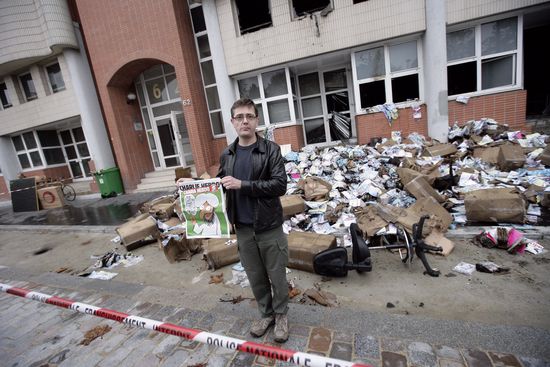
(Photo: The Charlie Hebdo's publisher, known only as Charb, shows a special edition of French satirical magazine Charlie Hebdo on November 2, 2011 in Paris, in front of the magazine's offices, which were destroyed by a petrol bomb attack overnight. By Alexander Klein/AFP/Getty Images.)

“The Idiot’s Guide To Buying A Congressman”

Jack Abramoff, the notorious lobbyist and ex-con, says he's thinking of writing a book with that title. Ezra Klein highlights portions of Abramoff's interview with Lesley Stahl, in which Abramoff explained how he could easily "own" people on Capitol Hill by offering them future high-paying lobbying jobs:

Once the key staffers or legislators were bought, the trick was getting clients what they wanted without attracting attention. "So what we did was we crafted language that was so obscure, so confusing, so uninformative, but so precise." The following line of text, for instance, quietly won Abramoff’s Native American clients a casino license: "Public law 100-89 is amended by striking section 207 (101 stat. 668, 672)."

Neil Volz, a lobbyist who worked with Abramoff, thinks he's exaggerating his hold over Hill staffers.

The Case For Legal Cannabis

Marijuana_GT

Paul Armentano makes it, at length. One leg of his argument: 

Several objective bodies have sought to assess the potential costs that marijuana use may impose on modern society. These calculations have consistently estimated the social costs associated with marijuana’s use to be relatively minimal. For example, a 2009 assessment published in the British Columbia Mental Health and Addictions Journal estimated that health-related costs per user are eight times higher for drinkers of alcoholic beverages than they are for those who use cannabis, and are more than 40 times higher for tobacco smokers.[11] “In terms of [health-related] costs per user: tobacco-related health costs are over $800 per user, alcohol-related health costs are much lower at $165 per user, and cannabis-related health costs are the lowest at $20 per user,” investigators concluded.

(Photo: A Mexican soldier uproots a marijuana plant to put it on a stack to be burnt on July 15, 2011. The 120 hectares plantation, the biggest found so far, was in San Quintin, Baja California state, near the border with the US. By Antonio Nava/AFP/Getty Images)

Correction Of The Day

A reader writes:

Love your blog. Been reading it daily since 2006.  I'm one of your 1.3 million proofreaders. On that note, you wrote: "But Greek? I could tackle the Gospels in the original! I could read Plato and Aristotle as they were meant to be read." Actually, the ancient Greek of Aristotle and Plato is different from the Koine Greek of the New Testament – a more common, street-Greek 600 years younger than Classical Greek. 

Would learning one make it easier to learn the other?  Absolutely.  I'm a Presbyterian minister who learned NT Greek in seminary and wish I retained and used it more, but it is helpful reading some dictionaries, Bible verses, etc. I think knowing Koine Greek helps me with English words, other Romance languages – as would Classical Greek (which I don't read).

Another adds:

Do it! Learn Koine Greek.  This is the language of the religious writings that you love. And it's a lot easier than Classical "the more syntax the better" Greek. I went the classical route because it was a required part of my curriculum in Ancient Near Eastern Languages. My knowledge of Greek was directly responsible for getting me the job I've held for the last eleven years (and I hope many more). Why did my bosses-to-be select me? The job involved reading astroparticle physics equations … which had Greek letters in them. Oh well, you take what you can get.

By the way, Coptic is fun too but doesn't pay as well.

I was quite brilliant at learning languages as a kid. Not so much any more, I suspect. Update from a reader:

You've probably already had a few classicists chime in, but your Presbyterian reader is not quite accurate in saying: "Actually, the ancient Greek of Aristotle and Plato is different from the Koine Greek of the New Testament – a more common, street-Greek 600 years younger than Classical Greek."

There are clear differences between classical Attic Greek (the dialect of Plato and Aristotle) and koine, but they are not different languages. The difference is rather (to somewhat simplify) that classical Greek is grammatically complex and in its best literary examples rhetorically flexible and nuanced language, whereas koine Greek is simplified form developed over several hundred years by the demands of incorporating many non-Greek peoples under a common (koine!) language. Any reader of classical Greek can read the New Testament without major difficulties, though the reverse is not true.

As Nietzsche said somewhere, "There’s something fine about the fact that God learned Greek when he wanted to become a writer — and that he did not learn it better."

Israel’s Threat; Iran’s Danger

Don't you get the feeling that, as we obsess about Herman Cain's sexual harassment and Justin Bieber's paternity test, the world could be headed soon for a new depression, as Europe implodes, and world war, as the Israel-Iran conflict explodes? Shmuel Rosner thinks two factors will influence Israel's decision to attack: the perceived risk of a nuclear Iran and the feasibility of a strike. Walter Russell Mead sees a change in Israeli attitudes on the latter front. Paul Mutter examines the impact of a "super Stuxnet" on Israeli thinking. Marc Tracy does a cost-benefit analysis:

The negative consequences of an Israeli attack—massive war with Hamas and Hezbollah, maybe rockets from Iran itself, God knows what worse forms of retaliation—are essentially known and all but guaranteed. By contrast, the negative consequences of not launching a strike range vastly and unknowably, and if they go all the way up to Armageddon in the Middle East, they also go all the way down to Iran’s never making weapons. I know this is scary, but it’s the way life is lived: you can believe that the worst-case scenario for not striking Iran is worse than the worst-case scenario for striking Iran, and, because of the odds and the contingencies, still oppose striking Iran.

Judah Grunstein is skeptical about both this calculus and the arguments in favor of a strike. Robert Farley sees the idea of war with Iran as flat-out insane. The real question is: for whom? Insanity is relative.

For Israel, you can see how Netanyahu, born and bred into profound but often justifiable paranoia, sees himself as Churchill. You can see how the Jewish people live perpetually in fear of Amalek. But Churchill confronted an enemy equal in military force, greater in industrial strength, and explicitly territorially expansionary. Netanyahu faces an enemy with no record of territorial aggression (unlike Israel), a faltering economy, a divided leadership, massive domestic opposition, and a much inferior military operation. Israel itself is deeply divided over whether risking global war to defeat this country's acquisition of a handful of nuclear weapons (while Israel has well over a hundred), makes sense. I can see why some Israelis and Jews do not consider this literally insane. I cannot see how a rational American can come to the same conclusion.

But for the US, it seems pretty obvious to me that an Israel-prompted regional war in the Middle East would be a disaster, wiping out many of the gains Obama has made in taming and targeting Islamist terror, devastating the Middle East, unleashing terror attacks across the globe, probably pushing Pakistan into open hostility, and pushing an already fragile global economy into the Second Great Depression.

This must be at the center of our foreign policy debate. Are we the instruments of Israel's understandable, if misguided, foreign policy or the masters of our own? Are we governed by our reason or others' panic?

America’s Populist Turn

There are so many ways to approach this question, and so much data giving you any result you want, but the latest WSJ poll seems to me to represent the collapse of popular support for 1980s Republicanism. I mean, look at the results. Hillary Clinton is the most popular public figure. Obama, at 9 percent unemployment, beats Romney by six points, up from two last month. More critically, in a populist year, the GOP looks set to nominate a candidate who makes Obama seem like Joe Biden:

47% of those surveyed said they wouldn't vote for Mr. Romney to be president. While white, working-class voters are ready to vote for an unnamed Republican over Mr. Obama by 48% to 36%, Mr. Romney finds himself deadlocked with Mr. Obama among that key demographic, 44% to 44%.

Then this:

More than three-quarters of the country says the nation's economic structure is out of balance and favors a very small proportion of the rich over the rest of the country. They say America needs to reduce the power of major banks and corporations, as well as end tax breaks for the affluent and corporations. Sixty percent say they strongly agree with such sentiments.

Count me among them. And note the rationale here: not equality but balance. I have no problem with substantive inequality as the result of a fair system; I have a real problem with massive inequality because of a rigged system. But, paradoxically, the populism also takes a more conservative, if not Republican, turn here:

53% of the country believes—and 33% believe strongly—that the national debt and the size of government must be cut significantly, that regulations on business should be pared back, and that taxes shouldn't be raised on anybody.

Basically Americans don't trust the government to fix the problems caused by the banks they don't trust either. Hence our impasse. But a strategy that insisted on some revenue increases from those who can most afford it, as a means of debt reduction, not redistribution, together with deep structural reforms of the tax code, strikes me as a winning option for the president.

So where is his tax reform plan? Where is his plan for drastically simplifying our insane tax code and redressing the appalling generational imbalance, as the boomers suck every last drop of money out of their kids and grandkids? Here's one thing I firmly believe: unless Obama proposes a bold reform plan for taxes, he is facing something worse than a one-term presidency. He is resisting he change he once promised to bring. Generationally, as he allows the Justice Dept to hound medical marijuana dispensaries and prevaricates on marriage equality and does little to redress the real distress of the twentysomethings who elected him, he is drifting into a de facto attack on his own coalition.

And that's politically fatal. Safety is not an option in populist times. Reform is. Yes, his record needs to be critical in assessing him; but so too must be his platform going forward. If all it is is a second stimulus, he won't get very far.

The Third Woman

The Daily has identified one of the women who filed harassment complaints against Herman Cain. She sounds like the usual leftist liar:

Karen Kraushaar, a 55-year-old former journalist and seasoned government spokeswoman who served on the front lines of the Elian Gonzalez custody battle, is a competitive equestrian and lover of golden retrievers. She has been married for more than two decades.

"She wouldn’t be the type to make false allegations," brother-in-law Ned Kraushaar, a Georgia software consultant, told The Daily. "This happened [more than] 10 years ago. It’s not like she wanted to try and hurt the Republican Party."

I believe that a man capable of abusing power and then lying about it categorically has no place in public office. That's why I couldn't endorse Clinton in 1996, despite my support for much of his substantive record. There is nothing more central to the integrity of the body politic than a record of abusing power and lying about it.

The View From Your Window Contest: Winner #75

Screen shot 2011-11-04 at 7.46.46 PM

A reader writes:

Aw c'mon. No cars, no washing lines, no hills or mountains – not even a passing little fleecy cloud?  Just anywhere in the world that has palm trees and blocky buildings. I'll say somewhere in the Canary Islands just because.

Another writes:

Not far off the equator, the trees and hazy blue sky make sense, and the absence of any landforms in the distance suggest a coastal city. Fortaleza, Brazil? It's the birthplace of my adopted son. We were there six weeks while our case went through the courts. The colonial architecture alongside the squat concrete office towers is quite familiar.

Another:

I always look at the VFYW contests with amazement that anyone can identify what look like such generic views. But this one seems to have a corner showing La Casa Rosada, as well as palm trees.  When I saw it several years ago, I was admiring of a people who could claim a Pink House as a national symbol. In the US, I'm certain it would be considered "too gay."

Many readers guessed along these lines:

I believe this is a picture of the Egyptian Museum, which is located on Cairo's Tahrir Square. Seeing the color and style of the pink building, plus the palm trees, brings me back to that location in Cairo. I must've visited that museum 10+ times when I lived there. It is incredible, stuffed full of Egyptian artifacts from every dynasty. Many hallways in the museum are lit only by natural light coming in through windows, the dead bulbs in the museum's lighting system having been ignored seemingly for years. More museum pieces lack identifying information than do, and for many items and objects, all the description you get is the original typewritten notes of the 19th century archeologist. That place defines kitsch, in the museum world.

Another:
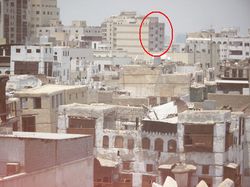
Jeddah_flickrOh my … I think I found it. My sister is on Hajj right now, so I've been thinking about Mecca lately… but the VFYW photo looked different somehow (mind you, I've never been there/complete speculation) so I checked out Jeddah.  Lo and behold, I found someone's photo during a random search on Flickr and I swear this is the same white, cubed building.  Maybe a few blocks off, but it sure looks like it. Of course, I'm probably wrong – like last week.  *sigh*

Another:

My hunch is that you couldn't resist choosing a photo from Greece, given the turmoil it has been causing in the EU. Googling Athens, palm trees, and white buildings resulted in some reasonably similar photos. My 9-year-old, who loves a good puzzle (especially it if involves geography), was certain Athens was the right place based on the combination of red roofs, white office buildings, and older, yellow buildings. Since Google didn't help us with street-views, I'm going with the 9-year-old.

Another:

Ho Chi Minh City, Vietnam? District 3 looks likely. Assuming I am not wildly off the key clues: Colonial architecture – Yellow like that seems to mean French. Palm trees and sky mean sub/tropical with a lot of rain – so probably Indochina. The look doesn't match Cambodia or Lao.  So it's Vietnam, and HCMC is a better match for the look than Hanoi. I think this photo may have an image of the hotel in the upper central part of the photo.

Another:

I'm sure you're getting a lot of guesses from Southeast Asia. We're on a three-day weekend here in Singapore, so my family will only forgive a bit of googling. So let me just throw out the Bamboo Green Hotel, Danang, Vietnam, fifth floor. I've got no good maps or images. But here's hoping my shot in the dark is close.

Correct floor, wrong continent. Another:

With all the palm trees, it's gotta be Madison, WI, right?

Another:

That's it, I'm going with my gut here. Where else has that strange mix of semi-fading colonial buildings, zoning that allows mid-sized towers seemingly at random, and mixed tropical and deciduous trees? Macau or bust; I'm going to keep guessing EVERY WEEK until I get it!

Another gets on the right track:

Palm trees and French windows and zero other clues. Most people will therefore guess somewhere in the former tropical French Empire, and the best way to win in such a random hurling of darts at a map is to pick somewhere really obscure – after all, if it really does turn out to be Senegal or French Guinea or somewhere obvious, somebody will manage to get it right down to the street. So I pick Toliara, Madagascar, a place I have never heard of before and never will again.

Another nails it:

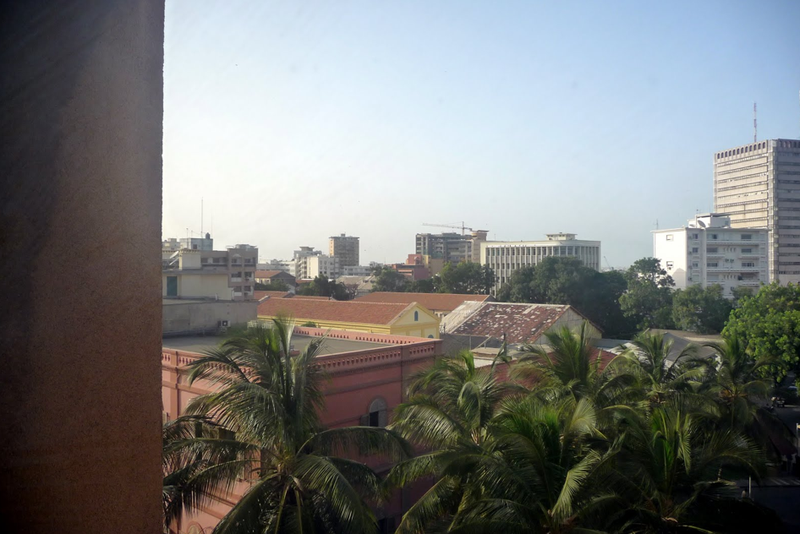
The photo was taken from the Novotel Hotel in Dakar, Senegal.

Not much to go on this week! Those arched windows at the top of the tallest building suggested a potentially Islamic influence, the palms keep it out of extreme latitudes, and the pink and yellow buildings suggest that it could be in just about any place except North America and Europe.

Among other places, we searched Beirut, Damascus, Aleppo, Kinshasa, Bogota, Mexico City, Caracas, Lima, Sao Paulo, Rio de Janeiro, Mumbai, New Delhi, Santiago, Panama City, San Jose (Costa Rica), Lagos, Cairo, Durban, Casablanca, Nairobi, Algiers, Tunis, Bermuda, Kingston, Tegucigalpa, and a couple cities in Pakistan, just for good Dakar Earth View 1ameasure. In nearly every place we were able to find something that looked similar. 
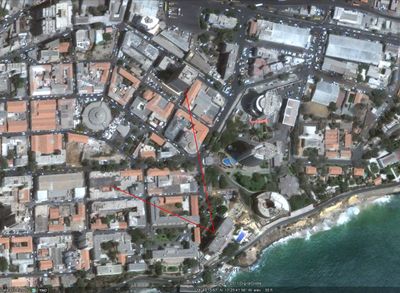
In the end, though, searching through African capital cities landed us in Dakar, and this photo. After that it was just a matter of finding the place. Here is a Google Earth view is attached.

The buildings next door house the Institut Francais, which contains La Galerie Le Manege, which has some virtual tour views from the interior courtyard that isn't quite visible in the photograph. There are remarkably few photos in Panoramio, but this view, also from the Novotel, is a little more to the west. From that photo we can see that the top of the pink building is roughly at the same height as the fourth floor. Since we're looking down on the top of that building, the photo was probably taken from around the sixth floor.

Another Dakar entry:

What I thought were black people and an open-top jeep or buggy in the bottom right corner of the photograph made me think Africa. The pink building reminded me of the French parts of New Orleans, but the city didn't feel right. So instead I started looking at French-colonised Africa. Cote d'Ivoire and Sierra Leone felt wrong but a lot closer. Then I saw a photograph of the Dakar cityscape, featuring a grey building with about as many floors as the one in the photograph, as well as the radio spire. Another photo confirmed the find, bearing the title 'Skyscrapers in Dakar are not very pretty'. The tallest skyscraper in the photo, with the radio spire, is the Immeuble Fahd. I think our photo was taken from the Novotel Dakar, about three or four levels up. Attached is an image of Dakar showing both buildings:
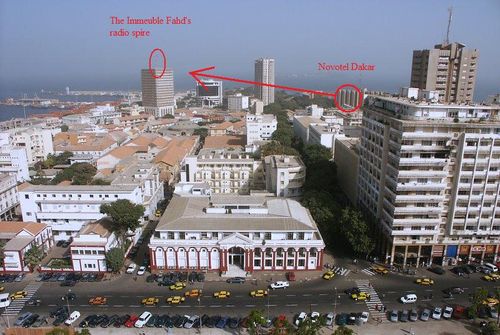
Dakar

Another:

This is a fantastic way to while away Saturday afternoon.  I was one of a million people to get the correct street last week, but I didn't get the address.  I started this time with South America, picking up on the colonial buildings and palm trees.  I couldn't find anywhere sufficiently flat, and near the water, without a million skyscrapers.  West Africa seemed like the next logical choice.  Took some googling, but the building to the right is pretty distinctive, so eventually I zeroed in on Dakar. I'm reasonably certain that I've picked the right window, although it could be a little below, or to the right as you face the hotel:

Novotel

Looks like a nice place.

Several excellent entries, but the prize this week goes to the only Novotel guesser who has gotten a difficult window in the past without winning:

This week's VFYW offers me the chance to redeem my very first VFYW guess – my most off-base guess ever. Back in the early days of the contest, before submitters had learned to exploit the powers of Google Earth, I guessed that the View_from_Novotelthat the image was actually taken in Ft. Lauderdale, I was so embarrassed by my inability to discern architectural differences between US and Senegalese buildings that I more or less gave up on the contest for one year. Since then, your readers' winning submissions have taught me how to properly sleuth these images and have even got a few correct, non-winning answers in recent months.
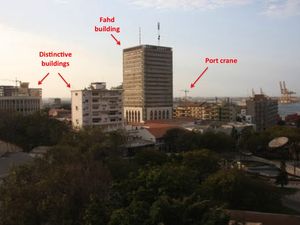
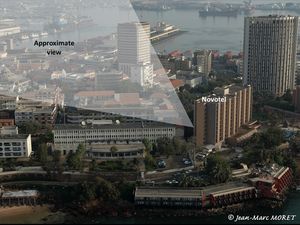
In any case, I knew this week's VFYW was Dakar because of the distinctive high rise Fahd building, the colonial architecture, and the neem shade trees (during my Peace Corps days I processed leaves from these trees into the most awful-smelling organic pesticide imaginable). The VFYW was taken from the Novotel in the Plateau neighborhood of Dakar, from what looks like the fourth floor. The attached images show the distinctive features of the scene, as well as an aerial shot of the approximate view from the window.

I'm afraid I don't have any good stories Aerial_Viewfrom the Novotel, but hidden behind the yellow buildings with the tile roofs is an amazing, open-air rooftop cinema boasting lounge seating and table service – it's easily the best movie theatre I've ever been to. Ironically, it's also where I watched the worst movie I've ever seen: Madonna's Swept Away (apologies to Aaron).
From the submitter:

The photo was taken from my 5th floor hotel room at the Novotel Dakar on Avenue Abdoulaye Fadiga, where I was staying for a week while in Dakar for work. I work for The Rotary Foundation, which is the charitable arm of Rotary International, a global humanitarian service organization. The event taking place in Dakar was a project fair, bringing together Rotary clubs worldwide to help enable and implement projects that will benefit countries in West Africa.

(Archive)