Untangling Egypt’s Democracy Problem

GT_EGYPT_120116

Steven Cook thinks Egyptians should swallow their anger and immunize the military junta from prosecution for their crimes:

If Egypt’s officers were guaranteed immunity, allowed to keep whatever ill-gotten gains they have, and  assured that civilianization of the political system is not tantamount to destroying the armed forces—a mistake the Turks seem to be making—the chances are better that the military will yield to civilian politicians and a more democratic order.  If the experience of Latin America can be any kind of guide, these guarantees and the traces of the previous authoritarian system that go with them will fade away as democratic practices and processes become institutionalized.

Phillip Seib has ideas about how America can reach out to Islamists. Amil Khan isn't convinced.

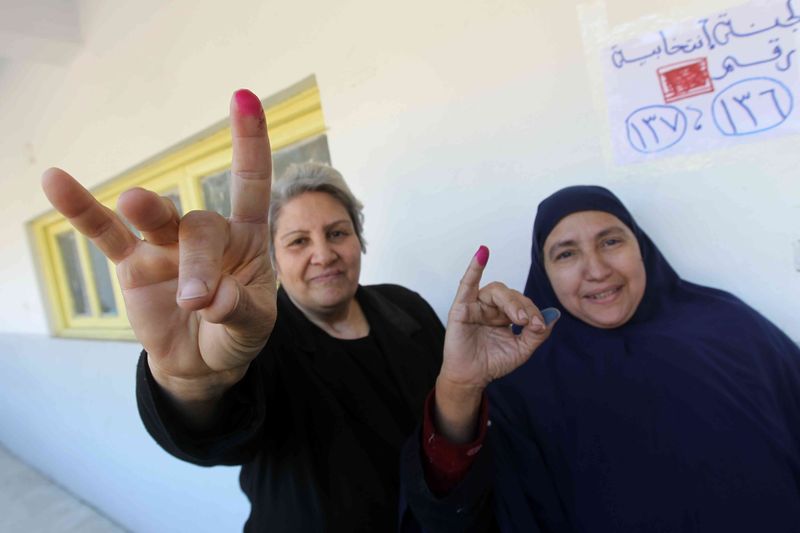
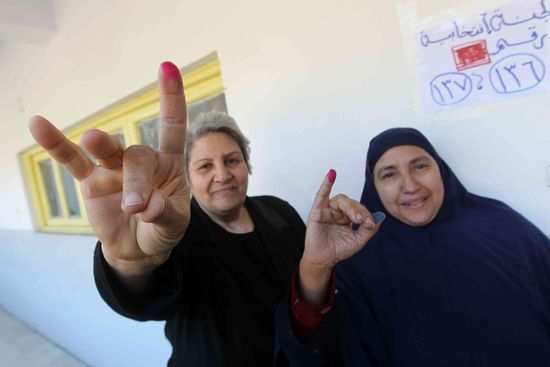
(Photo: Egyptian women show their ink-stained fingers after voting at a polling station in Cairo's al-Sahel district during a re-run round of landmark parliamentary elections on January 10, 2012. Egyptians are voting for the third and final phase of staggered elections to choose the first parliament since mass protests ousted Hosni Mubarak in February last year. By Khaled Desouki/AFP/Getty Images.)

Romney’s Budget Cuts

Jonathan Cohn considers them draconian:

The latest Congressional Budget Office projection suggests that GDP in 2016 will be $19.1 trillion. Sixteen percent of that is about $3.1 trillion. But, based on CBO figures, non-defense spending will be about $3.6 trillion in 2016. So to meet his goals, Romney would have to cut non-defense federal spending in 2016 by roughly $500 billion.

Romney doesn’t deny this. On the contrary, he’s been refreshingly honest on this subject. In the Washington D.C., speech where he laid out his budget vision, he said “we’ll need to find almost $500 billion in savings a year in 2016.” But Romney has not given many details on what that would entail. (Nor did his campaign respond to questions about this from TNR.) Perhaps that's because the impact of these cuts would scare the bejeezus out of some people.

Or perhaps it's because Romney doesn't intend to follow through on his cuts. But some even rough idea of where he would cut is surely worth knowing.

Global Democracy Watch

GT_BURMA-PRESSER-120117

Christian Caryl runs down the possibilities for the near future:

2012 is a year of elections. By the end of this year the citizens of 59 countries – one-third of the world's countries — will have gone to the polls to choose national, state, and local leaders. This would seem to bolster the claim that the overwhelming majority of Earth's inhabitants now implicitly accept the principles of democracy. By this argument, the Universal Declaration of Human Rights now embodies a global standard to which all people — and not just Westerners — aspire. That may be true. But it hardly means that the triumph of democracy is ensured. If history has taught us anything, it is that nothing in human affairs is inevitable.

Francis Fukuyama sees a universal quest for dignity as the underlying motivation for pro-democracy movements. Jacqueline Hale and POMED look, respectively, at the role Europe and the US can play in promoting democracy globally. Walter Russell Mead spotlights hopeful developments in Burma:

[T]he government signed a peace agreement with the Karen rebel group, which was part of a decades-long insurgency. Earlier [last] week, opposition leader Aung Sun Suu Kyi announced she would run for Parliament in April. Her party was excluded from politics for twenty years, until two weeks ago. These are hopeful signs. Reinforcing political openness will bring this once-pariah state into the international community and out of China’s tight embrace.

Aung Zaw goes in-depth on the strange country. Andreas Umland shifts the focus to Russia.

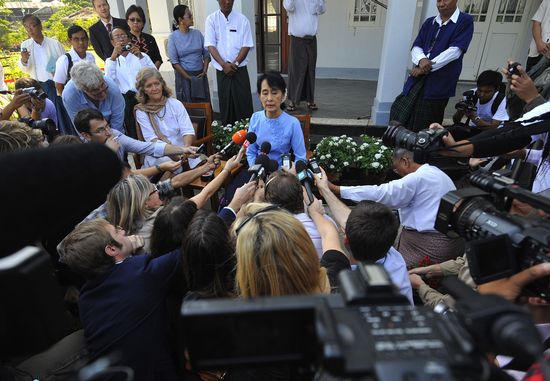
(Photo: Burmese democracy icon Aung San Suu Kyi addresses reporters following a meeting with French foreign minister Alain Juppe at her residence in Yangon on January 15, 2012. Following talks with Juppe, the highest-level French diplomat ever to visit the country, Suu Kyi said that she did not rule out taking a government position if she wins a parliamentary seat in upcoming by-elections. By Soe Than Win/AFP/Getty Images)

Could Romney Convert The GOP?

Sam Harris imagines what Mitt the Mormon would have to say to win over the base:

Let me make one thing absolutely clear to you: I believe what you believe. Your God is my God. I believe that Jesus Christ was the Messiah and the Son of God, crucified for our sins, and resurrected for our salvation. And I believe that He will return to earth to judge the living and the dead.

But my Church offers a further revelation: We believe that when Jesus Christ returns to earth, He will return, not to Jerusalem, or to Baghdad, but to this great nation—and His first stop will be Jackson County, Missouri. The LDS Church teaches that the Garden of Eden itself was in Missouri! Friends, it is a marvelous vision. Some Christians profess not to like this teaching. But I ask you, where would you rather the Garden of Eden be, in the great state of Missouri or in some hellhole in the Middle East?

Obama’s Long Game, Ctd

If you want to read a classic cocoon-right screed against yours truly, here's Big Government's Joel B Pollak. It's really something. Against my argument that Obama has cut taxes – not raised them – Pollak mentions cigarette taxes, and a slew of Obamacare fees, but doesn't mention the fact that the Bush tax cuts were sunsetted from the get-go, that Obama need not have extended them, and the massive third of the stimulus which was tax cuts, along with the extension of the payroll tax cut. They're that desperate. Then he argues that accepting the premises of almost every economist – that if you pump $800 billion into an economy, it will grow some – is a simple "post hoc, propter hoc" logical fallacy – something he links to Wikipedia's definition to help out. I kid you not.

Then this:

Aside from the war on Al Qaeda, Obama squandered every diplomatic and military success bequeathed to him by Bush. He destroyed missile defense in Europe, and wasted hard-won gains in Iraq by withdrawing troops against the advice of the military. While appeasing Iran and gutting the future of our defense, Obama alienated and undermined U.S allies.

I'm unaware of Bush's diplomatic successes, except one: the Iraq SOFA withdrawal date was signed by George W. Bush, not Obama. He has not "appeased' Iran. Iran is now enduring the most crippling sanctions and international isolation it has ever experienced – despite the brilliant idea of handing Iraq to Iran, which was inherent in anything but the most utopian versions of the Iraq war. Noel Sheppard's critique is on similar lines. He says I'm lying about my being an independent conservative who went for Obama after the Bush-Cheney catastrophe. Well, you can always check the archives, Noel. Then:

To give you an idea of the unlikelihood of this, only 20 percent of conservatives voted for Obama in 2008.

Well I was among the 20 percent. Not that unlikely, given my politics and record (I backed Clinton in 1992, for example). Then he says that Obama did not inherit a Bush recession:

Believing this requires one to completely ignore the Democrat takeover of Congress in January 2007, a 4.4 percent unemployment rate at the time, and that the recession Obama "inherited" and therefore can't be blamed for [what] began eleven months later.

He then says I'm unfair to Bush:

Bush's job performance starts from the day he was inaugurated despite him inheriting a recession from Bill Clinton.

This is what I mean by complete fantasies. Bush inherited a recession from Clinton? He inherited a boom and a surplus. He turned them into the worst recession since the 1930s and a crippling debt that made it very hard to recover. As for my point about the wrong input in the January 2009 predictions for the stimulus's effect, Sheppard simply writes:

Regardless of what the economy did in the fourth quarter of 2008, let's examine what these people predicted would be the direct result of ARRP otherwise known as Obama's stimulus plan …

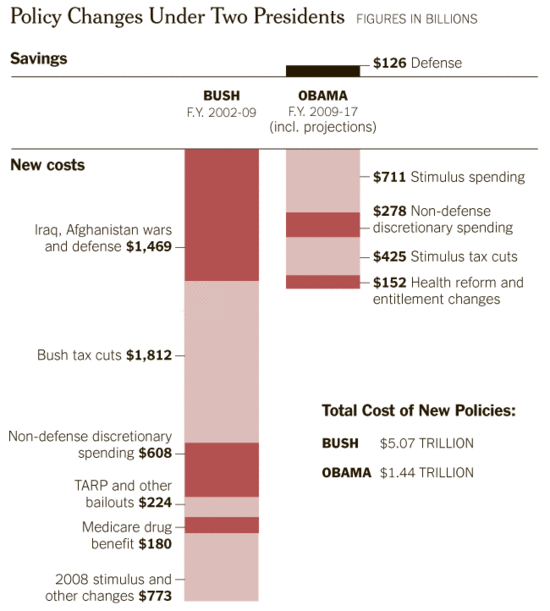
So let's just ignore my point entirely and pretend I didn't write it. My case for the differential between Bush and Obama on the debt comes from the chart of the year on the Dish:

6a00d83451c45669e201675fad5058970b-550wi

The one point I will concede I made too glibly is the CBO projected cost of Obamacare. The CBO did indeed score it as a net positive for the deficit. But there are many serious arguments that it won't in the long run. Much depends on how it evolves, how well the market exchanges work, the power of IPAB, etc. But it remains a modest, centrist reform. I actually believe that getting rid of free-riders in an already-socialized system is a good, conservative idea, as once did Gingrich and Romney. So sue me.

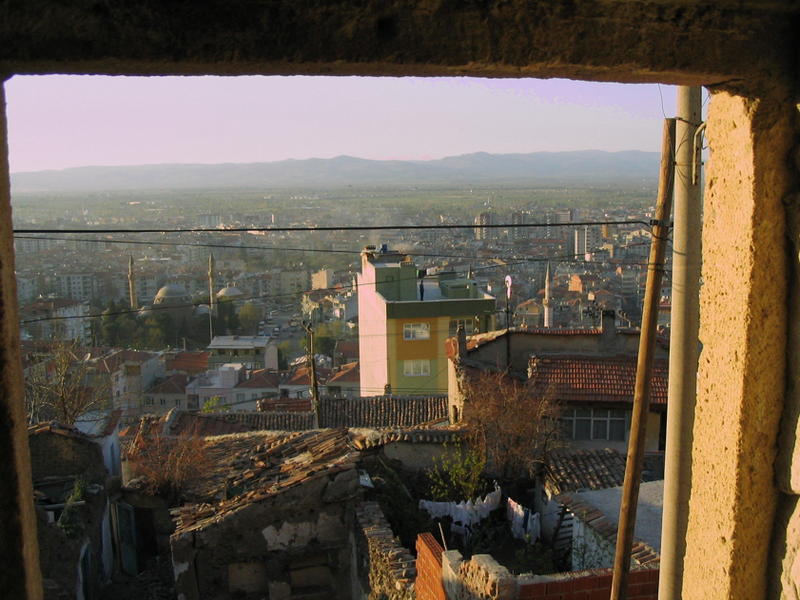
The View From Your Window Contest: Winner #85

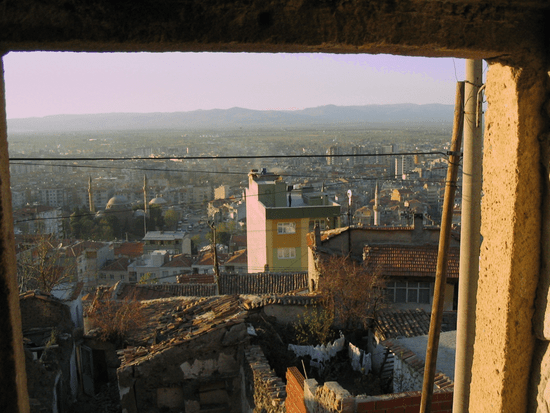
Vfyw_1-14

A reader writes:

The times when I’ve correctly guessed this contest, I’ve had a solid hunch from the get-go that bears out with 10 or 15 minutes of googling.  However, this time I’m stumped.  The flatness of the city, the mountains in the background, the red tiles, the obvious certain level of poverty, the mosque – it all says Central Asia to me.  And yet I can’t find anything that quite lines up with it.  That’s why I’m going with my best guess, Yerevan, Armenia.

Another writes:

Much tougher this week. This looks like part of a sprawling city nested near mountains, in a relatively green valley, with mosques. I’m going to go with Tehran, Iran, and call it a day.

Another:

Wow, lots of clues in this one.  Based on the apparent angle of the sunlight and the concentration of particulate matter in the atmosphere, it appears to have been taken in a city of approximately 200,000 residents at a latitude of between 35 and 40 degrees.  That eliminates most of Canada.  The hanging laundry visible foreground appears to be primarily whites, indicating in the populace a degree of piety not typically associated with any of the G7 nations.

Obviously many will focus on those round structures with the minarets, but I’m ignoring those, as they appear to have been photoshopped in.  For me the giveaway is the guy standing on the roof, who looks just like one of my old college buddies, Steve. He recently traveled to Norway, but that would be too obvious, so based on recent news developments plus a secret feeling I can’t describe I’m going to guess that this photo was snapped from one of the non-existent uranium enrichment facilities located in Sabzevar, Iran.

Thanks for another great contest, I wasted my whole Saturday on this, etc. etc.

Another:

Tuzla, Bosnia? I just googled red roofs and minarets and there’s a strong suggestion it’s Bosnia. Seems small to be Sarajevo, and maybe too dense to be Banja Luka. If I’m right, I have no idea what window it is.

Another:

The red-tiled roofs suggested Europe, and the two mosques that are visible further suggested the Balkans.  After some initial searching, I came across this mosque in nearby Evpatoria, Ukraine, that is identical to the mosque on the left of the VFYW picture. Interestingly, the mosque’s name appears to have several different spellings or versions on various websites, including Djuma-Djami, Juma-Jami or Cuma-Cami mosque.  Also interesting is the number of Ukranian mail-order bride websites that appear during searches related to this mosque (which may require some explaining to my wife).

Another:

Well, it’s a Muslim country. And I think the real hint is in the uniform high-rise buildings we see in this valley.  It looks like classic Soviet-style architecture, so this has to be a former Soviet Republic.  Just doing a Google image search of cities in former Soviet Central Asia countries (Almaty, Bishkek, Tashkent, etc.) shows that Ashgabat, Turkmenistan lies in a green valley with low hills to the side, so I’m going to go with that.

Another:

Homs, Syria? Wild guess. The mosque in the center of the picture looks close enough to Khaled Ibn Walid pictured on Google images. Whenever I poke around the VFYW contest, I run into reminders that people every where are the same – planning birthday parties, going to the coast for a quickie vacation, having friends in town stay at their apartment, etc. Syria is no different than US; people just want to live in peace and be left to their DVRs and grocery shopping.

I often think about a Syrian I knew 40 years ago, Khalid, a Syrian Warren Beatty. He managed the diner where I worked while going to college. He was handsome and devastatingly charming. Married to a Londoner who looked like Jean Shrimpton, he was boinking several of the waitresses. When he came into the diner to “manage” he would always put money in the jukebox and play Jim Morrison’s “Love Street”, a beautiful song about women as shrines of joy and magic. I dearly hope Khalid and his family are safe, wherever they are.

Another:

This one feels like the Harmony Mills contest three weeks ago except that instead of not being able to find the exact 19th century chimney, I can’t find the exact 19th century minarets.  Two mosques in the view means it is a Muslim country.  Red clay tiles on pitched roofs and deciduous trees eliminates Middle Eastern and African countries.  That leaves European countries.  Bosnian and Kosovo cities don’t feel quite as dense as this city.  I’ve really enjoyed Google-touring mosques in several Turkish cities but couldn’t find a match.  Based on terrain I’m going with somewhere on the outskirts of Ankara.

Another Ankara entry:
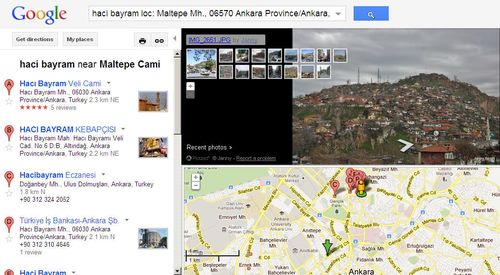
Hillside_Maltepe and Haci Bayram

So, I work for a bank and have the crappiest, most outdated software available (maybe that should tell me not to waste time/resources while I’m supposed to be working, but I honestly don’t have time to spend on this at home).  In any case, let’s say I won’t be making you a video … ever.  Although last week‘s winning entry was pretty awesome, I’m concerned it has set the bar too high and now we need to submit holograms or some tardis-based script as an entry.Maltepe Cami
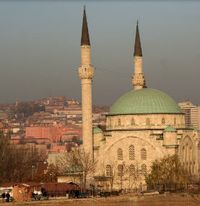
So with my limited resources and wild stabbing at the map, this looked like Turkey to me.  Ankara, specifically.  Mainly because that mosque on the left looks like Maltepe Cami (photo attached) and I think the submitter’s pic could have been taken from the hillside (photo/google search) looking over both Maltepe and minaret from Haci Bayram on the right.  Of course, Maltepe doesn’t have a double dome, so I’m probably in the wrong city. Nice try, though.  Maybe I’m close, who knows. I hate this contest.

Another:

Ten minute search today, which is only enough time to guess that we are in Turkey.  I wanted it to be Cappadocia, where I spent a memorable February weekend with the flu in a freezing hotel room built into the caves.  However, it is clearly not there.  I’m guessing Ankara because it still feels like interior Turkey and we are in a larger city, even though the plain in the background is probably too flat.  But that’s my guess and I’m sticking to it …

Another:

Interesting. From a distance, I thought South America, but then noticed the prominent mosques in the foreground.  Given that, and the mountain range, I lean towards a Moroccan or Turkish Window.  I have a feeling it’s a bit more Turkish, not Istanbul though, nor a picture from Ankara which is on the plateau.  Hard to imagine a mountain range on top of a plateau.  So, I’ll go with the 3rd largest Turkish City, Izmir.

Hey Andrew, why not pitch this to a TV executive as a game show idea?  Points could be based on miles away from the actual site, and sum up distances away from a series of pictures, and person with lowest score wins.  Could be part of your growing legacy and get American people interested in the world.  Alternatively, an app game.

Several more Turkish cities were submitted, but only two readers nailed the correct one:

The view appears to be from the top floor of an abandoned structure sometimes described as the Darphane in Manisa, Turkey (38° 36′ 28.55″ N  27° 25′ 45.07″ E).  The attached PDF file has the details behind my guess. Specifically, the view is from the top west window on the north side of the Darphane in Manisa, Turkey.
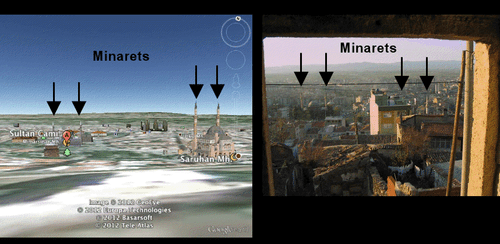
Screen shot 2012-01-17 at 12.57.00 PM

The PDF contains a spectacular slideshow (one of the slides seen above), but the other Manisa reader has also entered and correctly answered more contests in the past, so he wins this week:

Ok, this had to be Turkey, no doubt about that, and after a bit of checking out a number of midsize provincial cities things fell into place: Landscape, buildings, and the redbud trees suggest it must be a relatively prosperous town in the western part of the country. The mosque in the center gives the orientation, roughly looking north to northwest. The mosque itself is a sultanic mosque, because it has two minarets, and the architecture suggests an early classical Ottoman mosque. Behind it we see two other large domes with lanterns, obviously a Turkish bath, most likely built as part of the mosque complex, in order to generate income for the upkeep of the mosque.

Where are those? Bursa, the old capitalManisa1, looked promising, but the single-dome mosques of Bursa are too small, and too archaic, and the way the city extends towards the north did not fit. Edirne, the second capital after Bursa? No, the whole layout of the city is different. Manisa (in Greek: Magnesia), where the Ottoman princes in the 16th century held a provincial governorship in preparation for their office? Bingo.
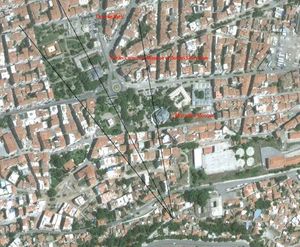
So the mosque turns out to be Sultan Camii, that is, that of Sultan Süleyman, who ruled 1520-1566, built in 1522, in honor of his mother. A double bath (i.e. with separate sections for men and women) and a hospital were added later, I’d estimate still in the 16th century.

Another mosque is visible to the right, with one of its minarets just sticking out behind the right rear corner of the apartment building in the middle. This is the Muradiye Mosque, built in 1585 by Murad III, the last prince who was called from Manisa to ascend to the throne of the Ottoman Empire. When the Ottoman princes were no longer sent to the provinces for training, Manisa lost its special status.

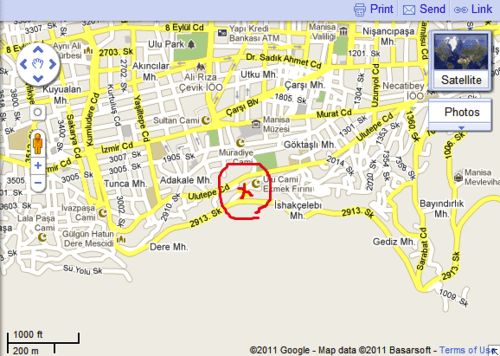
The perspective to the Western minaret of the Muradiye gives away the point from where the image must be taken: the little domed structure on 2003rd St. indicated in the screenshots from GoogleMap [above], which might house a fountain or a tomb – I can’t tell.

Despite much traveling in Turkey I have never been to Manisa. This is a nice reminder that it would be worthwhile.

Congrats!  We will get a VFYW book out to you shortly. From the reader who submitted the contest photo:
Manisa VFYW2

It was taken from the second floor of a ruined shop on 2003rd Street in Manisa, Turkey, just past the Seljuk-era Ulu Camii mosque. The name of the neighborhood is Ishakchelebi, after the ruler of the Saruhan emirate who built the Ulucamii (Great Mosque) in 1366. It is still open to prayer. The domed roof of the building is intact but we had to climb up through a hole in the second floor. The view is toward the plains of the Hermus River and away from Mount Sipylum. Manisa is the site of the Battle of Magnesia in 190 BC, at which Rome conquered the Seleucid Empire based in Antioch (modern Antakya, Turkey).

(Archive)
Obama’s Long Game, Ctd

Andrew Exum does a point-by-point assessment of my Newsweek take on Obama's foreign policy. One bit:

The president deserves real and enduring credit for his bold decision to launch the raid that killed Osama bin Laden, but let's not overstate the case here. Sullivan makes it sound as if the president was the de facto J3 for JSOC. (That was actually Rich Clark, if anyone at home is looking to assign credit.) The raid that killed Osama bin Laden was a great victory for the United States, but if victory truly has a thousand fathers, plenty of others deserve credit — including George W. Bush, who was the president as JSOC and its allies in the intelligence community built up many of the capabiltiies that allowed them to track and kill bin Laden. Bush most certainly did not "ignore" bin Laden. Ultimately, the raid was enabled because the United States caught a break on intelligence. And does anyone think that George W. Bush, if given a similar break, would not have made similar decisions?

Really? Andrew ignores the fact that Obama actually had a major fight with McCain in the debates in 2008 over whether he would unilaterally launch a mission into Pakistan to get the guy, without Pakistan's approval. McCain and the rest of the right cited this as evidence of Obama's naivete and incompetence in foreign policy. Obama set a new course in early 2009 – and did exactly what he said he'd do. Here's what we know of Bush and Bin Laden. He let him escape in Tora Bora; in 2002, he said this on Bin Laden:

In 2006, Bush stenographer, Fred Barnes, talked about the issue with Bush:

“Bin Laden doesn’t fit with the administration’s strategy for combating terrorism.” Barnes said Bush told him that capturing bin Laden is “not a top priority use of American resources.”

Obama changed that. And, as I said, if he were a Republican, and had this record on this issue, he'd be on Mount Rushmore by now. More to come – on Andrew's fair-minded critique and others'. This is a debate worth having.

Obama’s Long Game, Ctd

Jon Walker takes me to task for writing in my cover-story that, under Obama, "support for marriage equality and marijuana legalization has crested to record levels":

I apparently totally missed the moment when Obama convinced the American people to support gay marriage and marijuana legalization. The record is that Obama has repeatedly stated he opposes marijuana legalization and marriage equality. Logically Obama deserves no more credit for these trends, which seem driven by demographic changes, than George W. Bush does. After all, support for both issues repeatedly hit new record highs under Bush.

Oh please. If you accept my premise – that he "leads from behind" for a "long game" – you can begin to see my case. Obama is not going to crusade for either cause. But he is not going to oppose them either and has quietly encouraged them. Hence instructing the DEA not to interfere with state laws on medical marijuana and withdrawing a legal defense of DOMA. Yes, there's been some regional slippage in California on allowing states to determine their medical marijuana laws, but that hasn't apparently come from Obama's office. Combined with the breakthrough on gays in the military, this has been the most productive period for gay equality in a long time. And it's more durable because Obama didn't do it. We did. Which was the fucking premise of his entire campaign. He gently pushed it along, insofar as a president can on an issue that is essentially rooted in the states. Doug Mataconis lodges a common criticism of the president:

I tend to disagree with Sullivan’s rosy view of the President’s leadership and his alleged skills as a domestic policy strategist. From my perspective, the President erred from the beginning when he allowed far too much of his domestic agenda to be highjacked by the Congressional leadership. The stimulus bill, for example, ended up becoming a "Christmas Tree" bill for a decades worth of Democratic pet projects that had little connection to growing the economy.  Perhaps that was inevitable, Congress is the stronger branch of Government in domestic politics and the Congressional leadership in 2009 had been around Capitol Hill far longer than Obama, in some cases far longer than the length of Obama’s entire political career. Those people weren’t simply going to sit back and let this green kid from Chicago run the whole show no matter what his title is.

You want to get a $800 billion stimulus to get through Congress immediately? And you don't get perfection – but it works? Count me down with that. Again, what world are these people living in? Likewise, Michael Brendan Dougherty argues:

Upon entering office, instead of focusing on a jobs issue, he ditched all of his bipartisan rhetoric in order to get his health-care reform passed.

Upon entering office, as Dougherty himself in the same piece just wrote, Obama's focus was the stimulus and preventing the banks from imploding and the world economy going down the drain. The healthcare proposal – which does indeed include Heritage Foundation innovated market exchanges for healthcare and a variety of cost-control experiments – came later in the spring. It did not prevent the successful auto-bailout, or the big tax cuts that made up a third of the stimulus. As for ditching bipartisan rhetoric, I refer Michael to the September 2009 speech where Obama tried precisely to frame the bill in a bipartisan, moderate fashion. Here's Obama in September 2009 "ditching bipartisan rhetoric":

It has now been nearly a century since Theodore Roosevelt first called for health care reform. And ever since, nearly every President and Congress, whether Democrat or Republican, has attempted to meet this challenge in some way … There are those on the left who believe that the only way to fix the system is through a single-payer system like Canada's — (applause) — where we would severely restrict the private insurance market and have the government provide coverage for everybody. On the right, there are those who argue that we should end employer-based systems and leave individuals to buy health insurance on their own.

I've said — I have to say that there are arguments to be made for both these approaches. But either one would represent a radical shift that would disrupt the health care most people currently have. Since health care represents one-sixth of our economy, I believe it makes more sense to build on what works and fix what doesn't, rather than try to build an entirely new system from scratch.

I'm grateful for the responses to my piece. I'll keep responding to the substance, not the ad hominems. But I have to say that Dougherty's piece confirms my basic view. So many people have been taken in by fantasies – on both sides – that are demonstrably untrue.