The Madness Over “Mad Men”

Marc Tracy psychoanalyzes the show's appeal to both viewers and critics:

The most interesting thing about Mad Men isn’t judging how good it is, but trying to figure out why people think it's so much better than it plainly is; "the deeper, almost irrational reasons for the series’s appeal," as Mendelsohn put it. And part of it is, of course, that the show has figured out how to display and have us enjoy shiny surfaces that attain deeper meaning without requiring the investment, on either the creators’ or viewers’ parts, of more time.

[The recent scene showing a Jewish character's father blessing him] is an obvious example: it could not possibly hold any deeper meaning to us, because we have met the character less than one hour before; instead, it mugs an age-old prayer’s gravitas and importance and tricks us into thinking that what we’ve just seen is the thing with the gravitas and the importance. It’s a spiritual shortcut, the great-grandson of what the Catholics called simony, and today we call sentimentality (except, that is, when there is literally a prayer involved, in which case I guess we can still call it simony).

Tracy's Tablet colleague Rachel Shukert recently examined the new season's mid-1960s milieu, "an era when Jewish culture and American pop began to meld." She shares Tracy's scrutiny:

Why does Mad Men, despite being at times maddeningly slow and full of characters who remain maddeningly (if realistically) devoid of self-knowledge and personal growth, captivate us so? Like the song says, why oh why do we love it like we do?

Much has been made, and rightly, of the transformational aspect of the show’s ’60s setting: the Decade When Everything Changed. To paraphrase Harold Bloom’s Shakespeare analogy, if Shakespeare invented our modern conception of the human, the 1960s ushered in the America most of us know today: noisy, fractious, socially aware yet hopelessly narcissistic, grandiose yet paranoid, forever enmeshed in so-called "culture wars" that seem never to resolve.
What’s The Biggest Threat To Global Stability?

Food shortages?

Grain yields are beginning to hit a "glass ceiling" in many countries, [Lester Brown, founder of the Earth Policy Institute] said, where farmers have already taken advantage of what science has to offer for improving yield. As more and more countries hit an upper limit on productivity, the world grain harvest will begin to plateau, even as demand for food continues to rise, causing a rise in prices. More worrisome, the global food market is vulnerable to external shocks such as prolonged drought. “We don’t have idle land, we’re flat out,” says Brown. "We don’t have [food] stocks. We’re living harvest to harvest. The question becomes, what if we have a major shortfall in the world?"

Congress Has Mail

Inbound-Mail

Matt Glassman takes a close look at congressional inboxes:

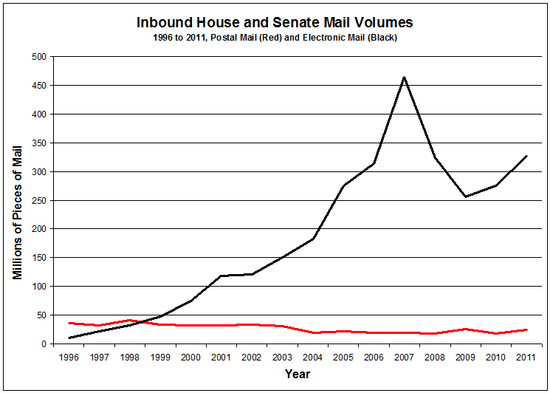
With postal mail, it was always easy to know if you were being written to by a constituent or by someone from outside your district. The rule of thumb for sorting such mail is typically something like this: if it’s a constituent or interest group from our district, put it in the pile for things that we will promptly respond to; if it’s a constituent from outside our district, put it in another pile for things that we will promptly deliver to the correct office; if it’s a interest group from outside our district, look through it quickly and see if it’s personal or a form letter / mass spamming. If it’s the former, consider responding. If it’s the latter, definitely trash it. The problem with email, though, is that you can’t tell if the sender is from the district or not.

And there are quite obvious incentives to not exclude anyone who might be a constituent. And so the incoming email has a tendency to nationalize the constituent communications techniques used in most Member offices; there’s just isn’t a sorting algorithm that lets you separate your constituents from other citizens. Which means that the information context Members are facing in their offices is much more national in scope, even after they’ve tried to filter it. This has consequences. For one, it forces a complete rethinking of an office communications strategy. But it also distorts one’s perspective of district opinion, and tends to orient Members toward national public policy; people from outside the district are much more likely to communicate about policy issues than distributive politics such as grants or earmarks.

In a follow-up post, Glassman tracks mail going the other direction.

Adoption In The Muslim World

Is often illegal:

As a single Muslim mother to an only child—my son Shibli, age 9—I have investigated adoption possibilities in a Muslim country, such as Afghanistan, where so many orphans suffer, and have been sadly discouraged, as have many Muslim couples and single Muslim women, about the possibilities of lifting children out of orphanages into stable, loving homes. Most Muslim majority countries adopt the interpretation of Islam that makes it illegal to adopt a child; some allow fostercare or guardianship, known as kafala.

“Driverless Cars Are In Our Future”

Driverless_Car

Google isn't the only one working on driverless cars:

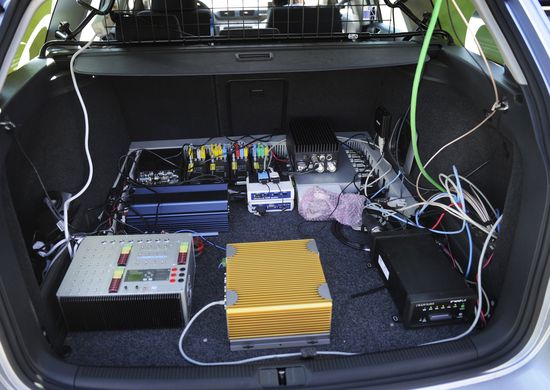
[Tinosch Ganjineh, leader of a driverless car research team in Germany] agrees that driverless technology has to be refined. "The size and price of these systems needs to come down. Today, half a trunk of equipment is needed for autonomous driving," he says. Another challenge, says [Paul Newman, a robotics engineer at the University of Oxford whose team is developing autonomous cars,] is getting the cars to recognise the precursors to risky events – like sudden bright sun reflections on the road, truck spray, which may blind some sensors, or simply a burst tyre.

Adam Ozimek expects the hurdles to be overcome:

Skeptics cite our deep aversion to handing over control to a computer as an impediment to the driverless car. But it need not be the case that the first time you hand control to a robot it will have you barreling down the interstate at 70 miles-per-hour. Autonomous driving might first be used for slow moving, stop-and-go traffic. You can see a precursor to this in cars that are already parking themselves. We can ease our way into comfort with it. We should have little doubt: driverless cars are in our future.

(Photo: A view of the trunk containing the electronic brain of the driver less car 'Made in Germany' (MIG), which from the outside looks like a regular Volkswagen Passat with a camera on top, as it is being put through its paces at Berlin's disused Tempelhof airport , October 13, 2010. By Odd Andersen/AFP/Getty Images)

Will The World Buy American?

Tyler Cowen provides reason to think so:  

To put it simply, the closer other nations come to our economic level, the more they will want to buy our stuff. Indeed most of those nations are growing rapidly, so we can expect their attentions to shift toward American exporters. The leading categories of American exports today—civilian aircraft, semiconductors, cars, pharmaceuticals, machinery and equipment, automobile accessories, and entertainment—are going to be in the sweet spot of growing demand in what we now call the developing world. 

The Crisis Of Christianity, Ctd

A reader writes:

I was just glancing over at former Christianist now Greek Orthodox Frank Schaeffer‘s blog and saw that he was applauding your essay. He’s posted it along with this note:

Once in a while I read something that “says” what I believe and at the same time clarifies that belief and makes it better than it was. Here is one such article. I share it here as my Lenten meditation.

I also went into the comment section and one reader made a book suggestion. The reader was suggesting the novel “Chasing Francis” by Ian M. Cron. It’s the story of a megachurch pastor who has a crisis of faith which leads to a visit to his uncle who is a Franciscan priest in Italy and a pilgrimage to know St. Francis and thereby his own faith. Money quote, as you would say:

“When I left here, I wasn’t sure what a Christian looked like anymore. My idea of what it meant to follow Jesus had run out of gas. I started feeling less like a pastor and more like a salesman of a consumerized Jesus I didn’t believe in. Learning about Francis helped me fall in love with Jesus again – and with the church again, too.”

That’s an uncanny passage, but its resonance reminds me that we are often less alone than we thnk in the world. I have to say that writing that piece and having it out there has made me feel very depleted, even empty, and depressed. It’s been such a glorious week of early Spring here in Washington and I have been struggling to put a face on.

The worldliness of Washington which I imbibe daily, hourly can weigh on the soul after a while. And I have rarely felt it so acutely as I have these past few weeks. Maybe it’s the news: our deadlocked, nasty polity; the total intractability of the Middle East; the backlashes that sting and the campaigns that drain. But all I want is Francis and through him Jesus.

This Lent has been, well, Lent for me. Forgive me the indulgence of showing that someone out there gets what I am fallibly trying to express. I just needed it.

The Daily Wrap

Today on the Dish, Andrew laid into the right's absud view of Obama (follow-up here), watched the primary returns fit well-worn patterns, blasted the Tea Party and SCOTUS' blinkered understandings of freedom, worried about America's "entangling alliance" with Israel, and despaired at America's treatment of gay, international couples. We linked Obama's anti-Ryan jeremiad to his message in the fall, yawned at today's primaries, watched the Romneys from different timelines battle each other, reexamined the Santorum/cyberbullying issue, snickered at Rick's trip to Mars, gaped at a Fox News anchor's silliness, watched the appeal of neoconservatism wane, got at the essence of that declining doctrine, and located the future of liberalism in post-liberalism. Ad War Update here.

Andrew also livechatted about his Newsweek  Christianity cover, clarified its argument in response to blogospheric feedback, defended the piece against reader dissents, and listened to more reader commentary here and here. We calmed fears about Iranian nukes spurring regional proliferation, heard the war drums on Iran abate, flagged an interview with Peter Beinart, gave context for Iraq's low death toll, and celebrated Burmese economic progress alongside its tentative steps toward liberalization. Taxes saved (?) the economy, job training programs failed, the "Big Football" thread moved forward, crowdsourcing entrepreneurship advanced (tentatively), and The Economist prospered. Scientists worked on an explanation for ideology, animals had superstitions, the young supported paid organ donors, and cyclists weighed in on the rules of the road. Sleeping with a porn star touched a reader's heart, community college became cool, and writing surprised writers. Ask Jonah Anything here, Cool Ad here, Quote for the Day here, VFYW Contest Winner here, VFYW here, MHB here, and FOTD here.

Z.B.

The Crisis Of Christianity, Ctd

Judge-16

A reader writes:

Those who crave a true and unmitigated relationship with God will find a way to have it. Even when we have to walk away from the trappings and dogma of Christianity, a religion not given to embracing gay people, in order to do it. And so I have done – without losing any of my own sense of God in my life, a sense I've had ever since one November evening in 1975, when 15 year old me asked God to come into my life and I was flooded by a sensation I've never recovered from. I was born into a new "me" that I had ever experienced before. I've since learned that in India the sensation is sometimes described as having one's heart chakra open.

My relationship with God, is more important to me than anything else in my life, and yet I no longer know what I actually mean when I state that…

Another:

Closing the chat with the story of Fr. Mychal Judge's extraordinary life was apt. (I went to that Franciscan church for most of the years I lived in NYC, and it is a place full of powerful and humble spiritual leaders.) Fr. Mychal lived the Franciscan dictum: "Proclaim the Gospel at all times. If necessary, use words."

I have always loved that dictum. Another:

I wish you all the best on your personal journey. But this is what it is – what you describe is a deeply personal journey, a personal experience, a personal battle between desire and sense-fulfillment on one side, and a sense of higher knowledge on the other. This journey can happen in a religious context but it really has nothing to do with any particular religion.

Strip religion down to those teachings that have to do with ego and transcendence of ego and what you end up with is Eastern philosophy – a philosophy (a set of them actually), not a religion. What you describe will always be the path of the few – religions on the other hand try to make themselves applicable to many and in so doing, inevitably become what they are.

Since you mention it in your article: it is my understanding that you will never be able to truly love your neighbor if you do not come to know yourself. It is also true that you will never come to know yourself if you don’t love your neighbor (at least a little). Thanks for the good read and again, I wish you the best.

PS: I’m writing you from an ashram in India where I’ve spent the last 16 years pursuing these very same goals. I’ll be the first to admit that even if the mountain is one, the paths to the summit are many.

It’s Over, Right?

142332001

With Maryland won, Wisconsin exit polls showing a solid Romney lead, and Drudge leading with tornadoes and trailer trucks, it must be. Here are Ryan Lizza, Joshua Putnam, and Andrew Prokop's final delegate projections

Romney will be 22 delegates short of the 1,144 he’ll need to win the nomination. That might sound like good news for Rick Santorum, but according to Putnam’s count there will also be 598 unbound delegates remaining at this point. These delegates can support any candidate, either because they are chosen in non-binding caucuses or conventions, or because they’ve been directly elected in primaries. If Romney is only slightly short of his magic number, it will be easy for him to win the support of unpledged delegates from states that he won, like Illinois, Maine, and Washington.

So it is over? Yeah, pretty much. Santorum is so far behind in delegates that he needs to significantly broaden his appeal to turn things around. But if he loses in Wisconsin and Maryland today, his time will have all but expired.

The exit polls from Wisconsin paint a very familiar picture. Romney's biggest selling point is that he is the strongest candidate to beat Obama. The message? Meh.

Ron Paul won the under-30s again. Romney's strength is still among seniors. He lost to Santorum again in the lowest income bracket, under $30,000, but Romney did better than usual among those without a college degree (i.e. he actually narrowly won that demographic). But … drum roll, please … Romney still lost the white evangelical vote to Santorum by 39 – 41. A low turnout among these voters may have been responsible for Romney's solid win. Catholics preferred Romney to Santorum – again. The mega-rich convert to Catholicism, Gingrich, came in last among Catholics.

Oh, and 23 percent of Wisconsin's Republicans think that Rick Santorum is not conservative enough. Ponder that for a while.

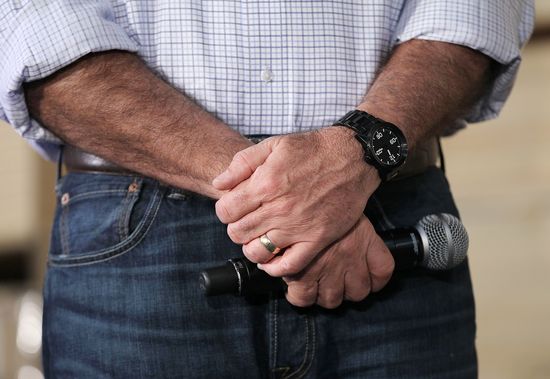
(Photo: Republican Presidential candidate, former Massachusetts Gov. Mitt Romney holds his microphone during a twon hall style meeting at Wisconsin Building Supply on April 2, 2012 in Green Bay, Wisconsin. By Justin Sullivan/Getty Images.)