Ad War Update: Playing Welfare

by Chas Danner

Today was the battle of the web videos, as the Obama campaign responds to Romney's welfare waiver attack with the following:

However, despite the substantial pushback, Team Romney is still going welfare-strong, uploading a Romney speech titled "We Should Not Turn America Into A Nation Of Dependancy," as well as bringing out the archival footage in this web ad:

The commentary is still coming regarding the new Priorities USA ad connecting Bain Capitol to a woman's cancer death. Today a Romney spokesperson surprisingly touted Romneycare to rebut the ad, a likely slippery slope mentioned in yesterday's ad update. Greg Sargent thinks the dustup reveals the big picture:

Even if this ad makes unsupportable charges — and even if you think there’s nothing objectionable about Bain’s conduct — the ad dramatizes a larger story about what has happened to the middle class in this country. There is a straightforward difference of opinion between the two candidates over how to respond to this — over the degree to which the federal government should intervene to protect people like Ms. Soptic. Obama believes in aggressive federal action to cushion the blow of market outcomes like the one that hit families like the Soptics with such force. Romney — even though his campaign has now said universal health care is the right answer in cases like hers — is promising to roll back government protections for families like theirs. Whatever you think of the ad, that's the more important larger argument to be having here — and it has been clarified this week.

Taking another look at examples of outside spending in downticket races, Karl Rove's Super "non-profit issues") PAC, Crossroads GPS, has some new ads up in a five-state, $7.2 million campaign. Here's a $700K+ ad against Democratic Senate candidate Shelley Berkley in Nevada:

In fundraising news, this week Politico looked at the proportion of small money in the campaign:

2,100 donors giving $50,000 or more have contributed about $200 million to the Obama and Romney campaign committees, victory funds and their supportive super PACs. That’s far more than the $148 million all those 2.5 million small donors contributed through the end of June, according to an analysis of Federal Election Commission data by POLITICO and the Campaign Finance Institute. In other words: In an election purportedly being driven by the economic concerns of the middle class, the top 0.07 percent of donors are more valuable than the bottom 86 percent.

If you'd been meaning to purchase the domain "Mom-Ney.com" for your mom-themed Romney fansite, you're officially too late, as both presidential campaigns have been locking down domain names for potential microsites. (The Obama campaign is apparently still sitting on MittBot.com  – will Obama fight a robot at the convention?) Lastly, Libertarian presidential candidate Gary Johnson continues to release polished and positively-charged web ads in an attempt to connect with more voters:

Ad War archive here.

A Gold In Tax Loopholes

by Patrick Appel

Yglesias cries foul:

If they gave out awards for dumb new policy ideas, President Obama and Republican rising star Sen. Marco Rubio would both be medaling this week. Their achievements? Rubio’s completely pointless bill offering a tax break to recipients of Olympic medals and—even worse—the president’s decision to hop on the bandwagon rather than show the country he has a firmer grasp on the issues than his adversaries do. In the scheme of things, of course, winning Olympic prizes is not an important sector of economic activity, and the medals’ tax status doesn’t really matter. But the overall shape of the tax code does matter a great deal, and the speed with which a bipartisan consensus emerged around making it worse bodes quite poorly for efforts to make it better.

He follows up at his blog:

Obviously the specific revenue implications of this bill are small. But the framing around it is deeply right-wing. The idea is that taxes are a kind of penalty, and that we shouldn't be penalizing these worthy athletes for their efforts. But by that token we shouldn't be penalizing the people who invented Gmail or founded Papa John's or earn a living driving a long-haul truck or making beds at the motel or designing marketing materials for Sabre printers. The typical way to make money is to do some work that some other people find valuable enough to pay you for.

Josh Barro is unsurprised:

Obama’s acquiescence isn’t surprising when you look at his broader take on tax policy. The president likes to talk about raising taxes on the wealthy so that they pay their “fair share.” But he irresponsibly promises that he won’t raise taxes on families making under $250,000 a year — 98 percent of the population — in spite of an $11 trillion budget gap over ten years. The president’s whole tax policy agenda is built around moral desert, not revenue sufficiency.

Europe’s Blind Financial Policeman

by Gwynn Guilford

Lisa Pollack bemoans the European Central Bank's pretty major handicap when it comes to monitoring financial institutions, a lack of data:

The data the European Central Bank currently have is arguably not enough for even the macro-prudential supervision they’d like to do, let alone the more specific kind — a troubling thought if it is to build out a regulatory capacity.

The reason for this dearth of data:

Concerning the legal hurdles, national regulators have a serious advantage over the ECB in that they are operating within their home jurisdiction. This means good access to information for financial institutions that operate in their territory. It’s kind of like having the power to do strip searches…. But the ECB is one step removed, sitting outside the relevant jurisdictions. Instead of a strip search it’s more like they can request a small pat down over tea and biscuits, should parties be so willing.

When Sponsors Back The Wrong Horse

by Gwynn Guilford

Corporate sponsors are scrambling to find an inspiring angle to the Olympic flameout of Chinese hurdler and gold-medal hopeful Liu Xiang, who injured his Achilles Heel on the first hurdle in the first heat of the 110-meter event:

All of the brands that had invested heavily in him as their sponsor—BMW, Mini, Nike and more—rushed to switch messaging gears. "As the father of the modern Olympics, Baron Pierre de Coubertin said, the Olympics most important thing is not to win, but to participate; not to have conquered, but to have fought. Liu Xiang achieved it!" That was the message on Tsingtao Beer's Weibo just a few hours after Liu's injury. The star hurdler is the anchor athlete of Tsingtao's London 2012 campaign. Mini Cooper China's message "Completing my journey, Regardless of position or results" — came with a questionable, if humorous, choice of images: a Mini roadster plowing carelessly through hurdles….

Nike has it the worst; in addition to Liu Xiang, it sponsors the Chinese men's basketball team:

Nike's Liu mess came just hours after the brand was forced to address the fact that China's Nike-sponsored basketball team had lost every game it played. Less than four hours before posting its "Who dares start all over again…" Liu Xiang message, Nike posted a (again prescient) message about China's basketball team falling out of contention: "Do not let your expectations disappoint. Tomorrow, please continue to pick up the ball. China basketball will never be extinguished…."

The salt in Nike's wounds is that China is otherwise doing spectacularly in London, trading the medal leads with America. Chinese [sportswear] brand Li-Ning is having a fabulous Olympics. Its Spain-sponsored basketball team is advancing and following a spectacular match that won him the badminton gold, China's Lin Dan gave a thankful pluck to the Li-Ning logo on his jersey.

Meanwhile, China Digital Times posts China's Propaganda Department directives regarding the coverage of Liu Xiang:

August 6, 2012

Propaganda Department of the Communist Party of China: The media must not make predictions on Liu Xiang’s performance in the preliminary heat. Do not report negative news about him. The media must strongly affirm Liu’s indomitable fighting spirit against all odds….

August 7, 2012

Propaganda Department of the Communist Party of China: In reporting on Liu Xiang failing to complete the race at the London Olympics, strictly adhere to the essence of the Department’s previous notice. Focus on Liu’s indomitable fighting spirit. Do not issue negative reporting or commentary.

But not everyone followed orders. Anthony Tao lets loose on the over-the-top gravitas of China Central Television's announcers:

Liu Xiang was in the sixth heat of the preliminaries in the 110-meter hurdles, and on his first leap his left foot collided with the hurdle, sending him down. He landed awkwardly, tumbled and tumbled, and the CCTV commentators emitted a scream and then went speechless for the next five seconds. One of them bravely managed the words, "Fallen to the ground," and then they let the runners who were on their feet cross the finish line without noting their existence or saying one goddamn word as if a half-deity had been assassinated and his blood was now pooling next to his beautiful evergreen body and turning the rubber MondoTrack black while the children of gods gouged out their eyes in disbelief.

And then one of the commentators totally lost perspective and began breathing hot and heavy into the microphone and sniffing and crying. HUH??? Grow a fucking pair, man. Liu Xiang is not your long-lost father, and he’s not DEAD. You didn’t see his foot fall off on live television…. He’s a fucking hurdler, for chrissakes — and one that didn’t try nearly as hard as this guy. PERSPECTIVE.

Hathos Alert, Ctd

by Gwynn Guilford

A reader gives a little more on the backstory of Singapore's "National Night" patriotic procreation campaign:

Thank you thank you thank you for the National Night bit. My husband is from Singapore. It has three main ethnic groups – Chinese, Malay, and Indian.  The Chinese run the place, but they also have the lowest population growth.  And they're scared to death of becoming a minority – so it's not openly spoken, but there's a constant push for the Chinese population – not just the wealthy and educated – to have more babies. Anyway I will enjoy showing this video for him – he's always embarrassed this time of year because of the faux patrotism imposed by the SG government for their National Day.

KC Ifeanyi expands on that point, noting that Singapore's fertility rate dropped to 1.2 in 2011, compared with 1.6 in 2000:

[W]ith verses such as "Like a government scholar, I wanna cram real hard / And tap you all night like an EZ Link card," it’s difficult to imagine how this won’t get the masses hot and bothered. But wait a minute, tiger! Not to douse the flames of passion burning betwixt your legs or anything, but the campaign’s brief explicitly states this libidinal lobbying is for "financially secure adult(s) in a stable, committed long-term relationship(s)."

Howard Zinn With A Guitar?

Springsteen_Bruce_GT

by Matthew Sitman

Responding to the recent outpouring of Boss-related commentary, especially by Jeffery Goldberg, David Remnick, and David Brooks, Leon Wieseltier characteristically unloads on "the literature of fandom" and Springsteen's supposed late-career artistic failings:

The musical decline of Bruce Springsteen has been obvious for decades. The sanctimony, the grandiosity, the utterly formulaic monumentality; the witlessness; the tiresome recycling of those anthemic figures, each time more preposterously distended; the disappearance of intimacy and the rejection of softness…The joy is programmatic; it is mere uplift, another expression of social responsibility, a further statement of an idealism that borders on illusion. The rising? Not quite yet. We take care of our own? No, we do not. Nothing has damaged Springsteen’s once-magnificent music more than his decision to become a spokesman for America. He is Howard Zinn with a guitar.

There is, of course, a measure of truth in Wieseltier's remarks. Like many great creative talents, Springsteen's early albums, in absolute terms, really are better than his most recent work – or at least they possess an urgency and freshness that necessarily has diminished with time. And yes, most of the latest writing about Springsteen – especially Brooks' tale of traveling to Europe to see him – is rather lame.

The core of Wieseltier's argument, though, is a form of snobbishness masquerading as criticism. The language is typically overblown and his statements – amusingly, given his castigation of other writers for their lack of nuance – are without a trace of hesitation or complexity. Wieseltier seems put off that people go to Springsteen concerts and come away hopeful and uplifted, but not raging against the machine. He is terribly upset, citing Marcuse, that the music has not yet inspired a revolution. Springsteen fans labor under a form of false consciousness: their "joy is programmatic; it is mere uplift, another expression of social responsibility." He laments tastes less sophisticated than his own, appalled at the simple pleasures of a rock show. That Springsteen's more political and social songs do not make the arguments he would like, or that certain rock numbers sometimes slip into sentimentality or rather hazy formulations – this means that the music is not serious enough.

And so Wieseltier has missed the point.

The Remnick essay – imperfect and too uncritical – makes clear that whatever "message" Springsteen hopes to convey in his songs, he labors mightily not just to be serious, but to provide those moments of connection between artist and audience that allow us to slip out of the burdens of everydayness and enjoy glimpses of meaning and fullness. What else could Springsteen have meant, as he once sang, that he learned more from a three minute record than he ever learned in school?

All this reminds me of a line from the great N+1 essay about TNR's back of the magazine: "It confuses censoriousness with a faculty of judgment that links the aesthetic to the moral sense." That essay was titled "Designated Haters." This ultimately is what Wieseltier finds so detestable about Springsteen; he clings to hope rather than hate. The Boss is earnest. In an age of irony and near total skepticism, the perils of hope coming across as naive, un-serious, an empty form of consolation abound. If Springsteen proffers this hope, at times, in less than convincing ways, I will still choose it over a pose of condescension and contrived contrarianism.

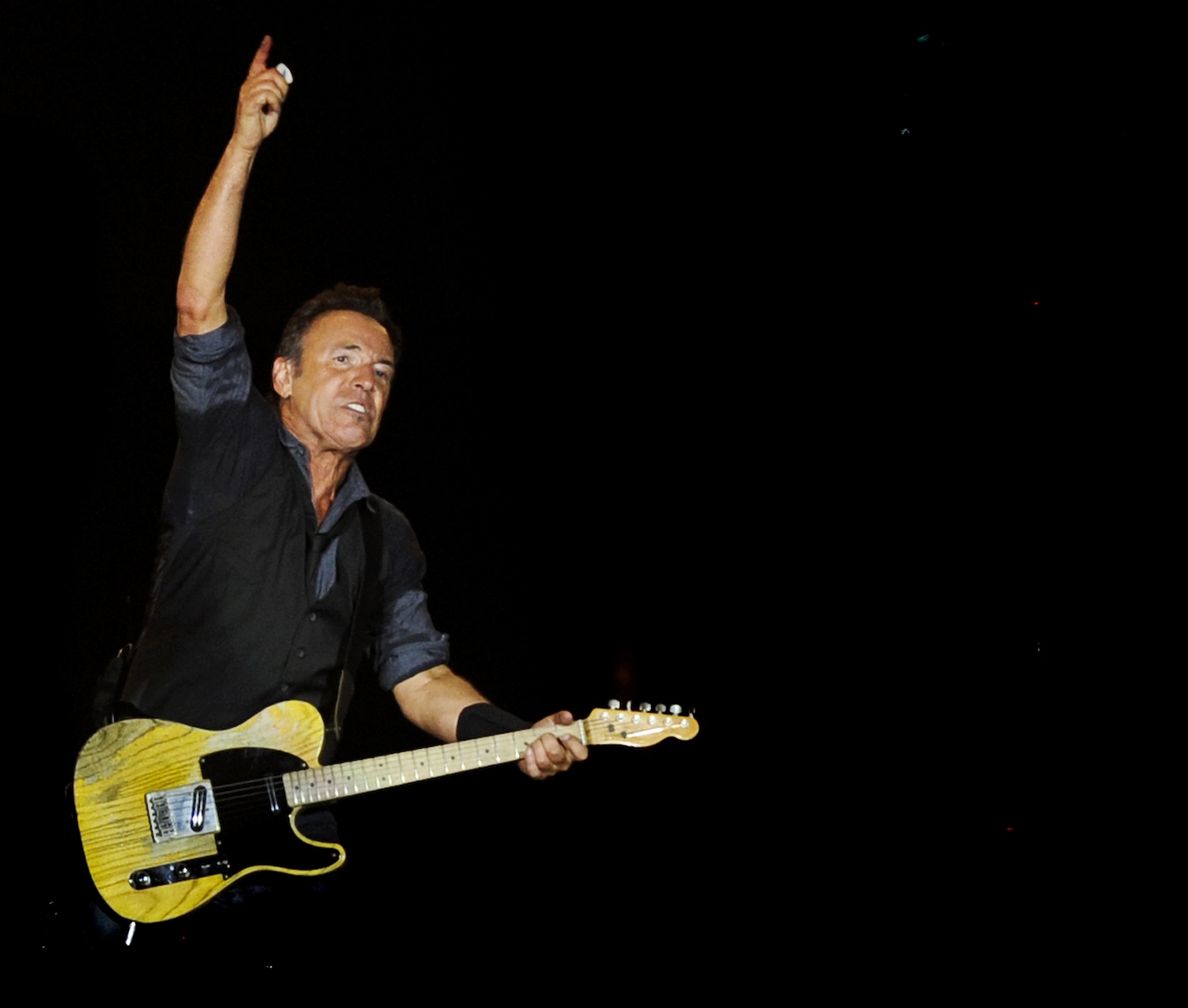
(Photo: North American singer Bruce Springsteen performs during the Rock in Rio Lisboa music festival at Bela Vista Park in Lisbon on June 3, 2012. Patricia De Melo Moreira/AFP/Getty Images)

A Cold War In The Middle East?

by Chas Danner and Patrick Appel

Jon Lee Anderson examines the international implications of the Syrian conflict:

[I]t’s clear enough that whatever it was before, Syria’s conflict is being fought along sectarian lines. The same holds true for the widening regional links being formed. Just as the Shiite-led Islamic Republic of Iran, and its Lebanese Shiite proxy, Hezbollah, are among Assad’s closest and most steadfast allies, the Sunni Muslim states of Saudi Arabia, Qatar, and Turkey are the main backers of the Syrian rebels. There is, of course, a geostrategic dimension to this as well: behind the Shiites stand Russia and China; behind the Sunnis stand the United States.

He believes that "post-Syria, we may well be speaking openly about a new Cold War, with the international battle lines drawn roughly as they are today around Syria, and with new proxy conflicts yet to come." As part of a larger look at the current state of the Arab Spring, Marc Lynch likewise fears "the regional effects of Syria's relentless shift from political uprising to externally-backed armed insurgency and sectarian rhetoric":

Like Iraq in the previous decade, Syria is increasingly the battleground for regional proxy war, the breeding ground for regional sectarianism and jihadist extremism, and a potent cautionary tale for autocrats seeking to frighten their discontented populations against further revolts.  The Syrian war overshadows almost all other issues in today's Arab media, driving out many of the political and social and intellectual issues brought to the fore by the early days of the Arab uprisings.  The idea that things would be better in Syria now had the United States intervened militarily is a fanciful one — more likely, such an intervention would only have destroyed hopes for a political solution more quickly, accelerated the violence, and now found American forces caught in the quagmire. The Obama administration has been wise to resist pressures to intervene militarily in Syria, and I fear that its emerging moves to support the insurgency, which it likely sees as now politically necessary even if unlikely to actually produce desirable outcomes, will come back to haunt it in the coming years.  But the reality is that there are now no good options.  

Bloomberg Knows Breast? Ctd

by Chris Bodenner

Remaining thoughts from readers on the baby formula debate:

God knows I wasn't going to comment, but I can't help myself. Bloomberg is an ass. Sorry. I breastfed all three of my children – my 3rd one, due to a dairy allergy, until she was 13 months old. This won't be a popular reaction, but I hated it. I did it because there was so much pressure on moms to breastfeed. With my 2nd child, I didn't produce enough milk. I sat and wept in the pediatrician's office when they weighed my baby and she had lost weight. I felt like a total failure. I went to a private lactation consultant. She told me to drink some special tea, get in bed with my daughter for 24 hours and nurse around the clock. She still wasn't gaining enough weight. Our pediatrician told me to supplement with formula. Reluctantly, I did, but I felt so inadequate. With my 3rd, she refused a bottle so I nursed her exclusively until she was 13 months and we could transition her to rice milk due to her allergy.

Some women love breastfeeding and it's obviously healthier, but we need to stop with all the guilt. And those terrible swag bags give free samples and coupons that families need. Formula is really expensive. It's one of the top grocery items shoplifted. And Bloomberg, who is pro-choice, should be an advocate of women choosing how we use our bodies.

Another tempers such reactions:

Many of your readers have been mislead as to the true nature of the "Latch on NYC" breastfeeding choice initiative.  The greatest myth is that the initiative is mandatory; it is entirely voluntary on the part of all hospitals.

Furthermore, there is absolutely no requirement that hospitals keep commercial baby formula under lock and key.  The initative does limit access to formula by hospital staff, in the same way many hospital medications and supplements may not be accessed unless specifically approved my physicians and medical supervisors.  A major reason for this limitation is due to the high incidences of breastfed infants being given supplemental formula feedings by hospital staff – against current medical policies and often without the approval of the parent(s).  The initiative specifically states that formula should be made available to those who make an informed decision not to breastfeed.

There is no need to rehash the economic and health benefits of breastfeeding, as they are proven beyond a doubt.  Yes, there are women who can not or do not wish to breastfeed, and the Latch On initiative respects the rights of these women.  It's the hospital that has no business – particularly without the express permission of the mother and her medical care givers – to promote the use of commercial products for its own convenience and possible financial advantage.

On the other hand, a reader details how expensive, and painful, breastfeeding can be for some mothers:

Before you attempt to do it, breastfeeding sounds easy:  Step 1: Attach infant to breast; Step 2: Feed.  At least that is what I thought before I had my baby.  In reality there is a lot more that goes into it.  You have to get the baby to latch on properly or else you will end up in excruciating pain (i.e. sore, bloody nipples).  Even if you get a good latch from the start, you will still experience a lot of soreness, and so for a period of a few weeks even wearing a shirt can be uncomfortable.  Also, just working on getting the latch and doing it right takes a lot of practice and can take a lot of time each time you go to feed your baby. 

Then feeding your baby itself takes a lot of time.  How much?  For a newborn (a baby up to 3 months), you are generally feeding on demand which means every 3 hours.  Doesn't sound like that much, till you think that means 8 times a day (24 hour period) and takes 45 – 60 minutes each time.  That is up to 8 hours of breast feeding a day.  It gets faster and more efficient (I am told) as you go along, but if you have to go back to work after 6 weeks, and you are exclusively breast feeding, that is a lot of time – with baby, with your pump, and worrying about your supply (the less time you are feeding baby, the more likely you get a drop in milk supply as a pump is not as efficient as a baby).

My plan – as an older, yuppie, blue state city dweller, white collar professional, first time mom – was to breast feed exclusively for a year in accordance with the American Academy of Pediatrics recommendation.  When reality got in the way, I managed to breast feed exclusively for a grand total of nine days – in which time my son gained half an ounce in total (when he should have been gaining an ounce a day and gotten back to and exceeded his birth weight), and I had bloody nipples, shooting pains through my chest, and a continual burning sensation on my nipples.  Over the course of the next three months, I consulted with three different lactation consultants ($100 – $250/visit); started mainlining herbs and tinctures meant to increase milk production (~ $15 – $25/container); rented a hospital grade (more powerful) breast pump ($75/month + special tubes/attachments/bottles $60, and had to be replaced monthly) in addition to my standard commercial pump I had bought prior to baby's arrival because i knew I would have to pump when I went back to work (~$250), bottles/storage for the pumped milk (~$50 – $75). 

The burning sensation never really dissipated.  My son spit up my blood on several occasions after nursing.  Neither of us ever enjoyed it.  It was a tense, stressful, painful and uncomfortable.  And every day, I felt like a failure, someone who couldn't even perform this most basic task of mothering: properly nourishing her child.  We soldiered on like this for 3.5 months – supplementing with formula (which at first I really resisted because of this concept that formula is poison), because despite my efforts, I still couldn't produce enough milk to keep up with him. 

Before I went back to work, my husband and I decided that I would stop.  The time involved for diminishing returns (5 oz of milk daily for a child consuming nearly 30 oz daily) coupled with the extreme emotional toll on me made it the right choice, especially when having to head back to work.  Even with all the resources, money, time, help and support I had, it just didn't work out for us.  I cannot imagine what it would be like if you were strapped for cash, had minimal maternity leave, and didn't have family support.

Another offers a glimpse of those mothers who lack support:

I was speaking to my wife about this issue and wanted to share her input. She is a dietitian in NYC who's had some experience working in lower-income communities:

"I really think people are over-reacting to this. The initiative doesn't block anyone from using formula – it just more appropriately regulates distributing it in the hospital. The people it will affect (poor, uneducated women) are the women who historically have had cultural practices that make them less likely to be successful breastfeeding and who may not have had enough (or any) education about breastfeeding  to understand how to do it. When I worked with WIC, I learned that a lot of Latin cultures (in particular) have a mindset about breastfeeding that trails affluent/white populations by about 20 years, that breastfeeding is hard work and if you are successful and have enough money, you should use formula because it is easier/better/a sign to the community that you can afford it. That opinion used to be commonplace in the 1950s-70s and it was a huge barrier.

The people who are so outraged about Bloomberg's initiative are the people who know that breastfeeding is better, understand that it is hard work, and have received education or have done their own research. But they are also the ones who can afford formula if they want to use it and have access to good doctors and lactation consultants and largely won't have problems feeding their babies. But the point is that ALL women who deliver in a hospital shouldn't just be given formula in their gift bag – it is a leftover from that mindset of the 1950s that formula feeding is what you should be doing. It sends a message to new moms who are having trouble breastfeeding in the beginning that they should just formula feed instead. And once a baby gets used to the bottle, it makes it MUCH harder to get it to latch back on to the breast AND it keeps the mom from making enough milk (because you need the constant stimulation of the baby feeding to build up the supply.)

So now instead of just handing formula to every mom leaving the hospital, nurses have to sign it out like medication and document why they are giving it out. That doesn't hurt anyone. And it saves money for the hospital. So it should reduce healthcare costs a little. Wow, what a concept."