This week the Dish twice noted a newly uncovered 4th century papyrus fragment of a Coptic text that includes Jesus saying the words, "My wife…" – first to mark the initial newstory, and again to air comments from readers. I promised some further reflections. Here they are.
The place to begin, it seems to me, is not the journalistic coverage of the fragment – which quickly became breathless meta-commentary – but Karen King's faculty research page at Harvard dedicated to the discovery. What impresses most about her work is its modesty, restraint, and care. The page includes photos of the papyrus fragment, a helpful Q&A, translations of the text, and, for the truly dedicated, a draft of the paper (PDF) she recently delivered in Rome explaining the find. At every turn, King emphasizes merely that the papyrus teaches us about the diversity of views in early Christianity, rather than "proving" Jesus had a wife. An example from the Q&A she provides:
…this fragment does not provide evidence that Jesus was married. The comparatively late date of this Coptic papyrus (a fourth century CE copy of a gospel probably written  in Greek in the second half of the second century) argues against its value as evidence for the life of the historical Jesus. Nor is there any reliable historical evidence to support the claim that he was not married, even though Christian tradition has long held that position. The oldest and most reliable evidence is entirely silent about Jesus's marital status.
The first claims that Jesus was not married are attested only in the late second century CE, so if the Gospel of Jesus's Wife was also composed in the second century CE, it does provide evidence, however, that the whole question about Jesus's marital status arose as part of the debates about sexuality and marriage that took place among early Christians at that time. From the very beginning, Christians disagreed about whether it was better to marry or to be celibate, but it was over a century after Jesus's death before they began using Jesus's marital status to support their different positions. Christian tradition preserved only those voices that claimed Jesus never married, but now the Gospel of Jesus's Wife shows that some Christians claimed Jesus was married, probably already in the late second century.
Ariel Sabar's long Smithsonian Magazine essay is easily the most helpful account of the find, King's work on it, the scholarly debates surrounding it, and the key details, such as where (as best we know) the fragment came from and how King went about trying to authenticate it.
Daniel Wallace also has a very detailed breakdown about the fragment and its import, and airs scholarly – rather than polemical – doubts about its authenticity and significance. It is a must-read for those with a more-than-passing interest in the matter.
The NYT helpfully rounds up the fallout from King's work on the fragment:
A few said that the papyrus must be a forgery. Others have questioned Dr. King’s interpretation of its meaning. Some have faulted her for publishing a paper on an item of unknown provenance. And many have criticized her decision to give the scrap of papyrus the attention-getting title “The Gospel of Jesus’s Wife,” as if it had equal weight to other, lengthier texts that are known as Gospels.
But even some of those casting doubt are also applauding her work. Many scholars said in interviews that they were excited by the discovery, because if it is genuine, it suggests at least one community of early adherents to Christianity believed that Jesus was married.
In late-breaking news, a British scholar claims he has proven the fragment a forgery:
Professor Francis Watson, of Durham University, says the papyrus fragment, which caused a worldwide sensation when it appeared earlier this week because it appeared to refer to Jesus's wife, is a patchwork of texts from the genuine Coptic-language Gospel of Thomas, which have been copied and reassembled out of order to make a suggestive new whole.
In a paper published online, Watson argues that all of the sentence fragments found on the papyrus fragment have been copied, sometimes with small alterations, from printed editions of the Gospel of Thomas.
Ross Douthat, predictably, argues that the response to the fragment "tells us much more about the religious preoccupations of our own era, and particularly the very American desire to refashion Jesus of Nazareth in our own image rather than letting go of him altogether, than it does about the Jesus who actually lived and preached in Palestine in the early decades A.D." I think that may be true for some, but King herself seems a very open, honest scholar.
The bottom line for me is that the Gnostic Gospels tell us merely that there was a lot of diversity and argument and division in the early church as memories of Jesus faded. But we knew that already. The Synoptic Gospels and Paul's letters pre-date them and carry far, far more weight. Ross says that "all the evidence still points toward an absolute negative" on Jesus' marital status. I'd replace "absolute" with "very probable." But Ross's instinctive resort to that absoluteness, like the Vatican's, and the conflation of King's modest scholarship with Dan Brown's ludicrous conspiracy theories among others is as telling as the shallow media hype.
A reader explains why:
This text is news because it goes precisely to questions that currently make up some of the weakest and most dubious parts of Church teaching–the notion of priestly 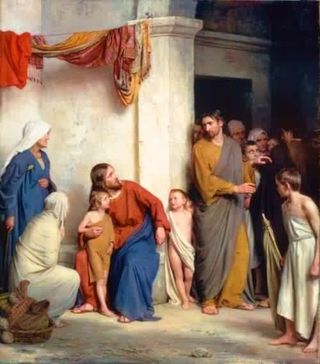 celibacy, that women are unsuited to the priesthood or to episcopacy, that no woman was a disciple. These notions are upheld vigorously by the current hierarchy (whose power in an important sense actually rests upon them).
But at the same time, they run strongly counter to the Zeitgeist, they seem increasingly a relic of a long-past society in which women held an inferior status. If Jesus had a wife (which this fragment in no way seriously proves) or if many early Christians believe he did (of which this fragment may be some evidence), that would suggest that these teachings are grave error hammered into dogma. In sum, this fragment could fuel a head-on conflict with the power and institutions of the Vatican, as the Nag Hammadi texts already do. Collectively they tell us that early Christians were far from uniform in their attitudes, that some strains sought reconciliation with Greek philosophy, others accorded a more prominent role to women, but that a misogynistic segment was ultimately dominant.
I am not that interested in whether Jesus was married or celibate. But I am interested in the way in which a patriarchal, male-only hierarchy, which has been exposed as a conspiracy to commit and then cover up child-rape still excludes half of humanity from true equality in a church based on Jesus' teachings. Jesus clearly saw women as total equals, trespassed over gender lines constantly, and told all of us to become like little children if we are to live in God's full love. Paul told us that there is "neither male nor female" in Christ's vision of our equality on His love.
These little moments – and this is a tiny one – help open that reality to the light: that the message and truth of Jesus is tragically being obscured by some of the Pharisees of our time.
(Painting: Magdalen with the Smoking Flame, by Georges de la Tour, c 1640. And Christ with Children, from Matthew 19 by Carl Bloch 1800s.)




 The Dish