Why Candidates Avoid Specifics

Galupo wishes Romney's tax proposals were less detailed:

I’m sympathetic to NR’s argument that we shouldn’t realistically expect copious policy details from presidential campaign platforms. But I fall back on this point: Mitt Romney could have saved himself a lot of trouble if he had not specifically promised a top marginal tax rate of 28 percent.

Gleckman compares Romney to Reagan:

Reagan cast reform in gauzy generalities of fairness, simplicity, and economic growth. He said he might broaden the tax base, but didn’t say how. He said he might cut tax rates, but didn’t say by how much. And he said he wanted the Treasury Secretary to get him a specific plan in December, not accidently a month after the 1984 election.

Romney, by contrast, not only promised to cut tax rates, he even said by exactly how much–20 percent across the board. Reagan’s popular goals of fairness and simplicity play distinct second fiddle to Romney’s focus on tax cuts for job creators. And instead of saying he’ll craft a plan of his own, Romney’s campaign says the details should be left to Congress. Given the level of public confidence in the Hill, he might as well have promised to turn it over to Snooki.

Women Aren’t Victims Of The Hookup Culture, Ctd

A reader quotes another:

When pretty much every convenience store (at least in New York City) has a slew of condoms hanging behind the counter, there is no access? That any woman that has already had a child is ignorant of birth control? Come on. This reply was just another example of liberals treating people like idiots.

People are not ALL idiots, but when abstinence-only public sex ed insists that condoms are fallible and therefore only abstinence works, the relative abundance of condoms in convenience stores does not matter.  I’d also point out that the vast majority of the American landscape is not New York City, and there are millions of sexually active teenagers and young men and women who do not have the easy access to condoms that our New Yorker enjoys.  Maybe a small-town drugstore stocks condoms too, but can a young person buy them without worrying that Mom and Dad will hear from the druggist, who’s in their church (where birth control is demonized)?  I love New York City, don’t get me wrong, but to generalize about the accessibility of ANYTHING from NYC to the rest of America is … idiotic.

Another adds, "Any prescription based birth control is expensive, and also difficult to access if you are uninsured or in a rural area or under 18." Another:

In the South, schools are frequently not allowed to teach about contraception, and when they are, parents are given advance warning and many withdraw their children from the sex ed classes rather than have them be educated. Birth control urban legends are legion, including, but hardly limited, to the idea that an aspirin inserted in the birth canal will prevent pregnancy (I've also heard coca cola because it is acidic, and soap because it will wash out the semen, amongst other similarly idiotic – these days weirdly mutated into the 'joke' that holding an aspirin between your knees will prevent pregnancy). When children-becoming-adolescents don't get official information from parents or teachers, they fall back on one another. I remember hearing the myth that you can't get pregnant on your first attempt. All these and more are still frequently circulated amongst teens all over the Western world (and while hardly an expert, I'd be surprised if the rest of the world cultures don't have similar legends amongst their teenaged population).

Another points to some stats:

The latest CDC survey (released January of this year) of teenagers ages 15 to 19 found that over half didn't use birth control and of those 31.4 percent believed that they couldn't get pregnant. Those teens who did get pregnant, as would be expected, were much less likely to use birth control.

Another takes a different tack:

I have to respond to this: "The root causes of generational fatherlessness and poverty are more about lack of comprehensive sex education in schools and access to health care, ie, birth control." Poverty doesn’t mean people don’t have the same wishes and dreams as people not living in poverty.  Isn’t it entirely possible that some poor women have children because they are not immune from wanting children?  Isn’t it possible that some poor women want children because they suspect they will never ever, have something that is unconditionally theirs and unconditionally loves them, besides a child? Isn’t it possible that some poor women have children because they were raised by a single mother and model what she did because THAT IS WHAT THEY KNOW?  Isn’t it possible that some poor women feel they will never do anything as meaningful as raising another human being and they want that meaning and purpose in their lives?

By the way, single motherhood is not a plight reserved for the urban poor.  It is a mainstream occurrence now.

To read the entire Dish thread on the hookup culture, go here.
The Euphemisms Of War

Judith Matloff considers the language journalists use when writing about military violence:

Covering conflict often entails hanging around political and military officials—at briefings, at press conferences, during embeds—and reporters can absorb the jargon without even realizing it. These sterile euphemisms are familiar to any news consumer. The sanitized and manipulative "collateral damage" refers to an unintended killing of civilians; one has to look beyond the words to photographs of massacred wedding parties to fully understand what actually happened. The phrase "smart bomb" conveys intelligence instead of carnage. My 11-year-old son was astounded to hear that "friendly fire" was not friendly at all. "You’ve got to be kidding," he nearly spat when he learned the definition: killing fellow troops by accident. "I thought it meant you shot at but didn’t hurt someone. Why don’t they just say it’s like a home goal?"

Almost Everyone Is Middle Class

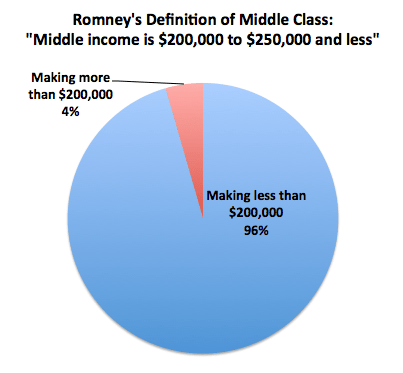
According to Romney, who claims "Middle income is $200,000 to $250,000 and less." Derek Thompson graphs this:

Middle_Class

Thompson later admits that Obama's definition of middle class is effectively the same. Dylan Matthews searches for a better definition. Catherine Rampell notes that a historically large percentage of young people identify as lower or lower-middle class. She wonders if this will persist:

Since people seem to define middle class by culture and values as much by income, it will be interesting to see if this growing self-identification with lower class sticks in the years ahead as this younger cohort ages, and if it does, what kind of pressure (if any) that might put on politicians to redefine their stated socioeconomic class categories. As I mentioned in an earlier post, even as the median American family has gotten poorer, Americans overall have lowered their expectations for what the rich should pay in taxes.

Quote For The Day III

"Journalism in its purest form is a transaction. But inch by inch, story by story, deal by deal, we are giving away our right to ask a simple question and expect a simple answer, one that can’t be taken back. It may seem obvious, but it is still worth stating: The first draft of history should not be rewritten by the people who make it," – David Carr, on the practice of journalists giving quote approval to their subjects in exchange for access [NYT].

One of the primary criticisms leveled at Michael Lewis' must-read Obama profile last week was that Lewis agreed to quote approval. Given the extraordinarily rare access he got, I think he's the least of the culprits.

Stuck With Sprawl

640-CGielen-7B

Andrew Tuck checks in on efforts to curb sprawl and increase density. Despite various efforts, we're still not as dense as we used to be. Tuck references the work of Dr. Shlomo Angel, author of the new book Planet of Cities:

Dr Angel looked at US cities and found that average tract densities, to use the correct terminology, have been in decline for a century. Even Manhattan, despite adding all those skyscrapers, is less densely populated now than in 1910. Then he looked at 30 global cities and found that most of these had densities that peaked in 1910 too. And in many cities the rate of decline is speeding up.

(Image of suburban sprawl by Christoph Gielen, via Ariel Schwartz)

Why Should Israel Get A Pass?

Eric Lewis asks the money question:

If India decided that, once and for all, it refused to live under the threat of an unstable and nuclear-armed Pakistan and intended to invade, we would never tell them it was up to them. If Taiwan had feared an attack from China across the Formosa Strait during the early 1970s, would Richard Nixon and Henry Kissinger have told them it was their call rather than ours whether to launch a surprise attack? Even to put the question shows the absurdity of a superpower’s acquiescing to allies on critical questions of war and peace in a nuclear age.

To be sure, Israel is a special ally, but that does not entitle it to make the decision on matters where United States interest and power are inextricably and centrally engaged. It is inconceivable that the United States would permit another ally dependent on American funds and American defense systems to take such a decision unilaterally. It is also inconceivable that we would permit another foreign government to intervene directly and forcefully in our political process to garner popular support for its policies over the objections of the administration.

And yet we do – and anyone who points this out is a bigot. Recent coverage of Netanyahu here, here and here.

Hathos Alert

Joe Coscarelli cringes:

Max Rice, who seems to think he's funny, begins his appearance by referring to Carlson as "Miss USA" — "Miss America," she corrects — before he takes a big swig of … water. Rice then admits he lost a bet and stutters his way through what might have been conceived as jokes — funny in theory, smug and awkward in practice.

The Cuts Are Coming

The White House's report on sequestration was released on Friday. Ezra Klein analyzes:

Spending we consider essential gets the same size cut as spending we consider wasteful. There’s no ability to make the cuts to farm subsidies a bit bigger and the cuts to, say, the FBI a bit smaller. It’s $1.2 trillion in deficit reduction in which we pretty much don’t make a single choice about what is and isn’t worth funding.

Along those lines, Rebecca Berg notes that US embassies would see around $129 million cut from their security. Nick Gillespie is unafraid:

[T]he cuts for 2013 amount to maybe a whopping $120 billion in an annual budget that is likely to run about $3.8 trillion. Out of the $120 billion, about $50 billion will come out of military budget that will be well north of $650 billion, including war funding. Let's leave aside the mad rush by every part of the government to link its current failures to a future spending cut and instead point out the obvious: Sequestration in no way threatens any basic governmental function. Period.

Suzy Khimm surveys the horizon:

No one on Capitol Hill thinks any deal will happen before Election Day. After Nov. 6, Congress will have just a few weeks to come up with an alternative to the sequester. The challenge is complicated by the fact that the Bush tax cuts, the payroll tax, unemployment benefits and a host of other tax breaks are all scheduled to expire Dec. 31. The cumulative impact of all of these scheduled cuts and changes is what’s popularly known as the fiscal cliff. There’s already talk of passing a short-term stopgap budget plan during the lame-duck session to buy legislators more time to come up with a grand bargain.

However, when asked to name any points that Republicans might be willing to budge on, Eric Cantor declined to respond. Boehner, meanwhile, suggested that a deal is unlikely, calling for Obama to lead on the issue. Ackerman unspins the GOP's spin:

The Republicans want to lay the blame for sequestration on President Obama, whose White House came up with putting defense on the sequestration block last year. They want Obama to sign a bill they recently passed exempting defense from sequestration. The White House wants to lay the blame for sequestration on the Republicans, who came up with the Budget Control Act in the first place during a gamble over the debt ceiling and overwhelmingly voted for it. The White House opposes the GOP bill on the grounds that exempting defense from sequestration would put the burden of budget cuts on programs intended to help the sick, the old, the poor, and the schoolchildren. Expect to hear the dull buzzword “sequestration” frequently from Mitt Romney as he argues that Obama is out to slash defense. An actual solution to avert this disaster is MIA.

Steve Benen fact-checks:

Romney claimed, "This sequestration idea emanated from the White House." No, it didn't. This sequestration idea emanated from House Republicans.