The Other Olympics, Ctd

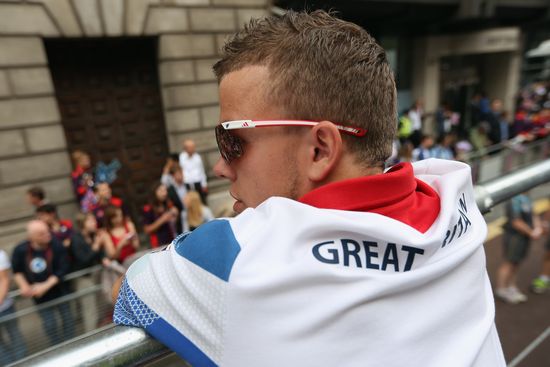
The closing ceremony for the Paralympics was last night. A reader reflects:

I'm a long time UK reader but only a first time commenter, so I'm hopeful that this is how you add to the discussion. I was lucky enough to be able to get tickets for the Olympics here in London last month.  I felt privileged to attend and it was amazing. There are many moments that will stay with me forever: seeing GB cyclist Victoria Pendelton break the Olympic record in the velodrome, cheering Mo Farah enter the stadium for the first round of the 5,000m only days after he won the 10,000m, celebrating the arrival of Sarah Attar, Saudi Arabia's first female track and field athlete. I'll always remember these moments because I was lucky enough to be there when they happened.  

However, I now realise I was something of a snob.  

London 2012 was designed to be a Games in two parts; an Olympics followed by a Paralympics - a parallel Olympics – and I speak as someone who "backed the bid" eight years ago and now works for a local authority who was partly responsible for hosting this year's Games.  I like many here initially focused on the first 17 days, but my experiences of attending sessions over the last week has been unbeatable.  My experience is that, at least here in Britain, these Paralympic Games are being taken just as seriously as the Olympics and in many ways have been taken to heart as "our games" in a way the Olympics couldn't be.

Yes, there are the amazing stories of inspiration that NBC would focus on, if only they were showing it. Not least Martine Wright, a survivor of the 7/7 bombings that took place one day after London was awarded the right to host the 30th Summer Olympiad, competing for GB's sitting volleyball. But what has been so amazing is that the audiences in the stadia and at home watching live on TV are taking these Games incredibly seriously.  GB wants second place in the table.  Australia and the US need to be beaten.  This is real sport.  

When Oscar Pistorius was beaten into second place on last Sunday night in his 200m final it made headline news and the back pages of the papers because it was a shock.  Pistorius wasn't brave; he was fast.  He wasn't an inspiration; he was expected to win.  This is where I would disagree with S.E Smith; my experience is that most people are treating this in a way that is far from patronising, far from a freak show.  This counts.  This really counts.  These competitors are true athletes.  People are turning up, having watched the Olympics, expecting top-class sport and finding that they are getting just that.  You need only see how Ellie Simmonds and David Weir are being celebrated as much a Jess Ennis and Bradley Wiggins.

I appreciate that this may not be true of other countries, but the UK celebrates its 2012 athletes today, and it celebrates both its Olympians and Paralympians together, at the same time.  At least at London 2012 they are being seen as one team, and I for one am aware of at least one family with a disabled daughter who has been inspired by what she has seen. Inspired not to think that she can merely survive, but that she can thrive, that she can be world class and that really is a legacy that I believe will last more than a generation.

To go back to what Oscar Pistorius said before the Games:

There are a lot of people around the world who are going to watch these Games and are going to be forced to see the Paralympics through the eyes of the people of the UK. And that is a great thing.

By the way, keep an eye out for the incredible kid featured in this video:

Like any other kid growing up in Rio de Janeiro, Gabriel Muniz has soccer on the brain. Although he was born without feet, the 11-year-old impressed Barcelona talent scouts and landed a trip to Spain for the club's summer training camp.
Is Al Qaeda Still A Threat?

Definitely, says Bruce Riedel:

The fastest-growing al Qaeda operation is in Syria. Zawahiri ordered al Qaeda jihadists from around the world to go to Syria last February. They carried out seven attacks in March, and at least 66 in June. Al Qaeda won’t take over the embattled country, but it will thrive in the civil war and chaos there—and use Syria as a base for attacks in Jordan, Turkey, and Lebanon.

Ad War Update: Post-Convention Pounce

The Romney campaign added one more ad and state, Wisconsin, to their avalanche of battleground ads:

That makes the blitz now sixteen ads across nine states since Friday. Alex Burns contextualizes:

There's still no advertising in Michigan or Pennsylvania, giving Romney a challenging nine-state target list for the fall campaign. But the addition of Wisconsin is the first real change to the map in 2012 and a potential offset to Romney's difficulties in Ohio and Western states with sizable Latino populations.

The Romney campaign also released the following Spanish language ad (size/scope unknown):

Meghashyam Mali captions:

The ad then showcases seven Latino voters who share their disappointment with Obama’s policies. "I voted for Obama four years ago. I believed in what he said," says one voter, identified as Gustavo Pinto. Another, Sandra Mora, adds, "He tells us a lot of nice things, then forgets about us."

"Obama has no idea what we are going through," says Lilly Lopez, while Roberto Serna adds "He looks like a nice guy, but that doesn’t get us jobs."

"Promises and promises and nothing," says Aline Fernandez of Obama’s tenure.

The ad concludes with voter Olga Rodriguez saying "I will not give Mr. Obama four more years."

Meanwhile, the pro-Obama Super PAC Priorities USA is out with a six-state TV ad going after Romney/Ryan on taxes again (part of a $30 million buy):

And the Obama campaign produced a web video pointing to Romney and Ryan's weekend media appearances during which they declined to fill the gaps in their loophole plan:

The RNC has updated its clever "Heard It All Before" concept from last week to reflect Obama's DNC speech:

And in some downticket news, Senator Scott Brown (R-MA) is out with an ad that sides with Obama on congressional insider trading:

In various news, the Obama campaign out-raised the Romney campaign last month $114 million to $111 million, though it's worth remembering that this does not mean that Team Obama is outraising Team Romney when you include the outside money groups. The Obama campaign also released a web video targeting Catholic voters, while Planned Parenthood's Super PAC is again hitting Romney/Ryan on women's issues as part of a $1.85 million buy – though only targeting Northern Virginia with the TV ad. From the other side the NRCC is putting up attack ads in 22 districts as part of a $4 million campaign – click here for an example ad targeting Rep. Bruce Braley (D-IA) with a variety of disproven Medi-scare claims. Lastly, The Atlantic.com put together this excellent survey of the last 60 years of presidential attack ads (22 in total):

Ad War archive here.

A PhD In Doomsday

Dan Duray profiles Dr. David Morrison, the senior scientist at NASA's Astrobiology Institute and NASA's unofficial expert in the apocalypse:

For the past eight years Morrison has run the Ask an Astrobiologist feature on the institute's website. Started by a civic-minded intern, the column has become the go-to place for concerned citizens to write to NASA and ask if, as they'd heard on the internet, the world will truly end on December 21, 2012. Before he took the helm on Ask an Astrobiologist, Dr. Morrison hadn't heard anything about such theories. Now he can't escape them. "I don't know why they write to NASA at all," he told me over the phone recently. "Probably because there's nowhere else to write."

The emails started filtering in at a trickle, but after a few years of what he called "relative peace," it’s become a deluge. He estimated that over the past four years, he's gotten over 5,000 emails related to doomsday. Lately, the column has been receiving about 50 emails a week, most of them about the apocalypse. 

Morrison's explanation for the increase in crazy theories:

Dr. Morrison believes that their faith might come from an increasingly virulent "conspiracy meme" he's seen come into play since President Obama's election. His evidence, he noted, is strictly anecdotal, but over the the past four years he's noticed an uptick in the number of people eager to believe that 1) bad things are going to happen and 2) that the current government will do anything it can to facilitate them. What's inexplicable to him is the ferocity of their conviction.

The Horserace From 10,000 Feet

Marc Ambinder, who has a new blog over at The Week, sizes up the next two months:

The election may hinge on whether Americans look at Mitt Romney and see someone who isn't a caricature. The GOP convention was not the disaster that pundits made it out to be, but neither was it an unalloyed success. Romney had a free swing at the bat, and by dodging specifics, asked Americans to define him based on the type of man that he was, rather than the type of president he will be. Both are important, of course, but the latter is arguably easier for Romney to carry, because his campaign fumbled the biographical angle from the start.

Romney's attack today is that Barack Obama has no plan to turn the economy around and was given a four year chance to do it. But while Americans disapprove of Obama's handling of the economy and tell pollsters they like Romney's ideas better, they don't know what those ideas are, because Romney hasn't really told them. And the Democrats did a pretty decent job defining them in the breach last week. The major danger for Romney: He enters the debate season with voters growing more suspicious of his (undefined) policy proposals while simultaneously not having a good idea of who the guy is in his maw.

Why Is There No Republican Bill Clinton? Ctd

Jonathan Bernstein keeps the discussion going. He argues that parties "emulate their successful presidents" and that Reagan is part of the problem:

Reagan's relationship with the truth was pretty complicated, and he would regularly say things that were just not true. I mean, regularly: after every press conference someone would have to clean it up (back then they cared about such things). William Safire attributes "misspoke himself" to Ron Ziegler talking for Nixon, but I think (although I could be wrong) it was really popularized for ordinary things with Reagan's presidency. The thing is that Reagan's genius was for believing what he wanted to believe, and once he was set on something it was nearly impossible to break him from it.

At any rate: during the Bush years there was a fair amount of pushback by Reagan supporters, but at the time one of the lessons that Republicans learned from Reagan was that facts just get in the way; what you want are politicians with strong beliefs, not a complex grasp of details.

Who’s Leaving The Workforce?

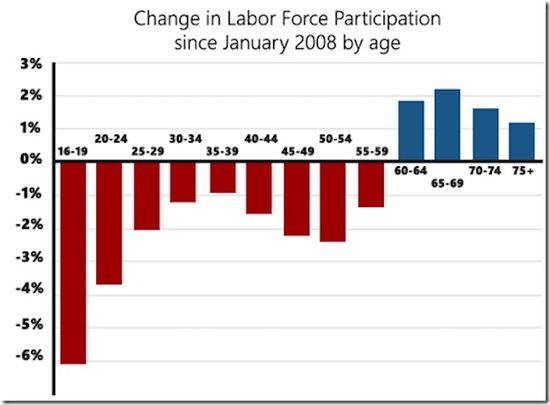
The young:

Age_Labor_Force

Suzy Khimm flags the above chart from May by Political Math. Khimm comments:

Labor force participation has been slowly declining for decades, in part because more young people are pursuing higher education. But there’s been a particularly sharp drop-off during the recession, as young workers have generally fared worse in the labor market than others: In 2011, their unemployment rate was 17.3 percent, while those aged 25 to 54 had an unemployment rate of 7.9 percent. And those who’ve stopped looking for work reported that they’ve done so because "that they were not able to find work, followed by the belief that no work was available," according to the Congressional Research Service

Foreign Policy Could Sink Mitt

After reviewing public opinion, Drezner entertains the idea that "maybe, just maybe, foreign policy will matter a little bit during this election" and "not in a way that helps Mitt Romney":

[I]f the economy doesn't produce the national poll movements that the Romney campaign wants, they'll have to shift to secondary issues.  For the last forty years, the GOP has been able to go to foreign policy and national security.  If Romney does that this time, however, he'll alienate the very independents he needs to win.

Could Romney/Ryan simply retool their foreign policy message for the general election to allay the concerns of independents and undecideds?  No, I don't think they can.  For one thing, it's simply too late to rebrand.  For another, when cornered on these questions they seem to like doubling down on past statements. Finally, I get the sense that one reason Romney sounds so hawkish is because the campaign thinks it's a cheap way to appeal to the GOP base.  Deviating from that script to woo the undecideds will only fuel suspicion of Romney's conservative bona fides.