The Cannabis Closet: When Paranoia Strikes

A reader writes:

I'm a daily reader and owner of The Cannabis Closet. I searched through the book looking for the paranoid stories, to no avail. My experiences when stoned mostly resemble this. My inner dialogue is terrible, even when I'm alone. I run for the gates when I'm in crowds. The only reason I keep trying is that I occasionally have fun relaxed times like Larry's dad. But usually it's panic-stricken awfulness. I'm pretty positive it all has to do with your mindset going in, but maybe that's for another book.

I recommend Dick Cheney's masterpiece, In My Time.

Obama’s Approval Hits 52 Percent On Gallup

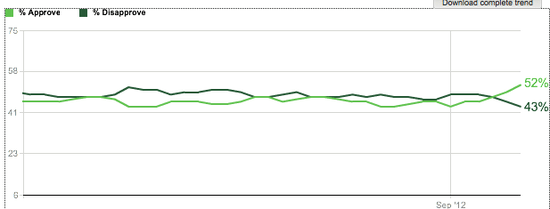
Screen shot 2012-09-07 at 2.35.43 PM

The landscape is coming into focus. Romney announced a big swing-state ad-buy last night. Chait notices that no ads are going up in Wisconsin, Michigan, or Pennsylvania:

The eight states where Romney is competing add up to a neat 100 electoral votes, of which Romney needs 79 and Obama just 23. If you play with the electoral possibilities, you can see that this would mean Obama could win with Florida alone or Ohio plus a small state or Virginia plus a couple small states, and so on.

Unless I’m missing something badly here, Romney needs either a significant national shift his way — possibly from the debates or some other news event — or else to hope that his advertising advantage is potent enough to move the dial in almost every swing state in which he’s competing.

And the Gallup tracking poll suggests a post-convention break-out in Obama's job approval. It doesn't include the whole convention yet. But national approval of Obama is now at 52 percent, a real breakthrough – especially since Gallup has been leaning a little GOP much of this year. More striking: that's the highest approval rating for Obama since 2009.

I'd call it the Clinton bump. Let's see if it lasts.

1964 or 1980? 1992 or 2004?

Jon Rauch pinpoints what Romney's cribbing of Reagan rhetoric means for the election:

Romney wins if he can do to Obama what Reagan did to Carter: Paint him as helpless to turn the economy around. Obama wins if he can do to Romney what LBJ did to Goldwater: Paint him as the leader of an extremist faction. If the election is about the economy, Romney wins. If it is about ideology, Obama wins.

That's why it's key to "change the subject from Romney's speech to Ryan's," argues Rauch:

Painting Mitt Romney as an ideologue won’t be easy, because he isn’t one, and he isn’t convincing when he plays one on TV. But painting his running mate, Wisconsin Rep. Paul Ryan, as an ideologue is easy, because he virtually defines the term. In his acceptance speech, when he promised "a clean break" from the country’s present course toward "a government-planned life, a country where everything is free but us," he was channeling Goldwater.

Except Ryan's fanatical theoconservatism is anathema to Goldwater, as was the entire Christianist right.

I suspect this election will be more like 1992 or 2004. Obama will be the victim of economic circumstances despite an exemplary and prudent record that laid the ground for full recovery and eventually lower deficits; or he will eke out a victory on the grounds that he has done well enough to deserve re-election from Independents, given the economic woes, and by cultural wedge issues, like immigration and women's equality, that have come to rebound against the GOP's neanderthal view of gays and women and immigrants.

The choice is between 1992 and 2004. And in my opinion, Romney is no Bill Clinton or Ross Perot from 1992 and Romney is as miserably tone-deaf as a candidate as John Kerry. The wild card? The worst recession since the 1930s, which is improving only incrementally.

The Economies Of Past Presidents

Sabato compares Obama to former incumbents:

Since 1948, only Carter’s glaring -7.9% slump was worse than Obama’s 1.7% GDP growth rate in the second quarter. What should be even more disconcerting for Obama is the fact that two incumbent presidents with higher second quarter GDP growth figures have failed to win reelection.

Both Gerald Ford in 1976 and George H.W. Bush in 1992 had to run with tepid economies, but in many ways their situations were better than the one Obama has now: both had lower unemployment rates and higher rates of second quarter GDP growth. So why did they lose? Other factors came into play. Ford had the burden of Watergate, and his pardon of Richard Nixon hurt him badly; a debate gaffe about Poland being free of Soviet domination also slowed his forward momentum for 10 critical days. The elder Bush had to cope with Ross Perot. While in the end Perot’s 19% was fairly split between potential Bush backers and Clinton supporters, Perot had gone after Bush tooth and nail for most of the election year — and it showed in Bush’s favorability ratings. The end of the Cold War, lessening the importance of foreign policy experience, probably played a role in Clinton’s success, too.

Can Conservatives Be Funny? Ctd

Several readers continue the discussion:

Humor and satire skewer people and social groups. Liberals naturally skewer and mock the powerful, and are comfortable doing so (and more power to them!). Conservatives, who at least in their current incarnation serve exclusively to protect and defend the ultra-privileged, have no natural interest in mocking or satirizing them. To attempt to do so would come off as flat and insincere. Their interest is in skewering the powerless and weak. While this can be devastatingly funny, is also cruel and harmful and corrosive to democratic values and is socially unacceptable if done openly.

I think we saw a bit of conservative humor at the Tampa convention, incidentally. Funny little private joke, that – throwing peanuts at an African American. But as we can see from the public reaction, socially unacceptable. I’m sure they’d have rather kept the joke private, just like the countless examples of Obama watermelon email jokes shared among some conservatives.

Another writes:

Your comments and the Oakeshott quote had impressed upon me a thought which I'm amazed never occurred to me: that atheism is a conservative position.

Certainly not historically, or in the social sense, but epistemologically. I suppose I am liberal in much the same way that you are conservative, and my atheism can be read as a break from my general record of tolerance and open-mindedness. The sense of truth that humanity holds is perhaps an odd thing to hold so dearly as slippery as it is, but it is the one thing which should not defer to the utilitarian or be held up by teleological defenses.

To borrow (perhaps too much) from Oakeshott: the limited, rather than unbounded grasp of our knowledge is imperfect, but exceedingly sufficient when considering how delusory the latter is. And present laughter is preferable to utopian bliss or the novelty of the crass imaginings of heaven. To give answer to questions so profound and unknown to us is the sin religion commits in the name of truth. So to plagiarize again from Oakeshott I will be equal to my own fortune, for existence itself marks me as the recipient of innumerable lotteries, and cultivate joys as I know they exist and not plan for, expect, or covet when I am (when we all are) lucky to know any.

Another:

Maybe the book Josh Green reviews mentions the idea, but when it comes to the topic of politics and humor, I find the late comedian Bill Hicks' words extremely applicable: "Fundamentalism breeds a lack of irony."  Sure, it's blurring the line, but considering how tied-together the modern US "conservative with Christian fundamentalism, it's still relevant.

A fundamentalist takes in information literally – the Bible is literal truth. The mindset is very Manichean – there is no nuance, no grey areas. Since so much grown-up humor is reliant on the use of satire, irony, analogy and the like, it's not hard to see why the hard-right has a hard time taking a joke and an even harder time coming up with good jokes. The right-wing rags that sometimes show up on my doorstep STILL have cartoons that poke fun at how fat/drunk Ted Kennedy and Bill Clinton were. They can't get beyond an elementary-school understanding of humor because they're too hard-wired to look at something as fundamentally true or false that there is an utter failure to comprehend irony.

Another:

I've thought a lot about the obvious asymmetry in humor between the Right and Left in America, and I think a big part of the explanation is the ever increasing epistemic closure among American conservatives. The problem is that most American conservatives these days operate on a set of shared assumptions and beliefs, created and re-enforced by right-wing media outlets, that are increasingly foreign to anyone outside of that epistemically closed world.  And humor, especially political humor, works by playing upon shared belief and assumptions.  So the kind of humor that might play well to an audience of devoted readers of the National Review is going to be utterly lost on a normal audience. 

To take an obvious example, it seems to be an unquestioned fact among conservative circles that Barack Obama is some kind of dim-witted moron who can read a teleprompter but is otherwise unintelligent and unaccomplished.  But outside of the right-wing echo chamber, no one believes that. The rest of the world sees an obviously intelligent and articulate guy who was editor-in-chief of the Harvard Law Review and a constitutional law professor.  If anything, the typical person sees Obama as a bit professorial.  So any joke premised on the assumption that Obama is a moron is going to be DOA to a normal audience.
Dish-Heads vs The Pundits

Some reader thoughts on the reaction to Obama's speech:

Noonan, Tomasky, and Brooks are pissing me off this morning.  Obama’s faced with an opposition party that will retain enough power even if he wins to obstruct anything "transformative," and the national debt constrains our resources anyway.  So he put forward the agenda of an Eisenhower Republican, or what you’d call a Tory: continue incremental revival of manufacturing and education, pursue energy independence with an eye on countering climate change, maintain our national security, and deal with the debt using a version of Simpson Bowles.  The unspoken complement of this realistic agenda will be to continue rolling out affordable healthcare and financial industry reform through the executive branch, and to use the power of his personal and family examples to model how we can live as citizens of virtue.

The one thing I appreciated about Brooks today was his recognition that Obama is self-aware and sane compared to so many of the twisted souls in politics.  Why does so much of the country fail to recognize how fortunate we are to have this guy leading us?

Another:

I wish that the pundits would watch these speeches with ordinary people.  Last night I watched the speech with a gathering of about 50 people, from junior-high age to seniors.  Everyone loved the speech.  The most important thing for me from his speech was that he was challenging us to be grown ups and offering a vision of a people who are united and proud of the contributions they make to each other.  Success is something to be celebrated and shared – not hoarded.  We have been treated like children for decades now but especially during the Bush years.  We were told that we would be kept safe, didn't need to sacrifice or join the effort.  We should simply go shopping.  The current Republican party is pushing a fairy tale agenda of pay as little as possible in taxes, invest nothing in the people and infrastructure, and live happily ever after. 

Last night you heard a President tell a nation that they must be tough, work hard, and contribute to something greater than themselves.  You heard a President tell us that our founding values and the sacrifices of generations demanded that we be good citizens.  You heard a President express his love for his people regardless of party or ideology.  As always he has been leading by example and he gave us some insight into the feelings and emotions and some of the actual people who deepen his commitment to and love for our country.

My middle son watched the speech with me and was cheering because he sees in our President a person who is a role model and that gives him hope.  He signed up to phone bank.  My oldest son texted me to say that the speech was incredible and that he was moved by the way that he brought us back to hope – a mature hope that is grounded in service to others.  But the best endorsement of the speech I found on my Facebook newsfeed after.  It was a post by a former student of mine who wrote that she has never been interested in politics or voting before but that after watching the speech she couldn't wait to vote and to do her part as a citizen.  I got tears in my eyes when I read that. 

And then there is his family.  Well they are beautiful – not just physically but in the way they love and enjoy each other.  Yes he has family values – the real values that are based in love and respect and self sacrifice.  You can tell that he puts his family first.  He challenged all of us to view our nation as family and to put it first before our own desires.  That this message and example of adult love and responsibility is inspiring to so many of us gives me hope.

Bush-Cheney’s Hidden Torture Abroad

Torture_Libya

America's record on torture appears to be even worse than we realized under Bush and Cheney:

Human Rights Watch has released a report claiming wider use by the United States of waterboarding than previously reported. The 156-page report, "Delivered Into Enemy Hands: U.S.-led Abuse and Rendition of Opponents to Gaddafi's Libya" includes interviews with 14 Libyans, most part of the anti-Qaddafi Islamic fighting group, who claim they were detained by the United States in various locations including Afghanistan and Pakistan and then sent back to Libya around 2004. The prisoners described their abuse at the hands of their interrogators, and it matched descriptions of waterboarding.

Here's a taste of what the war criminal president and vice-president authorized:

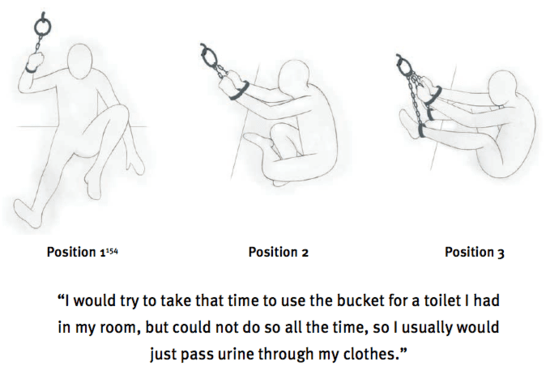
Five Libyans described their captivity in U.S.-run prisons in Afghanistan for between eight months and two years before they were rendered back to Libya. They described having been chained to walls naked—sometimes diapered—in pitch-dark, windowless cells for weeks or months at a time; being restrained in painful stress positions for long periods, being forced into cramped spaces; being beaten and slammed into walls; being kept inside for nearly five months without the right to bathe; being denied food; and being denied sleep by continuous, deafeningly loud Western music.

One former prisoner described having been waterboarded on repeated occasions during U.S. interrogations in Afghanistan. The report notes that the prisoner never used the phrase “waterboarding,” but described the procedure in detail: his captors put a hood over his head, strapped him onto a wooden board, “then they start with the water pouring. . . . They start to pour water to the point where you feel like you are suffocating.” He added: “[T]hey wouldn’t stop until they got some kind of answer from me.” He said a doctor was present during the waterboarding and that it happened so many times he could not keep count.

Notice the sentence: “[T]hey wouldn’t stop until they got some kind of answer from me.” The Thiessen defense of torture is that they did it to break down a human being's body and soul first and then asked questions after the prisoner had been mentally and psychologically broken. But this report suggests more classic torture: they kept it up until the right answers came out.

Ackerman further unpacks it. A blogger with Fairness & Accuracy in Reporting (FAIR) reviews the NYT's coverage of the report:

The Times does not completely avoid the T word. There is one reference to a "board being used in water torture" halfway through the piece.

(Image: A screenshot from the report)

Quote For The Day II

"The Government has already exercised this broad, unimpeded discretionary power [to restrict access of counsel]; it informed petitioners’ counsel that 'it anticipates limiting the number of attorneys who may have continued access to a detainee under the [Memorandum of Understanding] MOU to two and one translator… A document so one-sided that it gives one party the power to unilaterally modify its provisions renders any rights provided by such a document meaningless and illusory…

The Government wants to place itself as the sole arbiter of when a habeas petitioner is 'seeking' to challenge their own detention and when a habeas case is 'impending,' and thus when they can have access to counsel. But access to the Court means nothing without access to counsel.' The MOU actually gives the Government final, unreviewable power to delay, hinder, or prevent access to the courts. Moreover, the Government actions thus far demonstrate that it cannot be trusted with such power," – Judge Royce Lamberth, striking down the Obama administration’s scheme to restrict access to counsel for prisoners at Guantánamo through a "memorandum of understanding" which habeas lawyers were being coerced to sign, in a ruling yesterday. More here.

If someone had told me before November 2008 that almost four years' later the Obama administration was trying to restrict detainees' core habeas rights in Gitmo, I would have been shocked. Try to remain shocked. It's a betrayal of the core principles we elected Obama to sustain.