Hanna Rosin has a new book out, The End Of Men. Previous videos of Hanna here, here, here, here, here, here and here. “Ask Anything” archive here.
Taegan sums up the last two weeks accurately, I think:
The Obama campaign wanted this election to be a stark choice between two different governing philosophies and not a referendum on the president's tenure. With this beautifully orchestrated convention — and with poor strategic decisions and unforced errors by Mitt Romney and the Republicans — they have succeeded.
Democrats decisively won the battle of the party conventions. It wasn't even close really. And they continue to hold the upper hand in this election.
Hence the Romney ad avalanche beginning today. But what Obama did last night was project a realistic optimism; and the constant harping on the recession by the GOP – though obviously totally legit – can come off as pessimistic. The Republicans need to avoid that trap. Optimism always wins in American elections.
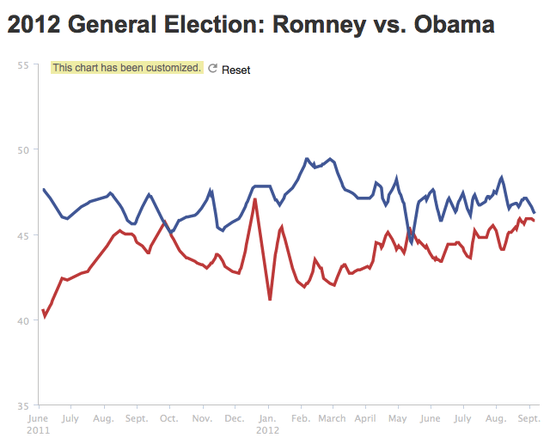
"The question is, did he let the air out of the balloon here? Lose the momentum that gathered with such undeniable force over the previous two nights? I suspect he may have. If he comes out of this convention with under a three-point bounce, that will constitute a horrible missed opportunity. This thing was teed up for him to build a five-point lead. If there’s little movement in next week’s polls, then there’s also little doubt whose fault it is. Michelle did her job, and Clinton more than did his," – Tomasky.
I get what Michael is saying. By Obama's standards, this was an average speech. The thing is: I'm not sure a soaring piece of rhetoric would have been more effective, given that people want more than soaring rhetoric at this stage. What it lacked was a single dramatic shift from the first four years. Unless you count what I and Digby immediately noticed:
when Governor Romney and his allies in Congress tell us we can somehow lower our deficit by spending trillions more on new tax breaks for the wealthy – well, you do the math. I refuse to go along with that. And as long as I’m President, I never will.
I refuse to ask middle class families to give up their deductions for owning a home or raising their kids just to pay for another millionaire’s tax cut. I refuse to ask students to pay more for college; or kick children out of Head Start programs, or eliminate health insurance for millions of Americans who are poor, elderly, or disabled – all so those with the most can pay less.
Digby worries – and I hope – that this means that Obama is prepared to put Medicare on a much more serious path to lower costs if he can win tax revenues that do not disproportionately fall on the middle class. In other words, the sentence I was waiting for:
Now, I’m still eager to reach an agreement based on the principles of my bipartisan debt commission. No party has a monopoly on wisdom. No democracy works without compromise. I want to get this done, and we can get it done.
And we can only get this done if Obama wins this one handily and the Democrats retain the Senate. The GOP is just not serious about the debt and not serious about the compromise needed to get it. Anyone calling for more tax cuts and more defense spending than even the Pentagon wants and rules out any new revenues is not a fiscal conservative. He's a modern, deficit-busting Republican.
(Chart from Pollster – sans Rasmussen, made as sensitive as possible.)
Fallows contends that the speech "was not one of his best but that it did the job":
"The job," in this sense, was having the party leave the convention feeling as if they had a case to present. I don't buy the argument that some of the home-run speeches of the convention — by Bill Clinton, Michelle Obama, Deval Patrick, Julian Castro, Andrew Tobias, and others including in their particular ways John Kerry and Joe Biden — "raised the bar" for Obama or "set him up for disappointment." At the Republican convention last week, speakers like Chris Christie and Marco Rubio were outright auditioning to be the candidate in 2016. That ambition depends on Romney's failure this year. Everyone at the DNC was pulling to get Obama and Biden across the line this year; each speech built on the others rather than competing with them for attention.
Joe Klein was underwhelmed:
I like and admire the President; he’s smart and funny and exemplary. He’s made some very difficult decisions, correct decisions under impossible circumstances. He pulled us from the brink, from an economic disaster largely caused by the plutocrats now criticizing him so shamelessly and falsely. But I want more from him, more guidance, more leadership. Somehow–and this is still true for an electoral majority of Americans–we all do.
Chait suspects that Obama was targeting undecideds:
The speech came, by and large, as a disappointment to political journalists and other campaign junkies. We have heard almost all of it before. The speech was probably aimed at undecided voters, who spend almost no time following politics. They received the paint-by-numbers outline of the election choice.
Galupo is on the same page:
[I]t’s clear that the Obama campaign had a specific goal in mind Thursday night: to peel away white middle- and working-class white men from Romney and Ryan. Biden’s speech focused on two big themes, each against the portrait of Obama as a decisive spine-of-steel Decider: the auto-industry bailout and the killing of Osama bin Laden. Obama himself trumpeted the Detroit bailout, spoke of a manufacturing revival, and sparked a big cheer with “three proud words: Made in America.” This was the cosmopolitan Democrats’ substitute for driving pickup trucks and chopping wood in the Texas wilderness.
Frum wanted more on about the future:
President Obama faced two equally urgent questions: will things get better? And how? Those questions, he did not answer.
Josh Barro felt that the speech was off:
[O]verall, the speech sounded really odd coming from someone who is already president. When you’ve been in office for four years, you have to tell us what you’ve done for us lately, and what you’ll do in the future. Obama should have taken some notes from Clinton on how to do that convincingly.
Jamelle Bouie argues that Obama "positioned himself as the challenger":
He's not holding the line in hopes it won't break; he's mounting a charge against the other side. Rather than make a full defense of his record, he detailed his plans for the next four years … Of course, if Obama’s the challenger, then there needs to be an incumbent. Obama’s focus on the future was complemented with an attack on the past, as represented by Mitt Romney and the Republican Party.
Jonathan Cohn compares Obama's speech to past ones:
[I]n 2004 and 2008, Obama was effectively making a case for bipartisanship—for overcoming the acrimony between Democrats and Republicans. This time, Obama was effectively making a case for social solidarity—the idea that everybody can benefit from programs that provide education or health insurance, and that everybody has an obligation to support them. And he was reminding voters that one party, the Republicans, don’t believe those things.
Obama depressed Michael Grunwald:
[T]he speech felt like a downer, hope and all. Joe Biden made a better case for his boss, and Bill Clinton and Michelle Obama made MUCH better cases. Obama made a persuasive argument that letting Republicans back in power could be a disaster for the country—it’s not a hard argument to make—but he didn’t make four more years of Obama sound like much fun. “Yes, our road is longer, but we’ll travel it together,” he warned us. “We don’t turn back. We leave no one behind.” Sounds like a tough slog.
Jonathan Bernstein thought the convention did its job:
[W]hat conventions can do is remind voters who are probably inclined to vote for a candidate exactly why it is that they would do such a thing. I’m not sure whether the Republicans in Tampa did quite as much of that as they could, and the polling indicates they probably didn’t. I’m pretty confident that the Democrats in Charlotte took much better advantage of their opportunity. They didn’t convince anyone inclined to vote for Romney to switch; you can’t do that. But I suspect that they did an excellent job of rounding up whatever there was to be rounded up.
And Beinart zooms out:
Overall, the Democrats still threw an impressive convention: tough, confident, disciplined. But Obama’s speech was an anticlimax. He’s still the better candidate; I still think he’ll prove that in the debates. But after tonight, I’m a little less sure.
"I want you to be the flower that attracts a bee to make honey, not the trash that attracts flies and dirt," – Osama Abou Salama, a professor of botany at Cairo University, to women in a pre-marital class in Egypt.
Greg Ip summarizes a disappointing report:
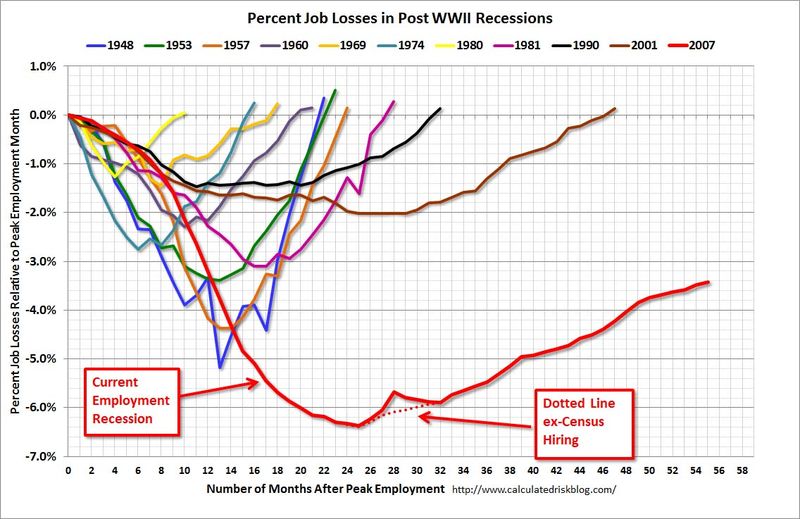
Otherwise ordinary news feels like bad news in the face of high expectations. So it is with America's economy. The August employment report was subdued, but not disastrous. Non-farm jobs rose 96,000 from July, or 0.1%, and the unemployment rate dropped to 8.1%, from 8.3%. Both figures show a job market on the same pace it has been since the winter: expanding just about quickly enough to keep the unemployment rate from rising, but no faster. The economy remains balanced between slowdown and recovery.
Dylan Matthews flags a harrowing statistic:
Labor force participation fell from 63.7 percent of the non-imprisoned population over 16 to 63.5 percent. That’s not just the lowest level since the recession hit, it’s the lowest level since September 1981, and the lowest level for men since the BLS started keeping track in 1948.
Derek Thompson takes stock:
The economy is now officially behind schedule compared to 2011. Average monthly job gains last year? 153,000. This year? 139,000. Over the past three months, the average has slipped to 94,000. That is probably either at, or just below, the rate of population growth.
Yglesias considers the politics of the report:
I think Obama's fortunes might be bolstered by the fact that the household survey showed a smallish decline in the unemployment rate. The unemployment rate is I think a better-known indicator to the average person, and a decline is better than a non-decline. The reality, however, is that this was basically driven by people dropping out of the labor force. Not all of that is a bad thing per se—it's fine for people to retire early or whatever—but it's hard to see it as "good news" for the economy on any level. It strikes me as very odd that Obama, who knew this report was coming, made no reference to any plans to fight unemployment in his speech.
Ezra Klein adds:
The administration is not without answers. The American Jobs Act is a serious, real policy proposal that would boost the labor market right now. Private forecasters estimate that it would add around 2 million new jobs over the next two years. In stark contrast to the policies outlined last night, which would be as appropriate in 2005 or 1995 as they are today, the American Jobs Act is actually designed for jobs crisis we’re in, and wouldn’t make much sense in more normal times. And yet, insofar as the president mentioned it, it was only a glancing, opaque reference.
Christopher Matthews wonders if the Fed will act:
[W]ith fiscal policy hamstrung by a fierce political election, the central bank is the only part of the government that has the capacity to act. The political effects of the job report are unknown at this point, as there will be two more jobs reports between now and ballot day (including one just five days before the November election), but we will find out what the Federal Reserve thinks of all this when it next meets on September 12.
Peter Boockvar thinks markets are asking the same question:
Bottom line, lame job growth continues, averaging just 139k per month year to date but all the markets are focused on is how central bankers will deal with the slowdown with more policy action.
And Kevin Roose puts the Fed debate in context:
[W]hen you're reduced to cheering up a dismal jobs report by arguing "well, at least now the Fed is more likely to take an emergency measure to stimulate the economy!", you've already conceded that the folks on Main Street are right to feel nothing but pessimism. Because, remember, that's what QE3 is: an emergency measure, meant for use in a bona fide crisis. The fact that some of us now expect policymakers to use these kinds of tools on a more or less regular basis is a reflection of how much we've acclimated to our situation. Emergency measures have become, to use this magazine's least-favorite phrase, the new normal.
Chart from Calculated Risk.
Lance Mannion believes that politicians who have run in smaller political races have a skill advantage over those who haven't:
You get out there and you shake as many hands, kiss as many babies, ring as many doorbells as there are minutes in the day every day. Ideally, before the campaign's over you'll have met every voter and asked them for their vote personally.
Of course the higher up the ladder, the larger the constituency, and the more that ideal becomes an impossibility. So you're forced to do a lot of it by proxy. Instead of meeting voters one at a time, you meet them in crowds. Instead of showing up on their doorsteps, you show up on their TVs and computer screens and mobile devices. You spend more time with big donors than with small business owners. And what used to be a matter of just doing your job, going out to listen to constituents tell you their troubles and ask for your help, becomes a photo op. If you worked your way up the political ladder, and you know what's good for you, you remember what the point was and you keep in mind who deserves your attention when you're out on the stump. And when you stop standing in front of the crowd and dive into it instead, all the old skills come back.
He says Obama, who campaigned at both the community and state senate level, has Romney beat in this regard:
[Romney] clearly doesn't know instinctively what to do when he has to deal with voters one to one. He's awkward and uncomfortable and prone to gaffes. I don't mean what the press corps would prefer to call gaffes, all his deliberate and calculated lies. I mean what happens when his apparently instinctive goofiness gets the better of him. He says and does stupid things, like forgetting to thank the owners of a diner he's taken over and trashed for a photo op. In another mood, in another post, making a different point I'd probably say this is a sign that he's an arrogant elitist who can't be bothered to muster up ordinary sympathy for the Help. And maybe it is or it's part of it. … I am, however, pretty sure that much of it is simply lack of practice.
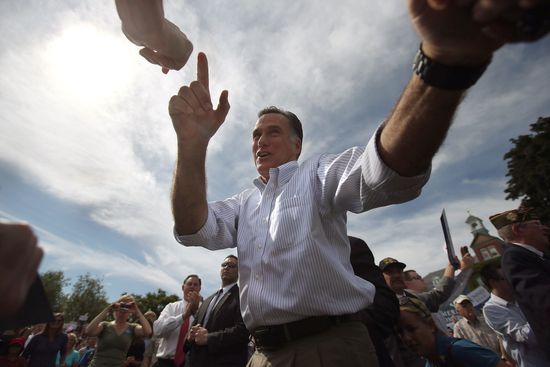
(Photo: Mitt Romney greets supporters during a campaign stop at Saint Anselm College on August 20, 2012 in Manchester, New Hampshire. By John Moore/Getty Images)
[Updated from yesterday with many more questions added by readers]
You probably recognize Hodgman from his appearances on The Daily Show and those ubiquitous Mac ads, but be sure to check out his book, That Is All, an audio and paperback version of which are being released October 2. Excerpts here:
That is All is predicated on the premise (ahem, CERTAIN KNOWLEDGE) that, starting quite soon, we will enter a pre-apocalyptic period leading up to the end of the world…. [The book] is basically tons of jokes, some of which are already somewhat dated (by 2015, how many people will know what Four Loko was?) and many of which will lead to some heavy Googling (for example, to learn more about George Plimpton or leetspeak or The Singularity). The writing is refreshingly bite-sized, such that you can literally open the book to any page, read something, have a chuckle, and move on. Also, like the previous volume, each page includes a page-a-day calendar at the top — except this one predicts the future, through the end of the world (it’s called TODAY IN RAGNAROK). You have roughly a year left; you might as well enjoy it, one page at a time.
Also check out John's podcast. To submit a question for him, simply enter it into the field at the top of the Urtak poll (ignore the "YES or NO question" aspect and simply enter any open-ended question). We primed the poll with questions you can vote on right away – click "Yes" if you have a strong interest in seeing John answer the question or "No" if you don't particularly care. We will air his responses soon. Thanks to everyone for participating.
On the eve of a new series, "Attenborough: 60 Years in the Wild," Samantha Weinberg recounts the career of England's iconic naturalist:
By 1956, Attenborough had persuaded the BBC to let him try a new way of filming—from and of the natural world. With only a cameraman and animal expert for company, he would go off for months to remote lands in search of rare beasts. In Borneo, some days’ walk from civilisation, he was on the trail of orangutan when he spied a man paddling up the river, wearing only a sarong and bearing a message tucked in a cleft stick. It was from the BBC, giving instructions on how to use their new toy: colour film. What started in a makeshift fashion with "Zoo Quest" matured over the decades into "Life on Earth", "The Private Life of Plants", "Life in Cold Blood", "Frozen Planet" and many more. With Attenborough, the phenomenon of natural-history film-making was born.
Attenborough hopes his film-making will push people into saving a planet they typically enjoy from the couch:
As he concludes in the last episode of the new series: "I've spent my life filming the natural world and I’ve travelled to some pretty remote and exciting places to do so… But every journey seems to have got quicker and shorter. It’s as if the world has shrunk – but then sadly so have the wild places."
Decades, says Charles Kenny:
[E]ven absent deep structural reforms, there’s a strong likelihood that China’s economy will maintain high levels of growth for the foreseeable future. Economic historian and Nobel laureate Robert Fogel argues (PDF) there is certainly the potential for China to continue growing at 8 percent until 2030. Despite an aging (PDF) population, there are still opportunities for more adults to work. And more of that labor will likely move into more productive sectors over time—out of agriculture and into manufacturing and services. These two factors alone could account for 30 percent of the country’s continued growth, Fogel suggests.
There are also considerable opportunities to increase labor productivity through education. From 1990 to 2004, China’s college enrollment rate increased sixfold—but it’s still far behind Western levels, so there’s room for continued improvement.
Earlier Dish on Chinese decline here.
 The Dish