Why Does Greater Israel Blockade Gaza’s Exports?

146541550

That's a good question Bob Wright asks:

What I'd like to see an enterprising MSM reporter ask is: How do Israel's severe restrictions on Gazan exports keep arms from getting to Hamas?

They don't. So what's the reason? Bob comes up with two: preventing a trading partnership between Gaza and the West Bank which could lead to greater unity, or simply collective punishment:

Maybe Israeli leaders want to keep all of Gaza impoverished as payback for the sins of Hamas. Maybe they even think that this impoverishment will lead Gazans to reject Hamas. If so, I have bad news: If Gazans reject Hamas, it will be in favor of Islamic Jihad or even more radical elements, in keeping with the general principle that imposing unjust suffering on people empowers extremists.

I see no way out for Israel at this point, except becoming an increasingly religious and militaristic non-democracy, regularly attacking its neighbors, and losing every regional ally in pursuit of total control of the entire Biblical land of Israel, expulsion of Palestinians therefrom, and more and more war and violence. The question for the US is whether we should continue to subsidize and pay directly for this Jacksonian policy at the cost of our entire relations with the Arab and Muslim world; and whether our alliance with Israel will come to destroy our relations with the rest of the West as thoroughly as it has Israel's.

I'm slowly reaching the conclusion that we cannot stop them from committing suicide, if that's what they want. They're a sovereign state. And I can't keep hoping for a two-state solution when it is in fact a shiny object meant to distract from Israel's determination to occupy one-state on the original Ben-Zion Netanyahu lines. My only caveat (and even that is quixotic) is: not on our dime. And the premise of any re-engagement with a two-state solution should be immediate dismantling of every single settlement outside of the 1967 lines, including East Jerusalem. The Israelis can maintain military control of the West Bank for legitimate security purposes, without continuing the ethnic social engineering being imposed by the settlements.

Obama was right four years ago. Until the settlements are reversed, the only future for Israel is a slow, brutalizing suicide. If the president had any control over policy toward Israel, he would end aid immediately until the Israelis start to destroy and evacuate all the settlements once and for all. But of course, he doesn't. The Congress controls the aid, and they will abandon Obama before they abandon Netanyahu. And Israel and America will be the victims in the end.

(Photo: A Palestinian boy from the village of Jabaa, east of Ramallah, looks at Hebrew graffiti reading 'Revenge' (L) and 'the war has begun' (R) on a mosque which settlers tried to burn overnight on June 19, 2012. Unknown attackers attempted to torch the mosque and sprayed it with Hebrew-language graffiti, in an incident that bore the hallmark of extremist Jewish settlers. By Abbas Momani/AFP/GettyImages.)
An Obamacare Unknown

Dana Goldman, Michael Chernew, and Anupam Jena are unsure whether the healthcare exchanges will drive down healthcare costs:

Ultimately, economic theory predicts that the effect of insurance exchanges on insurance premiums will depend on two offsetting factors. On one hand, smaller, less-consolidated insurance companies may have less bargaining power with large hospitals, physician groups and pharmaceutical companies, which traditionally command substantial market power. Reimbursements to these parties, as well as costs to insurers, may rise in a fractionated market, and if so, these costs would be passed on to consumers as higher premiums. On the other hand, exchanges may inject competition into the marketplace, reducing premiums as even the smallest insurer can market its plans, forcing larger insurers to lower their premiums to remain competitive. Which theoretical effect will dominate in reality is an open empirical question with important policy implications.

Hathos Alert

Furby

Rebecca Joines Schinsky highlights a new tumblr:

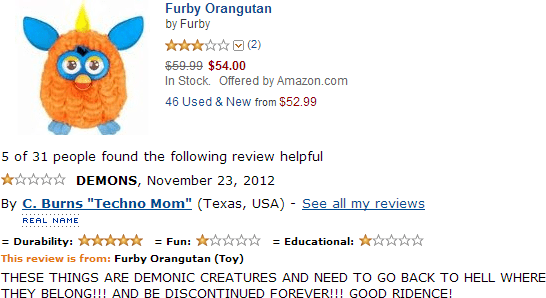
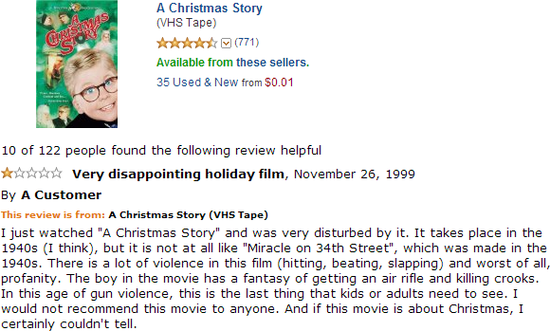
If you’ve spent any amount of time at all reading consumer book reviews at Amazon (or Goodreads, or B & N, or Powell’s), you’ve likely seen some doozies. Most helpful reviews might be best for when you’re actually shopping, but when you want to fall into the internet and lose your last shreds of faith in humanity? There’s nothing better than Least Helpful. It’s exactly what it sounds like–a collection of the least helpful (and often most hilarious) customer reviews from online retailers.

A Christmas-themed review after the jump:

Xmas-story

What About The West Bank?

This week, Mahmoud Abbas plans to ask the UN to recognize Palestine as a "nonmember state." Beinart fears the consequences:

The Palestinian Authority is already in crisis. It can barely pay its employees. It’s been battling protests since the Gaza War began. Abbas himself has repeatedly threatened to resign. And according to Haaretzhe recently told U.N. Secretary-General Ban Ki-moon that if Israel retaliates against his U.N. bid, “I will invite Netanyahu to the Muqata [the Palestinian Authority’s headquarters] in Ramallah and I will give him the keys.”

Is Abbas bluffing? Who knows. But the legitimacy of his power, and his will to retain it, are both in steep decline. This week’s U.N. bid makes the Palestinian Authority’s collapse more likely than ever before. And if the Palestinian Authority collapses, the danger Israel has been facing in the Gaza Strip could soon pale before the danger it faces in the West Bank.

Upgrading America

Federal_Projects

Surowiecki wants more investment in infrastructure:

[T]he U.S., as a rule, tends to underinvest in public infrastructure. We’ve been skimping on maintenance of roads and bridges for decades. In 2009, the American Society of Civil Engineers gave our infrastructure a D grade, and estimated that we’d need $2.2 trillion to bring it up to snuff. Our power grid is, by the standards of the developed world, shockingly unreliable. A study by three Carnegie Mellon professors in 2006 found that average annual power outages in the U.S. last four times as long as those in France and seven times as long as those in the Netherlands. (The past two years’ data would likely be even worse.) This isn’t because of a lack of resources—the U.S. is the world’s biggest economy. But, though we may have the coolest twenty-first-century technology in our homes, we’re stuck with mid-twentieth-century roads and wires.

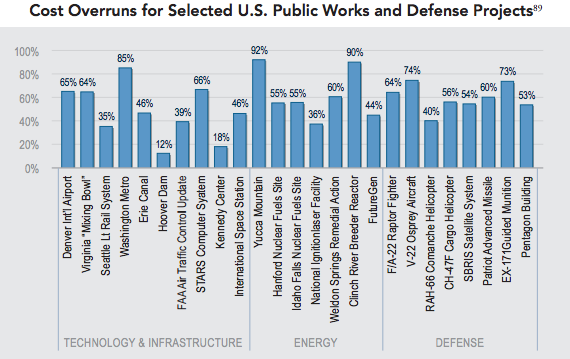
A recent Third Way report (pdf), which provides the chart above on federal project overruns, also encourages infrastructure improvements. A qualifier:

Democrats must accept that past cost overruns damage the public perception of capital projects. In a 2007 report of 27,000 U.S. federal government funded construction projects completed between 2001 and 2005, researchers found that 82% of projects with a price tag above $5 million ran over budget—and 30% ran at least 10% over budget. To turn this around and show that government can deliver on time and on budget, the Obama Administration has embraced sweeping reforms to prevent cost overruns—changes that, according to the Government Accountability Office, have brought many highway and capital projects in under budget. 93 Democrats must strongly support continued reforms, including those that ensure that projects are awarded for economic reasons, not constituent reasons

Will Immigration Reform Help The GOP?

Eliza Gray argues that Univision will help decide the answer to that question:

If the GOP’s strategy of embracing immigration reform has any chance of wooing back Latino voters, it will have to depend on Spanish-language media, particularly Univision, to get its message across. Eighty-eight percent of Latinos watch Spanish-language television, according to the American Journalism Review, and Univision is the clear leader in that market. For many Latinos, Univision is their only source of news.“72 percent of Latinos who watch Univision’s main evening news broadcast with Ramos and Salinas do not see any other television news,”according to the Guardian.

She adds that this "will be difficult for Republicans, because Univision has helped drive the perception that the GOP is hostile to Latinos."

New York Not So Shitty, Ctd

You were probably waiting for this post. But here was my Thanksgiving Day. Aaron was away in Rio promoting his new movie, "Bear City 2". I was planning on a good day of sleep and a dinner with one old and one new friend. But our older dog, Dusty, has been getting a little incontinent lately (she's 15) and we try and take her outside as soon as we get up to avoid messes in the apartment. 107076611Usually, in DC or Ptown, this is pretty easy. I stumble to the front door, open it, wait for her to wander a little bit, pee and come back for a treat. If it's early, I meander wearily back to bed.
But this is New York City and I hadn't even had any coffee yet. So I left the leash behind, wandered downstairs in my boxers and t-shirt, and let Dusty out as I held the building door. Suddenly a cop car came screaming down the street and for a split second I could envisage Dusty meandering into its path. I just ran, grabbed her and scrambled back toward the front door as it slammed shut. I had no keys, no FOB, no clothes, no shoes, and a leash-less dog. I tried every other apartment in the building. No one was in – it was Thanksgiving after all.

My next thought was the fire-escape. Somehow I managed to get the ladder unhitched from below, and began my way up. Two neighbors appeared out of nowhere, one with a cell-phone, then a sweatshirt, then another turned up with some socks. One brought a hammer to allow me to break into my own place. It was pretty chilly out.

So wielding a hammer, with my boxers doing a Marilyn Monroe in the brisk wind, I am climbing up toward the window when a voice appears out of the blue: "Andrew!" I look down, don't recognize the guy, suddenly fear I'm on Gawker tomorrow, and carry on. Maybe a Dishhead – I've been staggered how many there are of you in NYC (I can't seem to walk a block without meeting one). But no, he says he's Robert, a friend of Aaron's, whom Aaron had persuaded to dog-sit a month ago when I was in LA. "I have your keys! And your fob, if you need it."

And so, around the corner of the street, an angel arrived. An amazing coincidence? Balancing karma for all those times in life when nothing seems to go right? Divine intervention? You be the judge. But I had reason to be thankful last Thursday. And not only for a warm home for sockless and slightly blue bare feet, and a free country, but for New York City and its inhabitants.

Thanks. The ice is melting.

(Photo: Justin Sullivan/Getty.)

Told You So

Bruce Bartlett takes a tiny bit of pleasure – after years of grief – at being proven right about the GOP's suicidal trajectory since the early Bush-Cheney years. But what's striking to me about the piece, published in the best conservative magazine in America, The American Conservative, is his account of what generally happens to intellectual honesty in today's polarized Washington.

It is actively punished.

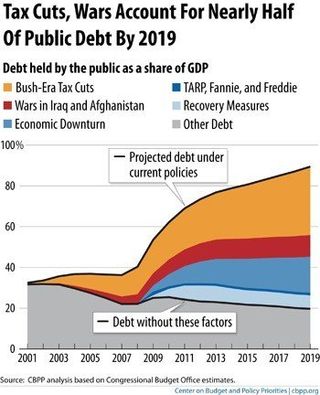
Bruce had three intellectual crises, as he calls them. He was shocked, as I was, by the Bush administration's shameless bribery of the voters and utter contempt for fiscal balance or CBPPpublicdebtparliamentary procedure, as Medicare D proved. He was shocked when two costly- incompetently run wars were not even budgeted. He was shocked again when he observed that not only were criticisms of such recklessness not allowed, they were not even heard because the right had created its own media chamber, which kept any dissidence or intellectual challenge firmly out of earshot. So Bruce wrote a book, explaining Bush's attack on core conservative principles: balanced budgets, just wars, individual liberty and states' rights. The result?  He was swiftly fired from his think-tank job, banned from Fox News, and turned into a non-person like an airbrushed-out member of an intellectual Politburo. (Bush tools, mediocrities and war criminals, on the other hand, were gladly ushered into AEI and the op-ed pages of the Washington Post.)

I endured the same kind of thing, although I was much less polite than Bruce and had an independent platform. But it's still remarkable to me that I have not been invited on Fox for a decade – even to discuss or debate my book on, er, conservatism and fundamentalism. My book, The Conservative Soul, was not reviewed in the Wall Street Journal, and given a formal excommunication/evisceration by National Review's Jonah Goldberg. Compare this with my first book, Virtually Normal, which was reviewed positively in the Wall Street Journal and got a review in National Review that any writer would die for by a distinguished professor of political theory, Kenneth Minogue. So a radically conservative book about homosexuality was admissible, even welcome, in conservative media in 1995, but a critique of modern conservatism's decline was verboten in 2006. No links to this blog were allowed at National Review's Corner. No mention of my name ever crossed the lips of a Republican loyalist.

What Bruce and I shared was a belief that the conservatism of the 1980s, while defensible in its time with a few obvious exceptions, was irrelevant for the world that Reaganism had created. He puts it this way:

I had written an op-ed for the New York Times in 2007 suggesting that it was time to retire "supply-side economics" as a school of thought. Having been deeply involved in its development, I felt that everything important the supply-siders had to say had now been fully incorporated into mainstream economics. All that was left was nutty stuff like the Laffer Curve that alienated academic economists who were otherwise sympathetic to the supply-side view. I said the supply-siders should declare victory and go home.

That was also my theory about tax rates and the more socially liberal society that economic freedom had helped accelerate. Taxes were way lower than they had historically been, and conservatives should be glad about this but vigilant about debt and spending – not eager to cut taxes even more, especially in wartime. America was more multicultural, and one minority, gay citizens, was actively seeking greater responsibility and inclusion. But by the new millennium, low taxes were unbreakable theological truths on the right and gays were Biblically repellent and had to be re-ostracized – by amending the federal constitution no less. Then came the crash of 2008 and a whole set of ideas about self-regulating markets and risk had to be re-thought (as intellectually honest libertarians like Alan Greenspan and Richard Posner conceded). Facing this reality, Bartlett rediscovered Keynes as he actually was and recognized the salience of Keynesianism for a new crisis that was an almost textbook case for government intervention:

Annoyingly, I found myself joined at the hip to Paul Krugman, whose analysis was identical to my own. I had previously viewed Krugman as an intellectual enemy and attacked him rather colorfully in an old column that he still remembers. For the record, no one has been more correct in his analysis and prescriptions for the economy’s problems than Paul Krugman. The blind hatred for him on the right simply pushed me further away from my old allies and comrades… The economy continues to conform to textbook Keynesianism. We still need more aggregate demand, and the Republican idea that tax cuts for the rich will save us becomes more ridiculous by the day.

We can easily become cynical about Washington. It contains a hundred times more schmoozers and social climbers and lobbyists and parasites than it does individuals genuinely committed to the common good in different ways. And of those earnest individuals, only a few are ballsy enough to follow their own reason doggedly enough to suffer social ostracism, removal from all conservative media outlets, and loss of a job – because their mind is not for sale or rent.

Bruce Bartlett is that kind of guy. We need so many more. But I'm thankful for one. And a legacy and example that will live on.

(Chart from TPM)

A Wild Flower Among The Wheat

Flowerwheat

David P. Barash explores the evolutionary mystery that is homosexuality, raising the possibility that being gay serves no direct biological purpose:

Homosexual behavior might be neither adaptive nor maladaptive, but simply nonadaptive. That is, it might not have been selected for but persists instead as a byproduct of traits that presumably have been directly favored, such as yearning to form a pair bond, seeking emotional or physical gratification, etc. As to why such an inclination would exist at all—why human connections are perceived as pleasurable—the answer may well be that historically (and prehistorically), it has often been in the context of a continuing pair-bond that individuals were most likely to reproduce successfully.

There are lots of other hypotheses for the evolution of homosexuality, although they are not the "infinite cornucopia" that Leszek Kolakowski postulated could be argued for any given position. At this point, we know enough to know that we have a real mystery: Homosexuality does have biological roots, and the question is how the biological mechanism developed over evolutionary time.

Another question (also yet unanswered) is why should we bother to find out.

Because I'd like to know? My own reflections on this topic, "What Are Homosexuals For?", form the epilogue in Virtually Normal.

(Photo by Flickr user heatkernel)