Why Do Veterans Struggle To Get Jobs?

Many recent vets are unemployed:

A lower percentage of veterans, as a whole, is unemployed (6.3%) compared with their never served counterparts (7.3%). But that’s not true of those who have worn the uniform post–9/11, who had a 10% jobless rate last month.

Sean Vitka pursues the reasons why:

One of the reasons—I suspect the biggest—can be found in an underreported story form just a few days ago. The International Business Times reported that the Department of Veterans Affairs had “stopped releasing statistics on non-fatal war casualties to the public.” It’s likely that the number of people injured from fighting in Afghanistan and Iraq just passed the 1 million mark; of course, we can’t know that, because the data is being withheld.

It’s hard for veterans to find jobs; it’s even harder if they’re disabled. The Department of Labor has the September unemployment rate of people with disabilities at 13.1 percent (and people without at 6.8 percent). If the bills America is paying are any indication, the number of disabled veterans is skyrocketing. America paid disabled veterans $14.8 billion in 2000. In 2011, that number rose to $39.4 billion. The percentages are also climbing. USA Today reported that for the same period, the percentage of veterans with disabilities climbed a staggering 45 percent.

Blockbusted

As Blockbuster gets ready to close its remaining 300 stores in the US, Alexis Madrigal pays homage:

This was our version of the great communal gatherings of the theater! This was our attenuated version of public space! We didn’t even browse the objects themselves, but avatars of the cassettes. Remember? All the tapes were stored behind the counter, and you’d carry this empty box that represented the movie up to the front register and they’d pull it out of their archival cabinet and load it into a clear plastic container for you. Josh Greenberg wrote a book about the creation of the home movie industry, From Betamax to Blockbuster, and he highlights how strange that was, “In the video store, customers browsed movies, represented by boxes that contained nothing more tangible than the experience of watching a movie itself.” For the industry, it was a way of helping you forget you weren’t watching on the silver screen, but the 22″ TV your parents bought at Walgreen’s.

Liz Galvao, who worked at Blockbuster in 2004 and 2005, remembers “one of the best jobs I’ve ever had.” But Jason Bailey, also a former employee, feels differently: “Let’s not soft-soap the fact that this was a chain that ran roughshod over local businesses, gouged customers on a regular basis, employed scores of movie-ignorant dullards, refused to stock controversial titles, imposed a bullshit ‘family’ morality that was hypocritical at best, and operated on a business model that was less about Film than it was about Product”:

Here’s a story that encapsulates everything you need to know about Blockbuster Video:

during a down moment in the initial, training shift for my part-time job at the Big Blue, I posed what seemed a fairly safe small-talk question to the store manager: So, what are your favorite movies? It was an icebreaker that had served me well in my three previous video store gigs; I’d been doing it since I was a teenager, mostly at rinky-dink mom-and-pop operations, but since the slick, well-funded Blockbuster franchise had driven them all out of town, I finally had to give in and go to work for the Evil Empire. But even my cynicism about my new employer didn’t prepare me for an answer I’d never heard from a fellow employee in all my years in the video store business. “Oh, I don’t really watch movies,” my manager cheerfully and matter-of-factly replied. “I mean, I’m around ‘em all day, so I don’t really wanna watch ‘em when I go home.” She wasn’t my manager for long; within a few months, Blockbuster had promoted her to district manager. And that was Blockbuster Video, in a nutshell.

But the Big Blue isn’t quite dead yet; Kathryn Olson presents a map that shows “the company is still going strong abroad, with 1,295 locations outside the U.S., including in Brazil, Mexico, the U.K., and Australia.”

Having A Strong Constitution

Not long after Norm Ornstein called for a constitutional right to vote and Stephen Lurie made the case for an amendment guaranteeing K-12 education, Alex Seitz-Wald proposes a full rewrite:

Clocking in at some 4,500 words – about the same length as the screenplay for an episode of Two and a Half Men – and without serious modification since 18-year-olds got the vote in 1971, the Constitution simply isn’t cut out for 21st-century governance. It’s full of holes, only some of which have been patched; it guarantees gridlock; and it’s virtually impossible to change.

“It gets close to a failing grade in terms of 21st-century notions on democratic theory,” says University of Texas law professor Sanford Levinson, part of the growing cadre of legal scholars who say the time has come for a new constitutional convention. Put simply, we’ve learned a lot since 1787. More than 700 constitutions have been composed since World War II alone, and other countries have solved the very problems that cripple us today. It seems un-American to look abroad for ways to change our sacred text, but the world’s nations copied us, so why not learn from them?

Chris Bray rolls his eyes:

The Constitution survived (for example) the long historical moment in which the Weather Underground was routinely bombing government buildings; three of the nation’s top leaders were assassinated; civil rights activists were clubbed and shot and attacked by police dogs and knocked over with firehoses; and churches were bombed, sometimes with children inside them, but it can’t survive any longer, because Ted Cruz. Be grateful that Seitz-Wald isn’t a doctor, too, because you’d go in with a hangnail and come out on chemotherapy.

The Senate doesn’t work anymore, he writes, because the Constitution is broken:

“Today, the Senate is an undemocratic relic where 41 senators, representing just 11 percent of the nation’s population, can use the filibuster to block almost anything and bring government to its knees.” But the filibuster isn’t a feature of the Constitution. It’s a product of Senate rules. …  In any case, no one complaining about American gridlock actually means that they hate gridlock. Here’s a deal for you, and it’ll solve the problem of gridlock right now: Give the deep red states far more power in the national government. Gridlock will end right away, and government will get busy doing things: banning abortion, banning gay marriage, slashing federal welfare spending, purging the military of gay and lesbian service members, increasing the military budget, expanding American military power, locking Gitmo and the military tribunal into permanent, uncontested features of our national life. Congratulations – no gridlock at all!

Falling In Love Again

bowie3

So this weekend I spent upstate with close friends and a three-legged beagle called Bowie. It’s a very Dish story. A Dish reader – and, oddly enough, a writer for AC360 Later – emailed me a few weeks ago. His girlfriend was taking care of three dogs (and a few birds) and one of the creatures – a rescued beagle – was proving a little too much on top of the menagerie, work, and life. She was trying to find a new home for the dog, and he recalled how I had lost one only this summer. It was a long shot but I was intrigued. So we agreed to meet the little scamp at the neighboring dog park, and then to take her for a weekend away. As I write this, she has coiled herself around my feet in a bedroom near Livingston Manor, New York.

She was given the name Bowie – after David – and it seems as good a name as any. She’s a small beagle – only 15 pounds – and still young for a survivor, at 18 months. The trip, alas, didn’t start that well. I fed her a calming treat that, an hour later, gave her awful gas in the backseat; and then she peed on my bed almost as soon as we got there. Smelled like Dusty. I crated her the first night, because of peeing worries, but at dawn, she woke me with whimpers. I took her out for a wee and then back to bed, where I left the crate behind and let her snuggle up against me, as I wheezed myself back to sleep (bad asthma lately). She woke me again a few hours later to kisses all over the beard. After breakfast, we went for an old-fashioned English country walk.

She came alive – her nose dragging us all forward, backward, up and down, the white tip of her tail a frenzy of white at the end of a long leash. She has a petite little beagle face, a perky, skittish mischievous streak, and, of course, a stump where her right hind leg used to be. She had been part of a hunting pack, I was told, and one day she’d been hit by a car. Rather than euthanize her, she was rescued and had her leg photo(5)amputated. I mention this because it is, of course, the first thing you notice about her, but it is also the first thing you forget. She runs like the wind, she pulls like a terrier, and she seems utterly oblivious to her handicap. Peeing can be a little tough, since a girl dog has to squat – and one-legged-squats can be tricky. Squeezing one out might seem a little odd too, but she manages it rather efficiently. The rest of the time, she loves playing with a tennis ball, and smelling everything in her vicinity. She has that beagle nose and that beagle curiosity.

Which included the resident cat, a large, Cartmanesque male called Bob. From the get-go, it was clear Bob was pissed off. He inhabited a neighboring house but is used to living in my friend’s place in the winter. He wasn’t too happy to see a three-legged dog enjoy his master’s company, while he was shut out – because of my allergies. So he got his revenge. After a few near-skirmishes, we thought we were out of the woods, literally and figuratively, and then we got home and somehow, he got inside. I was upstairs when I heard a snarl and then howls of panic and anguish from Bowie. I scooped her up and tended to her slightly bloody nose and a heartbeat faster than humming bird’s. Life-lesson number one: don’t mess with a fat cat. The rest of the weekend, united in fear of the creature, we were inseparable.

So we’re getting a new dog, via a Dish reader no less, and I have to say this weekend was a bit of a love affair. There is so much about her that reminds me of Dusty as a puppy – the pathological wolfing of the food, the constant interest in every smell, scent and sight, the sheer constant energy. But unlike Dusty, she’s extremely affectionate. And even obedient. By the end of the weekend, she had perfected “sit” and “stay” and (almost) “down” – and there were no more accidents. We didn’t use her crate after the first night. If I didn’t see her, all I had to do was say “Bowie” and she would come scampering around the corner to shower me with love.

Just when you least expect it … just what you least expect. I think the grieving is done now.

What Happened In The Iran Talks?

We’ll be deciphering this in greater detail tomorrow, but the invaluable Laura Rozen’s account is well worth a read. All was going well, it seems, until the French made a sudden turn:

“In fact, the French are the big upset in the way of an agreement,” the senior diplomat said, on condition his name or nationality not be named. He said there is a joint P5+1 draft text of a framework agreement the parties have been working on. Good progress was being made, including in the five hour trilateral meeting between Kerry, Zarif and Ashton Friday. But the French say it is not our text, the diplomat said, a point which Fabius himself subsequently confirmed.

What was the objection?

France’s concerns were reported to center on wanting Iran to halt work on the Arak heavy water facility during the negotiations, as well as on Iran’s stockpile of 20% uranium. Another P5+1 diplomat told Al-Monitor Saturday that no one is telling the diplomats here what is going on, describing the situation as ‘outrageous.’

That’s a strong word, even though the public face is one of continued negotiations. No one said this would be easy. But few foresaw that the division would not be between the P5 and Iran but between the P5 and France. Marcy Wheeler thinks she may have the reason for the French volte-face:

Several weeks after this WSJ article describing a staged Bandar bin Sultan tantrum about US actions, it was revealed the “Western diplomat” involved was a representative of France:

“Diplomats here said Prince Bandar, who is leading the kingdom’s efforts to fund, train and arm rebels fighting Syrian President Bashar al-Assad, invited a Western diplomat to the Saudi Red Sea city of Jeddah over the weekend to voice Riyadh’s frustration with the Obama administration and its regional policies, including the decision not to bomb Syria in response to its alleged use of chemical weapons in August … Disappointed, the Saudis told the U.S. that they were open to alternatives to their long-standing defense partnership, emphasizing that they would look for good weapons at good prices, whatever the source, the official said.

Ah, yes, an arms deal for the French from the Saudis. That would explain a lot. So in the new Great Power game in the Middle East, Saudi Arabia and Israel are aligning with France. This could be a bump in the road or an attempt to derail the detente entirely. The Brits remain optimistic:

The British foreign secretary, William Hague, asserted that Western representatives were united in the last hours of the meeting over the proposals left for Iran to consider during the break. Mr. Hague told the BBC that “narrow gaps” remained with Iran but that much had gone right in Geneva. “On the question of will it happen in the next few weeks, there is a good chance of that,” he added. “A deal is on the table, and it can be done. But it is a formidably difficult negotiation. I can’t say exactly when it will conclude.”

Let’s hope they can thread the needle. Can someone else bribe the French? They’re clearly open for business.

Camus At 100

On the centennial of Camus’s birth, Jerry Delaney considers the philosopher’s 1942 essay The Myth of Sisyphus:

The opening lines begin with what Camus called the first and most urgent of questions: If the world has no meaning, why live? If life is pointless, why not end it? Logic would favor suicide. Or so it would seem. But Camus quickly points out that absence of meaning is not why people commit suicide. People who commit suicide already have meaning in their lives. What they don’t have is a life. They commit suicide because they have no dignity, no self-respect, no pleasure, no honor, no value. They are checkmated in humiliation, without the minimal elements of a satisfactory existence.

Camus concludes with a startling statement: “Life will be lived all the better if it has no meaning.” The idea stops us on the page; we have to think about that. Camus is saying, by inference, that the things that make our life worth living are in our own hands. Forget about God. What people need is not an abstract benediction but concrete means to live with dignity and self-respect. Camus’ idea is not particularly profound, but he states it with a compelling lucidity and force. Unlike most philosophical insights, which slip from our grasp even as we grip to hold on, the Camus observation sticks. What Camus did was give us a language to express what our experience in life had already prepared us to accept; he gave coherence to those inchoate ideas and unspoken assumptions that were roiling deep and unspoken in our minds.

To mark the occasion, TNR pulled this 1946 review of The Stranger from their archives:

[N]othing is so characteristic of Camus as his refusal to give answers that would be merely logical, to ignore the diversity and the contradictions of experience. The theme of The Myth of Sisyphus, a collection of philosophical essays, is the absurdity of the Absurd, the impossibility of making a logical rule out of it. Pessimism or optimism. God or suicide. Reason or Unreason. These are all attempts to jump out of the real problem by giving it a final solution. Camus calls them “refusals to acknowledge.” In the same way, despair is the most intimate reality of man. To make of it a moral rule would be at the same time to debase it and to get rid of it. “Against eternal injustice, man must assert justice, and to protest against the universe of grief, he must create happiness,” says Camus in his Letters to a German Friend, written in the thick of the battle and probably the noblest document of the state of mind of the European Resistance.

Albert Camus speaks of happiness against a background of despair, and that is why his voice rings true. Aware as he is of the absurd, he stresses nothing like clear consciousness. And from the ultimate loneliness of man, he draws one consequence, which is the necessity today of reestablishing real communication among men, these “brother enemies” divided more than ever before by false thoughts and violence.

It’s worth remembering that Camus was born in Algeria, a place that loomed large in the French politics of his day. Tim Allen elaborates:

Camus didn’t hesitate to affirm the influence of his African years on his life’s work. Writing in 1958 in the preface to a new edition of his first collection of Algeria-centric essays, L’envers et l’endroit (sometimes translated as The Wrong Side and the Right Side), Camus states, “I know that my inspiration is in The Wrong Side and the Right Side, in this world of poverty and light where I lived for so long and whose memory still keeps me away from the two opposing dangers that menace every artist: resentment and satisfaction. […] I was placed halfway between misery and the sun. Misery kept me from believing that all is well in this world and with history; the sun taught me that history isn’t everything.” …

Perhaps befitting his intercultural status as a pied-noir (that is, a person of European descent living in French North Africa), Camus wholeheartedly embraced this notion of the halfway. His decision, however, often meant that he had to blaze his own trail, and consequently expose himself to strident criticism. During the Algerian War, for instance, Camus famously refused to support the cause of Algerian independence and did not condemn outright the atrocities committed by French soldiers. Though Camus vocally opposed the violence of war in all of its forms, and wrote frequently about the suffering of native-born Algerians under French colonial rule, he could not bring himself to reject the pied-noir community that had raised him. Algerian resentment over the perceived offense lingers to this day.

Here’s how Camus described the writer’s task in his Nobel Prize acceptance speech (excerpted in the above video), a task that consisted, for him, of two core principles – “the refusal to lie about what one knows and the resistance to oppression”:

[T]he writer’s role is not free from difficult duties. By definition he cannot put himself today in the service of those who make history; he is at the service of those who suffer it. Otherwise, he will be alone and deprived of his art. Not all the armies of tyranny with their millions of men will free him from his isolation, even and particularly if he falls into step with them. But the silence of an unknown prisoner, abandoned to humiliations at the other end of the world, is enough to draw the writer out of his exile, at least whenever, in the midst of the privileges of freedom, he manages not to forget that silence, and to transmit it in order to make it resound by means of his art.

Previous Dish on Camus here, here, and here.

Face Of The Day

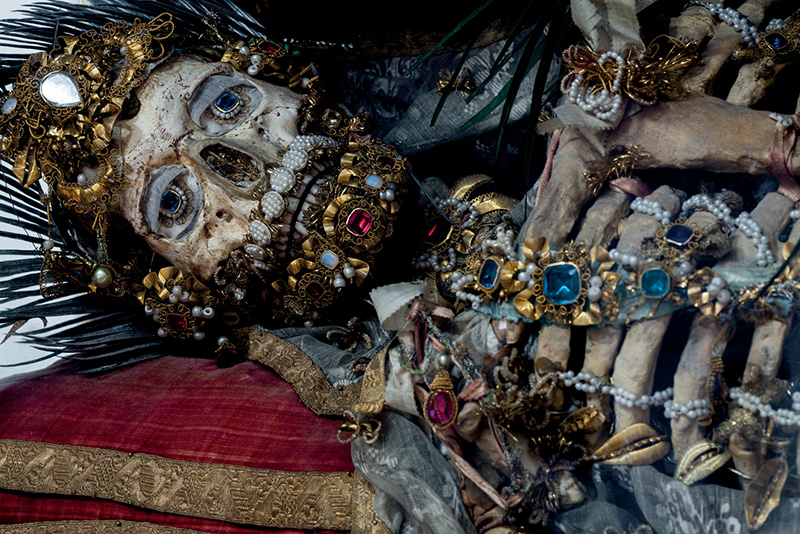
dish_fotdsun10

Colossal captions:

In 1578 word spread of the discovery in Rome of a network of underground tombs containing the remains of thousands of early Christian martyrs. Many skeletons of these supposed saints were soon removed from their resting place and sent to Catholic churches in Europe to replace holy relics that were destroyed during the Protestant Reformation. Once in place the skeletons were then carefully reassembled and enshrined in costumes, wigs, jewels, crowns, gold lace, and armor as a physical reminder of the heavenly treasures that awaited in the afterlife. Over the past few years photographer Paul Koudounaris who specializes in the photography of skeletal reliquaries, mummies and other aspects of death, managed to gain unprecendented access to various religious institutions to photograph many of these beautifully macabre shrines for the first time in history.

Previous Dish on relics here and here.

(Photo of St. Valerius by Paul Koudounaris from the book Heavenly Bodies)

The Choice We Must Make

Popova quotes a 20-year-old Hunter S. Thompson offering life advice to a friend:

“To be, or not to be: that is the question: Whether ’tis nobler in the mind to suffer the slings and arrows of outrageous fortune, or to take arms against a sea of troubles…”

And indeed, that IS the question: whether to float with the tide, or to swim for a goal. It is a choice we must all make consciously or unconsciously at one time in our lives. So few people understand this! Think of any decision you’ve ever made which had a bearing on your future: I may be wrong, but I don’t see how it could have been anything but a choice however indirect — between the two things I’ve mentioned: the floating or the swimming. …

A man who procrastinates in his CHOOSING will inevitably have his choice made for him by circumstance. So if you now number yourself among the disenchanted, then you have no choice but to accept things as they are, or to seriously seek something else. But beware of looking for goals: look for a way of life. Decide how you want to live and then see what you can do to make a living WITHIN that way of life. But you say, “I don’t know where to look; I don’t know what to look for.”

And there’s the crux. Is it worth giving up what I have to look for something better? I don’t know—is it? Who can make that decision but you? But even by DECIDING TO LOOK, you go a long way toward making the choice.

Experiments In Humility

nightskylongexposure

Detailing a number of scientific discoveries, like the Higgs Boson particle, that have left researchers with “no idea where to go next,” Jason Morehead learns to love that “with every discovery, nature is revealed to be far stranger and more mysterious than we could’ve imagined”:

Science is a chief way in which humanity increases in magnitude, in terms of what we know, what we can build, etc. However, science is also a chief way in which humanity can increase in humility, as we realize that despite our many wonderful achievements, there will always be deeper and stranger mysteries. We will never see the universe as it truly is. For some, this might give rise to despair. One detects a note of that in [a] quote from [physicist Steven] Weinberg: “The more the universe seems comprehensible, the more it also seems pointless.” However, despair need not be our only response.

In one of the Bible’s most stirring passages, we find a richer response: “When I look at your heavens, the work of your fingers, the moon and the stars, which you have set in place, what is man that you are mindful of him, and the son of man that you care for him? Yet you have made him a little lower than the heavenly beings and crowned him with glory and honor” (Psalm 8:3-5).

Our reason and intelligence, our scientific achievements — these are part of the “glory and honor” with which we’ve been crowned, and that’s something to revel in. But a glimpse of the heavens, in all of their majesty and mystery drives us to humility. Those two realities — that we possess glory and honor, and that we’re easily overwhelmed by the creation around us — define our species, and represent the truth of our existence.

(Photo by Jim Sher)