Ask Charles Camosy Anything: The Sin Of Factory Farming

In our first video from the author of For Love of Animals: Christian Ethics, Consistent Action, Charles details the many inherent evils of factory farming:

From his bio:

Charles Camosy is an assistant professor of Christian Ethics at Fordham University. … His early work focused on medical and clinical ethics with regard to stem cell research and the treatment of critically ill newborns in the neonatal intensive care unit, which was the focus of his first book, Too Expensive to Treat? Finitude, Tragedy, and the Neonatal ICU. His second book, Peter Singer and Christian Ethics: Beyond Polarization, uses intellectual solidarity in an attempt to begin a sustained and fruitful conversation between Peter Singer and Christian ethics.

Our full Ask Anything archive is here.

The Checkered Game Of Life

In a lengthy review of literature on happiness, Jackson Lears relates an anecdote that reveals how American attitudes toward happiness have changed:

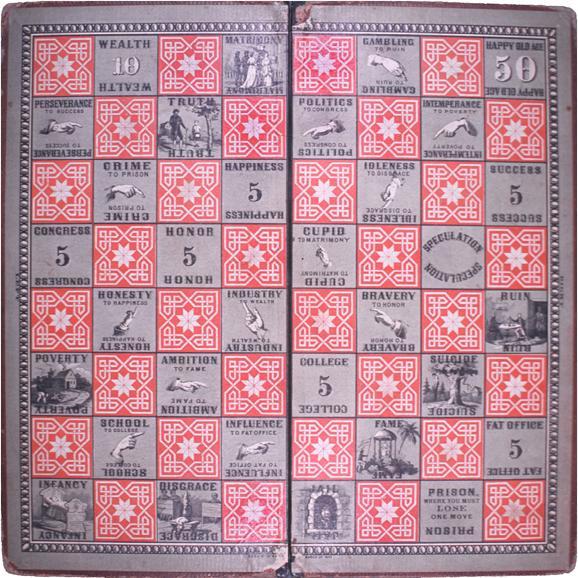
As Jill Lepore observes in her clever but chaotic The Mansion of Happiness, religious definitions of happiness persisted throughout the nineteenth century (although she dish_checkeredgame doesn’t mention it, they have carried on into the present as well). “O Lord! deliver us from sin, and when we shall have finished our earthly course, admit us to the mansion of bliss and happiness,” an evangelical preacher intoned in 1814. The original Mansion of Happiness was a pious, popular board game; revised from an English version for an American audience in 1843, it sold briskly for decades. According to its rules, the game

shows (while vice destruction brings)
That good from every virtue springs.
Be virtuous then and forward press,
To gain the seat of happiness.

No believing Christian could doubt that abiding happiness was reserved for the afterlife, while this earthly realm remained dominated by struggle and sorrow. But by 1860, signs of slippage from this orthodoxy were apparent, even in such didactic board games as Milton Bradley’s Checkered Game of Life, which ended (if you were lucky) in Happy Old Age. In 1960, to commemorate the centennial of the Checkered Game, the Milton Bradley Company issued another version, the Game of Life. Instead of virtue rewarded by heavenly happiness, Lepore writes, the Game of Life offered “a lesson in consumer conformity, a two-dimensional Levittown, complete with paychecks and retirement homes and medical bills.” Players who successfully navigated their tiny station wagons along the Highway of Life could retire, at length, in Millionaire Acres.

(Image of The Checkered Game of Life board via Wikimedia Commons)

Finding The Words For Grief

After her mother died, the poet Joy Katz stopped reading verse – it “felt false” to her, and she distrusted the ability of words to capture what she was experiencing, words that too often “reduced death to a salvo.” And then she stumbled upon Sarah Ruhl’s play, Eurydice:

The play said: elegies are false. They think they can talk to the dead, but dead people speak in the language of the dead, and we can’t.

Eurydice is about the playwright’s own bereavement. After dying and traveling to the underworld, Eurydice sees her father, but she does not recognize him. An ocean of sadness opened up in me as I watched. This play understood what the loss of a person means. I couldn’t speak to my mother not because I didn’t know where she was, and not because I had too little faith or imagination to envision where she was. I couldn’t speak to her because I could not recognize the Her she had become.

For me, the vital part of grieving was not to try to “resolve” or cross this distance. It was the distance. Eurydice led me back to poetry because it is not an elegy. It is about being left behind.

What all this taught Katz about poetry and grieving:

In the years since, I have found poems into which I can take my remnant grief. It took me a while to sense what kind of writing I could trust with it, because my relationship to poetry was shifting. Owing to my mother’s death, I had become uneasy with closure and impatient with poems that offer epiphanic “truths.” Poems of sorrow, especially, needed to do something else.

The ones that sustain me, I find, have to do with living people, humans who mourn, rather than with the departed. These poems are not “like” grieving—they are not lamentations—but instead open up the isolating process of mourning. They translate sorrow through poetic form rather than confining it to a metaphor.

Can Foreign Policy Include Forgiveness?

In an interview, the theologian Nigel Biggar, author of In Defence of War, a new book about the Christian just war tradition, answers with a qualified yes:

Forgiveness is a moral category before it’s a religious one. Nevertheless, it’s a virtue that Rembrandt_Harmensz_van_Rijn_-_Return_of_the_Prodigal_Son_-_Google_Art_Projectfeatures with distinctive prominence in the Christian tradition. This is partly because Jesus made it a primary characteristic of God, of course. But it might also be because eschatological hope that God will intervene to rectify un-righted wrongs at the end of time makes forbearance in the face of injustice here and now more psychologically possible, because it’s more rational.

Since the paradigms of forgiveness, repentance, and reconciliation are interpersonal — think Rembrandt’s Prodigal Son — when we talk about such things in the context of political or international relations, we’re talking about something analogous and weaker. Can nation-states forgive? Yes, but only in an attenuated fashion. Nation-states are not likely to embrace their enemies — certainly not in the midst of conflict — but they can and should have compassion for them, where compassion is due. And compassion is the matrix of forgiveness.

Biggar offers this example of what he’s describing:

[I]t would have been absurd for the United States to react to the attacks of 9/11 by declaring to al-Qaeda that it would continue to treat it as a friend. But it would not have been absurd for it to react by — among other, retributive things — straining to understand what motives had driven young, well-educated, middle class Arabs to sacrifice themselves in such a horrendous manner. Perhaps in the rank undergrowth of their deeply distorted worldview there lay some grievances that were justified and that deserved redress — say, the running sore of the unresolved plight of the Palestinian people. In that case, a complete response to 9/11 would have involved moments of rectification, as well as moments of retribution. Righteous hostility would have been tempered by a measure of compassion.

(Rembrandt’s The Return of the Prodigal Son, circa 1664, via Wikimedia Commons)

The Making Of Flannery O’Connor

James Parker puts Flannery O’Connor’s youthful prayer journals in context, describing her time at the Iowa Writer’s Workshop as where “spiky, brainy Mary Flannery O’Connor from Milledgeville, Georgia, became Flannery O’Connor, writer”:

Arriving in 1945 as a postgraduate student at the University of Iowa, she promptly homed in on the creative-writing classes run by the poet Paul Engle. Women were a minority at the time: by 1946, more than half of Engle’s pupils were returning servicemen, dish_flannery many of them writing stories about their experiences during the war. On the surface, as O’Connor’s biographer, Brad Gooch, tells it in Flannery, she was a quiet but significant classroom presence: “She scared the boys to death with her irony,” remembered one visiting lecturer, Andrew Lytle. Beneath the surface, as recorded on the 47 and a half handwritten pages to which we now have access (A Prayer Journal includes a facsimile), she was refining her vocation with the muscularity and spiritual ferocity of a young saint-in-waiting. The first page or pages of the notebook have been lost, and it begins—how poetic is this?—mid-sentence, with “effort at artistry.”
“Smash the ego,” wrote Peter Schjeldahl in a 1979 poem called “I Missed Punk,” “which always reconstitutes / (and if it doesn’t, well, / your worries are over).” For O’Connor, the space left by the destroyed ego—we can imagine it as a kind of humming vacancy, drifting with pieces of burned paper—was holy because it belonged to God. And she wanted it. Or, more precisely, and more poignantly, she wanted to want it. “Dear Lord, please make me want You. It would be the greatest bliss … to have the want driving in me, to have it like a cancer in me. It would kill me like a cancer and that would be the Fulfilment.” Electric with literary ambition, she prays to be erased. A paradox? Hardly. “Don’t let me ever think, dear God,” she pleads, “that I was anything but the instrument for Your story.”

About that irony – and how it connected to the deepest themes in her writing:

O’Connor’s was not the shifty, reactive, and merely local variety that passes for irony today: sitcom irony, skinny-jeans irony. It was vertical and biblical: the irony by which the mighty are lowered, the humble exalted, and the savior dies on a cross. And she would shortly be required to submit to it herself, in full. Within three years of leaving Iowa, where she had prayed for desire of the Lord to claim her like a disease, she was diagnosed with lupus. Stricken, she returned to her mother’s farm in Milledgeville, her base of production for the novels Wise Blood and The Violent Bear It Away, and the short-story collections A Good Man Is Hard to Find and Everything That Rises Must Converge, the latter published posthumously. Health and sex and adventure had been taken from her, and in their place was a vision, her world, blast-lit and still reeling under the first shock of creation. “The air was so quiet,” she wrote in “The River,” “he could hear the broken pieces of the sun knocking in the water.” It was a gift. And we are left with a question: Without this terrible narrowing-down, would she have achieved the greatness she prayed for?

Previous Dish on O’Connor’s prayer journals here and here.

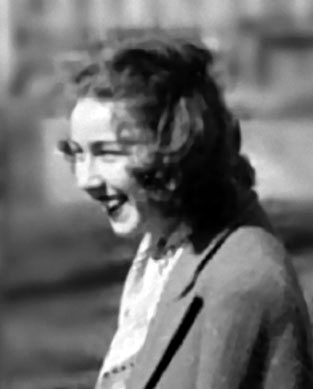
(Image of O’Connor in 1947 via Wikimedia Commons)
Quote For The Day

“It was granted me to carry away from my prison years on my bent back, which nearly broke beneath its load, this essential experience: how a human being becomes evil and how good. In the intoxication of youthful successes I had felt myself to be infallible, and I was therefore cruel. In the surfeit of power I was a murderer, and an oppressor. In my most evil moments I was convinced that I was doing good, and I was well supplied with systematic arguments. And it was only when I lay there on rotting prison straw that I sensed within myself the first stirrings of good. Gradually it was disclosed to me that the line separating good and evil passes not through states, nor between classes, nor between political parties either — but right through every human heart — and through all human hearts. This line shifts. Inside us, it oscillates with the years. And even within hearts overwhelmed by evil, one small bridgehead of good is retained. And even in the best of all hearts, there remains … an unuprooted small corner of evil.

Since then I have come to understand the truth of all the religions of the world: They struggle with the evil inside a human being (inside every human being). It is impossible to expel evil from the world in its entirety, but it is possible to constrict it within each person,” – Aleksandr Solzhenitsyn, The Gulag Archipelago.

Time-Tested Sacrilege

dish_boccaccio

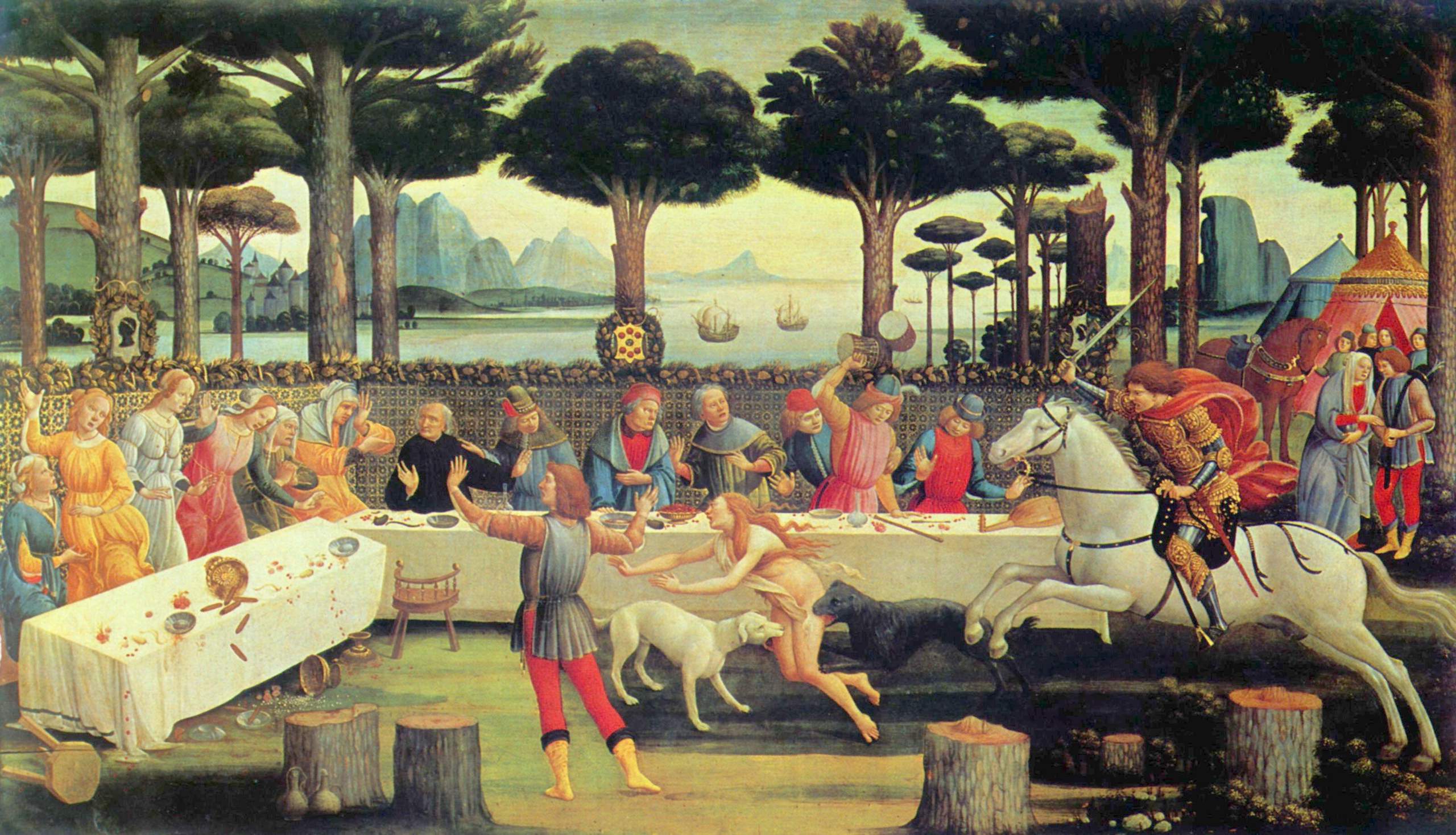
Reviewing Wayne A. Rebhorn’s new translation of Boccaccio’s Decameron, Joan Acocella considers the role of religion in what “is probably the dirtiest great book in the Western canon”:

The young people sometimes make ardent professions of faith. Yet Boccaccio is not afraid of blasphemy—at one point, he refers to a man’s erection as “the resurrection of the flesh”—and there is almost nothing he insists on more than the corruption of the clergy. They are stupid and lazy. Your wives are not safe with them. They smell like goats. In one story, the merchant Giannotto di Civignì tries to get his Jewish friend Abraham to convert to Christianity. Abraham says that he must first go to Rome, to observe the clergy and see if they lead holy lives. This worries Giannotto. He fears that Abraham will discover how debauched the priests are. And that is exactly what happens. Abraham, returning home, reports that the Roman clergy are all sots, satyrs, and sodomites. Then he invites Giannotto to go with him to church, where he intends to be baptized. If the Roman church survives, he says, despite the debauchery of its representatives, then it must be endorsed by the Holy Spirit, and he wants to join the winning team.

Acocella reveals that, in his later years, Boccaccio seemed conflicted about his one great work:

In the thirteen-fifties, just after the Decameron, he underwent a religious crisis. By 1360, he had taken holy orders. It is said that he wanted to destroy the Decameron—that he thought it was a frivolous and dirty thing. Yet, a few years before his death, he copied the whole manuscript out in his own hand. (This is the version used by all modern editors and translators.) So he seems to have had some residual pride in this book. Furthermore, he could never have taken the Decameron out of circulation. It was already famous.

(Image of The Banquet in the Pine Forest (1482/3) from Sandro Botticelli’s series The Story of Nastagio degli Onesti, which depicts parts of Boccaccio’s Decameron, via Wikimedia Commons)

Mothers Of The Church

Laura Keynes praises Kate Cooper’s Band of Angels, a new book that details “the largely unknown role of women in shaping the early Church”:

dish_thecla Cooper understands that women’s power doesn’t always come through formal institutional roles. Rather, it’s the “informal happenings of daily life” — sharing a meal, caring for the vulnerable, offering hospitality — that provide a framework for the transmission of culture. Christianity lacked a formal structure in its earliest years: meetings took place in courtyards or households, communities formed around converted families. Women were often at the centre of things, providing hospitality and shelter for new converts and creating what Cooper calls a “tide of female networking.”

If all that sounds rather boring, think again:

Band of Angels is not a dry work but a pacy tale of heroines, martyrs, virgins, mothers and sisters. … Early Christianity from a woman’s point of view is not a tale of domestic drudgery. These are women of spirit who “discover a blazing fierceness of purpose when faced with the impossible”. Women like Thecla, for example, who turned away from her expected role as wife and mother, leaving fiancé, home and family to follow Paul and preach the gospel. This kind of thinking didn’t go down too well with the imperial authorities and many early Christian women met sticky ends in Roman arenas, thrown to the lions in gladiatorial games.

Commenting on the book in August, Lucy Winkett wrote:

That women figured so prominently as Christianity was being formed makes their institutional silence in later centuries more poignant and casts new light on today’s debates about women and religious authority. … Reading about these first 500 years with the following thousand in mind makes the words of these early women all the more powerful, because we know that their successors were shut out of public office, banned from teaching and martyred for suggesting that their voices should be heard. Cooper’s rediscovery of these women rescues them from a fate as silent pastelled saints and virgins in the frescoes of many churches. The members of the “band of angels” in this book are not perfect, but they are witty, flawed, compassionate, loving and brave – as those of us who are women know we can be.

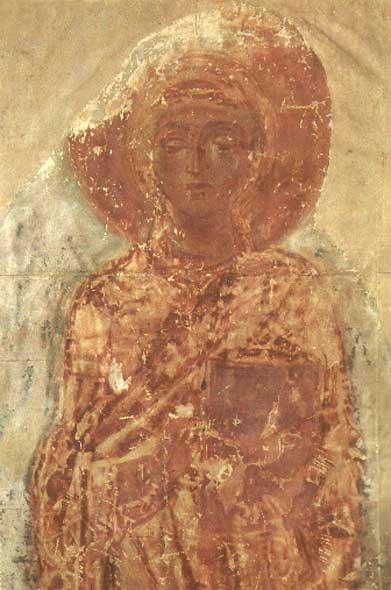
(Image of fresco of Saint Thecla via Wikimedia Commons)