
A Poem For Sunday

nycstreet

“Thought Problem” by Vijay Seshadri:

How strange would it be if you met yourself on the street?
How strange if you liked yourself,
took yourself in your arms, married your own self,
propagated by techniques known only to you,
and then populated the world? Replicas of you are everywhere.
Some are Arabs. Some are Jews. Some live in yurts. It is
an abomination, but better that your
sweet and scrupulously neat self
emerges at many points on the earth to watch the horned moon rise
than all those dolts out there,
turning into pillars of salt wherever we look.
If we have to have people, let them be you,
spritzing your geraniums, driving yourself to the haberdashery,
killing your supper with a blowgun.
Yes, only in the forest do you feel at peace,
up in the branches and down in the terrific gorges,
but you’ve seen through everything else.
You’ve fled in terror across the frozen lake,
you’ve found yourself in the sand, the palace,
the prison, the dockside stews;
and, long ago, on this same planet, you came home
to an empty house, poured a Scotch-and-soda,
and sat in a recliner in the unlit rumpus room,
puzzled at what became of you.

(From 3 Sections © by Vijay Seshadri, reprinted by kind permission of Graywolf Press. Photo by Jim Pennucci)
A Saint For Every Sinner

Eve Tushnet finds consolation in “the wild diversity of saints,” seeing cause for hope in the sheer breadth of those canonized by Christians down through the ages:

It’s so hard to see each life–even our own–the way God sees it, with love. So hard to see each unique constellation of sins, sorrows, and challenges, the pointillism of a human life which can seem like chaos from close up, the way He sees it. And yet from further off, we can see that His saints often look just as crazy, unintelligible even to themselves (St Teresa says this), trailing clouds of self-devised disasters. The diversity of saints is a diversity of sins.

We’re given the knowledge of the saints’ salvation for a whole lot of reasons: They show us that people in all kinds of jobs, with the typical failings of vastly different cultures, with every kind of privilege and lack of privilege, and with every kind of sin, are called by God. They offer us models of perseverance and models of repentance, against seemingly insuperable internal and external obstacles. They teach us to think in terms of the Body of Christ, not the individual believer or her culture. They teach us to think by analogy and empathy, feeling our way through the clutter of Christian history for someone whose story gives us hope.

“A Question Of What’s Real”

dish_chrismartin

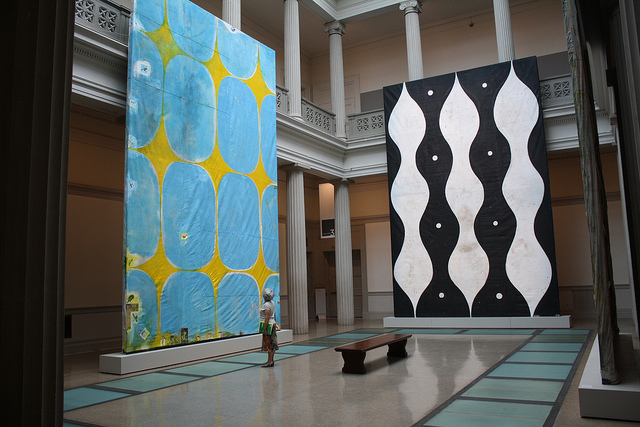
In an interview with The Believer, artist Chris Martin shares his thoughts on how the idea of “spirituality” applies to his work:

BLVR: The term spirituality is mentioned a lot around your paintings and I’m curious whether you agree with that connection.

CM: I think the word spirit comes from the Latin word for “breath”—spiritu—and I think the origin of the word spirituality has to do with breath and life force, the mysteries of the ancients and all this. The word is very suspect in much of the art world—the Western art world, now. Certainly, spirituality has become divorced from religious.

BLVR: Some people talk about how the art world is comparable to religion. It has a community, a shared language about something ineffable, a sort of icon worship.

CM: When people have a hard time with the word spirituality they’re assuming spirituality is something extra-mystical on top of what we all know to be true.

But that’s just a big pile of steaming shit, because really what’s at stake here is a question of what’s real, and when one tries to engage with serious questions about what is real, then things can get very mysterious and spooky. I hate the word spirituality but I… um, sure, why not use that word? We can think about the breath rather than think about some kind of empirical, material, formal idea of what this society thinks is real. And the word mystical is an even worse word than spirituality—that artists take drugs, and then they add some crazy extra thing to what we all know is real. But our job as artists or as human beings is to investigate what we really think is real, and to come back to the tribe and say, this is what the world feels like to me.

(Photo of works by Chris Martin from his 2011 exhibition “Painting Big” by Elvert Barnes)

Belief Needs No Evidence

David Auerbach reviews the autobiography of science writer Martin Gardner:

Gardner is at his most emotional describing what seem[s] to have been a classically happy marriage — he recalls sitting on the subway with his wife and newborn as one of the happiest moments of his life, a moment of peace and accomplishment, not ambition or prestige — and describing a very traditional sense of religious awe. While Gardner had no patience for supposed evidence of anything supernatural, he remained a firmly nondenominational monotheist for most of his life. He baldly admits that this is a matter of faith and flies in the face of all available evidence, and that it is a choice he has made for the sake of his own happiness. I suppose you could say he proselytizes a bit, but since he knows that his case is weak, he doesn’t come off as particularly confrontational: “I managed to retain faith in a personal God and a hope for an afterlife.” Gardner writes:

Philosophical theism is based unashamedly on posits of the heart, not the head.

It freely admits that atheists have all the best arguments. There are no proofs of God or of an afterlife. Indeed, all experience suggests there is no God. If God exists, why would he so carefully conceal himself? All experience suggests that when we die, our body rots and nothing in our brain survives. […] It’s a lasting escape from the despair that follows a stabbing realization that you and everyone else are soon to vanish utterly from the universe. It is an effort, perhaps genetic, to relieve the anguish of believing the universe is nothing more than the tale of a blind idiot, full of sound and fury and signifying nothing.

A weak case seems to make for a more robust faith.

The Art Of Shunga

dish_hokusai

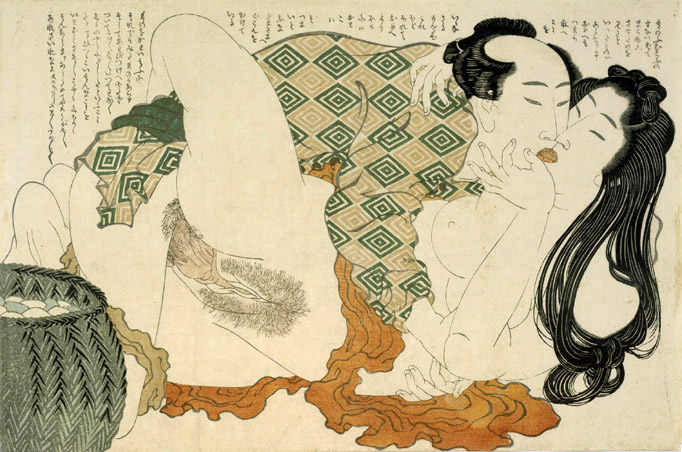
James Polchin visits an exhibit on shunga, a form of erotic art that flourished centuries ago in Japan:

Throughout these works bodies are minimally rendered with undulating lines and a flat, paleness of flesh. Instead, it is the fabric that attracts the attentions, the flows of color and details of patterns that dominate many of these works, often done with vibrate colors or golden paints. It is the actions and gestures that matter, the settings and stories that the images tell. The nakedness of the bodies — what was so concerning to Western viewers at that time — was just another form of dress. The erotic qualities emerged not from the flesh, but from what is hidden and what the artists let us see. Like a striptease, the pleasures of looking are wrapped up in the flow of fabric and flesh. …

Consider Katsushika Hokusai, most famous for his series of wave paintings that have become iconic of Japanese art of the 19th century. Hokusai’s works are often seen as major influence on trends in 19th century France, influencing the works of Gauguin, Toulouse Lautrec, and Degas among others. But Hokusai also produced nearly 20 shunga books and a number of large woodblock prints. His series “Adonis Flower” (c. 1822-3) captures closely pictured scenes of couples entangled in on another, the flow of bodily outlines contrasting with the undulating fabrics and flow of curtains and screens. Unlike his waves paintings with their expansive perspective, these works are tendered with concentrated intimacy, and, like [Torii] Kiyonaga’s horizontal scrolls, present the couples movements, their contorted bodies, crammed into the confining space of Hokusai’s frame.

The Dish recently featured another example of shunga here.

(Image of a print from Hokusai’s series “The Adonis Plant” via Wikimedia Commons)

Amorous Magic

Christine Baumgarthuber looks back to when charms, elixirs, and hexes were an ordinary part of romantic life:

[L]ove charms were as often as not small, unassuming things — necklaces and rings and dish_lovemagic
small vials of unfamiliar powders. Many people favored love packets, which they could easily fashion and secret away. The Irish adorned theirs with suns and moons and magic squares. Into them they stuffed toenail pairings and underwear fragments. Amorous Turks similarly fashioned pouches to stuff with even stranger items: a man’s molar and a particular bone in the left wing of a hoopoe (the bird sent by Solomon to the Queen of Sheba), among other things. Under the pillows of pretty women these parcels would go, put there in the hope of stoking passion for the bearer.

Any increase in attraction as a consequence of such doo-dads likely owed more to common belief than occult forces. The objects of such charms and rituals certainly did complain of falling under their influence, blaming them for everything from disappointing marriages to illegitimate children. A dalliance had as its cause a strand of hair left on a pillow; an unexpected pregnancy, a lavender sachet. Such hexes people saw as matter-of-fact events. To disbelieve them they thought unwise.

(Image depicting love magic, c. 1470, via Wikimedia Commons)

The Grand Dame Of Champagne

Natasha Geiling relates the story of Veuve Clicquot, the champagne named for the woman who “created the modern champagne market” in the early 1800s:

Champagne is made by adding sugar and live yeast to bottles of white wine, creating what is known as secondary fermentation. As the yeast digests the sugar, the bi-products created are alcohol and carbon dioxide, which give the wine its bubbles. There’s only one problem: when the yeast consumes all the sugar, it dies, leaving a winemaker with a sparkling bottle of wine–and dead yeast in the bottom. The dead yeast was more than unappetizing–it left the wine looking cloudy and visually unappealing. The first champagne makers dealt with this by pouring the finished product from one bottle to another in order to rid the wine of its yeast. The process was more than time-consuming and wasteful: it damaged the wine by constantly agitating the bubbles.

Barbe-Nicole [Clicquot] knew there had to be a better way.

Instead of transferring the wine from bottle to bottle to rid it of its yeast, she devised a method that kept the wine in the same bottle but consolidated the yeast by gently agitating the wine. The bottles were turned upside down and twisted, causing the yeast to gather in the neck of the bottle. This method, known as riddling, is still used by modern champagne makers.

Barbe-Nicole’s innovation was a revolution: not only was her champagne’s quality improved, she was able to produce it much faster. Her new technique was an extreme annoyance to her competitors, especially [vintner] Jean-Rémy Moët, who could not replicate her method. It wasn’t an easy secret to keep, since Barbe-Nicole employed a large number of workers in her cellars–but no one betrayed her secret, a testament to her workers loyalty, [The Widow Clicquot author Tilar] Mazzeo explains. It would be decades before any of them became wise to the method of riddling, giving Barbe-Nicole another advantage over the champagne market. … Veuve Clicquot helped turn champagne from a beverage enjoyed solely by the upper-class to a drink available to almost anyone in the middle-upper class–a seemingly small distinction, but one that vastly increased Barbe-Nicole’s market.

Previous Dish on champagne here, here, and here.

Becoming The Bad Guy

From a new study on videogame violence:

Christian Happ and his colleagues recruited 60 students (20 men) with varied video gaming experience and had them spend 15 minutes playing the violent and bloody beat-em-up game Mortal Combat vs. DC Universe on the Playstation 3. Some of the participants played the morally good character Superman, while the others played the Joker, the baddie from Batman. Apart from that, the game experience was the same for all participants – their time was spent in hand-to-hand combat against a variety of other computer-controlled game characters.

Another twist to the experiment was that before the game began half the participants read a bogus Wikipedia article about their character, designed to encourage them to empathise with him. For those playing Superman, the article said how he’d come from a loving family. The Joker article described how he’d suffered abuse in his childhood.

After playing the video game, the participants looked at grids of faces on a computer screen and indicated how hostile they looked. Some of the grids contained angry faces, but the crucial test was how hostile the participants rated the grids that contained all neutral faces. The key finding here was that participants who’d played the Joker were more likely to perceive hostility in neutral faces (a marker of an aggressive mindset), as compared with the participants who played Superman.

Another test was an old favourite known as the “lost letter technique”. As the students left the lab, they saw a stamped and addressed envelope on the floor outside. Those who’d played Superman in the violent game were 6.2 times more likely to post the letter or hand it in to the researchers, as compared with those who played The Joker (the rates were 20.7 per cent vs. 3.3 per cent, respectively).

Previous Dish on videogames and violence here, here, and here.

(Video via Devour: “From Wolfenstein 3D to Battlefield 3, here’s a look at how first person shooters have changed since 1992.”)

“A Sensitive Beast”

Matthew Hutson describes the work of psychologist Kurt Gray, whose research into how people objectify each other has yielded intriguing findings:

In one experiment, subjects saw a photograph and a short description of a man or a woman. The photo showed either just the head or also the shirtless torso. When presented shirtless, targets were seen as having less competence. This is just what you might expect from research on objectification: we’re easily induced to see others as mere objects, pieces of meat without thoughts of their own. But it wasn’t that simple. Shirtless targets weren’t seen as devoid of all thought. They were actually seen as being more capable of emotions and sensations than their less exposed selves. They didn’t have less mental life but a different mental life. Objectification is apparently a misnomer.

To explore the issue further, the researchers turned to the book XXX: 30 Porn-Star Portraits:

The photographer Timothy Greenfield-Sanders had shot 30 stars, first fully clothed, then naked, in the same position and with the same expression. The researchers used these images in a series of experiments and … [i]t turned out that naked porn stars are also seen as having less competence but more sensitivity than their clothed selves. And when one actress was shown in an especially sexual pose, the trend only increased, presumably due to greater focus on her body and its pleasures. True objectification, as traditionally conceived of, just did not happen. …

What emerged was that we see the capacity for feelings, whether pleasure or pain or happiness or anger, as distinct from the capacity for intellectual thought and planning. Namely, that we treat those we objectify as less intelligent, yet simultaneously we endow them with a greater ability to feel things. … In most cases, thinking of a person as a body does not lead to objectification in a literal sense, in which the person becomes an object. Rather, he’s dehumanised — he becomes a sensitive beast.

High Risk

Our brains become addicted to gambling the same way they get hooked on drugs:

Research to date shows that pathological gamblers and drug addicts share many of the same genetic predispositions for impulsivity and reward seeking. Just as substance addicts require increasingly strong hits to get high, compulsive gamblers pursue ever riskier ventures. Likewise, both drug addicts and problem gamblers endure symptoms of withdrawal when separated from the chemical or thrill they desire. And a few studies suggest that some people are especially vulnerable to both drug addiction and compulsive gambling because their reward circuitry is inherently underactive—which may partially explain why they seek big thrills in the first place.

Even more compelling, neuroscientists have learned that drugs and gambling alter many of the same brain circuits in similar ways. These insights come from studies of blood flow and electrical activity in people’s brains as they complete various tasks on computers that either mimic casino games or test their impulse control. In some experiments, virtual cards selected from different decks earn or lose a player money; other tasks challenge someone to respond quickly to certain images that flash on a screen but not to react to others.

A 2005 German study using such a card game suggests problem gamblers—like drug addicts—have lost sensitivity to their high: when winning, subjects had lower than typical electrical activity in a key region of the brain’s reward system.

Previous Dish on gambling addiction here and here.