Keller vs Greenwald: Why Not Both?

BRAZIL-US-ESPIONAGE-GREENWALD

Their exchange is one of the high moments of debate as journalism evolves in the digital era. If you haven’t, do yourself a favor and read it. I come down in favor of both approaches, i.e. alleged “objectivity” or an attempt at impartiality in competition with a press more open about its own biases and point of view. I think readers deserve both. In Britain – though it is far from working perfectly – the biases of the papers make more sense because of the massive resources of the BBC aspiring to impartiality.

But on the basis of this exchange, I think Glenn has the advantage. And that’s because his idea of journalism is inherently more honest – declaring your biases is always more transparent than concealing them. That’s why, I think, the web has rewarded individual stars who report and write but make no bones about where they are coming from. In the end, they seem more reliable and accountable because of their biases than institutions pretending to be above it all. In the NYT, the hidden biases are pretty obvious: an embedded liberal mindset in choosing what to cover, and how; and a self-understanding as a responsible and deeply connected institution in an American system of governance. These things sometimes coexist easily – as a liberal paper covering the Obama administration, for example, with sympathetic toughness. And sometimes, they don’t – as a liberal paper covering the Bush administration, for example, and becoming implicit with its newspeak.

On the latter, Glenn’s strongest point is about the NYT’s decision not to call torture torture when reporting on the torture regime of Bush and Cheney.  Keller still has no good answer here – except, quite obviously, his desire not to burn bridges with an administration and not become a lightning rod for right-wing press critics. Trying to appear objective, in other words, by appeasing both sides in a dispute, is not actually being objective or impartial. It’s enabling war crimes – which I think the New York Times did under Bill Keller’s leadership. No one ever hesitated to use the word torture to describe waterboarding in the past, and the NYT itself did so when other countries were guilty. So hiding your biases, and trying to appear objective, can mean the opposite of honest. That’s why, up there, the Dish has a simple motto: biased and balanced. You know where I’m coming from; and you can also judge if we fairly provide counter-points and dissent. The Dish evolved toward the “biased and balanced” mindset out of a desire to get things right, after I had proven myself all-too able to get things wrong.

Of course, I’m not running (as of yet) original reporting. But reporting, to me, is about finding stuff out, and publishing it without fear, and being accountable for it.

That means publishing without fear of being called leftist by the right, or of being called fascist by the left; publishing without fear of unsettling and even enraging governments; without fear of upsetting, offending, or even boring, readers because some difficult truths need to be gotten out there; and without fear of being called unpatriotic, or biased. That requires enormous discipline, constant tough judgment calls, brass balls, and discriminating restraint. Withholding the truth – unless for fear of risking others’ lives – is something you only do in extraordinarily rare circumstances. So, to take an obvious example, reporting about Iran’s nuclear program without noting Israel’s nuclear and chemical weapons – a key piece of context the NYT routinely refuses to note – is not impartial. And bias is best concealed within an allegedly unbiased news outlet.

Equally, it means matching revelations from democratic societies with revelations from autocracies. A press that constantly make the US government unable to keep secrets reliably needs to put in a lot of effort to do the same with far less porous regimes. It means careful consideration of internal government documents before publishing; it means eschewing excess zeal in revealing secrets, in favor of measured and responsible explanation of the broader issues involved. That’s called balance.

We have yet to see what Glenn and his future colleagues will produce under much more strenuous institutional boundaries. But we need him. And with any luck, the competition will sharpen the NYT as well. There is a golden mean here – one which the NYT aspires to but often fails to achieve. It will only do better with Glenn nipping at their heels.

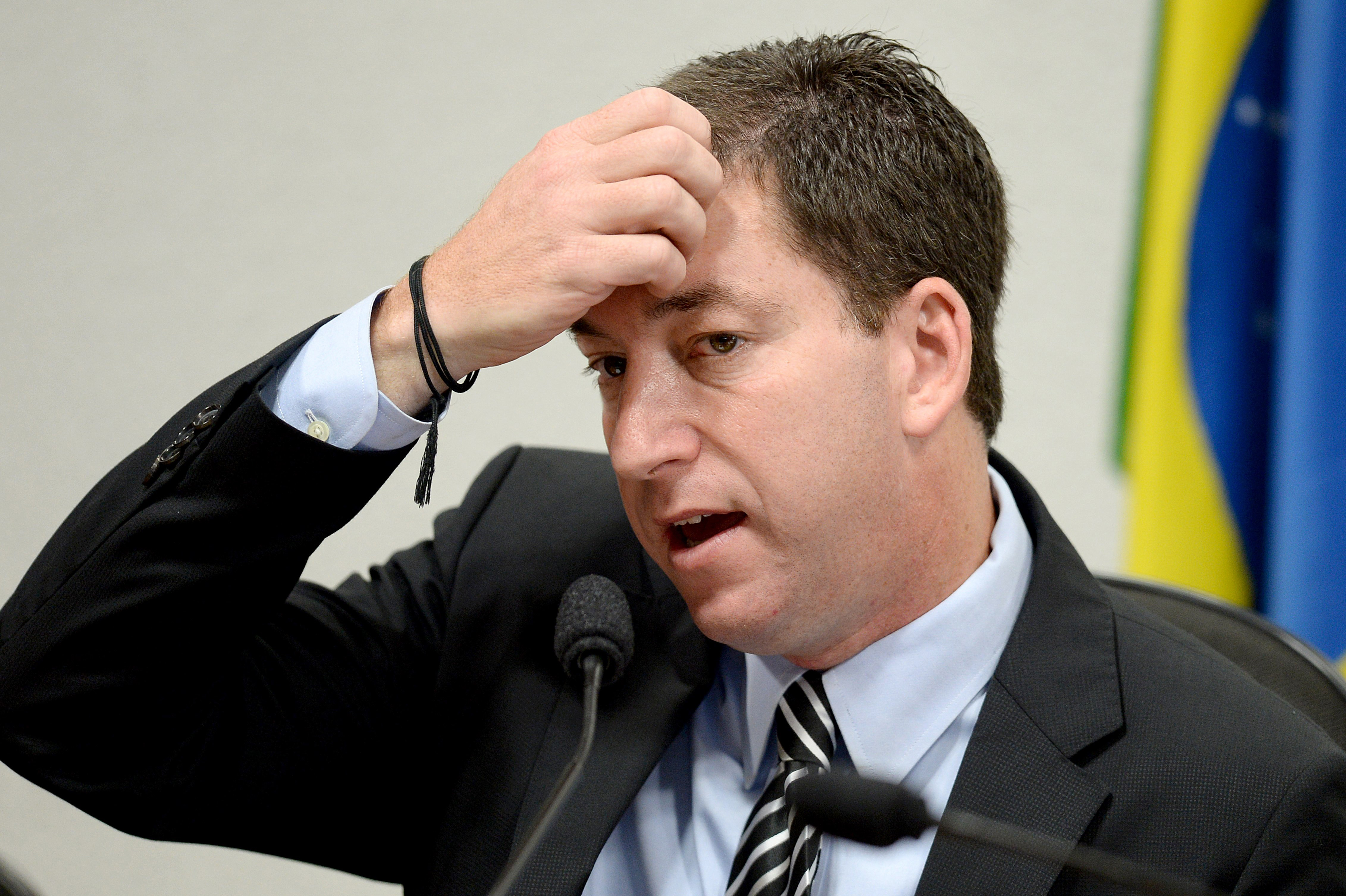
(Photo: The Guardian’s Brazil-based reporter Glenn Greenwald, who was among the first to reveal Washington’s vast electronic surveillance program, testifies before the investigative committee of the Brazilian Senate that examines charges of espionage by the United States in Brasilia on October 9, 2013. By Evaristo Sa, AFP/Getty Images.)

Why Does Sebelius Still Have A Job?

The head of HHS recently brushed off calls for her resignation:

Isaac Chotiner credits the GOP for Sebelius’s job security:

Just imagine for a moment that Obama fired Sebelius and was forced to appoint a new head of the HHS, who would of course need Senate confirmation. This person would almost automatically be labeled the new “Obamacare czar” and would be unlikely to win confirmation unless he or she promised to push for, say, the repeal of Obamacare and the imprisonment of everyone who voted for it. When the Senate goes to unprecedented lengths to block executive branch appointments, it creates a situation where the president is highly unlikely to make personnel changes. Holder undoubtedly remains in his job largely for this reason. Any new appointee for Attorney General would be forced to disown Holder’s record entirely and declare the necessity of investigating what Darrell Issa called ”the most corrupt government in history.”

Earlier Dish on firing Sebelius here and here.

The Healthcare.gov Deadline

On Friday, the administration announced that, “By the end of November, HealthCare.gov will work smoothly for the vast majority of users.” Chait parses this promise:

The administration is obviously putting its neck on the line here. If it fails to hit the deadline, all political hell will break loose. (There is a little wiggle room, as the promise applies to “the vast majority of users.”) Therefore, presumably, the administration is extremely confident it can hit this deadline. On the other hand, it was also extremely confident it could have the site working reasonably well by October 1. So Obama apparently believes not only that his administration can fix the technical problem, but also that it has already fixed the managerial problem that caused it to underestimate its technical problem.

Ezra weighs in:

[T]here’s one more possibility: That the White House is simply buying time.

Saying they can this done by the end of November takes some of the pressure off until then. And if they fail, well, that’s such a disaster for the law that adding the extra hit to credibility that would be lost from failing the timeline is almost irrelevant. It’s like skinning your knee after cutting off your foot.

Drum adds:

If there’s a reason for caution, it’s this: teams that are fixing bugs are usually under enormous pressure to offer up the most optimistic date possible for getting the system working. This suggests that the end of November is the absolute earliest plausible date for getting the Obamacare website working well. Take it with a grain of salt.

Sarah Kliff chimes in:

[Late November], perhaps not coincidentally, is the point at which most health-care experts believe the site needs to be up and running without causing serious damage to the Affordable Care Act’s first-year open enrollment numbers. It gives shoppers a few weeks to shop for coverage and purchase a plan before Dec. 15, the last day to purchase a plan that begins Jan. 1.

Using The Gender Card For Genocide

In Hitler’s Furies: German Women in the Nazi Killing Fields, Wendy Lower documents how German women contributed to the horrors of the Holocaust. An excerpt:

For the young women who were assigned to the East or who volunteered to go—to fulfill their ambitions and the regime’s expectations, to experience something new, and to further the Nazi cause — witnessing the realities of the Holocaust had usually several effects: it hardened their determination; it confused or eroded their sense of morality (as is clear in the assertion that the Jews in the ghetto “don’t feel this humiliation”); and it triggered the search for outlets to escape what was unpleasant or repulsive, for opiates such as sexual pleasure and alcohol. Vodka flowed in nightly parties with, as one secretary recalled, the “nice lads in the office.” Moral transgressions seemed to go unnoticed, or at least unpunished. Scenes of unfettered greed and violence were common. Those who tried to stay away from what was happening around them found few places untouched by the war’s devastation, and little solace.

In a review of the book, Michael Kimmage calls the aftermath – when some guilty women defended themselves as “incapable of crime because they were women and mothers” – “the bleakest page of a bleak book”:

In many cases, Holocaust survivors were able to testify against women who had committed horrendous crimes, and either the women were not tried or their accusers were not believed. If incarcerated, the women were released—often early. Johanna Altvater—the woman who undertook to murder Jews on her own—was tried and acquitted twice. She worked, after the war, in a child welfare office.

The biography of a woman named Erna Petri is no less extraordinary. Put on trial in East Germany, she “confessed to murdering six Jewish children between six and twelve years of age.” She was found guilty and imprisoned. After German reunification, she negotiated her release, possibly with the help of Stille Hilfe (Silent Aid), a postwar SS organization in Germany. She moved to a Bavarian village “where she enjoyed the Alpine mountains and lakes with Gudrun Burwitz, the daughter of Heinrich Himmler and a prominent member of Silent Aid.” The entire village attended her funeral.

This is a new genre of Holocaust story. Unlike Schindler’s List, a cinematic version of it would be unbearable.

Recent Dish on women’s role in the Third Reich here.

The Look Of Terror

Branding Terrora design book by former UN counter-terrorism analyst Artur Beifuss and creative director Francesco Trivini Bellini, catalogs the logos of 65 terrorist organizations across the globe. Jez Owen is a fan:

To be able to study the real thing … is an unusual opportunity for designers and dish_JAT historians. What we discover is that it is a rhetoric of idealism combined with a heavy dose of pageantry that drives these logos, and in turn the organizations that they represent. … Whilst some of the marks are theatrically elaborate, others are incredibly simple; where some are expertly created, others are crudely drawn; many employ cliché upon cliché: however, all apparently have the capacity to convey powerful messages. A world emerges where aesthetic and graphic design skills take second place to connotation. The goal, first and foremost, is to persuade.

Owen’s objection:

Branding Terror is a tour de force of visual research with one fundamental flaw: its categorization as a design book. As one reads, one can’t help feeling that to talk about terrorism in pure graphic terms is to ignore the violence that has been and will be committed in its name, that a discussion of color references and font choices trivializes the subject.

In a July review, Dawn Perlmutter scorned the book: “The authors should stick to producing art books, as they have no training in the significant subtleties of the subliminal and covert imagery contained in terrorist propaganda”:

The book “Branding Terror” essentially sugarcoats the jihadist threat by applying a biased interpretation of the emblems, minimizing the iconography of martyrdom and sanitizing obvious violent indicators, such as the black flags of jihad and swords that are depicted in many of the Islamist logos. The sword is described throughout the book as a premodern weapon that represents the historical struggle in early Islam. Two crossed swords in the emblem of the Indonesian group Jemmah Anshorut Tauhid are described as indicating “JAT’s commitment to jihad. As a pre-modern weapon, the sword is linked to early Islamic jihad campaigns; it is also associated with the purity and nobility of early Islamic heroes. By using swords as a design element JAT confers legitimacy on its jihadi activities, and portrays them as a modern extension of historical jihadi campaigns” (p. 187). There is no reference at all to the swords’ significance in representing “the sword verses” in the Quran, which jihadists use to justify their violence or that they represents Jihad by the sword (jihad bis saif), which refers to armed fighting in holy war. …

Merrell, the book’s publisher, claims on its website that “Branding Terror does not seek to make any political statements; rather, it offers insight into an understudied area of counter-intelligence, and provides an original and provocative source of inspiration for graphic designers.” The statement that this book’s aim is to be a source of inspiration for graphic designers is truly obscene and makes it clear that the authors have no concept of what these symbols represent. These groups are not selling cereal; they are selling fear and their “brand” is backed up by murder, suicide attacks, beheadings and bombings. They are not misunderstood freedom fighters, or peaceful protestors — they are mass murderers. Sugarcoating the violence minimizes the threat, and referring to their emblems as “brands” also diminishes the seriousness of their violent ideologies.

(Image of Jemmah Anshorut Tauhid emblem via TRAC)

Animal Affinities

Barbara J King extends anthropologist Marshall Sahlins’s concept of “mutuality of being” – a relationship in which “the individuals involved remain emotionally and cognitively taken up with each other’s lives even when they are not together” – to the animal kingdom:

In 2005, two Moulard ducks were rescued from a foie gras factory and brought to Farm Sanctuary, an organisation with safe-haven properties in New York and California. The two ducks, named Harper and Kohl, had suffered significant emotional and physical trauma at the factory.

When they arrived at the sanctuary, both animals were frightened of humans, both had the liver disease hepatic lipidosis, and each had his own serious medical issues too. For four years at the sanctuary, they were nearly inseparable. When Kohl could no longer walk or his pain be treated effectively, he was euthanised, and Harper was allowed to watch. When Harper approached the still body of Kohl, he first prodded it, but then lay down and draped his neck over Kohl — for hours. In the following days and weeks, Harper withdrew socially, preferring to spend his time alone near a small pond where he had often gone with Kohl. Two months later, Harper died, too.

This sad story moves me because it asks us to think beyond ‘the usual suspects’ at the frontiers of animal emotion and intelligence. While scientists and animal caretakers have only just begun to record qualitative data about animals’ responses to death, and to address larger questions that bear on mutuality of being, we have strong clues that suggest the fully interdependent nature of animals’ non-kin relationships. Mutuality of being need not be expressed only through language. Animals, too, can feel their lives deeply, and they might even feel the co-presence of others — whether related by blood or not — in those lives.

Previous Dish on the complexities of animal life here, here, and here.

Hathos Alert

Dan Colman captions:

Shaun Clayton got into the spirit, took a series of 1950’s and 60’s-era coffee commercials from the [Prelinger] Archives … and “edited them down to just the moments when the guys were the biggest jerks to their wives about coffee.” The point of the exercise, I’d like to think, wasn’t just to show men being jerks for the sake of it, but to throw into stark relief the disturbing attitudes coursing through American advertising and culture during that era. And nothing accomplishes that better than mashing up the scenes, placing them side by side, showing them one after another. It gives a clear historical reality to views we’ve seen treated artistically in shows like Mad Men.

Every Night Is Ladies’ Night In Reykjavik

The World Economic Forum has once again named Iceland the most equal country for women, while the US has slipped in the rankings to #23 (pdf). Catherine A. Traywick tells economists to take note:

The notion that gender equality drives development (rather than the other way round) has been so widely celebrated in recent years that it begins to seem trite. But as the newly released 2013 Global Gender Gap Index – which measures gender parity in 136 countries – reminds us, gender equity isn’t simply a matter of equal rights. It’s a matter of efficiency. …

Take the Philippines. It ranks #5 on the Global Gender Gap Index, higher than any other Asian nation. It’s the only country in Asia that has fully closed the education gender gap, and its labor force boasts growing ranks of women workers, especially professionals and managers. Not surprisingly, the Philippines is now the fastest growing economy in Asia, having recently edged out China (#69 on the index).