A Good, Painful Death

dish_doctor

Passing in pain was long considered spiritually cleansing:

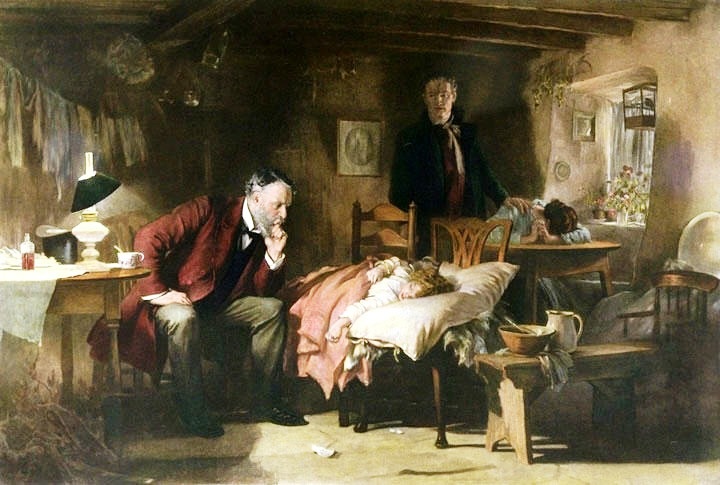
In earlier periods, many people believed that pain was a necessary component of a good death. Evangelical Christians, in particular, feared losing lucidity as death approached, as this would prohibit the person from begging forgiveness for past sins and putting his or hers worldly affairs in order before departing this life. For this reason, the physician rarely appeared at the bedside of a dying person because pain management was not required. Moreover, the general consensus was that it was inappropriate for a person to profit from another’s death. Caricatures depicting the greedy physician running off with bags of money after his patient had succumbed to his fate were not uncommon in the 18th and early 19th centuries.

Over time, however, religious sentiments faded, and physicians began to appear more regularly in the homes of the dying. Doctors also became more effective at pain management. At the start of the Victorian period, doctors typically administered laudanum drops orally to patients. This process was imprecise, and sometimes not effective at all. This changed in the 1860s, when physicians started to provide their patients morphine intravenously. As new techniques emerged, people’s attitudes towards pain management in treating the dying began to change. Soon, a painless death was not only seen to be acceptable, but also vital to achieving a “good death.” The doctor’s place at the bedside of the dying was now commonplace.

(Image: The Doctor by Luke Fildes, 1891, via Wikimedia Commons)

The Character Of God

Scott Adams ponders whether God has a personality:

The problem with the idea that God has a human-like personality is that human personalities are nothing but weaknesses and defects that we romanticize. For example, I might be kind to others because I want them to be nice to me, or perhaps I simply feel guilty when I’m not nice. God wouldn’t have feelings of guilt and he wouldn’t need a strategy just to be loved. He would have everything he needed all the time. Logically, God couldn’t have a personality in the sense that humans do because our personalities are expressions of our defects and our DNA and our neediness.


The Eastern Way Of Worship

Richard Madsen notices that, according to a recent Gallup poll, 47% of the Chinese population claims to be atheist – yet other surveys demonstrate that nearly 85% of the country “carry out rituals to honor ancestors, seek out good fortune, ward off evil, celebrate festivals, and accumulate merit for a good afterlife.” So what gives?

An answer is to be found in the social nature of indigenous Chinese religion—it is more about belonging than belief. The collapse of the commune and state industrial work unit systems has made the search for forms of community not controlled by the state more pressing than ever. These alternative forms are typically established through myth and ritual, which meaningfully anchor persons to families and communities. But participants in the myth-telling and ritual performance might understand them in very diverse ways, including skepticism about the truth of the myths that they tell and the efficacy of the rituals in which they engage. However, in order to remain members of the wider community, they practice them despite their doubts. If among the middle classes of the West it is now common for religion to take the form of “belief without belonging,” in China it may just as commonly take the form of belonging without belief.

If we see Chinese religion as a matter of community belonging rather than one of spiritual belief, we might gain a clearer perspective on how and why religion in China has been growing and transforming. Old forms of community are dying and new forms are yet to be born—a liminal situation reflected in the kaleidoscopic interplay of old and new forms of religion.


Relatedly, the Chinese Communist Party may be moving on from its longstanding treatment of religion as purely a threat to stability:


The view that religion represents a positive force in civil society is gaining ground, not only among religious believers, but also within the Communist Party itself, in part thanks to the patient and often courageous work of the epistemic community of Chinese scholars who have studied closely and objectively religious life and its evolutions, and who have focused in particular on the philanthropic activities of religious associations during the Republican period and among overseas Chinese communities.

The government’s facilitation of growing involvement on the part of religious organizations in philanthropy and disaster relief, including health care and poverty alleviation, indicates that the Party has listened to these scholars and understood the significance for society of religious adherents’ beliefs and values, and as a result has changed its approach to religion’s place in contemporary China. The Party increasingly looks at it as a resource not incompatible with progress and capable of contributing to social stability. Local government support for the rebuilding of Buddhist temples and for the expansion of the latter’s charities stand as a good example of this new appreciation. The newfound appraisal of traditional rituals known as popular beliefs represent another instance of this change of perspective in the state’s relationship with religion: dismissed until the 1970s as “feudal superstitions,” they are embraced today as a “national heritage” worthy of support.

The Muslim community in particular is making gains:

As one of China’s five official religions, Islam has gained much vigor in the three decades since the reform. In the process of urbanization, for example, rural Muslim migrants reenergized existing Muslim communities in cities like Guangzhou. New Muslim communities in urban centers have also grown at an unprecedented rate. The growing ties between Chinese Muslims and the heartland of the Islamic world are deemed useful within the framework of “building the religious/cultural stage to sing the economic opera” (文化搭台,经济唱戏). Hui Muslims, as the largest Muslim ethnic minority, have particularly benefited from the tide of religious revival and have played an important role in micro-level business activities in the China-Middle East trade because of their religious affinity and knowledge of Arabic.

The Road To Becoming A Relic

München

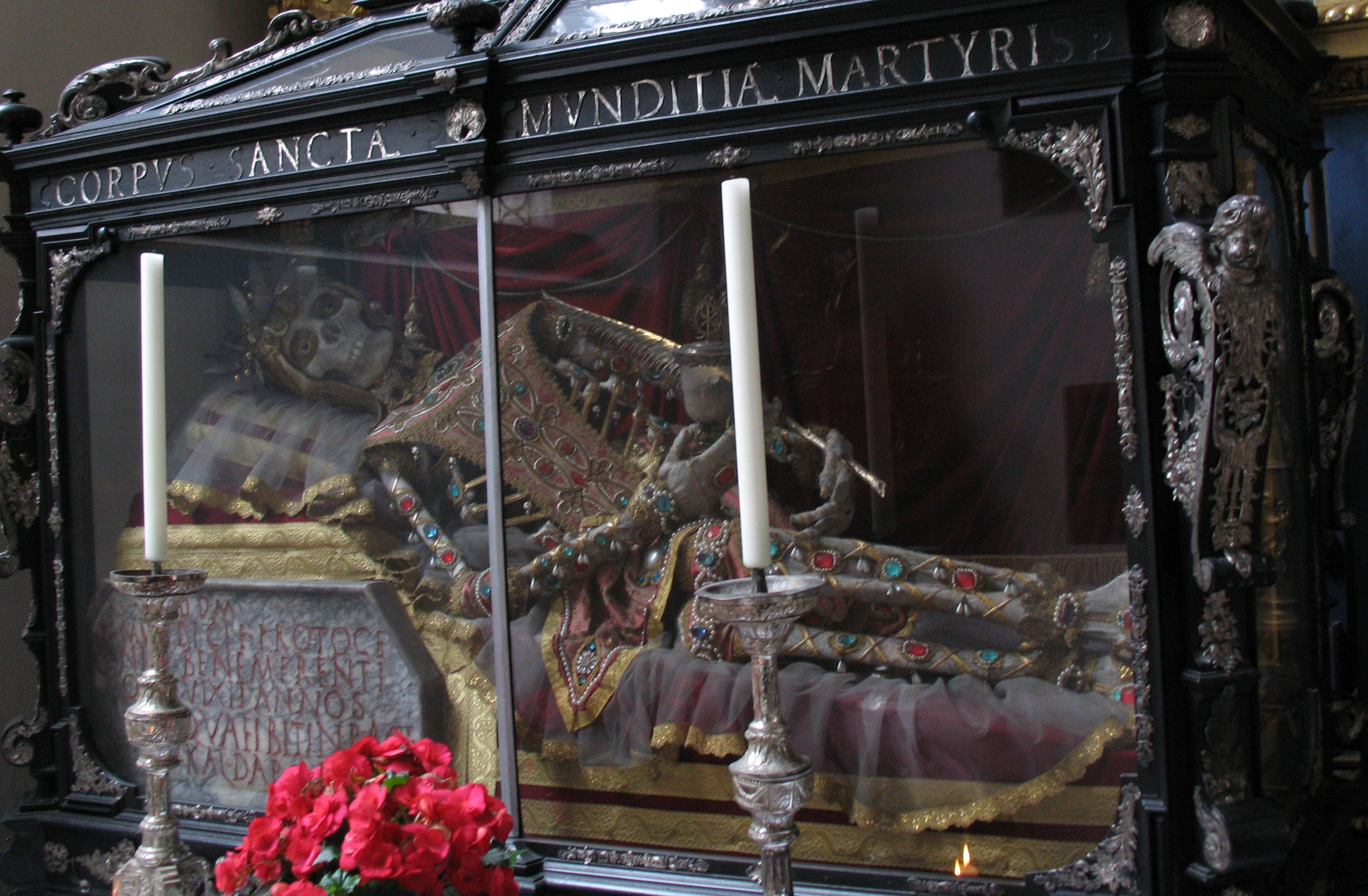
Rachel Nuwer describes the work of art historian Paul Koudounaris, whose book, Heavenly Bodies, documents how the bones of Christian martyrs in Roman catacombs were transformed into bejeweled relics, which were displayed in churches throughout Europe. How Vatican investigators determined which remains belonged to a departed saint:

[T]he process of ascertaining which of the thousands of skeletons belonged to a martyr was a nebulous one. If they found “M.” engraved next to a corpse, they took it to stand for “martyr,” ignoring the fact that the initial could also stand for “Marcus,” one of the most popular names in ancient Rome. If any vials of dehydrated sediment turned up with the bones, they assumed it must be a martyr’s blood rather than perfume, which the Romans often left on graves in the way we leave flowers today. The Church also believed that the bones of martyrs cast off a golden glow and a faintly sweet smell, and teams of psychics would journey through the corporeal tunnels, slip into a trance and point out skeletons from which they perceived a telling aura. After identifying a skeleton as holy, the Vatican then decided who was who and issued the title of martyr.

Once a skeleton was selected, highly-skilled monks and nuns would prepare it for presentation to a congregation, a process that could take up to three years:

Each convent would develop its own flair for enshrouding the bones in gold, gems and fine fabrics. The women and men who decorated the skeletons did so anonymously, for the most part. But as Koudounaris studied more and more bodies, he began recognizing the handiwork of particular convents or individuals. “Even if I couldn’t come up with the name of a specific decorator, I could look at certain relics and tie them stylistically to her handiwork,” he says.

Nuns were often renowned for their achievements in clothmaking. They spun fine mesh gauze, which they used to delicately wrap each bone. This prevented dust from settling on the fragile material and created a medium for attaching decorations. Local nobles often donated personal garments, which the nuns would lovingly slip onto the corpse and then cut out peepholes so people could see the bones beneath. Likewise, jewels and gold were often donated or paid for by a private enterprise. To add a personal touch, some sisters slipped their own rings onto a skeleton’s fingers.

Read the recent Dish thread on relics, “Saints on Display,” here.

(Photo of Saint Munditia’s relics, found in St. Peter’s Church in Munich, Germany, via Wikimedia Commons)

The Oskar Schindler Of Argentina?

John L. Allen, Jr. details a new Italian book that claims that title for the man who became Pope Francis:

In reply to persistent charges that the young Fr. Jorge Mario Bergoglio was complicit in Argentina’s infamous “dirty war” from 1976 to 1983, when roughly 30,000 people disappeared, Scavo asserts that Bergoglio was actually a Jesuit version of Oskar Schindler – quietly saving lives rather than engaging in noisy public protest.

The future pope, Scavo writes, saved as many as a thousand targets of the military dictatorship by providing shelter in a Jesuit college, passing them off as seminarians or laity on retreat, then helping them move out of Argentina.

In one case, according to Scavo, Bergoglio gave a man who bore him a passing resemblance his own passport and priest’s clothing to make his escape.

A Poem For Sunday

eddyeyes.jpg

“How It Is With Us, And How It Is With Them” by Mary Oliver:

We become religious,
then we turn from it,
then we are in need and maybe we turn back.
We turn to making money,
then we turn to the moral life,
then we think about making money again.
We meet wonderful people, but lose them
in our busyness.
We’re, as the saying goes, all over the place.
Steadfastness, it seems,
is more about dogs than about us.
One of the reasons we love them so much.

(From Dog Songs by Mary Oliver. Reprinted by arrangement of Penguin Press, a member of Penguin Random House LLC. © 2013 by Mary Oliver.)

Jefferson’s Outreach To Islam

Denise Spellberg finds that the Founding Fathers anticipated and advocated tolerance and equality for Muslim Americans:

Muslims, for most American Protestants, remained beyond the outer limit of those possessing acceptable beliefs, but they nevertheless became emblems of two competing conceptions of the nation’s identity: one essentially preserving the Protestant status quo, and the other fully realizing the pluralism implied in the Revolutionary rhetoric of inalienable and universal rights. Thus while some fought to exclude a group whose inclusion they feared would ultimately portend the undoing of the nation’s Protestant character, a pivotal minority, also Protestant, perceiving the ultimate benefit and justice of a religiously plural America, set about defending the rights of future Muslim citizens.

They did so, however, not for the sake of actual Muslims, because none were known at the time to live in America. Instead, Jefferson and others defended Muslim rights for the sake of “imagined Muslims,” the promotion of whose theoretical citizenship would prove the true universality of American rights. Indeed, this defense of imagined Muslims would also create political room to consider the rights of other despised minorities whose numbers in America, though small, were quite real, namely Jews and Catholics. Although it was Muslims who embodied the ideal of inclusion, Jews and Catholics were often linked to them in early American debates, as Jefferson and others fought for the rights of all non-Protestants.

“The Promised Land For Christian Fundamentalism”

Andrew O’Hehir watched God Loves Uganda:

[Murdered Ugandan LGBT activist] David Kato and other victimized and persecuted LGBT people in Uganda and other heavily evangelized African nations seem to be paying the price for the fact that [preacher] Lou Engle and people like him are gradually losing the culture wars at home. Uganda is their biggest success so far, but the long-term vision involves a wave of Christian revival that will sweep out of Africa into the first world, driving back the apparently victorious forces of secularism. But even Engle and his movement, although they strongly oppose gay-rights legislation, did not propose the death penalty for homosexuals. Credit for that belongs in large part to Scott Lively, an unhinged American “ex-gay” leader whose extended rants about how gays had caused the Nazi holocaust (exactly how I do not know) and now sought the destruction of traditional African family life found an enormous audience among Ugandan officials, politicians and teachers.

In May, John G. Stackhouse, Jr. criticized this argument:

From first to last, the anti-homosexuality campaign in Uganda is attributed to the imposition of Western values. But anti-homosexuality is clearly not a distinctive Western value. It is rife in tribal cultures in Africa and already in the outlook of Ugandans when the recent wave of American evangelical extremists arrived. Only such facts can explain the receptivity given to such people as Scott Lively (who apparently spoke for five hours with the Ugandan Parliament) and the resulting widespread and violent anti-homosexuality in government and popular media. By comparison, when evangelicals did dominate North American societies in the nineteenth century, sodomy was illegal, but was not punished by anything approaching life imprisonment, let alone the death penalty. So the tired trope of imperialistic foreigners corrupting the noble savages rears its head again and must once again be dispatched by a little careful thought.

In an interview earlier this year with Queerty, Williams discussed what inspired him to make the film:

I have a strong religious background, and grew up singing in the choir of my family church.  I have always been interested in the power of religion as a force for both good and evil.  My last film [Music by Prudence] took place in Zimbabwe and, while I was shooting there, I was struck by how popular conservative Christianity is in sub-Saharan Africa. After I read about Uganda’s now famous “Kill the Gays” bill, I wanted to explore the religious forces behind it.  I’m not interested in films that preach to the converted— I always wanted to make a film that starts a dialogue within the religious community.

Previous Dish coverage of gay persecution in Uganda here, here and here.

Taking His Message To The Streets

Taking stock of Pope Francis’s three recent headline-grabbing interviews, William L. Portier argues that the new pontiff is pioneering “a new genre of papal pronouncement, minimally authoritative, but unprecedented in its reach”:

Long before his election, Pope Francis urged his people in Buenos Aires not to focus on the internal life of the church but to take the church out into the streets. In response to a journalist on the flight back from Brazil, he described himself as “a street priest” who feels somewhat “caged” in the Vatican. With the papal news media interview, Pope Francis has found a way to pop the bubble that seemed to isolate his predecessor during his last days in office. He has, in a real sense, made it back to the streets. This new genre of papal pronouncement dodges grasping handlers and bureaucrats who would brand the pope restrictively, frustrate his wishes, and control his access. Pope Francis is now an anticipated part of the news cycle. The papal news media interview takes him directly to the people, all the people.